
To get government cleaning contracts, register your business in SAM.gov, confirm your small business and socio-economic status, search janitorial opportunities under NAICS code 561720, price your bid using the Department of Labor wage determination, and submit a compliant proposal. Once you have past performance, a GSA vehicle can widen your reach.
TL;DR
- Register in SAM.gov first. You cannot be awarded a federal contract without an active registration.
- Search SAM.gov for NAICS 561720 and watch for small business and socio-economic set-asides, which are where small cleaning firms win most often.
- Price from the DOL wage determination in the solicitation. Ignoring Service Contract Act wages is a classic way to lose a bid or lose money after winning.
- Build a one-page capability statement and keep your SBA Small Business Search profile current.
- After you have a few wins, a GSA Multiple Award Schedule can turn one-off bids into a standing offer agencies can order from.
Table of Contents
- How does federal cleaning work, and who buys it?
- What do you need before you bid?
- How do you find government cleaning contracts to bid on?
- How do you make yourself visible to contracting officers?
- How do you price a federal cleaning bid?
- What makes a cleaning proposal win?
- When does a GSA vehicle make sense for a cleaning company?
- Our view: start with bids, then build the vehicle
- How can we help you get onto a federal schedule?
- FAQ
- Sources
How does federal cleaning work, and who buys it?
Federal agencies buy janitorial and custodial work the way they buy most commercial services: they post a requirement, small firms compete, and a contracting officer awards a contract, often firm-fixed-price, for a base year plus option years. Courthouses, VA clinics, FAA offices, Army and Air Force installations, and federal office buildings all need floors, restrooms and trash handled on a schedule.
The classification that matters is NAICS code 561720, Janitorial Services. A custodial service solicitation on SAM.gov shows what a typical notice looks like: a defined building, a scope of recurring tasks, and a requirement to price to the applicable wage rules. Another example is an FAA janitorial solicitation that was corrected to be set aside for women-owned small businesses. That correction tells you something useful: set-aside status is written into the notice, and it decides who is even allowed to bid.
For small cleaning companies, the federal market has two real advantages over commercial work. Contracts are often multi-year, and the buyer pays on a predictable schedule. The trade-off is paperwork: registration, representations, wage compliance, insurance and security requirements.
What do you need before you bid?
Get these in place before you spend time on a proposal. Most take days or weeks, not hours, so start early.
- A legal business with an EIN, a bank account and business insurance. Solicitations usually spell out the insurance they want.
- An active SAM.gov registration. This is the federal government’s registration system, and it also issues your Unique Entity ID. Our write-up on the role of SAM registration in federal contracting explains what the registration covers and why a lapse stops payments.
- Accurate size and status representations. You will state whether you are a small business and whether you qualify as women-owned, service-disabled veteran-owned, HUBZone or 8(a). Do not guess. Wrong representations create real problems after award.
- A capability statement. More on that below.
- Proof you can staff the work. Contracting officers want to see who supervises, how many people you can put on site, and how fast you can start.
How do you find government cleaning contracts to bid on?
Start where the buyers post. Search SAM.gov’s contract opportunities for “janitorial” or “custodial,” filter by NAICS 561720, and save the search so new notices reach you. FedBizOpps, the old posting site, has been retired, so SAM.gov is the place to look.
Then narrow by three things:
- Place of performance. Cleaning is local. Pick a radius you can staff reliably, not the whole country.
- Set-aside type. Under FAR Subpart 19.5, acquisitions above the micro-purchase threshold generally must be set aside for small businesses when two or more responsible small businesses are expected to offer. For larger buys, contracting officers must consider socio-economic programs such as 8(a), HUBZone, SDVOSB and WOSB first. If you hold one of those statuses, filter for it.
- Contract size. Smaller purchases move under simplified procedures. FAR 13.003 directs agencies to use simplified acquisition procedures to the maximum extent practicable for purchases up to the simplified acquisition threshold, which usually means shorter solicitations and faster decisions. That is a good place to earn your first past performance.
Also look beyond active notices. Expired solicitations show who the incumbent is, how the work was described, and when it will likely recompete. The example custodial notice above is marked inactive, but it is still useful for studying scope language and timing.
Subcontracting is a legitimate first step
If prime bids feel like a stretch, call the larger facilities contractors who hold base operations or facilities support work in your area. Many need local cleaning subcontractors, and the work builds references. Be clear about your insurance and your ability to meet wage rules, because they will be held to them too.
How do you make yourself visible to contracting officers?
Bidding is only half of it. Contracting officers also search for firms. SBA’s Small Business Search, the sister site to SAM.gov, is where they look up businesses by set-aside status and capabilities, as described in SBA’s session on Small Business Search and capability statements. Your profile there should name the work you actually do: daily janitorial, floor stripping and waxing, window cleaning, sanitizing, restroom supply.
Public profiles show how others phrase this. One Massachusetts janitorial firm’s profile opens by naming its certifications, its home base and its customer types in one paragraph. Another small cleaning company’s profile states the square footage of buildings its manager has run and the size of the crews. Specific numbers beat adjectives.
Your one-page capability statement should carry:
- Core competencies in plain language
- Past performance, including commercial work, with contract values and dates if you can share them
- Your UEI, CAGE if you have one, NAICS codes and certifications
- A contact who answers the phone
On that last point, missed calls cost bids and site-visit invitations. A business that cannot answer quote requests quickly looks unreliable, and tools such as an AI phone answering service for contractors can cover calls while your crews are on site.
How do you price a federal cleaning bid?
Price is where first-time bidders go wrong. Federal service contracts are usually covered by the Service Contract Act, which requires a Department of Labor wage determination in the solicitation. According to a DOL overview of SCA wage determinations, each covered contract above $2,500 must contain provisions setting minimum wages and fringe benefits for service employees. You can look up wage determinations on SAM.gov’s wage determinations page.
A workable pricing sequence:
- Read the scope and the square footage. Note frequencies: daily, weekly, monthly, periodic tasks like strip and wax.
- Convert the scope to labor hours. Use your own production rates from commercial jobs, then add supervision.
- Apply the wage determination. Use the rate for the right job classification and county, plus the required health and welfare fringe.
- Add payroll taxes, insurance, supplies and equipment. Contracting officers look for firms that can furnish all materials and supplies.
- Add overhead and profit last, and test the total against what the government’s estimate or the previous award suggests.
A simple worked example of the structure, with illustrative numbers only: if your labor hours price out at a fully loaded figure, then supplies, insurance and overhead sit on top. If your bid is far below the others, check whether you left out the fringe benefit. Underbidding wages is a common reason for rejection or for a money-losing contract after award.
What makes a cleaning proposal win?
A lowest-price mindset loses to a credible plan. Contracting officers want evidence that you can start on time and keep the building clean on day 200 as well as day one. Strong proposals usually include:
- A mobilization plan. One janitorial contractor’s SBA profile highlights the ability to start operations within a short window; a clear start-up timeline with named steps does the same job in your proposal.
- A staffing and supervision plan, including background checks if the site requires them, and backup coverage for absences.
- A quality control plan: inspection checklists, how complaints are logged, how fast you correct them.
- Relevant past performance. Commercial buildings of similar size count. One small firm’s public profile lists a federal-and-commercial custodial contract with a stated value and period; that format is what evaluators want to see.
- Bundled capability when it fits. Agencies often prefer a single source for facilities support, so firms pair janitorial with grounds maintenance or pest control, either directly or through teaming.
Follow the solicitation’s format exactly. Missing a required form or answering a different question than the one asked is an easy way to be eliminated.
When does a GSA vehicle make sense for a cleaning company?
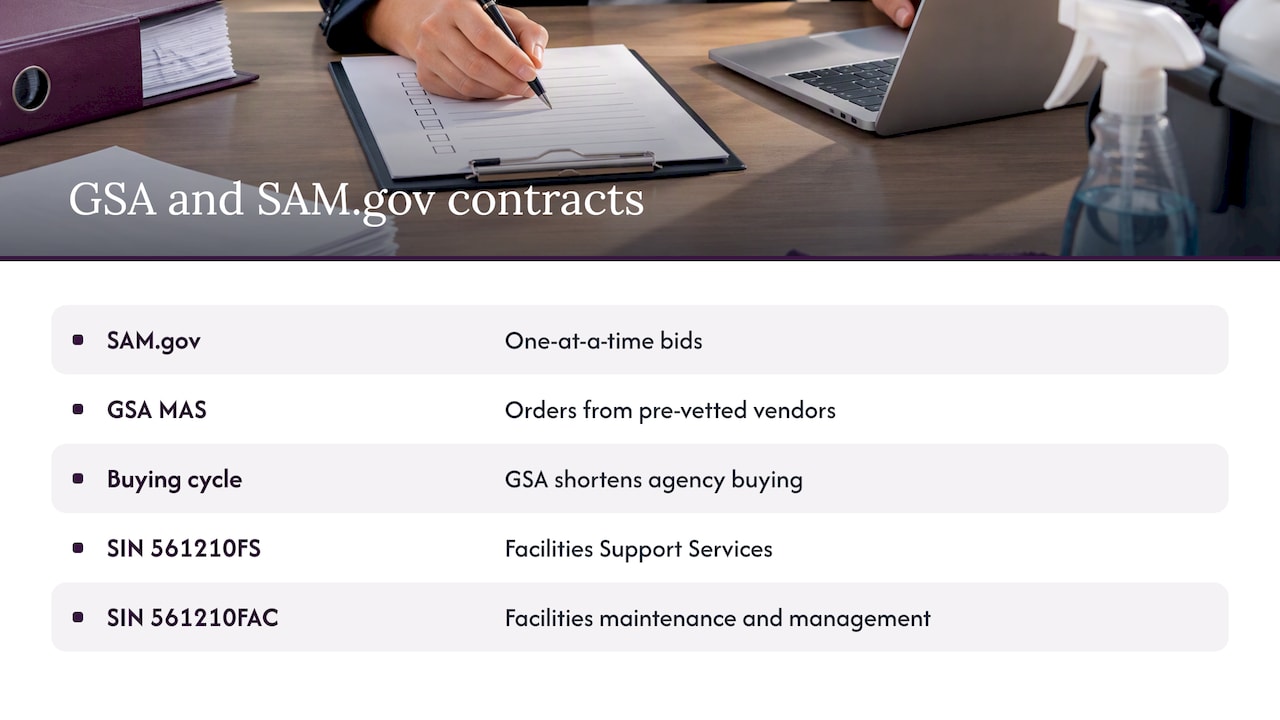
SAM.gov bids are one-at-a-time. A GSA Multiple Award Schedule contract works differently: agencies order from pre-vetted vendors, which shortens their buying cycle. For facilities work, the relevant categories include SIN 561210FS, Facilities Support Services, and the facilities maintenance and management SIN 561210FAC, which covers operations, maintenance and repair of federal real property including janitorial. The Federal Acquisition Regulatory Council’s category management buying guide points out that commercial services are a natural fit for speed-focused buying vehicles.
Be realistic about timing. A schedule is not the first step for a company with no experience. It tends to pay off when you have commercial or federal past performance, financial records that show stability, and a price list you can defend. Our guides cover what the schedule is, how janitorial and facilities services sell on it, and the facilities maintenance category.
DIY or consultant?
| Do it yourself | Work with a consultant | |
|---|---|---|
| Your time | Many hours of reading, forms and revisions | About 3 hours of your time with us |
| Typical timeline | Often 2+ years on your own | Typically about 6 months for our clients |
| Risk | Rejections, resubmissions, pricing errors | Application prepared and reviewed by specialists |
| Cost | Your time, plus a guide or toolkit if you buy one | Project fee, paid on award with us |
The timeline figures are what we see with our clients, not a government statistic. Your own timing depends on how ready your documents are.
Our view: start with bids, then build the vehicle
We only do one thing: help small businesses get and keep a GSA Schedule. So here is our plain advice to cleaning companies.
Do not wait for a schedule to start selling to the government. Register, pick up a small set-aside or a subcontract, and collect a performance reference. Then talk to us. When a cleaning firm comes to us with a few jobs behind it, a clean price list and tidy financials, the application goes far faster than for a company starting cold.
The mistake we see most often is not a missing form. It is a price list built without thinking about wage-determination labor categories, or a business that picked service categories that do not match what it actually performs. That mismatch creates negotiation headaches later. Our job is to map your services to the right categories, build the price list, handle the paperwork and negotiate, so you spend about three hours rather than months.
— Josh
How can we help you get onto a federal schedule?
If you already qualify and want help with a janitorial or facilities application, we offer full-service application support through our Startups, Specialty and Streamline proposals. We work on a no award, no fee basis and back it with a money-back guarantee. If you would rather do it yourself, the GSA DIY Quick Start is our self-service option. After award, our maintenance plans start at $99 per month for one contract modification per year. Or start with a free eligibility check and we will tell you honestly whether you are ready.
FAQ
How much is a government cleaning contract worth?
It varies widely with building size, frequency and contract length. Public profiles show the range: one small firm’s SBA listing reports a contract value of $312,168 over its period of performance. Read the solicitation and any prior award for the real number.
Do I need a certification to win federal cleaning work?
No. Many janitorial awards go to small businesses without special status. Certifications like WOSB, 8(a), HUBZone or SDVOSB open set-asides that fewer firms can bid on, so they help when you qualify. Check the specific solicitation for what it requires.
Can I start with subcontracting?
Yes. Subcontracting to a prime contractor is a common way to earn references and learn wage compliance before bidding as a prime. Make sure your insurance and payroll practices meet the prime’s requirements.
Where do I search for federal janitorial bids?
Use SAM.gov contract opportunities and filter by NAICS 561720 and your service area. Pair that with an up-to-date SBA Small Business Search profile so contracting officers can also find you.
Sources
- SAM.gov custodial service solicitation
- SAM.gov FAA janitorial solicitation
- FAR Subpart 19.5, Acquisition.gov
- FAR 13.003, Acquisition.gov
- SBA Small Business Search profile, Massachusetts janitorial firm
- SBA Small Business Search profile, federal building janitorial firm
- SBA Small Business Search profile, commercial and federal custodial firm
- DOL, SCA wage determinations
- SAM.gov wage determinations
- GSA eLibrary, SIN 561210FS
- Category management buying guide, Acquisition.gov
Recommended
- Applying for Government Contracts: Step-by-Step Guide
- Government Contracts: 6 Stages and GSA MAS Steps for Small Businesses
- Janitorial & Facilities Services on GSA: A Customer That Never Stops Cleaning
- Expert Guide on How to Win Government Contracts Easily