

A government contract is a legal agreement where a federal agency pays a business to deliver goods or services, and the fastest way into that market is to register on SAM.gov and confirm your eligibility before you bid on anything.
Federal agencies buy almost everything a business can supply, from office furniture to cybersecurity. Sellers fall into two groups: prime contractors who hold the contract directly, and subcontractors who perform part of the work under a prime’s agreement. Once you understand that basic buyer-seller relationship, the rest of the system, registration, contract types, bidding, and award, starts to make sense.
TL;DR:
- Match NAICS codes to your offerings, assess eligibility for SBA set asides, and research agency forecasts and past awards before targeting opportunities.
- Fixed price contracts put cost overruns on the contractor, while cost reimbursement contracts pay allowable costs plus a fee and usually bring closer oversight.
- Proposals are judged on technical approach, past performance, and price; follow the solicitation’s format and address every factor, since stronger work can still lose.
- MAS applicants must complete readiness training, typically three to four hours, while holders track sales reports, Industrial Funding Fee payments, and modification deadlines.
Table of Contents
- How government contracting works: the buyer’s goals and the acquisition lifecycle
- Who does what: primes, subs, contracting officers, and program offices
- How to get started: registration, codes, set-asides, and where to find opportunities
- Contract types and procurement methods: fixed-price, cost-reimbursement, IDIQ, and MAS
- How bidding, evaluation, and award work
- GSA MAS pathway: readiness, training, eOffer, and eMod
- Post-award essentials: contract management and staying compliant
- The full timeline: from registration to award and beyond
- What it costs to win and keep a government contract
- Marketing and leveraging a GSA Schedule for long-term growth
- Negotiating with a contracting officer to improve your terms
- Staying compliant through the life of your contract
- Handling contract modifications: pricing updates and extensions
- Where a GSA consultant actually earns their fee
- Get a free eligibility check before you apply
- FAQ
- Sources
How government contracting works: the buyer’s goals and the acquisition lifecycle
Federal agencies identify a need, write a description of what they want, and publish a solicitation so businesses can compete for the work. Three priorities shape nearly every decision an agency makes along the way: open competition, getting the best value for taxpayer money, and following the rules set out in the Federal Acquisition Regulation. Those rules exist to keep the process fair and auditable, which is why the paperwork can feel heavy even for small purchases.
Every contract moves through the same basic lifecycle, regardless of size:
- The agency defines the requirement and estimates its budget.
- It publishes a solicitation describing the work and how it will evaluate offers.
- Businesses submit proposals or bids, and the agency evaluates them against stated criteria.
- The agency awards the contract to the business that represents the best value.
- The contractor performs the work while the agency monitors progress.
- The contract closes out once all deliverables and payments are settled.
Knowing this sequence helps you figure out where your business fits and when to engage.
Who does what: primes, subs, contracting officers, and program offices
A prime contractor holds the contract and answers directly to the government, while a subcontractor performs part of the work under the prime’s direction. Subcontracting is often the easiest entry point for a new business because primes frequently need specialized partners to meet set-aside or capacity requirements.
The contracting officer (CO) is the only person with legal authority to bind the government to a contract, sign modifications, or approve changes in scope. Program offices define the technical requirements, while the CO manages the business and legal side of the deal.
- Primes carry overall contract responsibility and manage subcontractor performance.
- Subcontractors deliver a defined piece of the work and build the past performance record needed for future prime contracts.
- Contracting officers evaluate proposals, award contracts, and enforce compliance throughout performance.
Past performance and teaming arrangements matter because agencies weigh a contractor’s track record heavily when awarding future work.
How to get started: registration, codes, set-asides, and where to find opportunities
Getting ready to bid is mostly administrative, but skipping a step can stall you for weeks. Work through it in order.
- Register on SAM.gov and obtain your Unique Entity Identifier (UEI), the number that makes your business searchable by contracting officers and confirms your eligibility to be awarded a federal contract.
- Select the NAICS codes that match what you sell, since agencies use these codes to classify solicitations and small-business set-asides.
- Check your eligibility for SBA programs such as 8(a), HUBZone, Women-Owned Small Business (WOSB), Veteran-Owned Small Business (VOSB), or Service-Disabled Veteran-Owned Small Business (SDVOSB), which can unlock contracts reserved specifically for your category.
- Search for opportunities on SAM.gov’s contract opportunities database, review agency procurement forecasts, and check USASpending.gov or FPDS to see what agencies have bought in the past and from whom.
- If you want to sell through the General Services Administration, look at GSA eBuy and the Multiple Award Schedule (MAS) program as a standing contract vehicle agencies use repeatedly.
Pace your expectations accordingly. Businesses that research the right NAICS codes, target realistic set-asides, and build relationships with primes tend to move faster than those who apply broadly and wait. Our guide to SAM registration walks through the account setup in more detail, and our eligibility requirements guide covers NAICS and set-aside selection.
Contract types and procurement methods: fixed-price, cost-reimbursement, IDIQ, and MAS
The type of contract an agency uses determines who bears the financial risk if costs run over. Under FAR part 16, contracts fall broadly into fixed-price and cost-reimbursement families, with incentive contracts designed to link profit to performance outcomes.
- Fixed-price contracts pay a set amount regardless of the contractor’s actual costs, which puts the cost risk on the business.
- Cost-reimbursement contracts pay allowable costs plus a fee, which shifts more risk to the government and usually comes with closer oversight.
- Incentive contracts blend the two, adjusting profit based on cost control, schedule, or performance targets.
Beyond contract type, agencies use several procurement vehicles. Sealed bidding suits simple, well-defined purchases. Negotiated acquisitions, run through RFPs or RFQs, allow more discussion and judgment in award decisions. Indefinite Delivery, Indefinite Quantity (IDIQ) contracts and Blanket Purchase Agreements (BPAs) let agencies issue multiple task orders under one umbrella agreement. The GSA Multiple Award Schedule works similarly: it is a pre-negotiated, long-term contract vehicle that lets agencies buy from approved vendors without running a full competition each time.
The contract type you are bidding under should shape your proposal. A fixed-price bid needs airtight cost estimating, while a cost-reimbursement proposal needs a credible accounting system and a clear basis for the fee you are requesting.
How bidding, evaluation, and award work
A solicitation spells out exactly what the agency wants submitted, whether that is a technical narrative, past performance references, or a priced schedule. Read it closely: the format, page limits, and required attachments are rarely optional, and FAR part 15 governs how negotiated acquisitions handle those submissions.
Agencies typically evaluate proposals on three factors: technical approach, past performance, and cost or price. Some procurements use a “best value” approach that balances all three, while others use lowest price technically acceptable (LPTA), which awards to the cheapest proposal that clears a minimum technical bar.
- Mirror the solicitation’s structure in your proposal so evaluators can find what they’re scoring.
- Address every stated evaluation factor directly rather than relying on general marketing language.
- Document past performance with specifics: contract value, scope, and outcomes, since source selection decisions often weigh this heavily.
Proposals that ignore the stated criteria lose to competitors who answer them precisely, even when the ignored proposal describes better work.
GSA MAS pathway: readiness, training, eOffer, and eMod
The GSA Multiple Award Schedule is a standing contract that, once awarded, lets agencies buy from you without a new competition each time. Getting there follows a defined sequence.
- Complete a readiness assessment and the mandatory “Pathways to Success” training, which typically takes three to four hours and must be finished before you submit an offer.
- Prepare your eOffer package, including your price list, technical narratives, and SIN mapping, ideally drafted outside the portal first since eOffer imposes character limits on narrative fields.
- Submit through eOffer using the required templates and attachments, making sure a designated company employee completes the readiness steps the system records.
- Once awarded, use eMod for any future modifications, since mass modifications issued by GSA must be signed within set timelines or risk falling out of compliance.
Pro Tip: Draft your eOffer narratives in a separate document first so you’re not fighting character limits while trying to finalize your pricing.
Our step-by-step eOffer guide walks through the submission screens in more detail if you want a closer look before you start.
Post-award essentials: contract management and staying compliant
Winning the contract is the beginning of a new set of obligations, not the finish line. MAS holders in particular need to track recurring requirements closely.
- Report sales and pay the Industrial Funding Fee on schedule, since missed reporting is one of the most common compliance failures.
- Keep your SAM.gov profile current, since outdated information can affect your standing with contracting officers.
- Sign mass modifications and respond to eMod requests within the timelines GSA sets, since unsigned mass mods can jeopardize your contract.
- Maintain records of invoices, deliverables, and correspondence in case of an audit or contract review.
None of this is complicated on its own, but it adds up. A contractor juggling multiple schedules or multiple agencies can find the reporting calendar alone takes real staff time every quarter.
The full timeline: from registration to award and beyond
A realistic government contracting timeline runs in distinct phases, and knowing roughly how long each one takes helps you plan staffing and cash flow.
Registration comes first: setting up SAM.gov and obtaining your UEI usually takes a few weeks once your paperwork is in order. Market research and opportunity identification run in parallel, as you review NAICS codes, scan solicitations, and study agency forecasts.
Proposal preparation is the most time-intensive phase for most businesses, since a well-built technical and pricing proposal for even a modest contract can take days to weeks of focused work. Evaluation and award timelines vary enormously by agency and procurement type: simple purchases can award in weeks, while complex negotiated acquisitions can take months.
For the GSA MAS path specifically, the sequence is more structured: readiness assessment and training, eOffer preparation and submission, negotiation with your assigned contracting officer, and final award. Businesses that build their offer with experienced support often move faster than those handling the entire process without guidance.
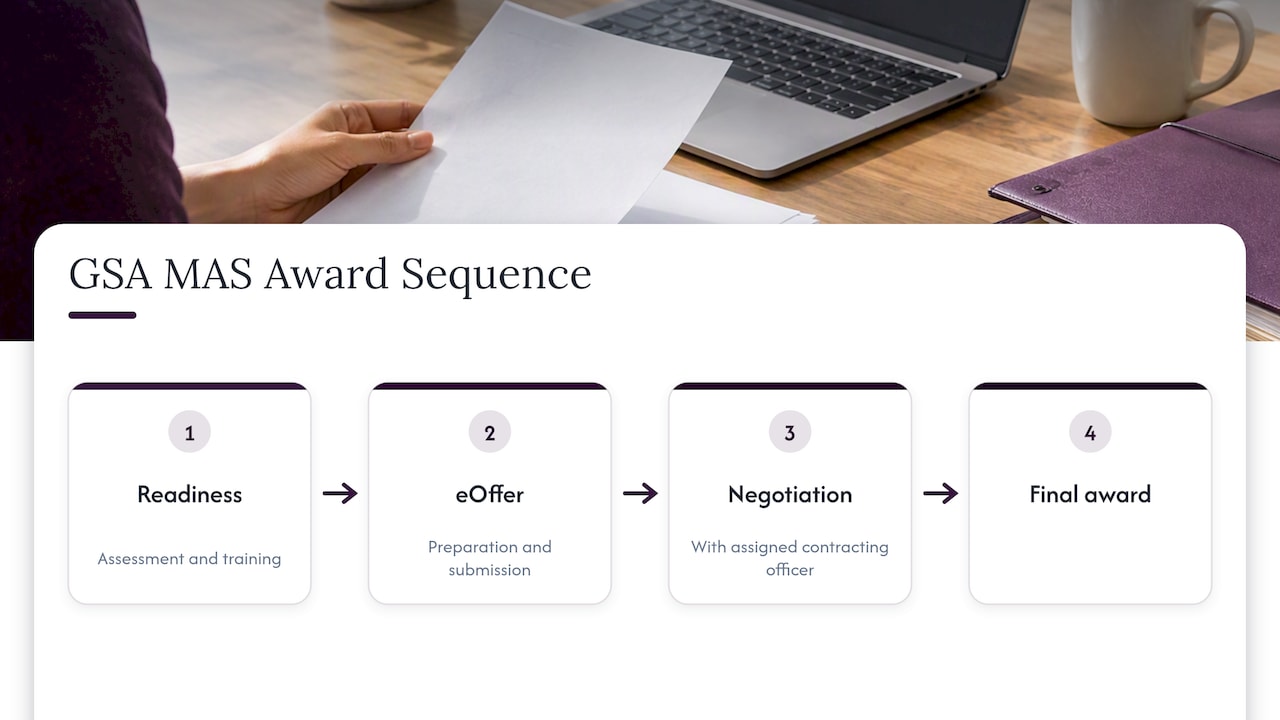
Post-award, the clock keeps running. Sales reporting deadlines, mass modification signatures, and price list updates all recur on fixed schedules, so the “timeline” never really ends once you hold a contract.
What it costs to win and keep a government contract
Costs show up in three places: getting ready to bid, preparing the submission, and maintaining compliance after award.
Direct costs are the easiest to estimate: registration on SAM.gov is free, but the staff time to gather documentation, write proposals, and build compliant pricing is not. Indirect costs, like the accounting system upgrades some cost-reimbursement contracts require, can be substantial if you are not already set up to track costs the way the government expects.
For the GSA MAS path, submission itself carries no government filing fee, but preparing a compliant eOffer package, your price list, technical narratives, and commercial sales practices documentation, takes real effort. Many businesses underestimate the ongoing cost of compliance once they hold a schedule: tracking sales for the Industrial Funding Fee, updating price lists, and responding to mass modifications all require recurring staff attention.
Businesses that want this handled without building that capacity in-house often turn to full-service support. Our Startups, Specialty, and Streamline packages cover the application itself, our Lite, Standard, and Plus plans start at $10,700 per year for federal marketing support, and ongoing maintenance runs from a $1,500 per year RETAINER to modification plans starting at $99 per month for one mod per year. Businesses that prefer to handle the work themselves can start with our GSA DIY Quick Start resources.
Marketing and leveraging a GSA Schedule for long-term growth
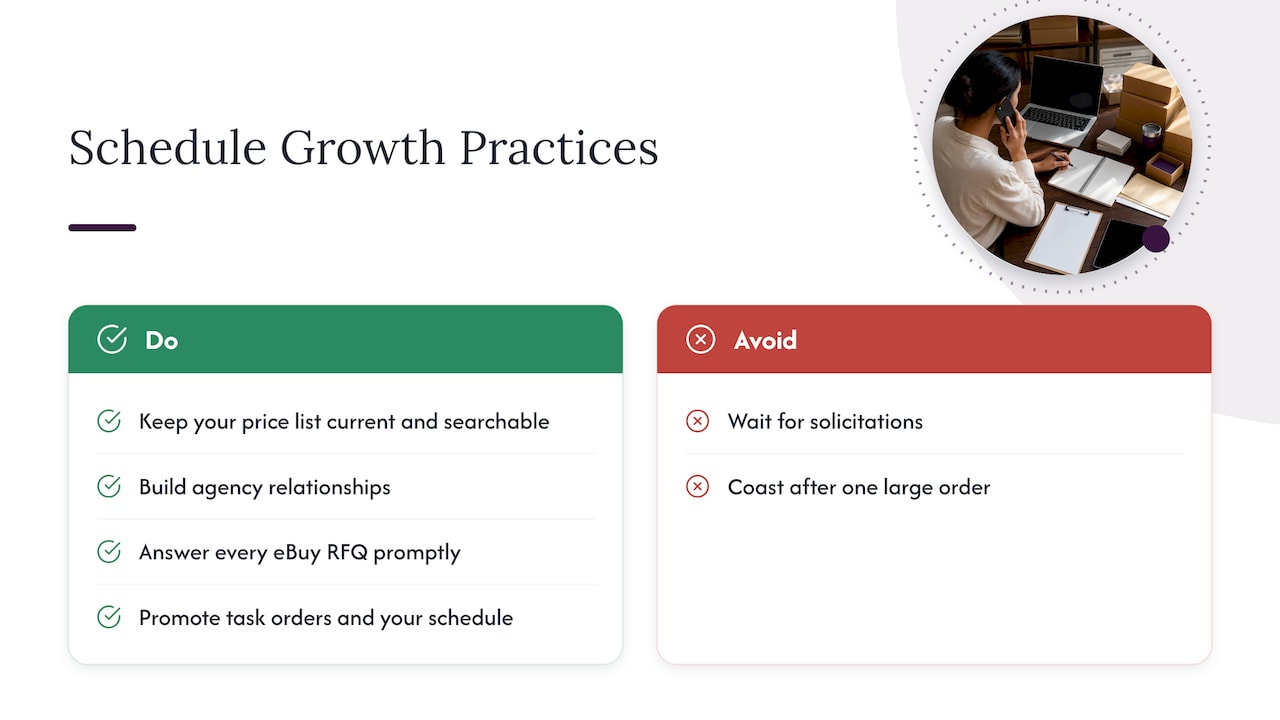
A GSA Schedule award is not automatic revenue. It is a sales license that works only if agencies know you exist and can find you easily through GSA eBuy and your published price list.
Keep your price list current and easy to search, since agencies comparing schedule holders often move quickly to whichever vendor presents clean, accurate pricing. Build relationships with contracting officers and program managers in the agencies most likely to need what you sell, rather than waiting for solicitations to appear. Respond promptly and completely to every eBuy request for quote, since response rate and quality often determine whether an agency comes back to you a second time.
Highlighting past task order performance in your marketing materials helps, since agencies weigh demonstrated results heavily when choosing among schedule holders. Many contractors also use their schedule as a credibility signal in broader federal marketing, listing it on capability statements and in conversations with primes who need subcontractors already cleared for government work.
Long-term growth on a schedule tends to come from consistent visibility and responsiveness, not from winning one large order and coasting.
Negotiating with a contracting officer to improve your terms
Contracting officers have real discretion, but they negotiate within boundaries set by the solicitation and the FAR, so effective negotiation starts with understanding those boundaries rather than pushing against them.
Come prepared with your actual cost and pricing data, since a CO is far more likely to adjust terms when your position is documented rather than asserted. If you are negotiating a GSA Schedule price list, benchmark your rates against your commercial sales practices, since the government expects pricing consistent with what you offer your best commercial customers.
Ask clarifying questions before you counter, since misunderstanding a requirement wastes a negotiation round and can make you look unprepared. Focus requests on the terms that matter most to your business, delivery schedule, payment terms, or scope boundaries, rather than contesting every clause. A CO who sees a focused, well-documented ask is more likely to move than one facing a long list of scattered objections.
Staying compliant through the life of your contract
Compliance is not a single event at award. It is a set of recurring obligations that vary by contract type but follow a few consistent patterns.
Fixed-price and cost-reimbursement contracts both require accurate recordkeeping, but cost-reimbursement contracts add the burden of an approved accounting system and regular cost reporting. GSA MAS holders face their own compliance calendar: sales reporting, Industrial Funding Fee payments, and keeping SAM.gov information current.
Mass modifications deserve special attention, since GSA periodically issues contract-wide changes that every schedule holder must sign within a set window. Missing that window can put your contract at risk even if your actual performance has been fine. Price list accuracy matters too, since a published price that no longer matches what you charge commercial customers can trigger a compliance review.
Building a simple internal calendar for reporting deadlines, modification windows, and SAM renewal dates prevents most compliance problems before they start.
Handling contract modifications: pricing updates and extensions
Modifications are a normal part of holding a government contract, not a sign that something went wrong. They fall into two broad categories: changes you request, like a price list update or an added SIN, and changes the government issues, like a mass modification.
For GSA Schedule holders, eMod is the system for both. Vendor-initiated mods, like a price increase tied to your commercial pricing, go through a review process before taking effect, so timing matters if you are planning a rate change around a contract anniversary. Government-initiated mass modifications typically come with a firm signing deadline, and missing it can affect your contract’s standing.
Extensions follow their own clock. Most multi-year contracts, including MAS, build in option periods, so tracking your contract’s eligible extension windows well before they arrive gives you time to prepare any updated documentation the extension requires.
Handling modifications well mostly comes down to tracking deadlines and keeping documentation current, rather than anything technically difficult.
Where a GSA consultant actually earns their fee
The gap most beginners underestimate is maintenance, not the application. Readiness checks, eOffer paperwork, and mass mod deadlines eat far more hours over a contract’s life than the initial submission does, which is exactly where outside help tends to pay for itself.
— Josh
Get a free eligibility check before you apply
Everything in this guide, registration, contract types, the MAS pathway, and ongoing compliance, is what we handle for small and medium businesses every day. Our full-service packages cover the GSA Schedule application itself through Startups, Specialty, and Streamline, our federal marketing plans range from $10,700 to $27,700 per year through Lite, Standard, and Plus, and once you’re awarded, we keep your schedule compliant through maintenance plans starting at affordable monthly rates.
A free eligibility check is the fastest way to find out where you stand. We review your NAICS codes, your commercial sales history, and your readiness for the MAS training requirement, then tell you plainly whether now is the right time to apply. Request your free eligibility check and we’ll walk you through what the process looks like for your business specifically.
FAQ
Is it hard to get government contracts?
Government contracting involves more paperwork than commercial sales, but it is largely a matter of proper registration, targeting the right solicitations, and preparing proposals that directly address the evaluation criteria. The SBA notes that the federal government is the world’s largest customer, which means opportunity exists across nearly every industry once you’re registered correctly.
What does contracting mean?
In this context, contracting means the legal process by which a government agency agrees to pay a business for specific goods or services under defined terms. The agency acts as the buyer, and the business acts as either a prime contractor or a subcontractor delivering part of the work.
How do I create a government contract?
You don’t create a government contract from scratch. Instead, you register as an eligible contractor on SAM.gov, then respond to a solicitation an agency has already published, and the contracting officer awards and signs the contract once your proposal is selected.
What types of government contracts are there?
The two broad families are fixed-price contracts, where you’re paid a set amount regardless of your actual costs, and cost-reimbursement contracts, where the government pays allowable costs plus a fee, as described in FAR part 16. Common contract vehicles built on these types include IDIQs, Blanket Purchase Agreements, and the GSA Multiple Award Schedule.
Sources
- SBA: Grow your business — Become a federal contractor
- GSA: Roadmap to get a MAS contract
- Acquisition
- GSA eOffer/eMod user guide — creating & submitting an eMod
Recommended
- 4 Barriers to GSA Contracts for Small Businesses
- Understanding GSA MAS Contract Types
- MAS Contract Definition: A Guide for Small Businesses
- Step-by-Step Guide: How to Get a GSA Contract for Your Small Business