
How The GSA Schedule Works in Practice
What Is a GSA Schedule?
Last updated: October 2026 · By Josh Ladick, GSA Focus · Sources: GSA.gov
Short answer: A GSA Schedule, officially the Multiple Award Schedule (MAS), is a long-term, government-wide contract that the General Services Administration awards to commercial companies. It sets pre-negotiated prices and terms, so federal, state, local and tribal buyers can purchase your products or services without running a full open-market competition. A GSA Schedule can last up to 20 years.
GSA Schedule at a glance
| Official name | Multiple Award Schedule (MAS), also called the Federal Supply Schedule or GSA Schedule |
|---|---|
| Who runs it | The U.S. General Services Administration (GSA) |
| Contract length | Five-year base period plus three five-year options, up to 20 years (GSA) |
| What you can sell | Commercial products and services in 12 large categories, divided into Special Item Numbers (SINs) |
| Who can buy | Federal agencies, plus state, local, tribal and other eligible buyers (GSA) |
| Ongoing obligations | 0.75% Industrial Funding Fee on sales, and minimum sales of $100,000 in the first five years (GSA) |
| Time to get one | About 6 months with GSA Focus; often 2+ years for companies that do it alone |
How a GSA Schedule works
GSA reviews your company once: your pricing, financials and past performance. If you are awarded, your prices and terms become part of a government-wide contract. From then on, agencies can buy from you directly or ask for quotes from schedule holders only, instead of opening every purchase to the whole market.
Holding a GSA Schedule also gives you access to the tools buyers use every day: GSA Advantage (the online catalog), GSA eBuy (where agencies post requests for quotes) and GSA eLibrary (where buyers look up contract holders).
A GSA Schedule does not guarantee sales. It is a license to compete; you still have to win the orders.
The 12 MAS categories
Since GSA consolidated its separate schedules, every GSA Schedule falls under one Multiple Award Schedule with 12 large categories:
- Facilities
- Furniture and furnishings
- Human capital
- Industrial products and services
- Information technology
- Miscellaneous
- Office management
- Professional services
- Scientific management and solutions
- Security and protection
- Transportation and logistics services
- Travel
Each category is split into Special Item Numbers (SINs) that describe exactly what you can sell. See our full list of GSA Schedules and SINs.
Benefits of a GSA Schedule
- Faster buying for agencies: buyers can order from pre-approved contractors instead of running a full competition.
- Trust: GSA has already vetted your pricing, financials and past performance.
- Visibility: your catalog appears on GSA Advantage and you receive buyer requests through GSA eBuy.
- A long-term asset: one award can keep selling for up to 20 years.
GSA Schedule FAQs
What does it mean to have a GSA Schedule?
It means GSA has pre-negotiated your prices and terms, so government buyers can purchase from you directly through tools like GSA Advantage and GSA eBuy without running a full open-market competition. It makes you eligible to be bought from; it does not guarantee orders.
What is the difference between a GSA Schedule and a GSA contract?
In everyday use they mean the same thing. A GSA Schedule contract is a contract under GSA’s Multiple Award Schedule (MAS) program. Federal Supply Schedule, GSA Schedule and MAS all refer to this program.
How long does a GSA Schedule last?
MAS contracts are awarded with a five-year base period and three five-year option periods, so a GSA Schedule can last up to 20 years.
How do you get a GSA Schedule?
Register in SAM.gov, complete GSA’s Pathways to Success training and readiness assessment, choose the SINs that match what you already sell, and submit an offer in eOffer with two years of financials, past performance and commercial pricing. With GSA Focus, most clients are awarded in about 6 months.
How much does a GSA Schedule cost?
GSA charges nothing to submit an offer. After award, a 0.75% Industrial Funding Fee is built into your prices. If you hire GSA Focus, the standard fee is a flat $12,000, with no fee if you aren’t awarded.
What does GSA stand for?
General Services Administration, the federal agency that manages government purchasing, real estate and vehicles. In contracting conversations, getting a GSA almost always means getting on the GSA Schedule.
Is a GSA Schedule right for your business?
Read our step-by-step guide on how to get on the GSA Schedule, check your eligibility, or book a free 20-minute call.
GSA Schedule = Better Opportunities
The GSA program (AKA – Multiple Award Schedule) provides a gateway into the federal marketplace.
A GSA Schedule is a long-term government-wide contract that lets federal agencies buy from commercial businesses at pre-negotiated prices, terms, and conditions.
In plain english…a GSA Schedule:
(1) removes complexity
(2) saves procurement officers time, and
(3) makes you a trusted source.
If your company is looking to expand into federal contracts, securing a GSA Schedule is often the first real step forward.
Think of it as your express lane into the federal buyer’s decision process.
GSA Schedule vs. Open Market Sales
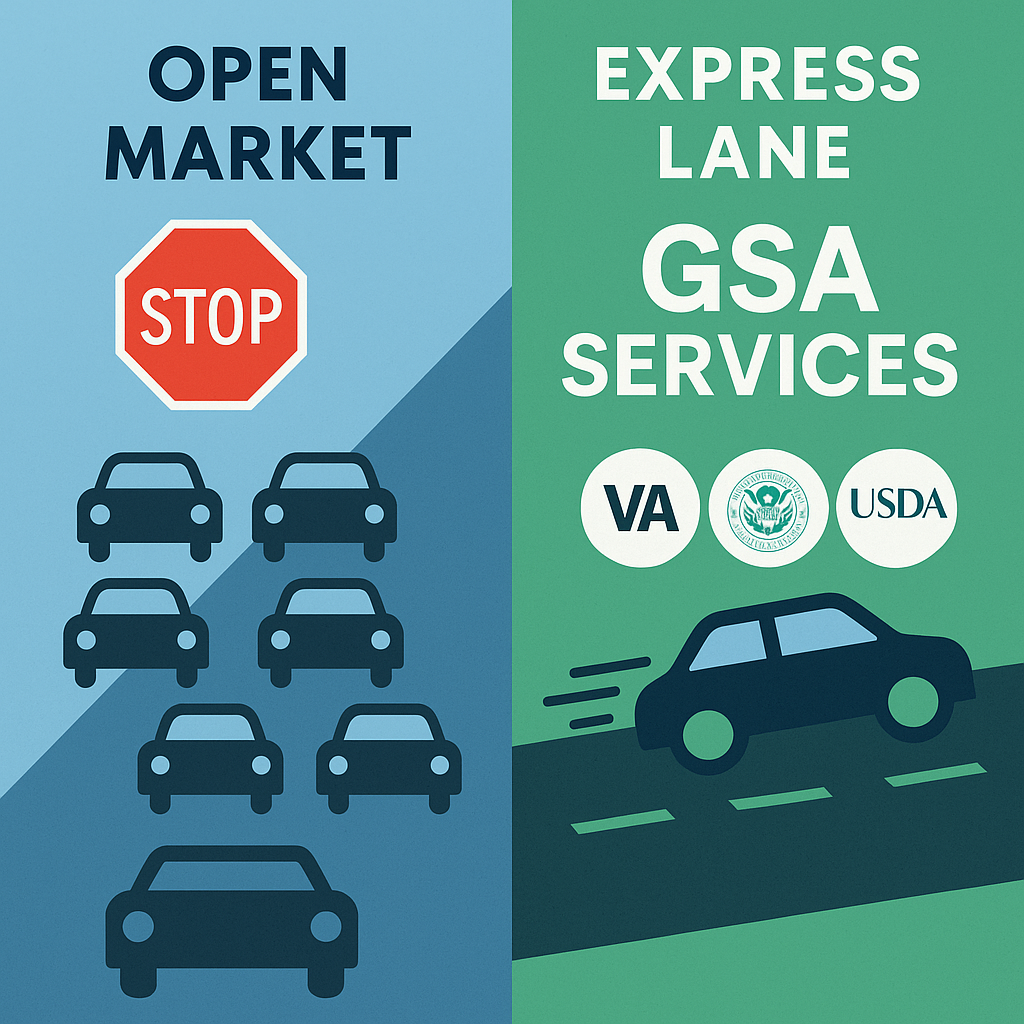
Doing business with the government without a GSA Schedule is possible, but slower, harder and less scalable. On the open market, buyers have to justify and compete each purchase. With a GSA Schedule, the agency can issue a task order or buy directly from pre-approved contractors.
Think of it this way: open market is like auditioning for every sale. A GSA Schedule means you’re already cast—you just need to show up and perform.
This makes you the go-to choice when timelines or urgency matter.
| Feature | GSA Schedule | Open Market Sales |
|---|---|---|
| Procurement Speed | Fast – agencies can issue task orders or direct purchases without full solicitation. | Slow – requires full solicitation, evaluation, and justification processes. |
| Competition | Limited – only GSA-approved vendors are considered. | High – dozens to hundreds of vendors may compete on each opportunity. |
| Approval Status | Pre-vetted by GSA for pricing, past performance, and financials. | No pre-approval; each proposal is evaluated from scratch. |
| Compliance Requirements | Ongoing compliance after award (e.g., quarterly reporting, price list maintenance). | One-time compliance for each proposal; varies by solicitation. |
| Sales Scalability | High – reusable contract with long-term selling potential. | Low – each sale requires new effort and paperwork. |
| Ease for Contracting Officers | Preferred – simplifies agency acquisition workload and reduces risk. | Difficult – more internal steps, risk assessment, and paperwork required. |
| Example Scenario | Agency buys IT services via GSA task order in 1–2 weeks. | Agency issues RFP, reviews bids, and awards after 2–6 months. |