
SAM registration is the official process that assigns your business a Unique Entity Identifier (UEI) and places you in the System for Award Management, the federal government’s authoritative vendor database. Without an active SAM.gov profile, your business cannot legally receive a federal contract award or payment. The role of SAM registration goes far beyond paperwork. It is the foundation of your entire federal contracting operation, determining your visibility to contracting officers, your eligibility for set-asides, and your ability to get paid once work begins. Understanding this process is the first real step toward competing in the federal marketplace.
What is the role of SAM registration in federal contracting?
SAM registration is the legal prerequisite to receiving federal contracts and payments, with no exceptions. Every business that wants to bid on a federal contract, receive a federal grant, or participate in federal assistance programs must hold an active registration on SAM.gov. The registration assigns your UEI, which replaced the old DUNS number system, and becomes your permanent identifier across all federal procurement systems.
SAM.gov acts as the federal government’s authoritative entity database, feeding data into procurement tools, payment systems, and reporting platforms used by agencies across the government. Your profile is not just a form you fill out once. It is a live record that contracting officers, grant managers, and prime contractors check before they engage with you.

The importance of SAM registration becomes clear the moment you miss a renewal or enter incorrect data. Your eligibility suspends immediately. Payments on active contracts can halt. Opportunities you spent months pursuing disappear because your profile shows as inactive on the day a contracting officer runs their check.
Why is SAM registration legally required?
Federal law makes SAM registration mandatory through two specific Federal Acquisition Regulation clauses. FAR 4.1102 requires all contractors to be registered in SAM before receiving a contract award. FAR 52.204-7 reinforces this by requiring active registration at the time of proposal submission and throughout the entire period of contract performance.
The legal consequences of non-compliance are direct:
- Contracting officers cannot legally award contracts to any entity without an active SAM registration, regardless of how strong the proposal is.
- An expired registration during contract performance can suspend payments on work already completed.
- Agencies cannot process invoices if your SAM profile is inactive or contains mismatched data.
- Subcontractors working under prime contracts may also face eligibility verification requirements that depend on active SAM status.
- Annual renewal is required every 365 days with no grace period. Missing the deadline triggers immediate suspension of awards and payments.
SAM.gov sends automated reminders at 60 and 30 days before your registration expires. Those reminders are your only warning. Treat them as hard deadlines, not suggestions.
The annual renewal requirement surprises many small business owners who assume registration is a one-time task. It is not. The federal government requires you to confirm and update your information every year to maintain eligibility. This is a compliance obligation, not optional maintenance.
How do you register for SAM? Steps and timeline
The SAM registration process is free and entirely self-managed on SAM.gov. Registration costs nothing, no government fees apply for registration, UEI assignment, or annual renewals. Any service charging you a fee for faster processing is a scam. No expedited government registration service exists.
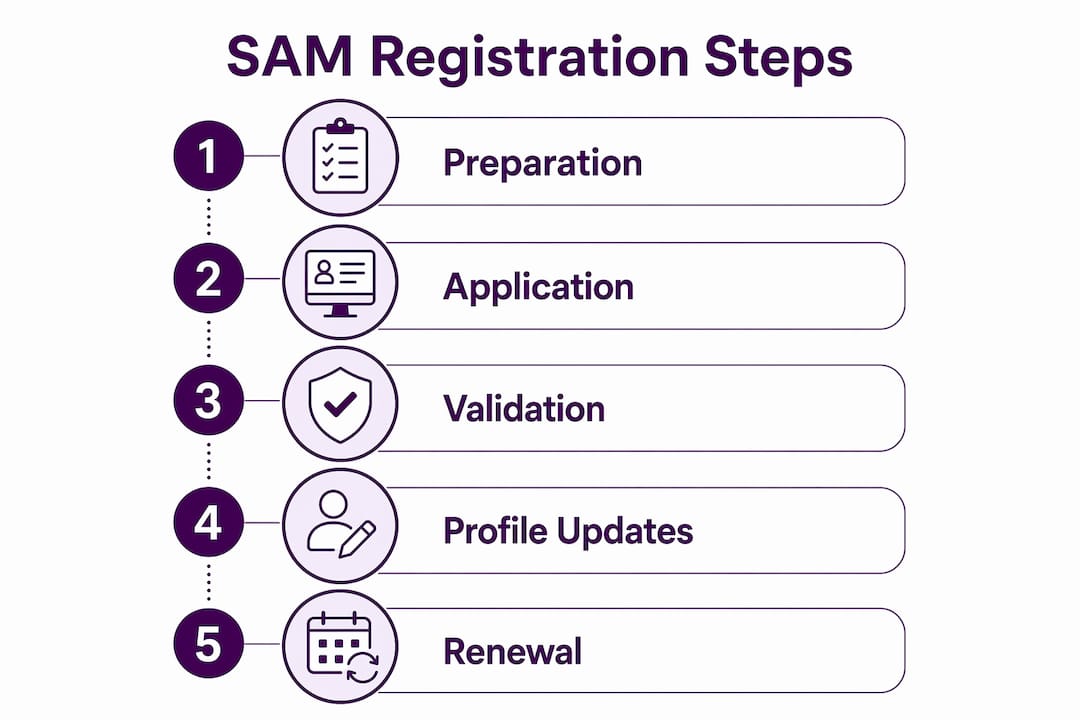
The steps for SAM registration follow a clear sequence:
- Gather your documentation. You need your Employer Identification Number (EIN) from the IRS, your legal business name exactly as it appears on your IRS records, your physical address, your NAICS codes, and your bank account information for Electronic Funds Transfer (EFT) setup.
- Create a Login.gov account. SAM.gov requires identity verification through Login.gov before you can begin an entity registration.
- Start your entity registration on SAM.gov. Enter your legal name, EIN, and address. Every character must match your official IRS and state business records exactly.
- Complete your core data, assertions, and representations. This includes your business type, size, ownership, and certifications such as small business, woman-owned, or veteran-owned status.
- Submit and wait for validation. The application takes 30–60 minutes to complete. Validation and processing take 7–10 business days after submission.
- Confirm your UEI assignment. Once approved, your UEI appears in your SAM profile and becomes your permanent federal identifier.
Pro Tip: Have your IRS EIN confirmation letter and your official state business registration documents open before you start. Data mismatches between your SAM entry and IRS records are the most common cause of registration delays, and fixing them restarts the validation clock.
After registration, you must update your profile within 30 days of any changes to your legal name, address, or bank account information. Failing to update triggers payment holds because government payment systems reject invoices with mismatched vendor data.
How does SAM registration affect your visibility and competitiveness?
Your SAM profile functions as your official storefront in the federal marketplace. Contracting officers use SAM data for market research and vendor identification before they ever issue a solicitation. An incomplete or stale profile reduces your visibility and cuts you out of opportunities before competition even begins.
The table below shows how an accurate SAM profile compares to a neglected one across key contracting outcomes:
| Profile factor | Active, accurate profile | Outdated or incomplete profile |
|---|---|---|
| Contracting officer discovery | High. Appears in NAICS code searches | Low. Missing or wrong codes mean no match |
| GSA eBuy and FPDS data accuracy | Correct. Data flows cleanly across systems | Errors propagate through federal systems |
| Payment processing | Smooth. EFT data matches invoices | Suspended. Mismatched data halts payments |
| Teaming and subcontracting | Easy. Primes verify eligibility instantly | Difficult. Raises compliance concerns |
| Set-aside eligibility | Confirmed. Certifications visible to buyers | Uncertain. Buyers skip unverified vendors |
Errors in your SAM profile propagate through systems like GSA eBuy, FPDS, and USAspending, creating compliance issues that follow your business across multiple agencies. Accuracy at setup prevents problems that are expensive and time-consuming to fix later.
Pro Tip: Review your NAICS codes every time you renew. Adding a relevant code you previously missed can open your profile to entirely new agency searches and contract opportunities you were invisible to before.
The impact of SAM registration on your competitive position is real and measurable. Contracting officers conducting market research pull vendor lists directly from SAM. If your profile does not appear in their search, you do not exist in their consideration set, regardless of your qualifications.
What are the most common SAM registration challenges?
Registration delays and compliance failures follow predictable patterns. Knowing them in advance saves weeks of lost time and protects your cash flow.
- Data mismatches cause the most delays. Your legal business name, EIN, and bank account details must match official government records character for character. A single abbreviation difference between your SAM entry and your IRS records will stall validation.
- Missed renewals suspend eligibility immediately. SAM.gov offers no grace period. If your registration lapses on a Tuesday, you are ineligible for awards and payments starting that Tuesday.
- Outdated profiles create payment holds. Businesses that change their bank account or address and fail to update SAM within 30 days face payment suspension on active contracts.
- Scams target new registrants. Third-party services that charge fees for SAM registration are not government authorized. No paid expedited service exists. Register only at SAM.gov directly.
- Subcontractors underestimate their need. While prime contractors face strict registration requirements, subcontractors benefit from maintaining an active profile. Primes use SAM to verify subcontractor eligibility and demonstrate compliance to agencies.
“Proactive management of the SAM profile, including timely renewals and data accuracy, differentiates successful contractors from those losing opportunities due to administrative oversight.” — SAM.gov Registration Guide 2026
The fraud risk is real and growing. Businesses searching for registration help online encounter services that charge hundreds of dollars for a process that is entirely free. The only legitimate place to register or renew is SAM.gov. Bookmark the official site and use it exclusively.
Key Takeaways
SAM registration is the non-negotiable legal foundation for every business that wants to compete for federal contracts, receive government payments, or participate in federal assistance programs.
| Point | Details |
|---|---|
| Legal requirement | FAR 4.1102 and 52.204-7 prohibit contract awards to any unregistered entity, with no exceptions. |
| Free and self-managed | Registration, UEI assignment, and annual renewal cost nothing on SAM.gov. |
| Annual renewal is mandatory | Renewals occur every 365 days with no grace period. Missing the deadline suspends eligibility immediately. |
| Profile accuracy drives visibility | Accurate NAICS codes and certifications determine whether contracting officers find you during market research. |
| Update within 30 days | Any change to your legal name, address, or bank account must be updated in SAM within 30 days to avoid payment holds. |
Why I think most small businesses treat SAM registration wrong
Most small business owners I have seen approach SAM registration as a box to check before submitting their first proposal. They rush through the setup, enter data that is close enough but not exact, and then forget about it until they get a rejection notice or a payment stops. That approach costs real money and real opportunities.
The businesses that win consistently in the federal market treat their SAM profile the way a retailer treats their storefront. They keep it current, they review their NAICS codes annually, and they update their certifications the moment they qualify for a new set-aside category. That discipline is what separates contractors who get found from contractors who wonder why the phone never rings.
The SAM.gov portal is not complicated once you understand what it is actually doing. It is feeding your data into every federal procurement system that matters. GSA eBuy pulls from it. FPDS records it. Contracting officers search it. Every piece of stale or incorrect data in your profile is a quiet tax on your competitiveness that you never see directly but always feel in your win rate.
My honest advice: set a calendar reminder 90 days before your SAM expiration date. Use that time to review every field in your profile, not just renew it. Treat the renewal as an annual audit of your federal market position. The contractors who do this consistently are the ones who show up in searches, pass compliance checks without friction, and get paid on time.
— Josh
How Gsascheduleservices can support your federal contracting goals
Gsascheduleservices works with small and medium-sized businesses that want to move beyond SAM registration and into active federal contract pursuit. SAM registration is the starting point, but securing a GSA Schedule contract opens access to a pre-competed vehicle that federal buyers use to purchase billions in goods and services each year. If you have your SAM registration in place and want to understand what comes next, the government contracting discovery process at Gsascheduleservices is built for exactly that moment. The team handles readiness assessments, paperwork, and negotiation support so you can focus on delivering, not on decoding federal procurement rules.
FAQ
What is SAM registration and why does it matter?
SAM registration is the process of enrolling your business in the System for Award Management at SAM.gov, which assigns your Unique Entity Identifier and makes you eligible for federal contracts and payments. Without active registration, contracting officers cannot legally award you a contract under FAR 4.1102.
How long does SAM registration take?
The application takes 30–60 minutes to complete, and validation takes 7–10 business days after submission. Registration is free and must be renewed every 365 days to maintain eligibility.
What happens if my SAM registration expires?
Your eligibility for contract awards and payments suspends immediately with no grace period. SAM.gov sends reminders at 60 and 30 days before expiration, so renewing early is the safest approach.
Can I pay someone to register faster in SAM?
No. No expedited government registration service exists, and any service charging fees for SAM registration is a scam. Registration is 100% free and self-managed at SAM.gov.
Do subcontractors need SAM registration?
Subcontractors are not always legally required to register, but primes frequently require it for compliance verification. Maintaining an active SAM profile improves your credibility and makes teaming arrangements easier to execute.
Recommended
- Navigate Federal Contracting on Beta SAM gov
- What is the System for Awards Management (aka SAM)?
- Understanding SAM.gov’s Functions and Uses
- Win Federal Bids with Effective & Masterful SAM Registration