

Manage a federal pipeline by logging every opportunity from SAM.gov and agency forecasts, scoring each with a go/no-go rule, moving it through fixed stages, and reviewing the list monthly. Add a contract vehicle such as a GSA Schedule so more buyers can order from you directly. Our clients typically spend about 3 hours on the Schedule paperwork.
TL;DR
- A federal pipeline runs on long cycles and public data: forecasts, solicitations and award records are all published, so you can plan months ahead.
- Track each opportunity through stages from discovery to award, with a written go/no-go score before you spend bid money.
- Probability of award is the chance you are right for the buyer multiplied by the chance you win. A score under 40% on the go side is a no-go.
- Treat marketing as part of your bid and proposal budget, not a separate bill that gets cut first.
- A contract vehicle widens the pool of opportunities you can pursue, but it does not guarantee sales. The pipeline is what turns it into revenue.
Table of Contents
- What makes a federal pipeline different from an ordinary sales pipeline?
- How do you set up the pipeline in the first place?
- Which stages should an opportunity move through?
- How do you decide go or no-go?
- What should you review every month?
- How much should a federal marketing budget be, and where does it go?
- Where does a contract vehicle fit in the pipeline?
- How much time does it take to get on a Schedule, and what does it cost?
- What if you want a marketing plan alongside the Schedule?
- Our view: the pipeline starts with the right vehicle
- Ready to see whether you qualify?
- FAQ
- Sources
What makes a federal pipeline different from an ordinary sales pipeline?
A commercial pipeline is built on conversations. A federal pipeline is built on public records and fixed rules. Agencies must advertise contracts over $25,000 on SAM.gov, and the SBA points small businesses to SAM.gov as the place those opportunities are listed. Every award over that amount lands in the Federal Procurement Data System, so you can see who bought what, from whom and for how much.
Three consequences shape how you manage the list:
- Cycles are long and dated. An opportunity usually shows up first as a forecast, then as a request for information (RFI), then as a request for quotation (RFQ) or request for proposal (RFP). Each needs a different level of response, as GSA’s guidance on doing business notes.
- Eligibility is part of the pipeline. Some work is reserved. Above the micro-purchase threshold, agencies must set contracts aside for small businesses when they expect competitive offers from two or more responsible small firms, and some work is reserved for HUBZone, service-disabled veteran-owned, women-owned, 8(a) and SBIR/STTR participants, according to GSA’s programs page. Your certifications decide which rows you can even enter.
- Access depends on the vehicle. GSA says a business must hold a Schedule, GWAC or MAC contract, or partner with a holder, to reach opportunities on those vehicles. Your pipeline should note which vehicle each target buys through.
So a federal pipeline is less a funnel of leads than a calendar of buying events, each with a rule set attached.
How do you set up the pipeline in the first place?
Start before the first opportunity. GSA lists the preparation steps: register in SAM.gov, get a Unique Entity Identifier (UEI), identify your NAICS codes (the industry codes agencies use to classify what they buy) and confirm your small business size status. Without those, nothing in the pipeline is actionable.
Then build one table. A spreadsheet is enough for the first 20 or 30 opportunities. Give each row these fields:
| Field | What to record |
|---|---|
| Opportunity | Title, agency, office, solicitation or forecast number |
| Source | SAM.gov, agency forecast, a teaming partner, an incumbent’s contract end date |
| Vehicle | Open market, small business set-aside, Schedule, GWAC, task order |
| Value and timing | Estimated value, expected solicitation date, response due date, award date |
| Set-aside status | Whether your certifications qualify you |
| Stage | One of the stages in the next section |
| Go/no-go score | The number and who approved it |
| Next action | One action, one owner, one date |
The “next action” column is the one that keeps the list alive. A row without a dated next step is a wish.
If you also want follow-up reminders and a shared view for a small team, a lightweight CRM can carry this table. For ideas on setting up AI tools for contractors, including scheduling and automated follow-ups, that article shows what a small owner can set up in a week.
Which stages should an opportunity move through?
Keep the stages few and unambiguous. Six is enough for a small company:
- Identified. The opportunity is on your radar from a forecast, search or contact. You have spent no bid money.
- Qualified. You have checked set-aside status, vehicle access, size standard, and whether your past performance fits. You have scored go/no-go.
- Shaping. You are contacting the agency’s points of contact, sending a capabilities statement and answering RFIs.
- Bidding. The solicitation is out and you are writing the quote or proposal.
- Submitted. You are waiting, answering clarification questions and tracking the award date.
- Won or lost. You record the result and the reason.
Shaping is where small firms most often lose ground. GSA recommends contacting agency points of contact early with an expression of interest and a capabilities statement. It also reminds readers that forecasts change, so final solicitation decisions are confirmed on SAM.gov. Your pipeline should treat a forecast as a signal to prepare, not a promise of a solicitation.
How do you decide go or no-go?
The cheapest bid is the one you decline early. Use a written scorecard with the same questions every time, so a hopeful salesperson cannot talk the company into a weak pursuit.
A workable scorecard rates each item from 1 to 5:
- Does the agency already know you, or could it by the time the solicitation drops?
- Does your past performance match the scope in size and kind?
- Do you qualify for the set-aside, or hold the required vehicle?
- Can you price competitively and still earn a margin?
- Do you have staff available during the proposal window?
- Do you know who the incumbent is, and can you beat them?
Turn the total into a percentage. This gives you the “probability of go” (Pgo). Then estimate your chance of winning if you bid (Pwin). A GovCon Wire interview with a Unanet expert describes probability of award as Pgo multiplied by Pwin. In that framework a Pgo scorecard below 40% signals no-go, 41 to 65% calls for executive review, and above 66% means the opportunity is worth pursuing.
A worked example. Suppose an opportunity scores 70% on the go side and you judge your win chance at 40%. The probability of award is 0.70 × 0.40 = 28%. If the contract is worth $500,000 in revenue, the weighted value in your pipeline is $140,000. That weighted number, not the headline $500,000, goes into your forecast. Add the weighted values across all open rows and you have a realistic revenue picture, not an optimistic one.
The thresholds above come from one practitioner’s framework, so adjust them after your first few results. What matters is that the rule is written down before you fall in love with the deal.
What should you review every month?
A pipeline only helps if you read it on a schedule. Hold a monthly review of 45 minutes with whoever owns sales, pricing and delivery. Walk through these in order:
- Coverage. Add up weighted value and compare it to your revenue goal for the next 12 months. Most small firms discover a gap here before it hurts.
- Aging. Flag any row that has sat in one stage for longer than its natural cycle, such as a forecast whose expected solicitation date has passed.
- Win and loss reasons. For every result, write one sentence on why. After six or eight results, patterns appear: you lose on price at one agency, or you win when you met the contracting officer early.
- Source quality. Count which sources produced bids and which produced awards. Move effort toward the better ones.
- Next 30 days. List the response deadlines and who is writing each.
The SBA adds a useful early-warning input: agency small business offices (OSDBU or OSBP) release procurement forecasts and host training and networking events to help small businesses identify opportunities. Put those events on your calendar as pipeline activities.
How much should a federal marketing budget be, and where does it go?
There is no official percentage, so be wary of anyone who quotes one as fact. Think instead about where federal marketing spend belongs. A white paper on aligning marketing with capture says marketing dollars can be part of the bid and proposal (B&P) budget for most procurements. It recommends bringing marketing into the planning sessions for each new year and each major RFP. It also suggests funding bid-related activities, such as capability materials, white papers tied to RFIs and industry-day participation, through pursuit budgets.
For a small company, that translates into three buckets:
- Foundation. Capabilities statement, past performance summaries, a website that answers a contracting officer’s questions, and your SAM.gov profile. This is a one-time build with light upkeep.
- Pursuit. Costs tied to specific rows: attending an industry day, tailoring a capabilities statement, writing a response to an RFI.
- Vehicle and compliance. What it costs to get and keep a contract vehicle: application, price list, annual modifications and reporting.
Pricing deserves its own line early. A Washington Technology column reports a survey in which a late price-to-win study led one contractor to abandon a bid after a $3 million vehicle investment plus nearly $1 million in proposal services. Its author argues that pricing work should start at the pursuit decision. You will not spend those sums, but the lesson scales down: know your target price before you write the first page of the quote.
Set the budget as a share of the weighted pipeline you expect to convert, then compare spend with awards at your monthly review.
Where does a contract vehicle fit in the pipeline?
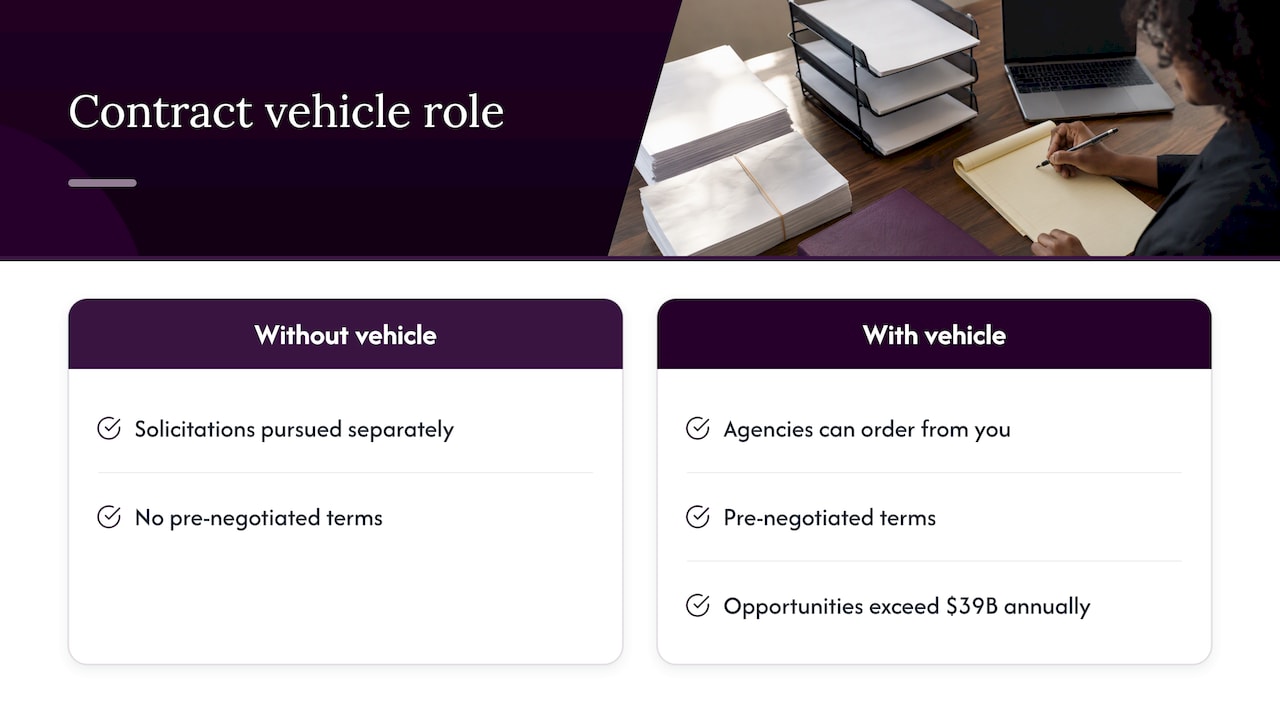
A vehicle changes the shape of your list. Without one, you chase each solicitation separately. With one, you also gain agencies that can order from you under pre-negotiated terms. GSA says the Multiple Award Schedule program opens the door to federal contracting opportunities exceeding $39 billion annually, and it is equally clear that individual contractors have no guaranteed sales. Its guidance on finding opportunities says holders must market, respond to RFQs and maintain pricing and compliance.
That is why the pipeline and the vehicle belong together. The Schedule gets you onto the buying list. The pipeline tells you which buyers to call, which RFQs to answer and when.
Eligibility is the first test. GSA states that a Schedule contract requires two years in business, two years of financial statements and measurable past performance. Those requirements may be waived for eligible businesses through the Startup Springboard program. Our own guides cover the routes in more detail: see how Startup Springboard works, how a new company can qualify and winning with 2 to 3 commercial projects. To size up your own case, use the eligibility estimator or the 2026 sales opportunity estimator.
How much time does it take to get on a Schedule, and what does it cost?
The application is document-heavy: company data, financials, past performance, a price list and negotiation of terms. Done alone, our experience is that it takes two years or more. Our clients are typically awarded in about six months while spending about 3 hours of their own time. We also state a fastest time-to-award of about 90 days for many clients and a 98% first-application approval rate.
Our approach is built on “no award, no fee”: payment comes only after approval, and a money-back guarantee backs it. The project pricing for new applications is set on a proposal, on the pages for Startups, Specialty and Streamline.
After award, the Schedule needs upkeep. Price list changes, added products or services and annual modifications keep the contract in good standing. Our maintenance plans run $99 per month for 1 modification a year, $159 for 2, $219 for 3 and $279 for 4, with custom plans from $339 per month. Our retainer is $1,500 per year. For the first weeks after award, our post-award checklist lists what to set up.
What if you want a marketing plan alongside the Schedule?
A Schedule with no outreach sits idle. We offer federal marketing packages at three levels: Lite at $10,700 per year, Standard at $15,700 per year and Plus at $27,700 per year. They are described on our federal marketing page. Treat that figure as one line in the budget buckets above, and compare it with the weighted pipeline value you aim to convert.
Our view: the pipeline starts with the right vehicle
We talk to owners every week who built a tidy tracking sheet and still had an empty pipeline. The sheet was fine. The problem was access: the opportunities they wanted were on a vehicle they did not hold.
Our view is that a small business should settle the vehicle question first, and settle it fast. Two years of paperwork alone is two years of lost pipeline. That is why we built our service around taking the paperwork off your desk: eligibility assessment, documentation, price list development, negotiation support and sales tracking setup, with about 3 hours of your time.
Once the award arrives, the work shifts to the habits in this article: score each opportunity, move it through stages, review it monthly, and keep the contract current through modifications. We design our maintenance and marketing plans to support exactly that rhythm.
The firms that do best treat the Schedule as the start of the pipeline, not the finish line.
Josh
Ready to see whether you qualify?
If your company already meets the eligibility basics, our GSA Schedule consulting handles the application end to end, and you pay only after approval. If you prefer to work through it yourself, the GSA DIY Quick Start is our self-service option. Either way, start with a free eligibility check at our site, so you know where you stand before you build the rest of your pipeline.
FAQ
What is the first step in building a federal pipeline?
Register in SAM.gov, get your UEI, identify your NAICS codes and confirm your size status. Then log your first 10 opportunities in a single table with a stage, a score and a dated next action. Once that works, add forecasts and agency events.
How many opportunities should a small business track?
There is no official number. Start with enough to cover your revenue goal after weighting each by its probability of award. If the weighted total falls short of your target, add more rows in the earlier stages.
Does holding a Schedule fill my pipeline?
No. GSA says a Schedule does not guarantee sales and that holders must market, respond to RFQs and keep pricing and compliance current. The Schedule gives you access; the pipeline routine produces the orders.
How often should I review the pipeline?
Monthly for the full review, weekly for the next 30 days of deadlines. Long federal cycles mean a monthly rhythm catches slipping dates without creating busywork.
Sources
- How to win contracts, U.S. Small Business Administration
- How to do business with GSA
- Programs and eligibility, GSA
- How to access contract opportunities, GSA
- Find opportunities, GSA
- From Gut Feel to Forecast Precision for GovCons, GovCon Wire
- Aligning Marketing, Business Development, Capture and Proposal, white paper
- Break barriers between marketing, BD, capture and proposal groups, Washington Technology
- AI tools for contractors, Arizona Strategy
Recommended
- How to Build a Federal Business Pipeline
- Government Contract Vehicles: A Guide for Small Businesses
- Government Contracts for Small Businesses: Top 10 Strategies
- Federal Business Opportunity Workflow for SMB Contractors