

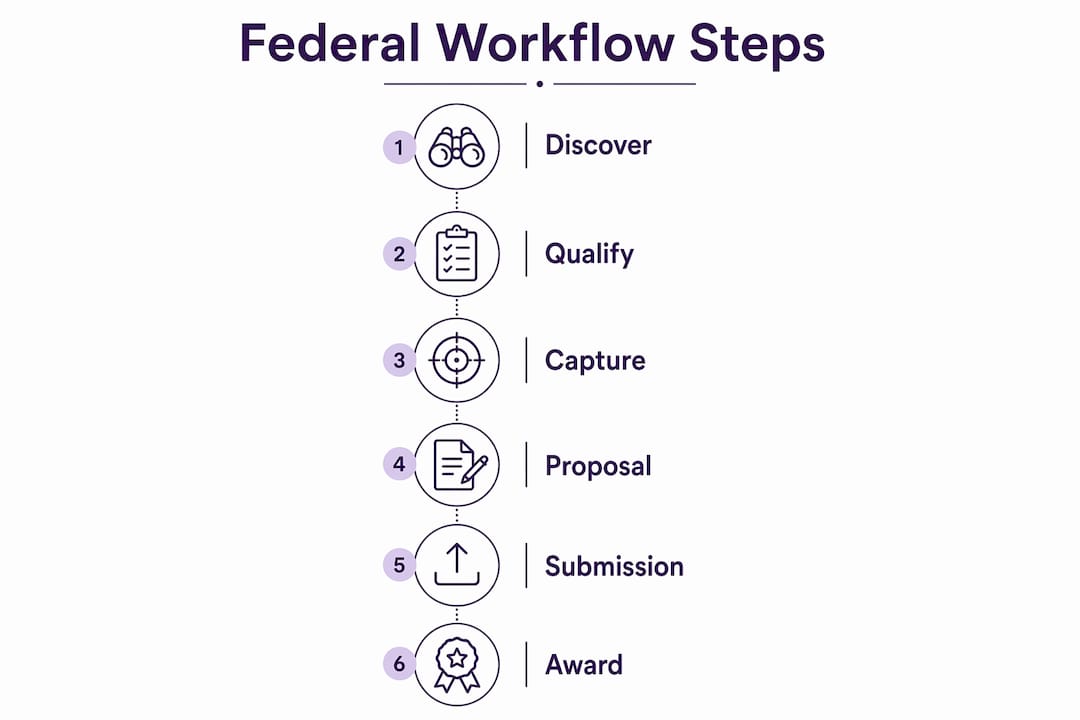
A federal business opportunity workflow is the structured, stage-by-stage process businesses use to identify, evaluate, and pursue government contracts from initial discovery through final submission. Without this structure, small and medium-sized businesses waste proposal resources on unwinnable bids and miss high-value opportunities entirely. The federal procurement workflow covers six core stages: Discover, Qualify, Capture, RFP Open, Submit, and Outcome. Tools like SAM.gov, GSA eBuy, and purpose-built platforms like GovScout sit at the center of each stage. This article walks you through every phase with the specificity you need to compete.
What is the federal business opportunity workflow?
The federal business opportunity workflow is not a traditional B2B sales funnel. Federal contracting workflows require a capture lifecycle approach with gate reviews and specific pursuit stages, not a linear pipeline from lead to close. That distinction matters because the government procurement process runs on its own timeline, often months before a solicitation ever appears publicly.
The six stages of the workflow are:
- Discover — Find relevant opportunities using official portals and supplementary tools.
- Qualify — Score each opportunity against objective criteria before committing resources.
- Capture — Engage agencies early, gather intelligence, and shape requirements.
- RFP Open — Develop your proposal once the solicitation is formally released.
- Submit — Deliver a compliant, complete package by the deadline.
- Outcome — Track award decisions, request debriefs, and feed lessons back into the pipeline.
Each stage has its own tools, decisions, and failure modes. Skipping qualification to jump straight to proposal writing is one of the most common and costly mistakes in government contracting. Teams that skip early discovery and qualification often waste resources chasing bids they were never positioned to win.
How do you discover and monitor federal business opportunities effectively?

SAM.gov is the central source for all federal contract opportunities, including pre-solicitations, Sources Sought notices, Requests for Information (RFIs), solicitations, and amendments. All federal agencies must post contract opportunities over $25,000 on SAM.gov, making it the non-negotiable starting point for any federal opportunity search workflow.
Effective discovery on SAM.gov depends on using its filters precisely:
- NAICS codes — Filter by the North American Industry Classification System codes that match your core services.
- Set-asides — Narrow results to small business, 8(a), HUBZone, SDVOSB, or WOSB designations that apply to your firm.
- Agency and sub-agency — Target agencies where you have past performance or existing relationships.
- Notice type — Separate Sources Sought from solicitations to prioritize your response effort.
- Keywords — Use specific technical terms from your capability statement, not generic phrases.
Beyond SAM.gov, agency small business offices publish procurement forecasts that identify upcoming contracts months before they appear publicly. These forecasts are underused by most small contractors and represent a genuine competitive edge. GSA eBuy is a separate portal specifically for GSA Schedule holders to receive Requests for Quote from federal buyers, making it a critical discovery channel if you hold a Schedule contract.
Supplementary platforms like SamSearch and GovScout aggregate SAM.gov data and apply additional scoring and filtering layers. They reduce the manual work of daily monitoring and surface opportunities that keyword searches alone would miss.
Pro Tip: Set up saved searches in SAM.gov with email alerts for your top three NAICS codes and two target agencies. Review those alerts every morning before checking anything else. Consistency in monitoring compounds over time into a real pipeline.
What is the process for qualifying federal contract opportunities?
Qualification is the gate between discovery and resource commitment. A disciplined qualification process scores each opportunity across multiple factors before your team spends a single hour on capture or proposal work. Opportunities scoring below your threshold get a no-bid decision or require executive approval to proceed.
The standard go/no-go scoring framework evaluates these factors:
- NAICS alignment — Does the primary NAICS code match your registered capabilities and past performance?
- Set-aside eligibility — Are you certified for the applicable set-aside, or will you compete in the full-and-open pool?
- Past performance relevance — Do you have at least two or three comparable contracts in scope, dollar value, and complexity?
- Competitive position — Do you know who the incumbent is, and can you articulate a clear win theme against them?
- Price-to-win viability — Can you price competitively and still maintain acceptable margins?
- Proposal capacity — Does your team have the bandwidth to write a compliant proposal by the due date?
- Strategic value — Does winning this contract open doors to follow-on work or a new agency relationship?
Qualification must include an honest assessment of capacity and pricing viability, not just fit. Many small businesses score well on fit but overcommit to bids they cannot staff or price to win.
Revisit your qualification decision when the final solicitation drops. Scope changes, evaluation criteria shifts, and new set-aside designations can all change the math. A bid that looked strong at the Sources Sought stage may score differently once Section L and Section M are published.
Pro Tip: Build a simple scoring sheet in Google Sheets or Notion with your seven qualification factors, each scored 1 to 5. Set a minimum threshold of 28 out of 35. Any bid below that number requires a written justification before your team touches it.
How to capture and shape opportunities before the solicitation is released
Capture is the phase most small businesses skip entirely, and it is where competitive advantage is actually built. Sources Sought notices are used by agencies to assess private sector capabilities and determine acquisition strategy. They are not bids. They do not lead directly to awards. But responding to them is often the highest-return activity a small federal contractor can do.
When you respond to a Sources Sought or RFI, you accomplish several things simultaneously:
- You signal your firm’s existence and capability to the contracting officer.
- You influence whether the acquisition is set aside for small business or a specific socioeconomic category.
- You learn the agency’s priorities, terminology, and evaluation preferences before competitors do.
- You establish a relationship that makes your eventual proposal feel familiar rather than cold.
Capture activities also include attending industry days, reviewing prior award data on USASpending.gov, identifying the incumbent contractor, and deciding whether to prime, subcontract, or team with another firm. Each of these decisions shapes your bid strategy before a single proposal page is written.
Practitioners maintain two timing lenses during capture. The notice and release horizon covers signals arriving months ahead, such as forecasts and Sources Sought. The bid execution horizon begins once the solicitation drops. Keeping these two lenses separate prevents your team from over-investing in early-stage intelligence gathering when proposal execution demands attention.
Build a capture checklist for every qualified opportunity. It should track the Q&A status, known incumbents, evaluation criteria signals, teaming decisions, and key contact names at the agency. This document becomes the foundation of your proposal strategy.
What are the best practices for proposal development and submission compliance?
Proposal development begins the moment the solicitation is released. The first task is not writing. It is building a compliance matrix by extracting every instruction from Section L (Instructions to Offerors) and every evaluation criterion from Section M (Evaluation Factors). A compliance matrix that links every requirement to an owner and a document version prevents the “quiet compliance drift” that causes avoidable bid losses.
Here is how a structured proposal workflow compares to an unstructured one:
| Factor | Structured workflow | Unstructured workflow |
|---|---|---|
| Compliance tracking | Centralized matrix with named owners | Ad hoc, writer-dependent |
| Version control | Locked naming conventions, dated files | Multiple conflicting drafts |
| Review cadence | Scheduled Pink Team and Red Team reviews | Last-minute edits before deadline |
| Attachment management | Checklist with file names and page limits | Assembled at submission |
| Risk of non-compliance | Low, caught early in review | High, often discovered too late |
Assign every section of the proposal to a named writer with a word count target and a first-draft deadline. Use a shared drive with a locked folder structure so no one overwrites another writer’s work. Schedule a Pink Team review at 30% completion and a Red Team review at 75% to catch compliance gaps before they become submission errors.
Enforced compliance matrices and document control are the practical fix for the most common cause of avoidable bid losses in federal contracting.
Pro Tip: Map every evaluation criterion from Section M to a specific paragraph in your proposal. If you cannot point to where you address a criterion, you have a compliance gap. Fix it before the Red Team review, not after.
How can you build and maintain an effective federal opportunity pipeline?
A pipeline without stages is just a list. Effective business opportunity management requires tracking every opportunity through defined lifecycle stages with clear ownership and data attached to each record.
The standard pipeline stages are: Discovered, Qualified, Capture Active, RFP Open, Proposal Submitted, and Awarded or Lost or No-Bid. Each stage should carry a record of the estimated contract value, the incumbent contractor, the key dates, the assigned capture lead, and the current go/no-bid status.
Advanced federal contract intelligence pipelines ingest opportunity feeds, normalize data across sources, and apply scoring to produce ranked daily digests for capture leads. This goes well beyond keyword filtering. Structured signal extraction from solicitation prose enables precise triage that catches opportunities a simple search would miss.
You do not need an enterprise system to start. A well-structured spreadsheet or a CRM like HubSpot, configured for government contracting stages, works for most small businesses. The procurement forecast data from agencies can feed directly into your pipeline as early-stage records, giving you months of lead time before a solicitation appears.
Maintaining a structured pipeline with ongoing qualification improves win rates and resource allocation. Set a weekly pipeline review cadence. Review every active capture for changes in agency signals, incumbent status, or solicitation timeline. Track your win rate by stage, by agency, and by contract type. That data tells you where your workflow is strong and where it leaks.
Key takeaways
A disciplined federal business opportunity workflow built on SAM.gov discovery, structured qualification scoring, early capture engagement, compliance-driven proposal development, and active pipeline management is the most reliable path to consistent federal contract wins for small and medium-sized businesses.
| Point | Details |
|---|---|
| Start with SAM.gov | All federal opportunities over $25,000 are posted there; filter by NAICS, set-aside, and agency. |
| Qualify before committing | Score every bid across seven factors before spending a single hour on capture or writing. |
| Respond to Sources Sought | Early engagement shapes set-aside decisions and builds agency relationships before competitors arrive. |
| Use a compliance matrix | Map every Section L and M requirement to an owner and document version to prevent compliance drift. |
| Maintain a staged pipeline | Track opportunities through defined stages with key dates, incumbents, and win rate data attached. |
What I’ve learned from watching small businesses fight for federal contracts
I have watched small businesses treat SAM.gov like a job board, refreshing it daily and chasing every solicitation that matches their NAICS code. That approach produces a lot of proposals and very few wins. The contractors who consistently win federal work do something different. They spend more time before the solicitation drops than after it.
The counterintuitive truth about the government contracting process is that the proposal phase is almost too late to change the outcome. By the time a solicitation is published, the agency has often already formed a mental picture of what a strong offeror looks like. That picture was shaped by Sources Sought responses, industry day conversations, and prior contract performance. If you were not in that picture, your proposal is fighting uphill.
The other pattern I see consistently is qualification avoidance. Teams feel pressure to keep the pipeline full, so they lower their standards and pursue bids they have no realistic chance of winning. This is not ambition. It is resource destruction. A go/no-go scoring framework is not bureaucracy. It is the discipline that keeps your best people focused on winnable work.
Technology helps, but it does not replace judgment. AI-powered scoring tools can rank opportunities and flag anomalies in solicitation language. They cannot tell you whether your relationship with a contracting officer is strong enough to overcome an incumbent’s advantage. Use the tools for discovery and triage. Use human judgment for capture strategy and teaming decisions.
Build your workflow once, maintain it consistently, and review it quarterly. The businesses that win federal contracts at scale are not smarter than their competitors. They are more disciplined.
— Josh
How Gsascheduleservices can support your contracting workflow
Gsascheduleservices works specifically with small and medium-sized businesses that want to access federal procurement opportunities through GSA Schedule contracts. If your discovery and qualification workflow keeps surfacing GSA opportunities you are not positioned to pursue, a GSA Schedule contract changes that. Gsascheduleservices handles the readiness assessment, paperwork, and negotiation so your team stays focused on capture and proposal work. Visit the GSA contract discovery page to see how the process works and what your business qualifies for. You can also explore the SAM.gov guidance on the Gsascheduleservices blog to sharpen your opportunity monitoring before your next bid.
FAQ
What is a federal business opportunity workflow?
A federal business opportunity workflow is the structured process businesses use to discover, qualify, capture, and submit bids on government contracts. It typically follows six stages: Discover, Qualify, Capture, RFP Open, Submit, and Outcome.
Where do I find federal contract opportunities?
SAM.gov is the primary source for all federal contract opportunities, including solicitations, Sources Sought notices, and RFIs. All federal agencies must post contracts over $25,000 there.
What is a Sources Sought notice?
A Sources Sought notice is a market research tool agencies use to assess private sector capabilities before issuing a formal solicitation. Responding to one does not constitute a bid, but it can influence whether the contract is set aside for small business.
How do I qualify a federal opportunity before bidding?
Score each opportunity across factors like NAICS alignment, set-aside eligibility, past performance relevance, competitive position, price-to-win viability, proposal capacity, and strategic value. Bids that fall below your minimum threshold should receive a no-bid decision.
What is a compliance matrix in federal proposals?
A compliance matrix is a document that maps every instruction from Section L and every evaluation criterion from Section M of a solicitation to a named writer and a specific proposal section. It prevents compliance gaps from reaching the final submission.
Recommended
- Federal Government Procurement Forecast 2023 Guide
- Professional Federal Contractor Services in the United States
- SAM.gov: Your Guide to Government Contracting
- Guide to Becoming a Government Contractor: Your Path To Success