

You can win a GSA MAS contract without federal past performance. GSA’s own Startup Springboard pathway lets qualified firms substitute commercial evidence, key personnel resumes, and financial proof for federal contract history. Combine that with three strong customer references or Past Performance Questionnaires, and eOffer accepts your application through the standard channel.
TL;DR:
- Firms without federal past performance can qualify through the Startup Springboard program by providing resumes, commercial records, or financial proof instead of CPARS reports.
- Relevance of commercial projects to the specific SIN matters more than the contract size, with recent, directly related work weighing heavily in evaluation.
- Successful PPQs must detail distinct recent contracts with all contact information, and references should respond reliably to questionnaires.
- Preparing an effective narrative involves clearly mapping relevant commercial work to the SIN, including outcomes and supporting documentation, while keeping within character limits.
- Most delays stem from incomplete references or vague narratives; focusing on tight, relevant examples and thorough preparation significantly improves review speed.
Table of Contents
- Can You Get a GSA Contract Without Past Performance?
- How Does Startup Springboard Work for New Contractors?
- How Do You Turn Commercial Work Into GSA-Ready Evidence?
- What Do PPQs Need to Include, and When Are They Required?
- What Are Evaluators Actually Looking For?
- How Long Does the Process Take, and What’s the Checklist?
- What Should New Contractors Do First?
- When Does It Make Sense to Get Help With Your GSA Offer?
- Official GSA Resources Worth Bookmarking
- Sources
- FAQ
Can You Get a GSA Contract Without Past Performance?
Yes, but you need to understand why the rule exists before you can satisfy it. The Federal Acquisition Regulation 12.206 treats past performance as an important evaluation factor for commercial acquisitions, not a mandatory gatekeeper. Contracting officers weigh it alongside other information, and firms with no history get what’s informally called a neutral rating rather than automatic disqualification.
That said, GSA’s Multiple Award Schedule solicitation still wants evidence. When CPARS reports aren’t available, which is the case for nearly every business bidding without federal history, the MAS solicitation document requires three references from distinct orders or contracts completed within the last three years, backed by three completed PPQs. For ongoing work, at least the base year of performance must already be done for it to count.
Contracting officers have real latitude here. They can request additional documentation, ask follow-up questions about relevance, or lean harder on recency when a reference feels thin. The practical takeaway:
- Relevance to your offered SIN matters more than the size of the contract.
- Recency inside the three-year window carries more weight than an older, larger job.
- A missing reference is fixable; a vague or contradictory one is not.
How Does Startup Springboard Work for New Contractors?
Startup Springboard is GSA’s official answer for firms without a federal track record, and it’s built specifically for companies that don’t fit the traditional past-performance mold. Eligibility runs through the FASt Lane program: you qualify if you have less than two years of corporate experience for the SINs you’re offering. Once eligible, you select “yes” to that question inside eOffer and the system routes you to the alternative documentation path instead of asking for CPARS history you don’t have.
GSA doesn’t treat the “two years” threshold as a company-age checkbox. It’s a proxy for operational maturity, evidence that your team can actually deliver under federal terms. That’s why the Startup Springboard pathway accepts:
- Resumes for key personnel showing relevant technical or delivery experience.
- Commercial invoices or sales records proving you’ve done similar work for paying customers.
- Bank statements, SBA loan documentation, or investor funding records as financial substitutes.
- Past performance from an affiliate company, if you can show a real operational connection.
- A Certificate of Competency from the SBA, where applicable.
Before you submit through this route, you’ll need to complete Pathways to Success training and acknowledge the readiness assessment inside eOffer. Skip either step and your offer stalls before a human ever reviews it.
How Do You Turn Commercial Work Into GSA-Ready Evidence?
This is where most new offerors either win or lose the evaluation, because GSA explicitly accepts commercial experience as a substitute, provided you map it precisely to the SIN you’re pursuing. Pick projects that match the SIN’s scope of work, not your biggest invoice. A $40,000 contract that mirrors your target SIN’s tasks line for line beats a $2 million project in an unrelated field every time.
Structure each project narrative the same way:
- Name the customer and describe your role on the engagement.
- State the period of performance with specific start and end dates.
- Give the dollar value of the contract or order.
- List the deliverables you actually produced.
- Include a measurable outcome (cost savings, turnaround time, error reduction).
- Draw an explicit line connecting the work to the SIN’s key tasks.
Attach supporting artifacts for every narrative: invoices, statements of work, purchase orders, or written acceptance from the client. Redact sensitive pricing or personal data before uploading anything. Key personnel resumes should sit alongside the narrative they support, not in a separate, disconnected file.
eOffer narrative fields cap out around 10,000 characters, so write tight. Once the narrative is drafted, cross-check it against your pricing workbook. Nothing sinks an offer faster than a narrative claiming enterprise-scale delivery while your price list reflects a two-person shop.
Pro Tip: Write the narrative as if the evaluator has never met you and never will. If a stranger can’t tell what you did, for whom, and what changed as a result, rewrite it before you submit.
What Do PPQs Need to Include, and When Are They Required?
PPQs step in whenever CPARS records don’t exist, which covers almost every new offeror. Each PPQ needs to document a distinct order or contract, not three invoices from the same client relationship split into pieces. GSA’s past performance instructions require each reference to list:
- A point of contact with a working email and phone number.
- The dollar value of the order or contract.
- The period of performance.
- A description of the work that matches your SIN narrative.
The single biggest failure point isn’t the paperwork itself. It’s unresponsive references. Confirm every contact will actually complete the questionnaire before you list them, and line up one or two backups in case someone goes silent during review. When your solicitation allows direct-forwarded PPQs, upload a signed letter of intent from the reference so the contracting officer knows the questionnaire is coming rather than missing.
What Are Evaluators Actually Looking For?
Evaluators score against a fixed set of factors: corporate experience, past performance, quality control, and relevant project experience. Translate each into something you can check off before you hit submit.
- Corporate experience: does your narrative show your company, not just an individual, has done this work before?
- Past performance: do your references and PPQs cover three distinct orders within the last three years?
- Quality control: have you spelled out an actual process, not just claimed you have one?
- Relevant project experience: does every attached project map directly to the SIN, without stretching the connection?
The most common pitfalls are avoidable. Relevance mismatch tops the list, followed by missing or incomplete PPQs, pricing narratives that contradict the price list, and skipped Pathways to Success training. Reconcile your pricing story with your technical narrative before submission, double check every reference contact is current, and state your quality-control procedure in plain language rather than vague reassurance.
Pro Tip: If a reviewer would have to guess what you mean by “quality control process,” rewrite that sentence. Vague language reads as a missing process, even when one exists.
How Long Does the Process Take, and What’s the Checklist?
Expect roughly one to two months for training and readiness assessment, one to two months to prepare documentation, and another one to three months for eOffer review and negotiation once submitted, per GSA’s roadmap.
- Complete Pathways to Success training and the readiness assessment.
- Select two to three commercial projects that map tightly to your primary SIN.
- Draft narratives and gather PPQs or references.
- Build your pricing workbook and cross-check it against your narratives.
- Submit through eOffer and respond quickly to contracting officer questions.
Handling all five steps solo is possible. Handling them fast, without rework, is where most new offerors struggle.
What Should New Contractors Do First?
My honest recommendation: don’t try to document everything at once. Pick two or three projects that map cleanly to your strongest SIN, confirm those clients will actually respond to a PPQ, and build your narrative around that smaller, tighter set. A thin but airtight package beats a thick one full of loose ends.
Finish Pathways to Success training and the readiness assessment before you touch eOffer. Reviewers can tell within minutes whether an offeror rushed past the prep work, and it colors how they read everything that follows. If you’re unsure where your business stands, checking eligibility costs you nothing and tells you exactly what to fix first.
— Josh
When Does It Make Sense to Get Help With Your GSA Offer?
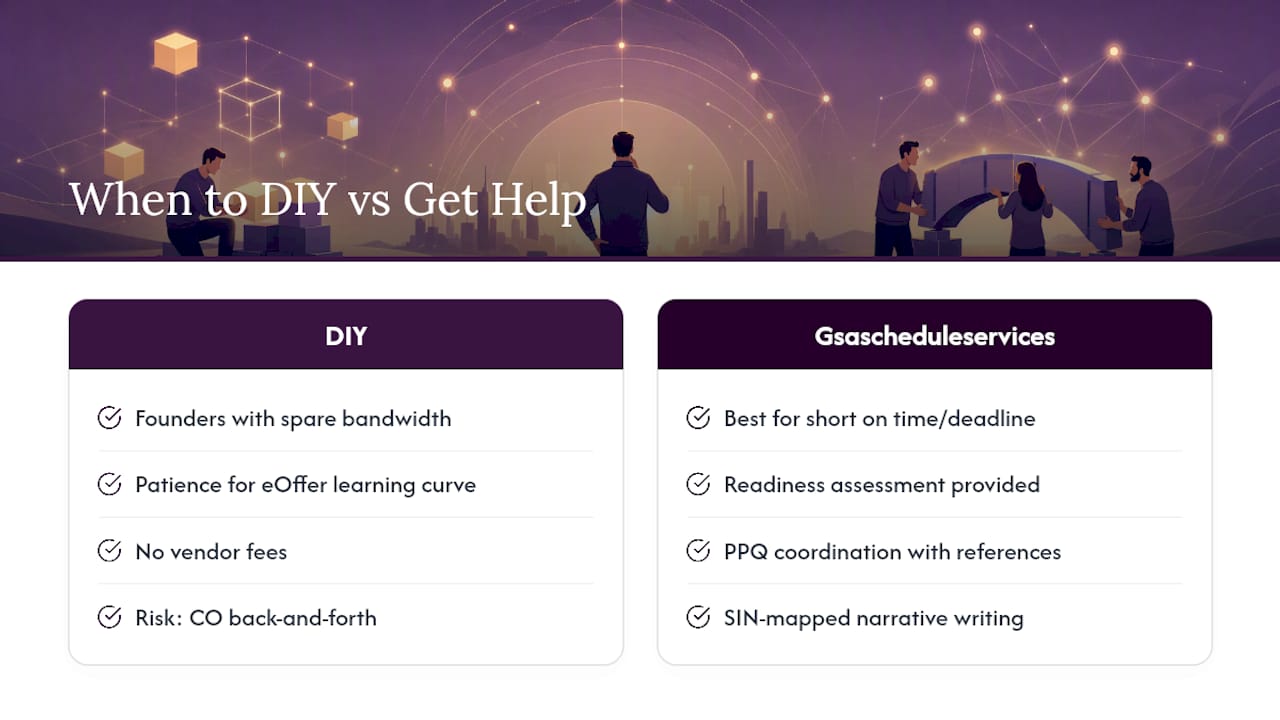
DIY works for founders with spare bandwidth and patience for eOffer’s learning curve. It doesn’t work as well when you’re short on time, unfamiliar with federal narrative writing, or facing a deadline tied to an upcoming opportunity. Most first-time applicants underestimate the potential back-and-forth a contracting officer’s questions can generate.
Gsascheduleservices exists for exactly that gap. Instead of learning eOffer’s quirks through trial and error, you get a readiness assessment, PPQ coordination with your references, narrative writing that maps directly to your SIN, and full eOffer submission plus negotiation support handled for you. Clients who go this route often achieve award within a few months, and Gsascheduleservices only gets paid after your schedule is approved. If you’d rather hand off the paperwork and keep running your business, start with the Startups, Specialty, and Streamline packages, or check your eligibility now to see which path fits your situation.
Official GSA Resources Worth Bookmarking
Before you submit anything, review the source documents directly. Start with the GSA Roadmap to a MAS contract for Startup Springboard details, pull the required MAS offer templates including the PPQ form, and read FAR 12.206 directly rather than relying on secondhand summaries.
Sources
- Startup Springboard | GSA
- MAS solicitation document (MAS Refresh) — past performance instructions
- 12.206 Use of past performance. — FAR
FAQ
Are You Required to Prepare an Annual Past Performance Evaluation?
Federal agencies, not commercial offerors, complete CPARS evaluations after contract performance. As a new applicant without federal contracts, you submit PPQs or references instead, since there’s no CPARS history yet.
How Hard Is It to Get a GSA Schedule?
Difficulty depends on how well your documentation matches the SIN and how responsive your references are, not on company size or age. Firms that use Startup Springboard and submit tight, relevant commercial evidence often move through review faster than those relying on vague past performance claims.
What Is the Rule of Two in Government Contracting?
The rule of two, found in FAR small business guidance, requires agencies to set aside acquisitions for small businesses when at least two qualified small businesses can reasonably compete. It’s separate from MAS past performance requirements but relevant if you’re pursuing set-aside opportunities.
Who Are the Big Five Government Contractors?
The largest federal prime contractors typically named in industry rankings include Lockheed Martin, Raytheon Technologies, Boeing, General Dynamics, and Northrop Grumman. They dominate defense contracting specifically, not the broader MAS marketplace where other firms compete.
Does Gsascheduleservices Guarantee Approval Without Past Performance?
Gsascheduleservices states it works only after your schedule is approved and reports most clients awarded in about 90 days but no legitimate provider can guarantee outcomes that ultimately rest with GSA’s contracting officers.
Recommended
- GSA Schedule Contracts: Your Guide to Success
- Winning Strategies for GSA Government Contracts
- How to Obtain a GSA Schedule Number: Step-by-step
- Winning Business with a GSA Contract