

An SCA wage determination is a Department of Labor document that lists the minimum hourly wages and fringe benefits you must pay service employees on a covered federal service contract, by job class and location. You find it attached to the solicitation on SAM.gov, and you pay at least those rates.
TL;DR
- SCA wage determinations apply to federal and D.C. service contracts over $2,500, and they bind primes and subcontractors alike.
- Each one lists job classes, hourly rates, fringe benefits and holidays for a specific county or area. Fringe benefits are paid in addition to wages.
- If your job class is missing, you file an SF 1444 conformance request, and you pay your proposed rates while you wait.
- Wage determinations are revised over time, but one properly included at award generally stays put for the contract term unless the contract is multi-year.
- The same labor-rate discipline carries into GSA Schedule pricing, so build it correctly the first time.
Table of Contents
- What is an SCA wage determination and who has to follow it?
- How do you find the right wage determination for a contract?
- How do you read an SCA wage determination?
- What if the job classification you need is missing?
- When can a wage determination change?
- What must you pay, post and record under the SCA?
- How do SCA wages connect to GSA Schedule pricing?
- Perspective: why wage rules belong in your GSA plan from day one
- Want help getting a GSA Schedule for your services business?
- FAQ
- Sources
What is an SCA wage determination and who has to follow it?
The McNamara-O’Hara Service Contract Act (SCA) sets a wage floor for people who perform services under federal contracts. An SCA wage determination is the document that turns that floor into numbers. According to the Department of Labor, it sets forth the prevailing wages and fringe benefits that prime contractors and subcontractors must pay service employees on covered contracts in specified geographic areas. It applies to federal and District of Columbia service contracts over $2,500.
The law covers contracts whose principal purpose is furnishing services in the United States through “service employees.” Per DOL Fact Sheet #67, that means anyone performing the contract work other than a bona fide executive, administrative or professional employee who meets the exemption criteria in 29 CFR Part 541. Think janitorial staff, security guards, food service workers, help desk technicians, drivers, clerical staff and similar roles.
What contracts fall outside the SCA?
The same fact sheet lists the exclusions. The main ones:
- Construction, alteration or repair of public buildings or public works, which fall under the Davis-Bacon Act
- Work covered by the Walsh-Healey Public Contracts Act
- Freight or personnel transportation where published tariff rates are in effect
- Certain communications and public utility services
- Services performed outside the U.S., except in certain territories the Act defines
- Contracts that receive an administrative exemption from the Secretary of Labor
Geography matters too. The DOL’s SCA FAQ says the Act applies to work in any state, the District of Columbia, Puerto Rico, the Virgin Islands, Outer Continental Shelf lands, American Samoa, Guam, Wake Island, Johnston Island and the Northern Mariana Islands. It does not reach work on a U.S. base or possession in a foreign country.
If you are a small business new to federal work, the practical takeaway is simple. Before you price a services bid, check whether the solicitation includes a wage determination. If it does, your labor costs have a floor you cannot go under.
How do you find the right wage determination for a contract?
You usually do not pick it yourself. The contracting officer does, and the document is attached to the solicitation. Your job is to find it, confirm it matches the work and place of performance, and price to it.
Where agencies get wage determinations
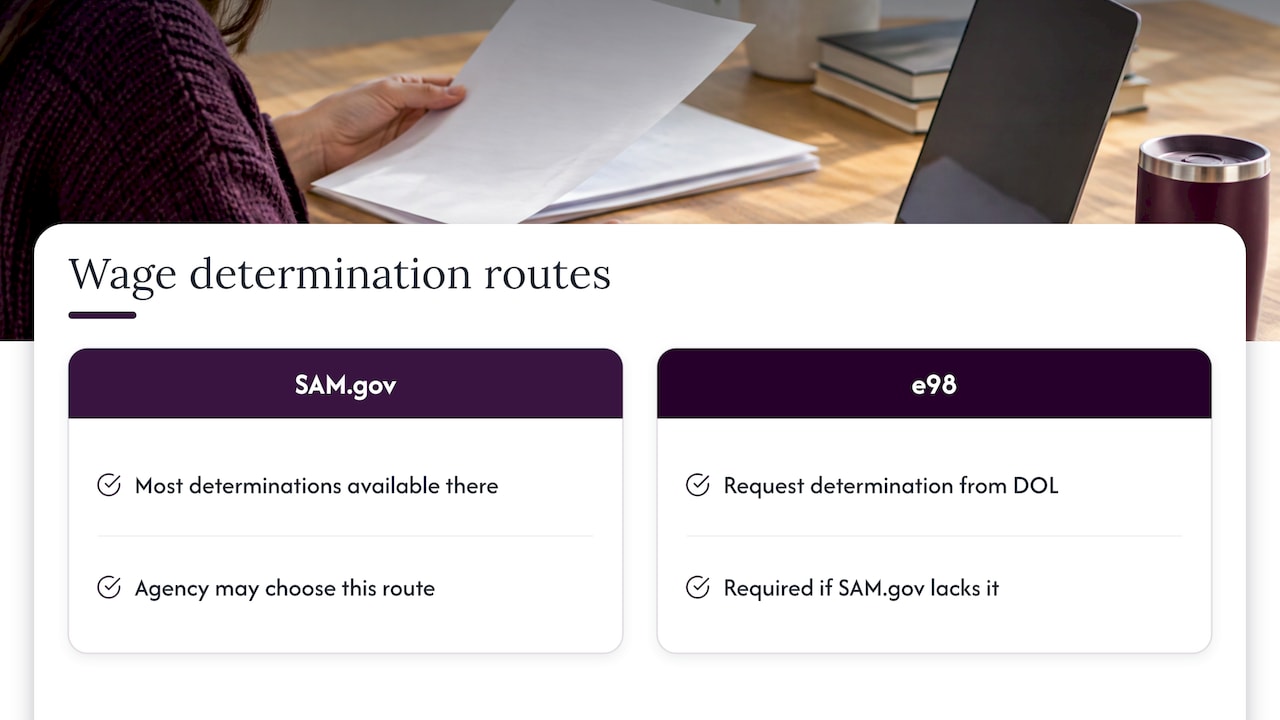
The DOL explains that agencies have two routes: the electronic “e98” process under 29 CFR 4.4(b) or the SAM.gov process under 29 CFR 4.4©, and the agency has total discretion over which to use (DOL). Under FAR 22.1008-1, contracting officers may obtain most determinations from the Wage Determinations page on SAM.gov. If the database does not hold the applicable one, they must use the e98 process to request it from DOL.
What the agency must decide first
Per the same FAR section, the contracting officer determines the classes of service employees using the Service Contract Act Directory of Occupations, the locality where the services will be performed, whether 41 U.S.C. 6707© applies, and the wage that would be paid each class if employed by the agency. That is why the place of performance on a solicitation matters so much. A county change can mean a different set of rates.
When an e98 request goes to DOL, the agency supplies the procurement dates, county and state, occupational classes, number of employees and incumbent contract information. The DOL says that in many cases an answer displays immediately, and when research is needed, DOL replies by email within three to five business days (About the SF-98 Form).
A practical search routine
- Open the solicitation on SAM.gov and look in the attachments for a wage determination number and revision.
- Note the county and state listed for the place of performance.
- Match each position in your staffing plan to a listed job title.
- Flag any role with no match, since that is a conformance issue (covered below).
- Ask the contracting officer through the Q&A process if the determination seems wrong for the location or work.
If you are still getting comfortable with the portal, our SAM.gov registration and contract search guide walks through the basics.
How do you read an SCA wage determination?
A wage determination is long, but it has a predictable layout. The DOL describes it as listing minimum monetary wages for classes of service employees, usually as hourly rates, with fringe benefit requirements stated after the rates (DOL).
The parts to check, in order
| Section | What it tells you | What to do with it |
|---|---|---|
| Header | Determination number, revision, area covered | Confirm it matches the solicitation and the county where work happens |
| Occupation list | Job titles with codes and hourly rates | Map each of your positions to a title |
| Fringe benefits | Health and welfare, vacation, holidays and related items | Budget these as separate, additional costs |
| Footnotes and notes | Special conditions that apply to certain titles | Read them before you price |
Wages and fringe benefits are two separate obligations
This is the mistake that trips up new contractors. According to DOL Fact Sheet #67B, fringe benefits must be furnished separately from and in addition to the monetary wages. You cannot pay a higher hourly wage to cover the fringe obligation. The required benefits can be met through equivalent combinations of bona fide benefits or equivalent or differential cash payments, and you must keep records that show wages and fringe benefits paid separately.
A quick worked illustration
Suppose a wage determination lists a rate for a job title and a separate hourly health and welfare amount. Your cost for one hour of that employee is the wage plus the fringe amount, before your overhead, indirect costs and profit. Pricing only the wage line understates your cost on every hour worked. Build the fringe line into your price from day one.
What if the job classification you need is missing?
It happens often, especially with newer technical or specialized roles. The process is called conformance, and it has firm timelines.
Per the SAM.gov SCA Conformances page, the awarded contractor starts the request. You prepare an SF 1444, Request for Authorization of Additional Classification and Rate, when you employ someone in the unlisted classification. You complete blocks 2 through 15. The employees or their designated representative sign block 16 to note agreement or disagreement with your proposed rate. You submit it to the contracting officer and pay your proposed rates while DOL responds.
The clock
The DOL conformance guide says the request must reach the contracting agency no later than 30 days after employment begins. The contracting officer forwards it to the Wage and Hour Division, which approves, modifies or disapproves it within 30 days of receipt, or says it needs more time.
Two planning points from DOL
- The Wage and Hour Division does not conform a classification when the position is vacant.
- If your bid is meant to estimate actual costs, develop the conformance proposal before you respond to the solicitation, and give estimates to the contracting officer only, not to the Wage and Hour Division.
We break down the steps and deadlines in Beat the 30 Day Clock: SCA Conformance Process for U.S. Contractors.
When can a wage determination change?
Most determinations are revised periodically as new health and welfare benefit or wage survey data become available, according to the DOL. A determination properly included in the contract at award generally should not be modified to include later revisions before the contract ends, unless the contract is multi-year.
Two timing triggers are worth knowing:
- Delays. The same DOL page says the agency should submit a revised e98 if the bid opening date or contract start is delayed by more than 60 days.
- Options and renewals. For multi-year contracts, new determinations typically come in when the agency exercises an option or renews, so build escalation into your out-year pricing.
Successor contracts and collective bargaining agreements
The SCA also protects wages negotiated by a predecessor. Fact Sheet #67B says contractors must pay at least the locally prevailing rates or the rates, including prospective increases, in a predecessor contractor’s collective bargaining agreement. If you are bidding on a recompete, ask the contracting officer whether a predecessor agreement exists, and request the employee list with anniversary dates. Foley & Lardner’s compliance guide recommends exactly that.
What must you pay, post and record under the SCA?
The obligations fall into four buckets.
Pay
Every service employee working on a covered contract over $2,500 must receive at least the monetary wages and fringe benefits set for their classification, or the predecessor’s CBA rates (DOL SCA FAQ). If no determination applies to the contract, employees must be paid at least the federal minimum wage under section 6(a)(1) of the Fair Labor Standards Act, per the same FAQ.
Pay must also arrive on time. Under 29 CFR 4.6(h), as cited in the Army’s SCA compliance guide, wages are due unconditionally, free and clear, no later than one pay period after the regular pay period in which they were earned.
Classify correctly
If an employee works in more than one classification, you segregate the hours and pay each at its own rate. When you cannot prove the split, the DOL’s compliance principles say you must pay the highest applicable rate for all hours that week. Time sheets that show the class of work are not optional.
Notify and post
Contract clauses require you to tell each service employee, when they start, the minimum wage and fringe benefits required, or to post the wage determination. You must also display the “Notice to Employees Working on Government Contracts” (WH Publication 1313) in a prominent, accessible place at the worksite, per the same DOL page.
Keep records
Foley & Lardner’s guide, citing the regulations, says you keep records for at least three years after the work ends. They include the employee’s name, address and Social Security number, the labor category, wage and fringe rates paid, daily and weekly hours, deductions and refunds, and the contract, modifications and wage determinations. Keep wages and fringe amounts separate in your payroll system.
How do SCA wages connect to GSA Schedule pricing?
If you plan to sell services through a GSA Schedule, your labor categories and rates become part of your contract. When your work is also subject to the SCA, the wage determination for each task order can matter to how you price and staff it. Hourly rates that ignore fringe costs, or labor categories that do not map to real job duties, create problems later.
Three habits help:
- Define labor categories around the work you actually perform, as covered in our guide to GSA labor categories.
- Build rates from a documented method, as we explain in defensible GSA labor rates using CALC+ and eMod.
- Treat fringe benefits as a real cost line, not a rounding error. Our fringe benefits in GSA pricing FAQs cover the common questions.
If you are earlier in the journey and want to see how federal buying works before you commit, our step-by-step guide to winning GSA contract sales is the place to start.
Perspective: why wage rules belong in your GSA plan from day one
We talk with service companies every week that treat wage determinations as a problem for later, after the award. That order costs money. The labor categories and rates you put on a federal price list shape what you can bid, what you can staff and how much margin is left once fringe benefits are paid.
Our approach is to settle those questions up front. We map your roles to defensible labor categories, build the price list around your real cost structure, and handle the paperwork so you are not spending evenings on forms. Our clients are typically awarded in about six months, and many reach award in about 90 days, with roughly three hours of their own time. Going it alone, we see it take two years or more.
We also stand behind the work: payment comes only after approval, and a money-back guarantee backs the engagement. If your business sells services to the government, or wants to, the schedule is where steady demand starts, and getting your pricing right is how you keep it profitable.
Josh
Want help getting a GSA Schedule for your services business?
If your company already qualifies and you want a consultant to handle the application, we offer full-service support covering eligibility, documentation, price list development, negotiation and ongoing maintenance. See our GSA Schedule contract services or review the professional services schedule. Already hold a schedule? Our maintenance plans start at $99 per month for one modification a year. Not sure where you stand? Start with a free eligibility check.
FAQ
Do SCA wage determinations apply to subcontractors?
Yes. The DOL states that prime contractors and subcontractors must pay service employees on covered contracts the rates in the applicable wage determination. If you are a subcontractor, your prime should pass the determination down to you in the subcontract.
Where do I find an SCA wage determination for a bid?
Look in the solicitation attachments on SAM.gov, where contracting officers obtain most determinations. If the database does not hold the applicable one, the agency must request it from DOL through the e98 process, so ask the contracting officer if you cannot find it.
What happens if no wage determination is in the contract?
When no determination has been made applicable, employees must be paid at least the federal minimum wage under section 6(a)(1) of the Fair Labor Standards Act, per the DOL’s SCA FAQ. Raise the question with the contracting officer before you submit a price.
How long do I have to request a missing job classification?
The conformance request must reach the contracting agency within 30 days after the employee starts work. DOL then has 30 days from receipt to approve, modify or disapprove, or to say it needs more time. Pay your proposed rates in the meantime.
Can a consultant help me with SCA pricing and a GSA Schedule?
We help with the GSA Schedule side: labor categories, price lists, negotiation and compliance upkeep. Book a free eligibility check and we will tell you whether your business is ready to apply and what the process would look like.
Sources
- SCA Wage Determinations, U.S. Department of Labor
- Fact Sheet #67: The McNamara-O’Hara Service Contract Act
- Fact Sheet #67B: Meeting Requirements for Service Contract Act
- Service Contract Act FAQ, U.S. Department of Labor
- FAR 22.1008-1 Obtaining wage determinations, Acquisition.GOV
- About the SF-98 Form, U.S. Department of Labor
- SCA Conformances, SAM.gov
- SCA Conformance Guide, U.S. Department of Labor
- SCA Compliance Principles, U.S. Department of Labor
- McNamara-O’Hara Service Contract Act Compliance Guide, U.S. Army
- Government Contracts: Service Contract Labor Standards, Foley & Lardner
Recommended
- Beat the 30 Day Clock: SCA Conformance Process for U.S. Contractors
- Wage Determination Penalties
- GSA Labor Categories: A Compliance Guide for Contractors
- Service Contract Labor Standards (SCLS), formerly Service Contract Act (SCA)