

A GSA Schedule proposal, called an “offer,” is a set of templates, financial statements, past performance proof and narrative answers uploaded to GSA’s eOffer system. Write to GSA’s solicitation exactly, use its templates unchanged, and put your best price in the first submission. Our clients typically finish with about 3 hours of their own time.
TL;DR
- Read the full solicitation first. GSA says this is the most important step before you draft anything.
- Use GSA’s own templates and upload them unaltered, with two years of financial statements and past performance proof.
- Factors 1, 3 and 4 of the technical proposal are eOffer narratives capped at 10,000 characters each.
- Price at or better than your Most Favored Customer pricing, and submit your best price up front, because GSA can award without discussions.
- Many of our clients are awarded in about 90 days, and we are paid only after approval.
Table of Contents
- What actually goes into a GSA Schedule proposal?
- Who can submit a proposal, and what should be finished first?
- How do you write the technical proposal?
- How do you present past performance?
- How do you build and support your pricing?
- How do you submit the proposal and handle GSA’s review?
- What has changed in recent GSA offer rules?
- Should you write it yourself or use a consultant?
- What do we think about GSA proposal writing?
- What does it cost to keep the contract after the proposal is approved?
- Where can you start with a free eligibility check?
- FAQ
- Sources
What actually goes into a GSA Schedule proposal?
Think of the proposal as five pieces that GSA reviews together: eligibility proof, technical narratives, past performance, pricing and administrative uploads. Each one has its own format, and the most common reason offers stall is a piece that does not follow GSA’s format.
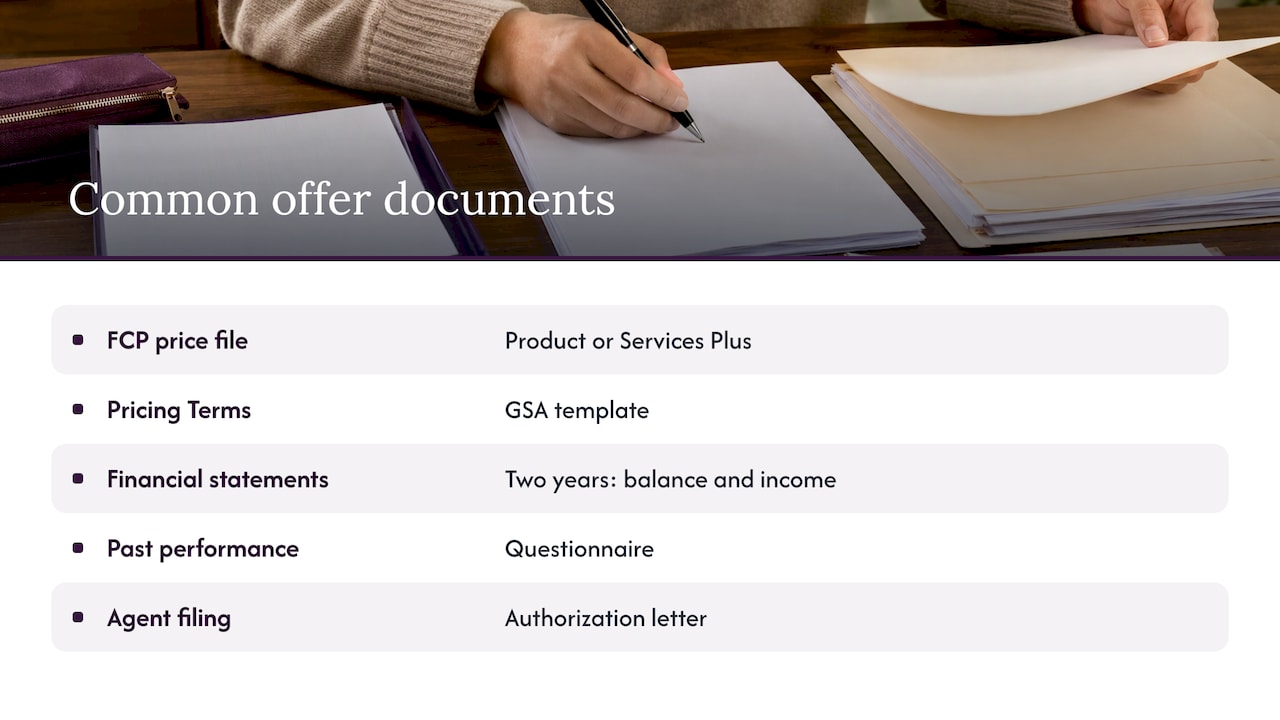
GSA’s required templates page for a MAS offer says to use GSA’s templates and upload them to the offer. That means the FCP Product or FCP Services Plus price file and the Pricing Terms file, plus extra templates for certain SINs (Special Item Numbers, the categories GSA sorts offerings into). The same page lists two years of financial statements with a balance sheet and income statement, a past performance questionnaire, and an agent authorization letter if someone files on your behalf.
An Ohio procurement assistance presentation from August 2024 also lists what offerors commonly assemble: a signed Readiness Assessment dated within one year, a Pathways to Success training certificate, a commercial price list and a professional compensation plan for service firms. See the full list in that GSA presentation. Which items apply to you depends on what you sell.
If you are new to federal work, the Schedule is a long-term contract that lets agencies buy from you without running a fresh competition each time. You find individual opportunities on SAM.gov, which replaced the retired FedBizOpps. For how the program works end to end, see our explainer on how the GSA Schedule works.
Who can submit a proposal, and what should be finished first?
You need to meet the eligibility rules and complete the prerequisites before drafting a single narrative.
GSA’s access page says a business generally needs two years in business, two years of financial statements and measurable past performance. These requirements may be waived for eligible businesses through the Startup Springboard program. It also says a business can make an offer at any time, so there is no filing window to wait for.
GSA’s Pathways to Success document (December 2021) adds the prerequisites:
- Complete the mandatory Pathways to Success training.
- Complete the Readiness Assessment self-evaluation, signed by an authorized officer of your firm.
- Register for a unique entity identifier (UEI) at SAM.gov.
The same document names the single most important preparation step: read the entire MAS solicitation and its category attachments, especially the SCP-FSS-001 Instructions to Offerors, before you start the Readiness Assessment or the proposal. Most rejected offers can be traced to a requirement that was in that text.
Two of our articles help you decide where you stand: GSA eligibility requirements explained and can a new company get a GSA Schedule. If you are under two years old, read about the Startup Springboard program.
How do you write the technical proposal?
Answer all four technical factors in the order GSA lists them, in the places GSA tells you to put them.
According to GSA’s templates page, the technical proposal must address the four factors in Section II of SCP-FSS-001. Factors 1, 3 and 4 must be eOffer narratives limited to 10,000 characters each, and uploaded documents will not be considered for those factors. That last point catches people: a polished PDF attached to the wrong place is simply not read.
A practical way to write each narrative:
- Mirror the question. Open each paragraph with the requirement it answers, so a reviewer can tick it off without hunting.
- State facts, not adjectives. Name the services you will offer, the staff roles, the quality controls and the tools you use. “Experienced and dedicated” tells a reviewer nothing.
- Stay inside the character limit. Draft in a plain text editor and count characters, including spaces, before pasting into eOffer.
- Match the SIN. If you offer several categories, make sure each narrative supports every SIN you chose.
- Do not copy across factors. Each factor asks something different, and repeated text wastes limited space.
Small businesses often under-describe what they do because the work feels routine to them. A reviewer has never seen your operation, so describe your process as if to an intelligent stranger.
How do you present past performance?
Give GSA verifiable projects that are similar in scope to what you will sell on the Schedule, with numbers and a contact who can confirm them.
The templates page recommends invoices, statements of work, SF 1449 forms or subcontract agreements as evidence for cited references and project experience. Under the June 2026 refresh of SCP-FSS-001, the route depends on whether you have CPARS reports, the government’s contractor performance assessments:
| Your situation | What the solicitation asks for |
|---|---|
| Three or more CPARS reports | Verify in eOffer that you have at least three assessment reports from contracts or orders ongoing or completed within the past three years, covering at least three distinct orders or contracts with similar work |
| No qualifying CPARS reports | Upload three relevant customer references and three completed Past Performance Questionnaires |
Most small businesses fall into the second row. Each reference needs to be someone who will answer the questionnaire quickly, so call them before you list them. A strong reference with a modest project beats an impressive project with a contact who never replies.
Use a consistent structure for every project: who the customer was, what you delivered, the dates, the dollar value and a measurable result such as a cost saving or a delivery record. Our guides explain how GSA evaluates past performance and five steps to prepare past performance documents. If your history is thin, see how to win a Schedule using two or three commercial projects.
How do you build and support your pricing?
Price at your best commercial level, in GSA’s Excel template, and expect GSA to negotiate from what you submit.
The November 2025 SCP-FSS-001 sets out the rules for offerors that are not in Transactional Data Reporting (TDR). GSA’s goal is pricing equal to or better than your Most Favored Customer (MFC) price, meaning the lowest price you give a comparable commercial customer. Prices go in the Excel Price Proposal Template, must be consistent with your commercial practices and must include the 0.75% Industrial Funding Fee, the fee GSA charges on Schedule sales. You also complete the Economic Price Adjustment Method module in eOffer, which describes how your prices may change over the contract.
A September 2026 draft of the next refresh (Refresh 33) says offerors are no longer required to submit pricing support such as invoices, quotes or contracts at the time of the offer. GSA will use existing government data first, and the contracting officer will ask for more only if needed. Because this is a draft, check the final solicitation on GSA’s site before you submit.
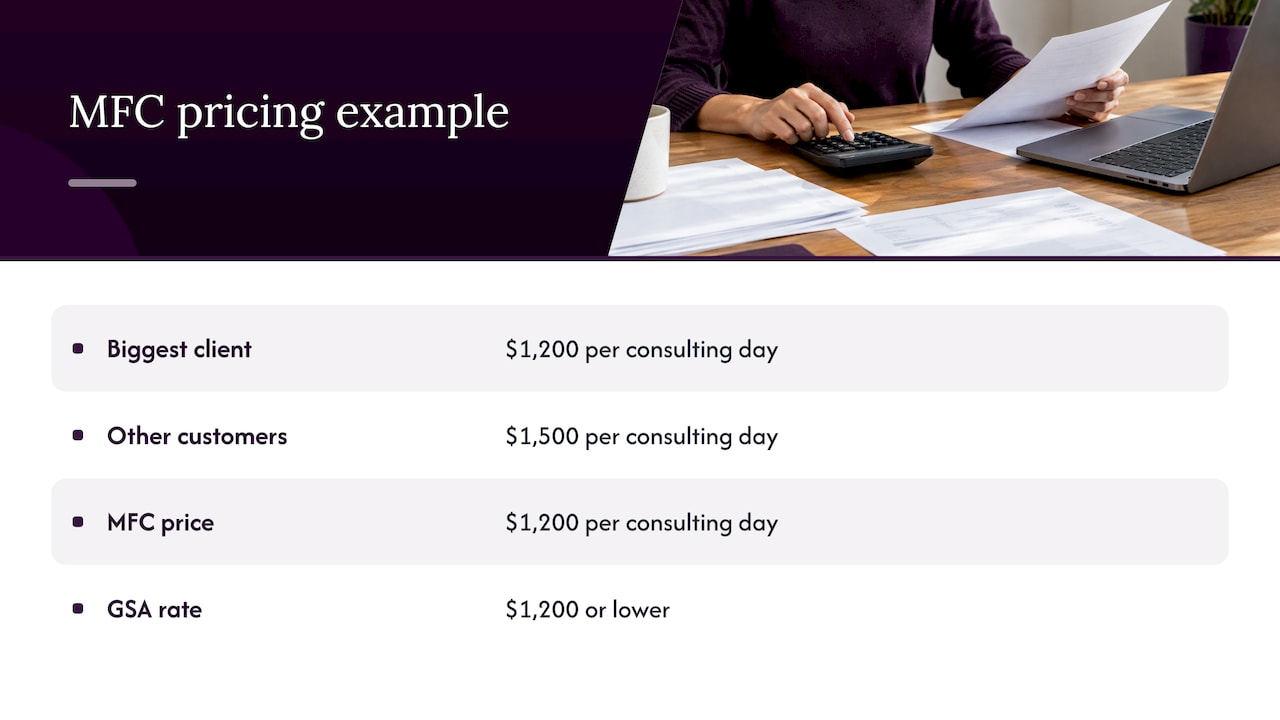
A worked example of the MFC logic: suppose you sell a consulting day at $1,200 to your biggest commercial client and $1,500 to everyone else. Your MFC price is $1,200, so GSA expects your Schedule rate to be $1,200 or lower. Offering $1,500 invites a negotiation round that costs weeks.
Two more points matter. First, the draft Refresh 33 says identical items with the same terms can be awarded under different SINs at the same price, but not at different price points. Second, joint ventures without their own MFC data complete the template using their partners’ MFC information, and mentor-protégé joint ventures must show the protégé has some experience in the type of work.
For deeper pricing logic, read our guides on GSA pricing strategy and price reasonableness versus Most Favored Customer pricing.
How do you submit the proposal and handle GSA’s review?
You submit electronically in eOffer, and you should send your final version the first time, because GSA may award or reject without discussions.
GSA’s eOffer overview says you sign in with FAS ID credentials, complete the offer sections, add supporting documents and select Submit Proposal. A GSA Contracting Official then reviews the offer and may ask for clarifications or more information. After review, the contract package is generated and signed electronically by you and the Contracting Officer. The overview frames the work as three stages: get ready with training, registrations and reading the solicitation; assemble the offer; and finalize it.
Under the November 2025 SCP-FSS-001, a few details are worth planning for:
- eOffer submission is mandatory, and access uses FAS ID Multi-Factor Authentication.
- You should have at least two Authorized Negotiators who are authorized to sign, and one must be a company employee even if you use a consultant.
- GSA considers award to a responsible offeror whose offer conforms, is technically acceptable and has fair and reasonable prices. It reserves the right to award or reject without discussions, so the first submission should carry your best price and complete technical terms.
If you are not a small business, the June 2026 refresh also requires a Small Business Subcontracting Plan under FAR 52.219-9, submitted through the Subcontracting Module in eOffer and approved by the contracting officer before award. Failing to submit it when required results in rejection.
When GSA sends questions, answer the exact question, in writing, quickly. Delays usually come from slow replies, not from the review itself.
What has changed in recent GSA offer rules?
The biggest shift is in pricing reporting. TDR moves the program from reporting commercial sales practices to reporting what was actually sold.
GSA’s TDR User Guide says that once the Participate in TDR modification takes effect, contractors report all required data elements within 30 days of the end of each month. The May 2024 SCP-FSS-001 refresh adds that TDR participants do not provide Commercial Sales Practices disclosures or monitor price reduction violations, and that opting in applies TDR terms to the whole contract, including option periods.
Solicitation text is refreshed several times a year, and a draft is not final. Always download the current SCP-FSS-001 from GSA’s site the day you start writing.
Should you write it yourself or use a consultant?
Writing it yourself works when you have a clean financial history, strong references and time to read hundreds of pages of solicitation. A consultant makes sense when time-to-award matters or an earlier attempt stalled.
The real cost of doing it alone is your own hours. GSA presentations note that getting a contract can take up to a year, based on the Ohio APEX material. The same material notes that MAS contractors must reach $100,000 in sales within the first five years and $125,000 in each five-year period after, or GSA may cancel the contract. A proposal is only the entry ticket; you also need a sales plan.
Our GSA Quick Start DIY option is built for owners who prefer self-service. For full-service work, our programs cover the readiness assessment, documentation, price list, SIN mapping and negotiation support. Our application services (Startups, Specialty and Streamline) do not have a published price, and you can see them on our application services page.
By our own account, we are paid only after approval (“no award, no fee”), we offer a money-back guarantee, and our first-application approval rate is 98%. Our clients spend about 3 hours of their own time, and many are awarded in about 90 days. We handle the paperwork so you do not spend weeks inside the solicitation.
What do we think about GSA proposal writing?
We see proposal writing as a project-management problem more than a writing problem. The words in the narratives matter, but the real work is matching your business to the right SINs, collecting clean financials, lining up references who will respond, and pricing in a way GSA can accept the first time.
Most owners want the contract for the revenue, not for the paperwork. That is why we designed our process to take the paperwork off your desk: eligibility assessment, documentation, price list development, SIN mapping and negotiation support, with about 3 hours of your time. Because we are paid only after approval, our interests are aligned with yours.
After the award, the work continues. Modifications, price list changes and sales tracking decide whether the Schedule becomes revenue. Our maintenance plans start at $99 per month for one modification a year, so you do not have to learn the modification process while running your company.
Josh
What does it cost to keep the contract after the proposal is approved?
After award, you maintain the contract through modifications such as adding services or updating prices. Our maintenance plans are billed monthly:
| Plan | Price |
|---|---|
| 1 Mod per year | $99 per month |
| 2 Mods per year | $159 per month |
| 3 Mods per year | $219 per month |
| 4 Mods per year | $279 per month |
| Custom number of mods | from $339 per month |
Our retainer is $1,500 per year. For selling after the award, our federal marketing programs are Lite at $10,700 per year, Standard at $15,700 per year and Plus at $27,700 per year, on our federal marketing page. To estimate what the contract could bring in, try our 2026 GSA sales opportunity estimator. Once you hold the contract, our guide to winning GSA contract sales shows how to turn it into orders.
Where can you start with a free eligibility check?
If you are unsure whether your business qualifies, the quickest step is to ask us. We review your years in business, financials and past performance, then tell you which route fits. Start with a free eligibility check at gsascheduleservices.com.
FAQ
Can ChatGPT write a GSA proposal?
AI tools can help you draft or tighten a narrative, but they do not know your business facts or GSA’s current solicitation. The narratives are capped at 10,000 characters, and a reviewer needs specifics about your services, staff and processes. Treat any AI draft as a starting point that you verify against the solicitation.
What is the format for a GSA proposal?
The offer is built in eOffer using GSA’s templates. You upload the price files and supporting documents, and write Factors 1, 3 and 4 as narratives of up to 10,000 characters each. Check the current SCP-FSS-001 for the latest instructions.
How long does a GSA proposal take to write?
GSA presentations say getting a contract can take up to a year. Many of our clients are awarded in about 90 days, with roughly 3 hours of their own time. Your timeline depends mostly on how fast you can gather financials and references.
Do I need past performance to submit?
GSA’s eligibility page says measurable past performance is generally required, though it may be waived for eligible businesses through Startup Springboard. If you have no CPARS reports, you upload three customer references and three completed questionnaires. A free eligibility check shows which route fits your company.
Sources
- How to access contract opportunities | GSA
- Pathways to Success | GSA
- Required templates for a MAS offer | GSA
- Getting on Schedule by GSA presentation, Ohio APEX, August 2024
- SCP-FSS-001 Instructions, June 2026
- SCP-FSS-001 Instructions, November 2025
- SCP-FSS-001 Instructions, May 2024
- Draft SCP-FSS-001 Refresh 33, September 2026
- About eOffer | GSA
- Multiple Award Schedule TDR User Guide | GSA
Recommended
- How to Avoid GSA Proposal Rejections
- 5 Key Sections in a Winning GSA Proposal
- How to Organize a GSA Technical Proposal
- How to Submit a GSA Proposal Online