

A GSA price list has a cover page, a numbered Customer Information section and net prices for every awarded item, as clause I-FSS-600 requires. Today you build the pricing in GSA’s Excel templates or its catalog platform, and you support every price with commercial documents.
TL;DR
- The published price list shows net prices (discount already deducted) and only Government-accepted items.
- The cover page carries your contract number, contract period, contractor details, business size and the schedule title.
- Pricing in the offer goes into GSA’s current Excel templates or, for contractors on the catalog platform, the Product File or Services Plus File.
- Every proposed price needs support: a commercial price list, catalog, invoices, contracts or quote sheets.
- Do not reformat a template. Visible formulas and the current version are what keep a modification from being rejected.
Table of Contents
- What is a GSA price list, and how is it different from the pricing in your offer?
- What does the GSA price list format require?
- Where do I get a GSA price list template?
- What is the FCP, and which file does my business use?
- How do I fill in the FCP Product File for the first time?
- How do I create and submit a GSA catalog price list?
- How do price list changes work after award?
- What mistakes make a price list get rejected?
- Should I build the price list myself or hand it off?
- Our view: the price list is a negotiation document
- Frequently asked questions
- Ready to find out if you qualify?
- Sources
What is a GSA price list, and how is it different from the pricing in your offer?
Two documents get confused here. The first is the pricing you submit with your offer. The second is the price list GSA publishes for ordering agencies once you hold the contract.
The offer pricing is your argument. The Multiple Award Schedule solicitation says proposed prices go into the applicable Price Proposal Templates in Excel. Each price must be tied to a published commercial price list or a commercial market price, with supporting catalogs, invoices, contracts or quote sheets for each proposed price. You also propose how prices will adjust in the future, either a fixed annual escalation rate or a market indicator such as the BLS Employment Cost Index.
The published price list is the result. Under 48 CFR 8.402, Schedule contractors must publish an Authorized Federal Supply Schedule Pricelist covering all supplies and services offered, with prices and terms for each Special Item Number (SIN, the code that groups what you sell). You must give a copy to any ordering activity that asks.
If you are new to how the program fits together, our explainer on how the GSA Schedule works covers the full path from offer to award.
What does the GSA price list format require?
The format comes from clause I-FSS-600 (December 2022). Its rules are short, and the details are where offers stall.
Net prices only. The price list must show net prices and carry the cover-page statement “Prices Shown Herein are Net (discount deducted).” It may contain only items the Government has accepted. Anything you listed in your commercial catalog but that was not awarded stays off.
A complete cover page. According to the same clause, the cover page lists:
- the schedule title
- the FSC Group/Part/Section or Standard Industrial Group
- the FSC Class(es), Product Code(s) and/or Service Codes
- your contract number and contract period
- your name, address and phone (plus toll-free and fax if you have them)
- your website
- the contract administration source
- your business size
A numbered Customer Information section. It is numbered consecutively and covers the awarded SINs, pricing, ordering terms, delivery terms and other specified details.
GSA publishes a price list template (November 2025, 508-compliant PDF) that outlines how this should look. It has a field for the five-year contract period and expects your address to match the one in SAM.gov, the federal registration system. If you amend the list, repeat the cover-page information and add a sequentially numbered “Supplement No.” with effective dates.
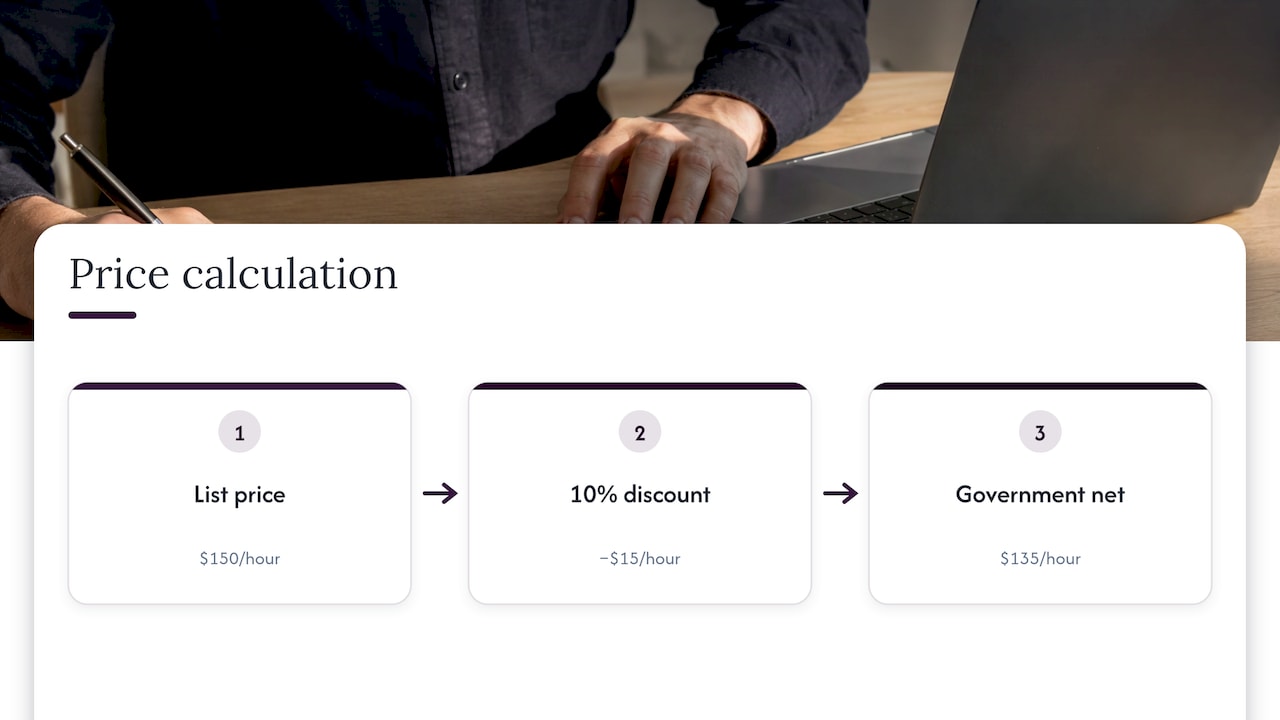
A quick sample of the logic
Suppose your commercial list price for a service is $150 per hour and you offered GSA a 10% discount. The government price is $135. That $135 is what appears on the published list, because the list shows net prices. The commercial documents in your offer must show where the $150 came from.
Where do I get a GSA price list template?
GSA’s Required templates for a MAS offer page is the source for current files. Download from there, not from an old email or a template site, because only the current version is accepted.
The page lists two main catalog files:
- FCP Product file (XLSX) for products
- FCP Services Plus file (XLSX) for labor categories, fixed-price services and similar items
It also lists SIN-specific templates, such as the one for fourth-party logistics and the ones for the 531-series real estate SINs. Which ones you need depends on the SINs you are applying for.
If you are searching for a Word or PDF “GSA price list sample,” the I-FSS-600 outline above is the closest official thing. The pricing itself lives in Excel.
What is the FCP, and which file does my business use?
GSA’s FAS Catalog Platform (FCP) is where catalog data now goes. According to GSA’s Catalog Management page, the Product File and Services Plus File capture catalog details during the modification process, satisfy the Price Proposal Template requirement in eMod (GSA’s modification system), and allow automated publishing to GSA Advantage.
The two files split like this:
| Question | Product File | Services Plus File |
|---|---|---|
| What it covers | Items with a manufacturer name, part number and country of origin | Labor categories, fixed-price services, courses and training, ODCs, language services, ancillary items, products not suited to online sale |
| What it replaces | Products PPT and the SIP/EDI-832 template | Services & Training and Language Services PPTs and text price lists |
| Typical user | Resellers and manufacturers | Professional services, training and mixed offerings |
The Services Plus File guide adds practical rules:
- It supports eight item types: Commercial Labor Category, SCLS Labor Category, Fixed Price Services and Solution, Courses and Training, Language Services, ODCs, Ancillary Item and Product.
- Prices allow four decimal places.
- Percentages are entered as decimals between 0 and 1, and discounts fall between -1 and 1.
- Pricing must run from the current contract year through the end of the awarded option period.
- The file is saved as .xlsx and limited to 1 million lines.
The guide even explains why four decimals matter: a translation priced per word can be as little as $0.0045. The system tolerates up to 0.0199 when checking price calculations and rounds anything beyond four decimals.
If you sell labor, the labor rates themselves are the harder part. Our labor rate development guide and the piece on building defensible rates go through how rates are justified.
How do I fill in the FCP Product File for the first time?
The Getting Started vendor guide (v1.2) walks first-time users through it. In short:
- Download the Latest Catalog File.
- Verify the product data already in it.
- Fill the blank fields. These include Recycled_Content_Percent (required for copy paper) and MFC_Name and MFC_Price (required if you do not participate in Transactional Data Reporting).
- Complete Govt_Price_No_Fee, required for every vendor. The guide gives a formula in cell O3 of the PRODUCTS tab that you drag down the column.
- If you price by markup, also complete Dealer_Cost, MFC_Markup_Percentage and Govt_Markup_Percentage.
- Leave TPR information alone and never modify govt_price_with_fee.
The formula in the guide reflects the contract fee that GSA deducts, 2% or 0.75% depending on the SIN, so the no-fee government price lines up with your last awarded price. Pick the wrong factor and every row is wrong, which is why this step deserves a second pair of eyes.
How do I create and submit a GSA catalog price list?
GSA’s Vendor Support Center lays out the onboarding sequence:
- Submit a Seller Profile at catalog.gsa.gov.
- Prepare the Product File or Services Plus File with all required information, paying attention to the data validation rules.
- Start a “Catalog Baseline Mod” in eMod.
- Open a Baseline Action in FCP.
- Clear every error, warning and compliance flag.
- Submit for approval. Once approved, the catalog publishes to GSA Advantage.
- Upload your terms and conditions file, without pricing for Product and Services Plus File users, to eLibrary and GSA Advantage.
For legacy EDI submissions, the 832 file is checked for syntax and content, and rejections come back as 824 transactions that must be resubmitted within 30 calendar days.
Two timing rules matter. At award, I-FSS-600 says you receive instructions for submitting electronic contract data, and files must be complete, correct, readable and virus-free, received no later than 30 days after award. Accuracy is also yours to own: incorrect information can force resubmission and can be cause for termination under clause 552.212-4, including monetary recovery.
How do price list changes work after award?
Your list is not frozen. Prices change, items are added and options renew, and each change goes through a modification.
GSA’s MAS Modification Guide (November 2025) is blunt about the Price Proposal Template in this situation:
- It is not part of eMod, so it goes in as a separate attachment.
- Only the current version is accepted.
- You must not reformat it.
- Formulas must be visible, or the contracting officer can reject the modification.
- Contractors operating in FCP do not need the PPT, because the Product File and Services Plus File serve that role.
The data requirement is also ongoing. The current version of clause 552.238-77 (Pricing and Catalog Data, Refresh 34 deviation) requires pricing and catalog data to be submitted through the platforms GSA designates, and kept current, accurate and complete. GSA’s own Refresh 34 summary says the clause is retained in the planned GSAR overhaul. Refresh dates and clause wording move, so check GSA’s Interact page for the current refresh before you submit.
For practical routines, see our posts on updating GSA schedule prices, product catalog updates and catalog management tips.
What mistakes make a price list get rejected?
Most problems come from a handful of habits:
- Reformatting the template. Merged cells, hidden formulas or a rebuilt layout trigger rejection.
- Using an old file. Templates are updated, and only the current one is accepted.
- Prices with no paper behind them. Each proposed price needs a catalog, invoice, contract or quote sheet that shows the commercial basis.
- Listing gross instead of net. The published list is net of the discount.
- A cover page that does not match SAM.gov. The template expects the contractor address to match your registration.
- No escalation mechanism. The solicitation asks for a proposed way to adjust prices, either a fixed annual rate or an index.
- Wrong fee factor. The 2% versus 0.75% difference changes every no-fee price.
- Treating the price list as a one-time task. The data must stay current, accurate and complete.
Should I build the price list myself or hand it off?
If you already qualify for a Schedule, the price list is the step where a good business can lose months. The template rules are exacting, and the pricing has to be both competitive and defensible against your commercial documents.
Our clients are typically awarded in about six months while spending about three hours of their own time. Going alone commonly takes two years or more. Our service covers price list development, SIN mapping, documentation preparation and negotiation support, and our model is “no award, no fee,” paid only after approval. For the full-service route, start with our GSA Schedule consulting or the Startups, Specialty and Streamline proposals.
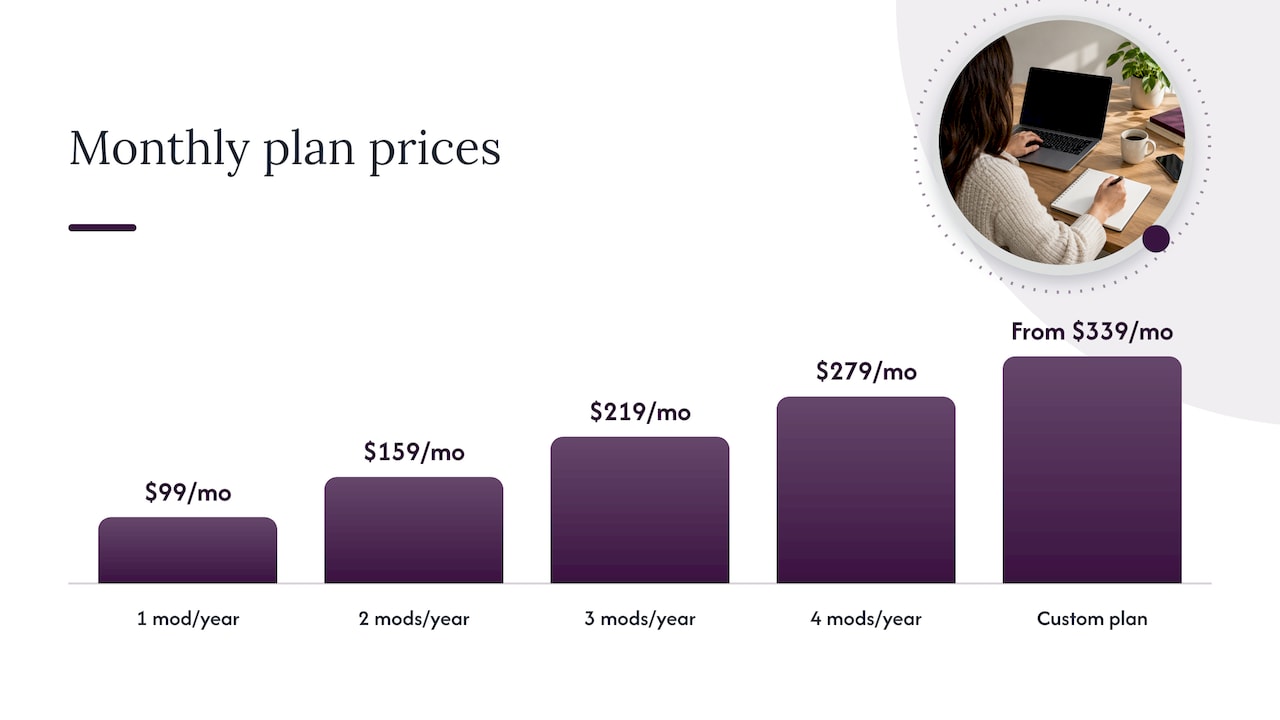
If you prefer to build it yourself, the GSA DIY Quick Start is our self-service option. Once you hold a contract, price list changes (simple, basic or advanced) are handled on the price list change page, and the maintenance plans start at $99 per month for one modification a year. Further tiers cover two, three or four mods a year at $159, $219 and $279 per month, and custom plans start from $339 per month.
For a wider view of the small business path, read our guide to getting, maintaining and selling on a Schedule and the price list resources for small businesses.
Our view: the price list is a negotiation document
Most businesses treat the price list as a form to complete. We treat it as the document that decides what you can charge a federal buyer for the next five years.
The format rules are fixed, and GSA publishes them. What is not fixed is how you present your commercial pricing, which discounts you offer, and how you set your escalation. Those choices are where a Schedule becomes profitable or stays a certificate on the wall.
That is why our work starts with an eligibility assessment and price list development, then moves to SIN mapping and negotiation support. Our approach is designed to keep your time commitment to about three hours, and we aim for award without a second round of questions. We back it with a money-back guarantee and no fee until you are awarded.
Once the contract is live, the same discipline carries over to modifications. A clean, current price list is easier to change, and cheaper to keep compliant.
Josh
Frequently asked questions
Is there a single official GSA price list format in Word?
The official outline is GSA’s I-FSS-600 template, a PDF that shows how the published list should look. Your offer pricing goes into Excel templates or the FCP Product and Services Plus Files, which GSA publishes on its required templates page.
Do I need a GSA price list before I apply?
You need a price proposal, built in GSA’s templates and tied to a published commercial price list or commercial market price. The final Authorized Federal Supply Schedule Pricelist, with net prices, is published after the Government accepts your items.
Can I change prices after award?
Yes, through a modification in eMod. Contractors using FCP update the Product File or Services Plus File, and others upload the current PPT as a separate attachment without reformatting it. Our maintenance plans cover price list changes.
What is the difference between a catalog price list and the contract price list?
The catalog is the item-level data that publishes to GSA Advantage through FCP. The price list is the document ordering agencies can request, with a cover page, customer information and net prices. Both must agree with your awarded pricing.
Ready to find out if you qualify?
If you want a price list built to GSA’s format the first time, start with a free eligibility check.
Sources
- Solicitation Document 47QSMD20R0001 (Refresh 0028)
- 48 CFR 8.402, General
- I-FSS-600 Contract Price Lists (Dec 2022)
- Federal Supply Schedule Price List template (November 2025)
- Required templates for a MAS offer
- Catalog Management, Vendor Support Center
- Managing a Services Catalog in FCP Vendor User Guide v1.2
- Getting Started in FCP Vendor User Guide v1.2
- Vendor Support Center onboarding
- MAS Modification Guide (November 2025)
- GSAR 552.238-77 Pricing and Catalog Data
- Significant Changes for MAS Refresh 34
Recommended
- GSA Pricing: Cost Analysis Basics
- Top Strategies for GSA Price List Success
- Top 7 GSA Price List Best Practices
- How GSA Pricing Works: A Guide for Vendors