

GSA price analysis is the contracting officer’s review of whether your proposed Schedule prices are fair and reasonable. The officer compares your prices to government data, market research and what you charge commercial customers, then negotiates. You prepare by documenting how each price relates to your commercial pricing and explaining any gap in a short narrative.
TL;DR
- Price analysis compares your proposed prices with other prices. Cost analysis examines your actual costs. Most Schedule offers are judged by price analysis.
- GSA’s stated goal is to get prices equal to or better than your Most Favored Customer pricing under similar terms. If yours are not, explain why.
- Your pricing narrative should tie every price to evidence and explain every discount gap in plain terms.
- Recent GSA instructions say it will use existing government data first and limit requests for more to what it needs.
- Weak pricing support is a common reason offers stall. A consultant who builds the price list and narrative with you can shorten the path.
Table of Contents
- What does price analysis mean for a Schedule offer, and how is it different from cost analysis?
- How does GSA decide your prices are fair and reasonable?
- What should a GSA pricing narrative include?
- What pricing evidence do you actually need to submit?
- Where do price analyses go wrong?
- How do you search GSA rates before you set prices?
- What changed in Schedule pricing rules recently?
- Why use a consultant for your pricing analysis?
- How does our service handle pricing for you?
- FAQ
- Sources
What does price analysis mean for a Schedule offer, and how is it different from cost analysis?
Price analysis asks one question: is this price reasonable when set beside other prices? Cost analysis asks a different one: what does it cost you to deliver, and is the profit fair? The FAR 15.404-1 rules on proposal analysis define both and describe the techniques officers use.
For most Schedule offers you will live in price analysis. You are offering commercial products or services, and the officer wants to see how your Schedule prices stack up against what you charge others and what the government already pays for similar work. You do not usually open your books.
That does not make your own costs irrelevant. Before you propose a discount, you need to know the margin you can afford to give up. A cost to serve analysis shows which customers and services earn their keep, which tells you how deep a Schedule discount can go before the contract stops paying. For a deeper look at the cost side, see our guide to GSA pricing and cost analysis basics.
How does GSA decide your prices are fair and reasonable?
GSA’s acquisition manual sets an order of preference. When the commercial sales practices format is not part of the offer, contracting officers use the FAR 15.404 techniques in this sequence:
- Readily available prices-paid, contract-level and commercial data.
- Market research.
- Data you provide, other than certified cost or pricing data.
The practical meaning: the officer starts with what GSA already knows. Your own paperwork comes in to fill gaps, not to carry the whole case.
The FAR 15.404-1 techniques include comparing competing proposed prices, historical prices paid, published price lists and indexes, independent government estimates and market research. In a Schedule negotiation, a GAO review found contract specialists compare your prices to other vendors’ prices, your commercial customer prices and competitors’ price lists, discounts and rebates.
GSA’s own instructions to offerors state the target. Under the December 2019 SCP-FSS-001 instructions, the goal is pricing equal to or better than your Most Favored Customer (MFC) pricing under the same or similar terms. MFC pricing is the best price or discount you give any customer. Offers with MFC pricing that is not highly competitive will not be found fair and reasonable. If you want the full background, read what Most Favored Customer pricing means.
The same GAO report notes that regulations allow an award above the MFC price when the award serves the government’s interest and the price is still fair and reasonable. That is where a clear explanation earns its keep.
Who decides once you hold the contract?
Once your Schedule is awarded, ordering agencies do not repeat the full exercise. FAR 8.402(d) says GSA has already determined Schedule prices fair and reasonable for supplies, fixed-price services and hourly rates. Buyers still may ask for additional discounts before placing an order. So the real hurdle is the negotiation with GSA, and the discount you win there works for you on every later order.
What should a GSA pricing narrative include?
A pricing narrative is the written explanation that sits behind your price proposal. It turns a spreadsheet into an argument. The officer reading it has dozens of offers and little patience for guesswork.
A good narrative covers five things:
- The basis of each price. Say whether it rests on a Commercial Price List or a Commercial Market Price, the two bases named in the December 2019 instructions, which cite the FAR 2.101 definitions.
- Your MFC position. State who your best customer is, what they pay, and how your Schedule price compares.
- The reason for any gap. If Schedule pricing is not equal to or better than MFC, the same instructions call for a rationale. Volume, delivery terms, warranty, or a different scope are the usual explanations.
- Same or similar comparisons. Match labor categories, experience levels and terms to what you compare against.
- Your pricing terms. Discounts, payment terms and any price adjustment approach.
The commercial sales practices (CSP) disclosure is the formal link to your marketplace behavior. GSA’s inspector general describes it as the document that lets the officer set market-based pricing, and found that without current, accurate and complete disclosures that ability is significantly impaired. Treat the CSP and the narrative as one story told twice. If they disagree, expect questions.
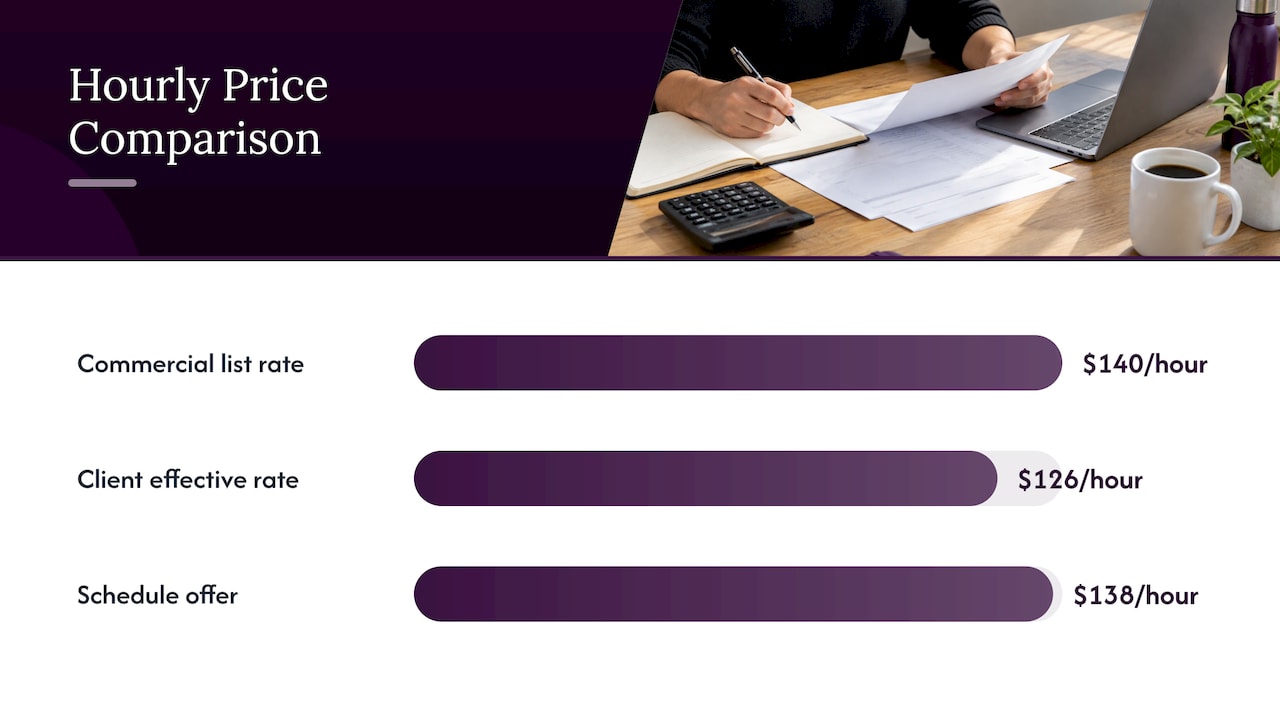
A short worked example. Say you sell IT support at $140 an hour to your largest commercial client, with a 10% volume discount. You propose $138 on the Schedule. The narrative should state the $140 list rate, the client’s effective $126 rate, why that client gets it (a multi-year, high-volume agreement), and why a single-task-order Schedule buyer does not carry the same commitment. Without that last piece, the officer sees a $12 gap and asks for it to be closed.
What pricing evidence do you actually need to submit?
This is where timing matters, because the rules have shifted.
The December 2019 instructions asked offerors to use the Excel Price Proposal Template and attach supporting documents such as catalogs, invoices, contracts and quote sheets, each with a clear relationship to the price. Offerors in Transactional Data Reporting (TDR), where you report sales data to GSA, were exempt from those documentation and rationale requirements.
The June 2026 refresh of the same instructions changed the posture. Offerors are not required to submit supporting data such as invoices, quotes or contracts when they submit the offer. Under GSA Class Deviation RFO-2025-15, GSA says it will maximize use of existing government data and other sources before asking for more, and any request will be limited to what is needed to judge whether prices are fair and reasonable. Pricing goes in through eOffer using separate templates for products, services and specific SINs, plus a pricing terms template. Identical items with the same terms can be on different SINs only if priced the same.
Two lessons follow:
- Do not skip the evidence. Even if you do not upload it, you may be asked for it, and gathering invoices under a deadline is how errors creep in. Keep a folder for each price, ready to send.
- Check the current instructions on the offer you are submitting. Solicitation refreshes change requirements, and the version in force at submission is the one that counts.
Where do price analyses go wrong?
GSA’s inspector general has repeatedly audited how price analysis is done. The findings show what officers look for, and what weakens a file.
| Common gap | What the audits found |
|---|---|
| Incomplete CSP disclosures | Disclosures lacked enough commercial sales information to support fair and reasonable pricing |
| Unsupported MFC claims | A 2024 audit found personnel frequently accepted unsubstantiated most-favored-customer and commercial pricing information |
| Not same or similar | CALC comparisons were often invalid, for example an Analyst compared with an Economist III, or a 4 to 45 year experience range against a 6-year requirement |
| Leaning on tools | A 2019 audit found officers on 17 of 30 contracts relied mainly on pricing tools rather than evaluating the contractor’s best commercial pricing |
| Thin documentation | Where the analysis was not sufficiently detailed or documented, files could not verify the determination |
What this means for you: an officer is under pressure to justify a price with a record. Give them clean comparisons and a clear MFC statement, and you make that job easy. Hand them a vague spreadsheet and the negotiation turns into a series of requests for more information.
Also note a limit of the data. A 2023 audit found that of more than $14.6 billion in FY 2022 sales with transactional data, $12.6 billion, or 87 percent, could not be used for meaningful price analysis. In practice, that makes your own documented commercial pricing the stronger part of your case.
How do you search GSA rates before you set prices?
GSA publishes pricing research tools on buy.gsa.gov, including CALC+ for awarded labor rates. They are worth using to see where your rates sit among awarded ceiling rates for similar roles.
Use them for context, not as your argument. The audit history above shows that tool comparisons only count when they meet the same or similar standard. A search for a title that sounds alike is not a comparison. Match the role, the years of experience and the education, and note the ceiling rates are not-to-exceed figures, not what every buyer pays.
For a starting point on how rates are built, our guides on GSA pricing strategy, what fair and reasonable means and negotiating GSA prices walk through the decisions in order.
What changed in Schedule pricing rules recently?
One change affects pricing after award. GSA’s Change Order 187, effective September 4, 2024, merged four Schedule economic price adjustment (EPA) clauses into one, GSAR 552.238-120, and removed procedural limits to match commercial practice. The stated aims include more offerings and lower administrative cost, especially for small businesses and new entrants.
The Federal Register notice of August 5, 2024 explains that an EPA method is an agreed procedure for adjusting prices through the contract period. It allows increases and decreases on specified conditions, such as market index changes. Adjustments based on statute, regulation or Executive Order, change clauses, and price reductions under 552.238-81 sit outside it.
Why it matters for your offer: you can propose how your prices will move over a multi-year term, rather than locking a figure that inflation erodes. Build that into your pricing terms from the start.
Why use a consultant for your pricing analysis?
Price analysis is where many first-time offerors lose months. The offer may be eligible and the paperwork complete, yet the pricing support invites rounds of questions. A consultant who has built price lists and narratives before knows which comparisons hold up and which draw challenge.
Our view on pricing
Most offerors treat the price list as a form to fill in. We treat it as the argument for the whole offer. When we prepare a price list, we start from the offeror’s commercial pricing, map it to the right SINs, and write the narrative so each price has a reason attached.
The reason this matters is simple. Our clients are typically awarded in about six months, and they spend about 3 hours of their own time on the process. Offerors who go it alone often spend two years or more, and a large share of that is the back and forth over pricing.
We built our service around that gap. Our model is no award, no fee: payment comes after approval. Our own figures put first-application approval at 98%, with a money-back guarantee behind the work.
If you have documented commercial pricing and the business to support federal sales, the pricing is the part we would rather carry for you.
Josh
How does our service handle pricing for you?
Our work covers the pieces that make an offer defensible: eligibility assessment, price list development, NAICS and SIN code mapping, documentation, compliance guidance and negotiation support. We prepare the paperwork so you do not have to learn each template.
After award, pricing keeps moving. We offer maintenance plans for contract modifications, starting at $99 per month for one modification a year, with higher tiers for more modifications. A retainer is $1,500 per year. Price list changes, from simple to advanced, are handled under our maintenance proposals. For the full application, see our turnkey GSA Schedule services.
If you want to see whether your business is ready, start with a free eligibility check at Gsascheduleservices. We will tell you whether your commercial pricing supports an offer and what the timeline looks like.
FAQ
What is the difference between a cost analysis and a price analysis?
Price analysis compares your proposed price with other prices, such as past government purchases, competitors’ lists and your own commercial rates. Cost analysis reviews the elements of your cost and profit. Schedule offers are mostly judged by price analysis, because they are built on commercial pricing.
Where can I find GSA pricing tools and guidance?
GSA’s pricing research tools, including CALC+, are on buy.gsa.gov/pricing. The acquisition manual’s Subpart 538.2 and the offeror instructions in SCP-FSS-001 describe how pricing is evaluated. Check the version attached to your solicitation, because instructions are refreshed.
Do I have to send invoices and contracts with my price proposal?
GSA’s June 2026 instructions say offerors need not submit supporting data such as invoices, quotes or contracts at the time of offer. GSA may still request limited data if needed to judge fairness. Keep the evidence organized so you can respond quickly.
How long does GSA price negotiation take?
It depends on how complete your pricing support is and how many questions the officer raises. Offerors working alone often take two years or more from start to award. Our clients are typically awarded in about six months, with about 3 hours of their own time. A free eligibility check will tell you where your offer stands.
Sources
- FAR 15.404-1, Proposal analysis techniques
- GSAM Subpart 538.2, Establishing and Administering Federal Supply Schedules
- FAR Subpart 8.4, Federal Supply Schedules
- GAO-05-229, Contract Management: Opportunities to Improve Pricing of GSA Multiple Award Schedules
- SCP-FSS-001 Instructions, December 2019
- SCP-FSS-001 Instructions, June 2026
- GSA OIG audit A120050-6, Commercial Sales Practices disclosures
- GSA OIG audit A120124, Schedule 84 pricing
- GSA OIG audit A180068, Use of pricing tools
- GSA OIG audit A230040, Price analyses
- GSA OIG audit A210081, Transactional Data Reporting pilot
- GSAM Change Order 187
- Federal Register, August 5, 2024, GSAR 552.238-120
Recommended
- GSA Schedule Pricing Calculator
- GSA Pricing: Cost Analysis Basics
- How to Analyze GSA Competitor Pricing
- Understanding GSA Contract Pricing Strategies