

Government contract factoring means selling your unpaid government invoices to a finance company for an immediate advance, typically most of the invoice value, then receiving the balance minus fees when the agency pays. On federal work, the sale must follow the Assignment of Claims Act, including written notice to the government.
TL;DR
- Factoring gives you cash within days of invoicing instead of waiting for the agency’s payment cycle, but it costs more than most bank credit.
- Federal invoices can only be assigned under strict rules: a contract of at least $1,000, no prohibition on assignment, one assignee, and written notice to the government.
- Published fee ranges vary widely, so compare the effective annual cost, not just the headline rate.
- Cheaper options exist before you invoice, including asset-based lending and a stronger contract vehicle that brings steadier, better-priced work.
- If you qualify for a GSA Schedule, we can check your eligibility for free.
Table of Contents
- What is government contract factoring?
- How does a contractor factor a government invoice, from submission to payment?
- What rules apply when you assign a federal invoice?
- Who qualifies, and what do funders review?
- How much does factoring government invoices cost?
- What are the benefits, drawbacks, and risks?
- What alternatives exist before or after you invoice?
- Is there a better answer than financing every invoice?
- Our perspective: fix the pipeline, then finance the gap
- How do you keep a Schedule contract running smoothly after award?
- Should you apply for a GSA Schedule or just finance invoices?
- FAQ
- Check whether you qualify for a GSA Schedule
- Sources
What is government contract factoring?
You deliver goods or services under a government contract and send an invoice. The agency pays on its own timetable. Under the federal prompt payment clause, the standard due date is the 30th day after the billing office receives a proper invoice. A factor shortens that wait. It buys the invoice, advances you cash, collects from the government, and pays you the remainder after taking its fee.
The agency is a strong payer, so factors like government receivables. The catch is paperwork. A federal invoice is not an ordinary commercial receivable, and a proper sale depends on rules written into statute and the Federal Acquisition Regulation.
Two terms get mixed up:
- Factoring is a sale of invoices you have already issued.
- Purchase order funding pays your supplier before you can deliver, so it is a different product for a different stage.
This article covers the first, and points you to alternatives for the second.
How does a contractor factor a government invoice, from submission to payment?
The sequence is similar from one funder to the next, though each agreement sets its own terms.
- Win and read the contract. Confirm the award states payments of at least $1,000 and does not forbid assignment. Check whether the Assignment of Claims clause is included.
- Apply with a funder. Expect to provide the contract, your invoices, and company documents. The funder will look at the agency, the contract terms, and your delivery record.
- Deliver and invoice correctly. For commercial products and services under FAR 52.212-4, the clause calls for an original invoice and three copies, or an authorized electronic invoice. A defective invoice delays payment, and a delayed invoice delays your advance.
- Send the notice of assignment. The government has to be told in writing, as covered in the next section.
- Receive the advance. The funder pays a percentage of the invoice, often within days.
- The agency pays the funder. Payment goes to the assignee, not to you.
- Receive the rebate. The funder releases the remaining balance minus its fees.
If you sell to several agencies, step 4 repeats for every contract. That is why factors who work in this niche ask for contract-level detail rather than just an aging report.
What rules apply when you assign a federal invoice?
This is where federal factoring differs from commercial factoring. The rules sit in 41 U.S.C. § 6305 and FAR Subpart 32.8, and they are enforced strictly.
The main requirements:
- Minimum value. The contract must specify aggregate payments of at least $1,000.
- Eligible assignee. Under FAR 32.8, the assignee is a bank, trust company, or other financing institution.
- No prohibition. The contract must not bar assignment.
- All unpaid amounts, one party. Under FAR 32.802, the assignment generally covers all amounts still payable and goes to one party, with a stated exception for financing arrangements. The assignee cannot reassign it further.
- Written notice. Notice goes to the contracting officer, the surety if there is one, and the disbursing officer.
The notice matters for your funder’s protection. A GAO decision explains that after a valid notice is filed, an erroneous payment to the contractor is made at the government’s peril, so the government stays liable to the assignee. The same decision stresses that the Act’s requirements are strictly construed to prevent multiple claims on government funds.
Three practical consequences follow:
- You cannot factor one invoice with one funder and another invoice under the same contract with someone else, except in the financing scenario FAR describes.
- Contracts that restrict assignment may not be fundable at all.
- State and local government invoices follow different rules, so a funder’s federal process does not automatically apply to them.
A small business owner should have the contract language reviewed by counsel or the funder before signing an agreement, because a mistake in assignment is hard to undo.
Who qualifies, and what do funders review?
Funders care less about your credit history than about whether the invoice will actually be paid. Typical items under review:
- Proof the government accepted the goods or services
- Whether the invoice matches the contract line items
- Payment status and any prior assignments
- Existing liens on your receivables
- Possible deductions or offsets the agency could apply
- Who is legally entitled to be paid
One financing firm puts it plainly: submitting an invoice alone may not establish eligibility. The funder has to establish what amount is payable, to whom, and when, rather than rely only on an aging report.
If you are a subcontractor, expect more scrutiny. Your customer is a prime contractor, not the government, so the federal assignment rules may not apply the same way and the prime’s payment behavior becomes the risk.
What documents should you have ready?
Gather these before you call a funder:
- The awarded contract or task order with all modifications
- Copies of invoices and proof of delivery or acceptance
- Your SAM.gov registration, since you cannot receive federal awards without an active one
- A list of existing loans, liens, and lenders
- Recent financial statements
Having these ready shortens onboarding and shows the funder you run a clean operation.
How much does factoring government invoices cost?
Published numbers come from the funders themselves, not from a regulator, so treat them as ranges and ask for a written fee schedule. One funder cited in an industry roundup says advances can reach 90%, with an initial fee of 0.90% to 3.50% and incremental fees of 0.25% to 1.50% per additional charge. The same source cites a lending marketplace estimating discounts on federal receivables at 1% to 3%.
Those sound small, but fees accrue by period. The same roundup notes that once annualized, factoring can cost roughly 12% to 42% a year, depending on how long the agency takes to pay and how the fees stack.
Here is a worked example with made-up round numbers, to show how to compare offers:
| Item | Example |
|---|---|
| Invoice | $100,000 |
| Advance rate | 90% = $90,000 |
| Reserve held back | $10,000 |
| Fee if paid in 30 days | 2% = $2,000 |
| Fee if paid in 60 days | 4% = $4,000 |
| Your rebate at 30 days | $8,000 |
| Your rebate at 60 days | $6,000 |
This is an illustration, not a quote. The lesson is that slower payment costs you more, so a clean invoice, filed correctly the first time, is worth real money.
What should you ask before signing?
Several terms decide your true cost:
- Is the deal recourse or nonrecourse? The word “factoring” alone does not settle it, and recourse, collection, disputes, repurchase, and fee accrual must be read in the agreement.
- Are there minimum volumes, monthly minimums, or early termination fees?
- Can you choose which invoices to factor, or must you factor everything?
- What are the due diligence, wire, and notice-filing fees?
- Who handles disputes with the agency?
Estimate your margin before you accept any fee. Our Government Contract Profit Calculator helps you see whether a contract still pays after financing costs.
What are the benefits, drawbacks, and risks?
Benefits
- Cash arrives in days, which helps with payroll, suppliers, and the next delivery.
- Funding scales with sales, so you are not limited to a fixed credit line.
- Approval depends on the government’s payment record more than on your own credit.
Drawbacks
- It is often the most expensive form of working capital once annualized.
- You hand a third party a view into your customer relationship.
- Contract restrictions can make some invoices unfundable.
Risks
- A payment dispute, offset, or setoff can reduce what the funder collects, and under a recourse deal you may owe it back.
- Mistakes in the notice of assignment can create legal trouble for you and the funder.
- Funding a low-margin contract can leave you working for the funder.
Factoring suits a contractor with healthy margins, a real cash gap, and no cheaper source of capital. It is a poor fit as a permanent patch for a contract that does not pay.
What alternatives exist before or after you invoice?
Factoring is one of several tools. Match the tool to the stage of the work:
- Asset-based lending. A line secured by receivables and other assets. The SBA notes that eligible assets must be high-value and readily convertible to cash, and that assessment and origination costs run higher than traditional financing.
- Bank lines of credit and term loans. Cheaper, but slower to arrange and tougher to qualify for with a new company.
- SBA-backed products. Lenders offer government-guaranteed loans for working capital, with timing set by the lender and your documents.
- Faster payment on your side. Submit a proper invoice the first time. A defective invoice can be returned within days and the 30-day clock restarts when you resubmit.
- Better contract terms. Pricing and payment terms negotiated up front reduce how much financing you need at all.
A useful rule: financing the gap costs money every time you invoice. Improving the deal itself pays you every time.
Is there a better answer than financing every invoice?
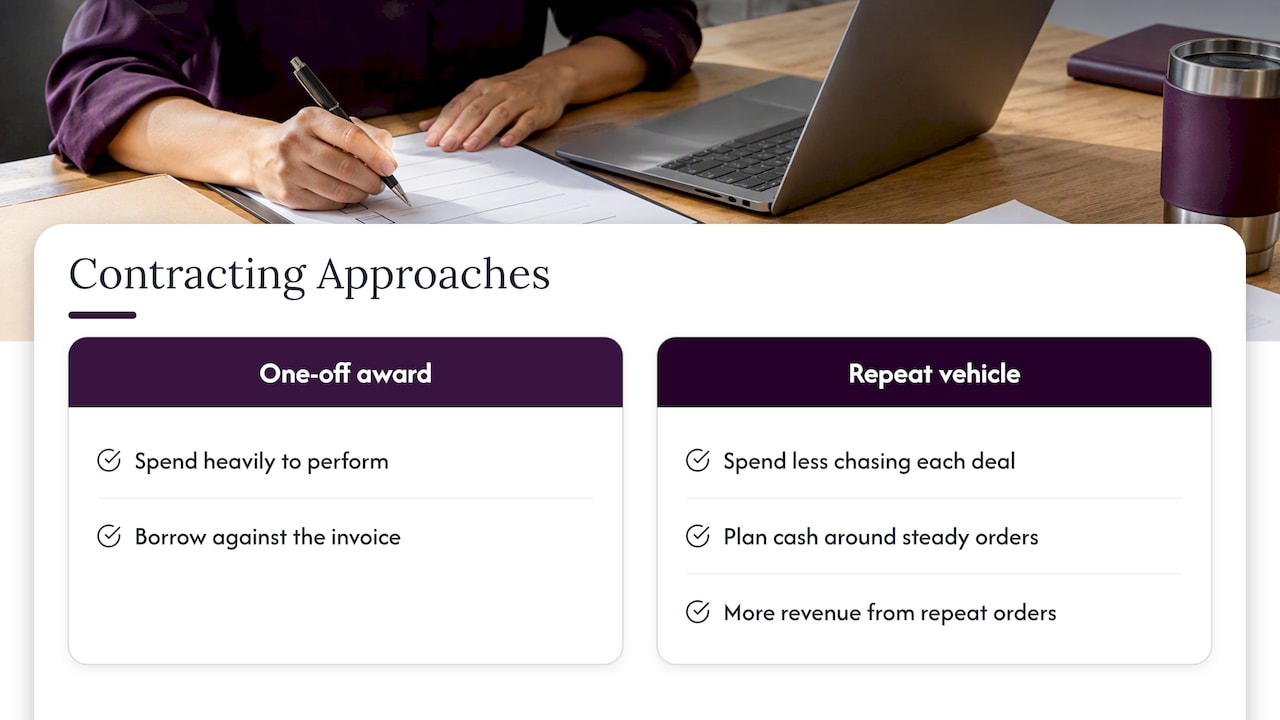
For many small businesses, the cash squeeze is a symptom. You win a one-off award, spend heavily to perform, and then borrow against the invoice. Repeat work on a pre-negotiated vehicle changes that math, because you spend less chasing each deal and can plan your cash around steady orders.
That is the idea behind a GSA Schedule. It does not replace working capital, and it does not speed up the government’s payment clock. What it does is put your pricing in front of buyers who can order from you directly, so more of your revenue comes from repeat orders. If you want to size that opportunity, try our Government Contract Revenue Calculator or look at the Federal Contract Opportunity Finder. If a term in your contract confuses you, our Federal Contract Terms Glossary explains it in plain English.
New to federal buying? Start by searching active solicitations on SAM.gov, which replaced the retired FedBizOpps. Then think about which contract vehicle fits the work you do.
Our perspective: fix the pipeline, then finance the gap
We talk with business owners every week who ask about factoring because cash is tight after a federal award. We understand why. Waiting on a government payment while payroll is due is stressful.
But the pattern we see is that financing helps most when the underlying contract is healthy. If your prices were set too low, if you win only single awards, or if you reinvent your bid every time, a factor will not fix the problem. It will add cost to it.
What changes the picture is a repeatable route to government buyers. That is why we focus on GSA Schedule acquisition and maintenance. Our clients are typically awarded in about six months while spending about three hours of their own time. Most owners who try it alone report taking two years or more. We charge for the application only after approval: no award, no fee.
Once you hold a Schedule, the work does not stop. Price list changes, modifications, and compliance keep your contract in good standing, and a lapse there can cost you orders. We keep that work off your plate so you can concentrate on delivery and cash flow.
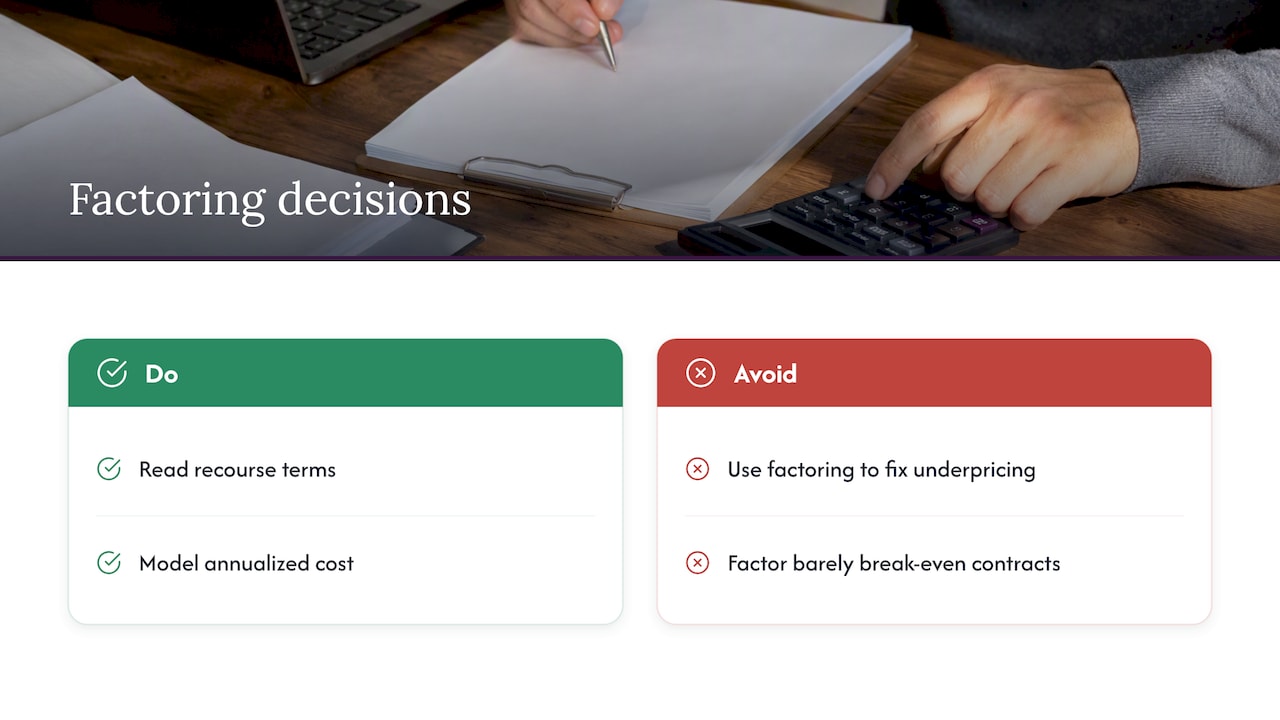
If you must finance invoices in the meantime, do it with clear eyes: read the recourse terms, model the annualized cost, and do not factor contracts that barely break even.
— Josh
How do you keep a Schedule contract running smoothly after award?
Holders of a Schedule need to manage modifications such as adding products, changing prices, or updating terms. Our maintenance plans start at $99 per month for one modification a year, with higher tiers for more changes. Single price list changes can be quoted through our maintenance proposal page.
Should you apply for a GSA Schedule or just finance invoices?
If you already qualify, the application is the higher-leverage move. Consider:
| Question | Factoring | GSA Schedule |
|---|---|---|
| What does it solve? | Slow payment on invoices you already issued | Access to repeat federal buyers and pre-negotiated terms |
| When does it help? | After delivery | Before you bid and while you sell |
| Cost pattern | Fees on every funded invoice | One-time application work plus upkeep |
| Effect on margins | Reduces them | Can improve them through negotiated pricing |
They are not mutually exclusive. Some contractors use both. But if you have to pick where to put your next dollar and your next hour, a path to steadier orders is the sounder bet. Our Startups, Specialty, and Streamline options describe the full-service route, and the GSA DIY Quick Start is there for owners who prefer to do it themselves.
For pricing strategy, read our piece on competitive pricing in federal contracts.
FAQ
Can any government contractor factor invoices?
Not automatically. The contract must be worth at least $1,000, must not prohibit assignment, and the funder must be able to verify acceptance and payment terms. Subcontractors face extra checks because the payer is a prime contractor.
Does the government have to be told about the factoring?
For federal contracts under the Assignment of Claims Act, yes. Written notice goes to the contracting officer, the surety if any, and the disbursing officer. Without a valid notice, the government may pay you directly.
How fast does the government pay invoices?
The standard prompt payment clause sets the due date as the 30th day after a proper invoice is received. An invoice that is not proper can be returned, which restarts the clock. Check your own contract for any different terms.
Is factoring cheaper than a bank loan?
Usually not. Fees are charged per period, and annualized costs published by industry sources run from roughly 12% to 42%. Bank credit and asset-based lines can cost less, but they take longer to arrange and need stronger financials.
Does a GSA Schedule help my cash flow?
Indirectly. It does not change how fast the government pays, but it can bring repeat orders and better-negotiated pricing, which makes cash flow easier to plan.
Check whether you qualify for a GSA Schedule
If you are looking at factoring because federal revenue is lumpy, find out first whether a Schedule could stabilize it. Request your free eligibility check and we will tell you where you stand.
Sources
- FAR 52.232-25 Prompt Payment
- FAR 52.212-4 Contract Terms and Conditions, Commercial Products and Commercial Services
- 41 U.S.C. § 6305: Prohibition on transfer of contract and certain claims
- FAR Subpart 32.8, Assignment of Claims
- GAO decision B-270715 on payments to assignees
- Government receivables financing overview
- Government contract factoring and FAR financing overview
- SBA: Asset-Based Lending, upside and downside
Recommended
- Government Contract Profit Calculator
- Government Contract ROI Calculator
- Government Contract Revenue Estimator
- Government Contract Revenue Calculator