

Best value is the federal buyer’s decision about which offer gives the government the most for its money, not automatically the lowest price. The contracting officer compares proposals against the factors the solicitation announced, such as price, technical approach and past performance, and documents why the winner earned the award.
TL;DR
- Best value means the government weighs price against quality factors that the solicitation lists in advance, with their relative importance.
- In a tradeoff, the government may pay more than the lowest price if the benefits justify it, and it must write down why.
- Competition usually establishes a fair price in fixed-price buys, so your price is judged mostly against other offers.
- Orders under a GSA Schedule follow their own ordering rules, where past performance, delivery and warranties can count alongside price.
- You win best value by making every factor easy for the evaluator to score, and a schedule contract puts you in front of those buyers.
Table of Contents
- What does best value actually mean to a contracting officer?
- What are the two main ways agencies reach best value?
- How does the government document a best value decision?
- How do evaluators decide whether your price is fair?
- How is best value judged when you sell through a GSA Schedule?
- How do you position your offer to win a best value decision?
- Why does a schedule contract help you compete on best value?
- What does it cost to get ready, and what are your options?
- FAQ
- Sources
What does best value actually mean to a contracting officer?
Most first-time bidders assume the government buys the cheapest thing. Sometimes it does. But the FAR (the Federal Acquisition Regulation, the rulebook for federal buying) says agencies can obtain best value in negotiated acquisitions using any one or a combination of approaches, and the weight given to cost or price varies from one acquisition to the next.
The same rule explains the logic. When a requirement is less well defined or riskier, technical and past-performance factors may matter more than price. When the requirement is simple and standard, price tends to dominate.
Two things follow for you as a business owner:
- The solicitation tells you in advance what matters. The buyer must identify the factors that affect the award and their relative importance, and say whether the non-price factors combined are significantly more important than, about equal to, or significantly less important than price.
- The buyer may not invent new criteria after the fact. Under FAR 15.305, agencies assess proposals only against the factors and subfactors in the solicitation.
That second point is good news. Best value is not a mystery judgment. It is a published scoring frame, and your job is to read it like a customer would.
What are the two main ways agencies reach best value?
The “best value continuum” runs from pure price competition at one end to a full tradeoff at the other. In practice, readers meet two techniques.
Lowest price technically acceptable (LPTA)
The agency sets minimum requirements. Every offer that meets them is acceptable, and the lowest-priced acceptable offer wins. There is no credit for exceeding the minimum, so extra capability does not help you. Your effort goes into proving you pass every requirement, then pricing sharply.
Tradeoff
The agency weighs price against non-price factors. Under FAR 15.101-1, a tradeoff may result in an award to an offeror other than the lowest-priced one when the perceived benefits merit the additional cost, and the rationale must be documented. Here a stronger technical approach or a better track record can justify a higher price.
Recent agency guidance keeps both in the toolbox. The Department of State’s Part 15 deviation summary lists LPTA, tradeoff, Highest Technically Rated with a Fair and Reasonable Price, and phased acquisitions among its source-selection approaches. That document notes the department’s deviation took effect on February 27, 2026, after the model language was released on September 30, 2025. A deviation is an agency’s official departure from the standard FAR text, so which wording applies depends on the agency you sell to. Always read the solicitation and the agency’s implemented version of the rule.
| LPTA | Tradeoff | |
|---|---|---|
| What wins | Lowest price among acceptable offers | Best mix of price and non-price factors |
| Credit for exceeding requirements | None | Yes, if the solicitation rewards it |
| Can the winner cost more than a rival? | No | Yes, if benefits justify it |
| Where you spend your effort | Proving compliance, sharp pricing | Showing strengths, risk reduction, track record |
How does the government document a best value decision?
The documentation is where best value becomes real for a bidder, because the file is the evaluator’s proof that the award was fair.
- Evaluation: FAR 15.305 directs the agency to record strengths, deficiencies, significant weaknesses and risks in the contract file.
- Evaluation teams: FAR 15.303 makes the source selection authority (the official who makes the final choice) responsible for selecting the source that represents best value, and requires evaluation teams with appropriate expertise.
- Decision: FAR 15.308 says that decision must compare proposals against all the solicitation criteria, reflect the official’s independent judgment, and document the rationale, including the benefits tied to any extra cost.
Read those three together and you see how your proposal gets used. The evaluator needs sentences they can lift into the file: a clearly labeled strength, a risk you have already reduced, a past project that matches the scope. A proposal that buries these in marketing language forces the evaluator to dig, and evaluators under deadline do not dig.
For guidance on building that kind of content, see our walkthrough of the five key criteria for technical proposal evaluation and how to organize a GSA technical proposal so each factor is easy to find.
How do evaluators decide whether your price is fair?
Price is the one factor you almost never escape. FAR 15.304 generally requires price or cost to be evaluated in every source selection. The narrow exception covers certain defense, NASA and Coast Guard multiple-award contracts where all qualifying offerors are meant to receive awards.
There are two ways to judge it:
- Price analysis looks at the total price and compares it, usually against other offers or against reference prices.
- Cost analysis examines the individual cost elements behind a price, such as labor, materials and overhead.
For firm-fixed-price contracts, FAR 15.305 says competition normally establishes price reasonableness, so comparing the proposed prices will usually satisfy the price-analysis requirement and cost analysis is not normally needed. For cost-reimbursement contracts the rule requires a cost-realism analysis: an estimate of what the work will realistically cost the government, plus a look at whether you understand the work and can perform it.
A worked example
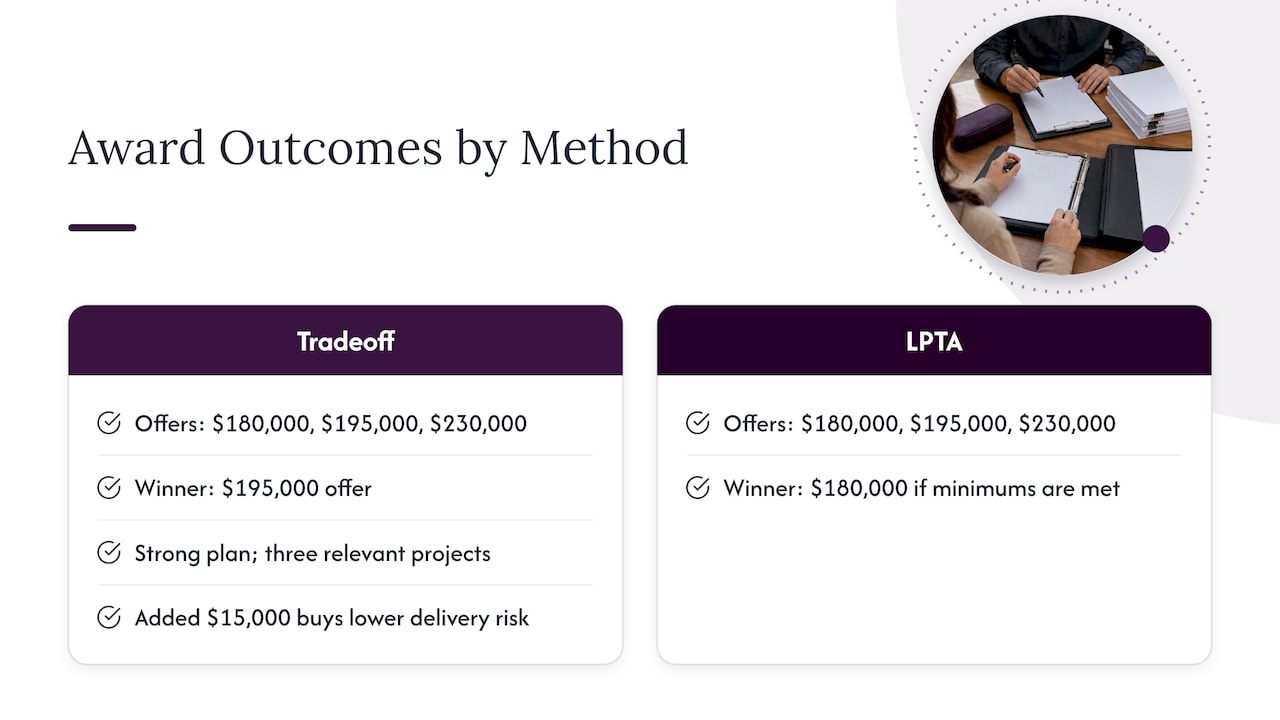
Say an agency wants a fixed-price training service and receives three offers at $180,000, $195,000 and $230,000. The agency stated that non-price factors are significantly more important than price. The $195,000 offer shows a strong plan and three relevant past projects. The $180,000 offer has a thin plan and no comparable history.
A tradeoff lets the officer pick the $195,000 offer, as long as the file explains that the added $15,000 buys lower delivery risk. Under an LPTA solicitation, the $180,000 offer would win if it met every minimum. Same three bids, opposite outcomes, depending on the announced method. This is a simplified illustration, not a real procurement.
To make your price easy to support, tie each line to a clearly described deliverable, keep labor categories consistent with what the solicitation asks for, and explain any figure that looks out of line with the market before the evaluator has to ask.
How is best value judged when you sell through a GSA Schedule?
A schedule contract changes the starting point. Your prices have already been reviewed during the contract award and sit on a price list that buyers can order from. Then each order has its own competition, governed by FAR 8.405-1.
For Multiple Award Schedule orders above the simplified acquisition threshold (the dollar level under which the government can use streamlined buying rules), that section requires a request for quotation (RFQ) that states the requirement and the basis for selection. The agency must fairly consider the quotes it gets and make the award consistent with the stated basis. It generally posts the RFQ on eBuy, the schedule’s quoting platform, or solicits enough sources to reasonably seek at least three capable quotes.
The same section lets the ordering office look beyond price. FAR 8.405-1 lists factors such as:
- past performance
- special features of the offering
- trade-in considerations and expected product life
- warranties and maintenance
- environmental and energy efficiency considerations
- delivery terms
So a quote that spells out delivery commitments, warranty terms and relevant history competes on more than a number. Our guides on top evaluation criteria for GSA Schedule contracts and how to use past performance in RFQ responses show how to answer those factors line by line.
How do you position your offer to win a best value decision?
Whatever the contract vehicle, the same habits help. Most of them come from reading the rules above as an evaluator would.
1. Read the evaluation section first
Before writing a word, find the factors and their stated importance. Then decide: is this LPTA or a tradeoff? Your whole approach, including how much to invest in the technical volume, depends on the answer. Opportunities are listed on SAM.gov, the government’s official site for contract opportunities, so that is where you start.
2. Answer every factor in the solicitation’s own order
Evaluators are limited to the stated factors, so anything outside them earns nothing. Use the solicitation’s headings and terminology, and keep each answer short enough to score quickly. Our technical proposal requirements guide covers what evaluators usually expect to see.
3. Turn your history into evidence
Past performance is often the factor that lets a higher-priced offer win a tradeoff. Pick projects that match the scope, size and complexity, and describe results in terms of what the buyer cares about: on-time delivery, quality, resolved issues. If you need a process, see five steps to prepare past performance documents and our explanation of what GSA past performance evaluation covers.
4. Match contract size to your record
If your largest project is small compared with the target contract, the evaluator will notice. The government contract size converter helps you judge how your experience lines up with the size of an opportunity.
5. Price to be supportable, not just low
In a fixed-price competition, your number is compared to the others. In a tradeoff, it must be defensible against your strengths. In both, clear labor categories and consistent assumptions help the officer write the price-reasonableness finding without follow-up questions.
6. Borrow the discipline of other industries
Buyers outside government run structured supplier checks too. One example is this overview of five procurement tests for formulation support, which shows how a methodical, criteria-based evaluation separates suppliers. Federal best value follows the same logic with the added rule that the criteria must be published.
Why does a schedule contract help you compete on best value?
A schedule gets you into the pool of vendors agencies can order from, with your pricing already reviewed. Without one, many agencies simply never see your quote. The work is in the application: eligibility, a compliant price list, correct service codes, a technical narrative and past-performance records, then negotiation.
That is the part we do for clients. Our approach is built for owners who cannot spend months on paperwork: our clients are typically awarded in about six months while spending about three hours of their own time, where going alone commonly takes two years or more. We operate on a “no award, no fee” basis, with payment only after approval, and we offer a money-back guarantee. Our stated first-application approval rate is 98%.
What do we think about best value?
Most of the owners who come to us have the same worry: they believe the government will pick the cheapest bidder, so they price down and hope. We see best value differently. The rules say the solicitation must state what matters and how much, and the file must explain the decision. That makes the outcome something you can prepare for.
The preparation that counts happens before any single RFQ arrives. A clean price list, the right service codes, a technical narrative that reads like an evaluator’s checklist and past-performance records that are ready to attach. When those pieces exist, you answer a quote request in hours, not weeks, and you can compete on strengths instead of scrambling to prove you are eligible.
That is why we handle the application end to end, and why we keep the client’s time to about three hours. Your best hours belong to delivering for customers and answering quotes, not to forms.
Josh
What does it cost to get ready, and what are your options?
We organize our work by stage. For the application itself, our Startups, Specialty and Streamline packages cover documentation, compliance guidance, price list development, service-code mapping and negotiation support. These packages have no published price, so request a proposal. Our full-service page describes the turnkey GSA contract services in detail, and the acquisition agreement sets out the terms.
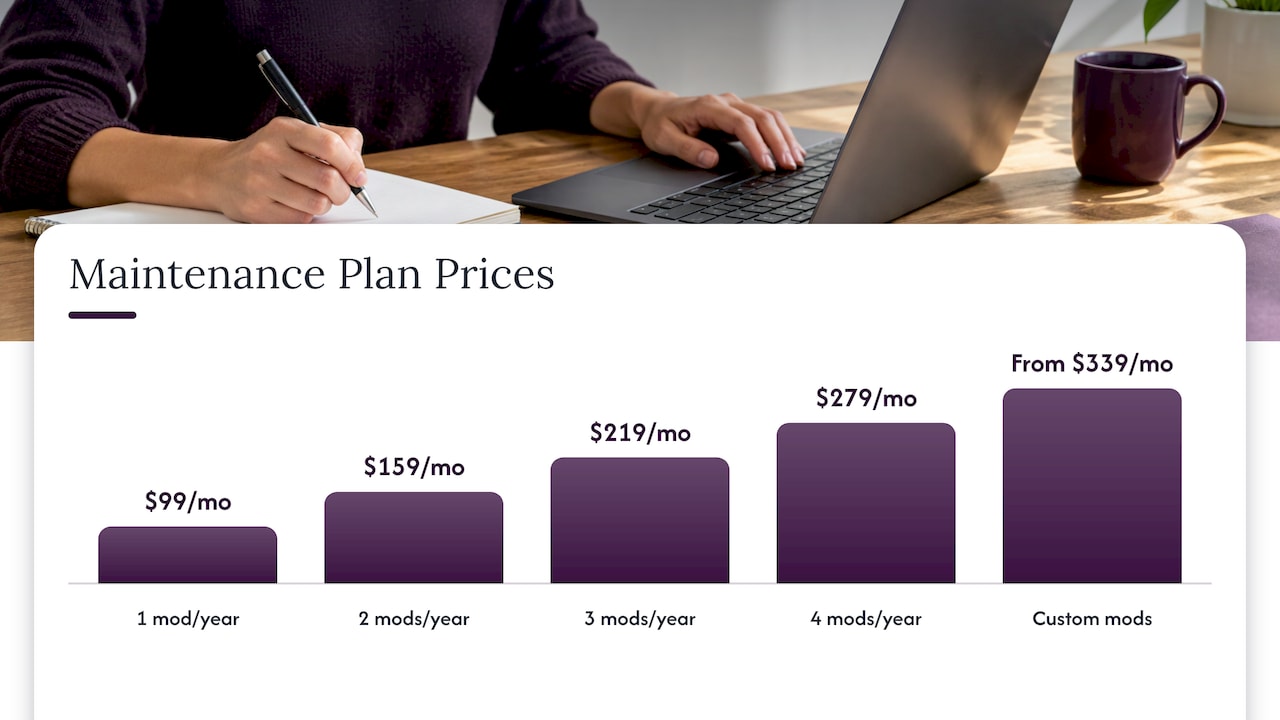
After award, your price list and offerings will change. Our maintenance plans cover contract modifications (the formal changes you submit to keep a contract current) at these published monthly rates:
| Plan | Price |
|---|---|
| 1 mod per year | $99 per month |
| 2 mods per year | $159 per month |
| 3 mods per year | $219 per month |
| 4 mods per year | $279 per month |
| Custom number of mods | from $339 per month |
The details are on our maintenance plans page. A retainer is available at $1,500 per year. For owners who want help winning orders once the contract is in place, our federal marketing tiers are Lite at $10,700 per year, Standard at $15,700 per year and Plus at $27,700 per year, described on the federal marketing page. Our step-by-step guide to winning contract sales shows how those orders typically come together, and our professional services page covers the service category.
If you prefer to run the application yourself, we also offer the GSA DIY Quick Start.
FAQ
What is the difference between best value and lowest price?
Lowest price means the cheapest offer wins. Best value means the agency weighs price with other announced factors, and under a tradeoff it may pay more when the benefits justify the extra cost. In an LPTA buy, best value effectively comes down to the lowest-priced offer that meets the minimum requirements.
Does the government have to explain why it chose a higher-priced offer?
Yes. Under FAR 15.101-1, when a tradeoff results in an award to someone other than the lowest-priced offeror, the rationale must be documented. FAR 15.308 also requires the source selection decision to record the benefits associated with any additional cost.
Can an agency use evaluation criteria that were not in the solicitation?
No. FAR 15.305 directs agencies to assess proposals only against the factors and subfactors stated in the solicitation. That is why reading the evaluation section first is the most useful habit a new bidder can build.
Do best value rules differ by agency?
Sometimes. Agencies can adopt deviations from the standard FAR text, and the Department of State’s Part 15 deviation, for example, took effect on February 27, 2026. Check the solicitation and the buying agency’s current version of the rule before you bid.
Will a schedule contract guarantee I win best value orders?
No contract guarantees an order. A schedule places you where agencies can request your quote, and each order is then competed under its own stated basis. Strong past performance, clear delivery terms and a supportable price are what carry a quote.
If you already meet the basic eligibility requirements and want to know how fast you could be on a schedule, ask us for a free eligibility check at gsascheduleservices.com.
Sources
- eCFR, 48 CFR Part 15 Subpart 15.1, Source Selection Processes and Techniques
- Acquisition.gov, FAR Subpart 15.1
- Acquisition.gov, FAR 15.305 Proposal evaluation
- Acquisition.gov, FAR 15.308 Source selection decision
- Acquisition.gov, FAR Subpart 15.3 Source Selection
- Acquisition.gov, FAR 15.304 Evaluation factors and significant subfactors
- Acquisition.gov, FAR 8.405-1 Ordering procedures
- Acquisition.gov, Department of State RFO Part 15 deviation
Recommended
- How Value-Based Pricing Impacts GSA Contracts
- Competitive Pricing in Federal Contracts: Analysis
- How Federal Buyers Choose Vendors
- The GSA Rule of Three: How Federal Buyers Pick Vendors