

A GSA compliance checklist has three parts. Before you offer: two years in business, financials, past performance, training, and an active SAM.gov registration. During the offer: complete eOffer files and pricing. After award: catalog, sales tracking, fee remittance, reporting, and eMod for every change. Miss one item and the offer or contract stalls.
TL;DR
- Before you apply, confirm two years in business, two years of financials and measurable past performance, or check whether you qualify for a waiver.
- Complete the Pathways to Success training and Readiness Assessment within the year before you submit, then file through eOffer with FAS ID multi-factor authentication.
- Price every SIN consistently and be ready to back up your prices with sales data.
- After award, publish your catalog, track sales by SIN, report sales and remit the fee on time, and route every change through eMod.
- Our done-for-you process is designed to take about 3 hours of your time.
Table of Contents
- What does a GSA compliance checklist need to cover?
- What should you confirm before you start an offer?
- Which registrations must be active before you submit?
- How do you build an offer that gets accepted?
- What must you do within 30 days of award?
- What does ongoing compliance look like?
- Where do GSA offers and contracts usually go wrong?
- Can you handle this checklist yourself, or do you need a consultant?
- What does it cost to have compliance handled for you?
- FAQ
- Sources
What does a GSA compliance checklist need to cover?
Most checklists you will find online cover only one stage. That is a problem, because compliance with the General Services Administration (GSA) Multiple Award Schedule (MAS) program is not a single event. It runs in three phases, and each has its own failure points:
- Readiness: are you eligible, and do you have the documents?
- Offer: is the submission complete, consistent and priced in a way GSA can accept?
- Contract life: do you keep reporting, tracking and modifying correctly for as long as you hold the contract?
The lists below follow that order. Each item points to the GSA page or solicitation clause behind it. Requirements change with each solicitation refresh, so treat the current solicitation as the final word and check it before you file.
What should you confirm before you start an offer?
This is where most delays begin, because the work is unglamorous: finding paperwork and proving you are a going concern.
Business history and financial standing
GSA’s guidance says to confirm you have been in business for two years, have two years of financial statements and can show measurable past performance. Some businesses can have those requirements waived through Startup Springboard, so a young company should check that route before assuming it is out.
The checklist for this stage:
- Two years of financial statements (balance sheet and income statement) ready to upload.
- Past performance examples you can describe with dates, scope and results.
- A clear picture of your commercial offerings: what you sell, to whom, at what price.
- No unresolved issues that would hurt a responsibility review. Contracting officers use FAR Subpart 9.1 to judge integrity, ethics, financial capability and experience.
We keep a longer list of paperwork in our guide to documents needed for a GSA Schedule offer.
Training and Readiness Assessment
As of the June 2026 instructions, prospective MAS offerors must complete the mandatory Pathways to Success training and the Readiness Assessment within the year before submitting an offer, unless you qualify for a streamlined offer process. If your training is older than a year when you are ready to file, it has to be redone. Put the completion date on your calendar.
Which registrations must be active before you submit?
Three registrations come up again and again in rejected or delayed offers.
| Item | What it is | What goes wrong |
|---|---|---|
| SAM.gov registration and UEI | The federal registry every offeror must be in | Registration lapses or has stale data |
| NAICS codes | Codes that describe your primary business activities | Codes do not match the SINs you propose |
| eOffer account with FAS ID | The portal where the offer is filed | MFA not set up, or access held by someone who left |
GSA states that businesses need SAM.gov registration and a UEI, and must register for eOffer, with FAS ID part of the process. The solicitation instructions add that your SAM registration must be current, accurate and complete, with NAICS codes that fit your proposed SINs. SAM.gov is also where federal opportunities are posted, so a clean registration pays off beyond the Schedule.
Note that registration must be renewed every year. A lapse during review is an avoidable problem.
How do you build an offer that gets accepted?
Electronic submission through eOffer is mandatory, and offerors must use FAS ID multi-factor authentication. Beyond access, the checklist is about fit.
Read the solicitation and pick the right SIN
GSA’s Pathways guidance tells offerors to read the entire solicitation and the category attachments and to use eLibrary to select the SIN that best matches what they sell. This is also how you decide which checklist items apply to you: a products offer, a professional services offer and an IT offer do not carry the same attachments.
Check each of these before you press submit:
- Every required attachment for your category and SIN is uploaded.
- Every solicitation instruction is followed, with no skipped fields.
- Descriptions of your services match the SIN you chose.
- If you were rejected before, you include the rejection letter and a signed response to each rejection and clarification point.
On that last point, the June 2026 instructions are explicit. A resubmission without those responses is not a fresh start.
Price it so it holds together
Offerors download and complete GSA’s pricing templates and submit them through eOffer, and prices must be fair and reasonable. GSA uses existing data where it can, but it may ask for established prices or previous sales when it needs more to decide on reasonableness.
One rule catches many first-time offerors: identical items with the same terms and conditions cannot be awarded at different prices on the same contract, so your pricing has to be consistent across SINs. Our notes on multiple-SIN pricing and TDR explain how that plays out in modification rejections, and our article on price reasonableness versus most favored customer pricing separates two ideas that are often confused. For the broader strategy, see GSA pricing strategy.
Pricing checklist:
- Your commercial price list is current and matches what you actually charge.
- Discounts offered to your best commercial customers are documented.
- Each labor category or product is priced the same way everywhere it appears.
- You can produce invoices or sales records if GSA asks for them.
What must you do within 30 days of award?
Award is the start of the compliance work, not the end. After you register in the Vendor Support Center, GSA requires you to publish electronic contract data on GSA Advantage, eBuy and eLibrary through the FAS Catalog Platform within 30 calendar days of award.
A first-month list:
- Register in the Vendor Support Center.
- Load your catalog with correct part numbers, descriptions and contract prices.
- Set up sales tracking by SIN before your first order arrives.
- Confirm who in your company owns reporting and fee payment.
- Calendar your annual SAM renewal.
Our post-award checklist walks through these in more detail, and our catalog management tips cover the upkeep that follows.
What does ongoing compliance look like?
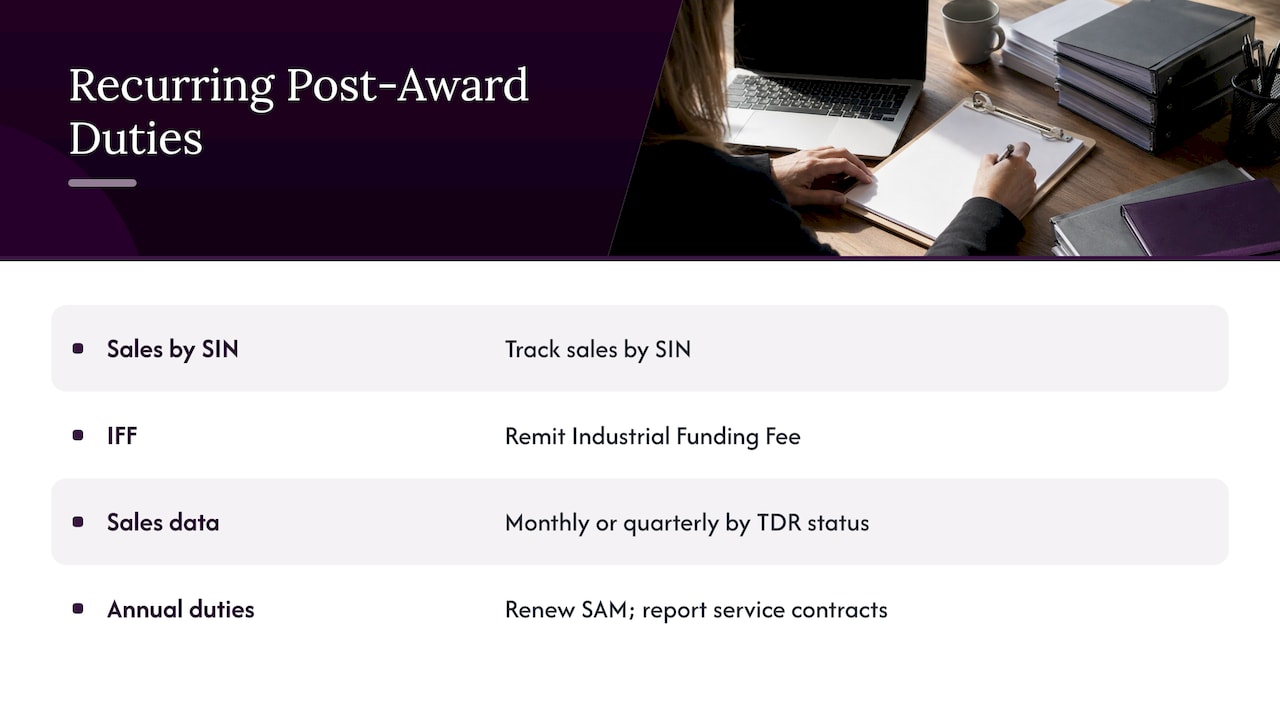
GSA’s post-award page lists the recurring duties: tracking sales by SIN, remitting the Industrial Funding Fee, submitting monthly or quarterly sales data depending on Transactional Data Reporting (TDR) status, annual SAM registration and service contract reporting.
Sales tracking and the fee
For contractors reporting through the 72A system, the Industrial Funding Fee has been 0.75% of sales since January 2004. GSA does not require a particular accounting package. The Contractor Assessment Reference Guide says only that you need a system that can accurately track and report GSA-eligible sales. A spreadsheet can work at low volume, but it has to separate Schedule sales from commercial sales cleanly.
Transactional Data Reporting
The draft Refresh 33 solicitation mandates TDR for all SINs, meaning electronic reporting of line-item data for products or services purchased through MAS. If your internal systems cannot produce line-item data, build that capability early. Confirm the final text in the current solicitation.
Modifications through eMod
Catalog updates, additions and deletions all go through eMod. The MAS Modification Guide says requirements differ by category, subcategory and SIN, and that incomplete requests may be rejected. Keep a mod checklist per request type:
- The request type is identified correctly before you start.
- Every document the Modification Guide lists for that SIN is attached.
- Pricing for new items is consistent with pricing already on the contract.
- The request is filed under the current guide, not an old copy.
There is a step-by-step list for this in our eMod-focused guidance, and our overview of GSA compliance requirements is the pillar page for the whole topic.
Where do GSA offers and contracts usually go wrong?
The patterns repeat:
- Stale training or registration. The Readiness Assessment is older than a year, or SAM data no longer matches the offer.
- Wrong SIN or NAICS mapping. The business description and the SIN point in different directions.
- Inconsistent pricing. The same item shows two prices on one contract.
- Thin past performance. Examples lack dates, scope or measurable results.
- Late or missing reports. Nobody owns quarterly or monthly reporting after the award.
- Mods filed from memory. The request skips a document the current guide requires.
Every one of these is on this checklist, and every one is cheaper to fix before submission than after a rejection.
Can you handle this checklist yourself, or do you need a consultant?
You can work through the list above on your own. The question is time and risk. Each item is simple, but they depend on each other: your NAICS codes must fit your SINs, your SINs must fit your price list, and your price list must fit your sales records. Doing that alone for the first time, while running a business, is how an offer drifts for a year or more.
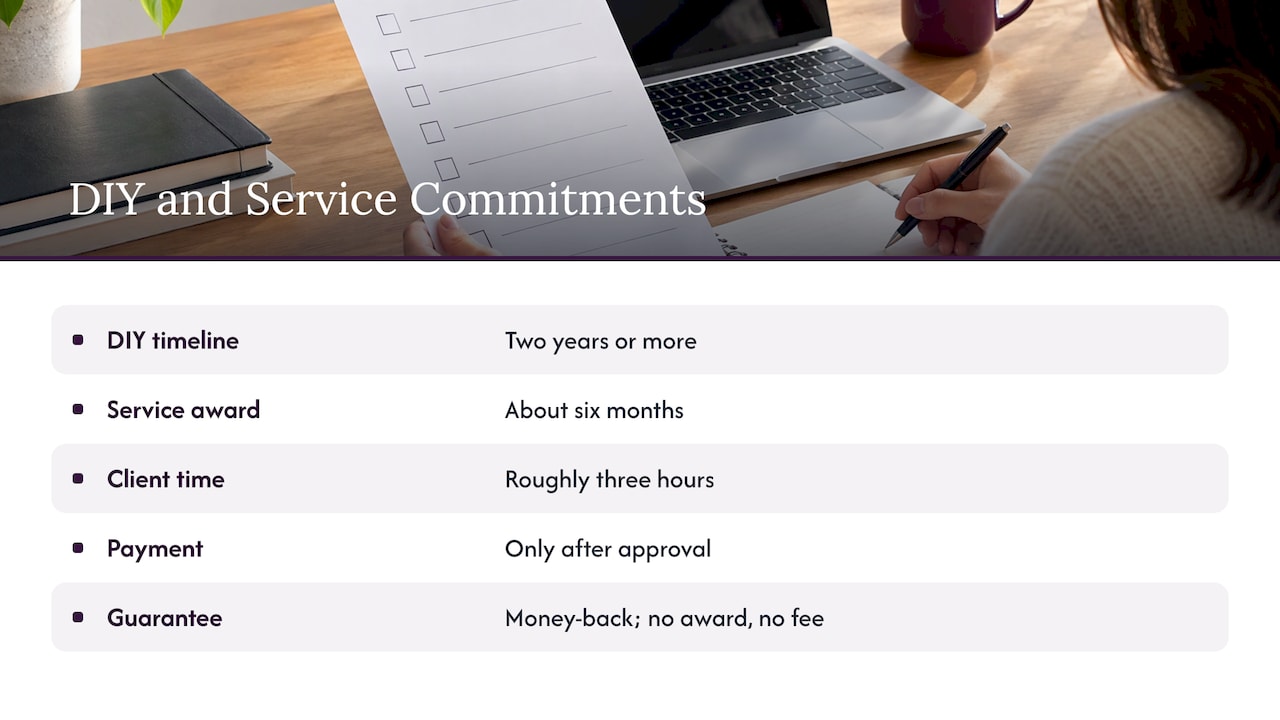
Our experience, and the way we structure our service, is built around that gap. We say clients can be awarded in about six months while spending roughly three hours of their own time, and that going alone commonly takes two years or more. We also state a money-back guarantee and an “no award, no fee” payment model, with payment only after approval. Those are our own commitments, set out in our acquisition agreement.
What we tell clients about compliance
Compliance is not a binder you finish once. It is a set of habits that start before the offer and last as long as the contract. The businesses that struggle are rarely the ones with weak products. They are the ones whose paperwork, pricing and reporting do not agree with each other.
That is why we handle the full chain for you: eligibility assessment, documentation, price list development, NAICS and SIN mapping, negotiation support and sales tracking setup. You provide the facts about your business, and we take on the filing work. After award, we maintain the contract through modifications and price list changes so that the compliance duties do not fall on your small team.
Our approach is designed so you can sell to federal buyers rather than spend months learning portal mechanics.
Josh
What does it cost to have compliance handled for you?
Acquisition packages (Startups, Specialty and Streamline) are quoted through the proposal page. Our federal marketing tiers run $10,700 per year for Lite, $15,700 per year for Standard and $27,700 per year for Plus.
Once you hold a contract, the ongoing work can be packaged:
| Plan | Price |
|---|---|
| Retainer | $1,500 per year |
| 1 modification per year | $99 per month |
| 2 modifications per year | $159 per month |
| 3 modifications per year | $219 per month |
| 4 modifications per year | $279 per month |
| Custom number of modifications | from $339 per month |
See the retainer details and the modification plans. Price list changes (simple, basic or advanced) are handled through our maintenance proposal page. If you prefer to start on your own, the GSA DIY Quick Start is our self-service option. To see what a Schedule could be worth to you, try the 2026 GSA Sales Opportunity Estimator.
FAQ
What are the main GSA compliance requirements?
Before award: eligibility, financial statements, past performance, training and Readiness Assessment, SAM.gov and eOffer registration. After award: catalog publication, sales tracking by SIN, fee remittance, sales reporting and eMod for changes. Our compliance requirements guide expands each one.
How often do GSA compliance rules change?
The solicitation is refreshed periodically, and each refresh can change requirements. Read the current solicitation and the current MAS Modification Guide before every offer or modification. Our write-up of MAS Refresh 31 shows the kind of change to expect.
What happens if I miss a reporting or modification requirement?
Incomplete modification requests may be rejected, and reporting and fee duties are part of your contract terms. Build ownership of each task into your calendar and keep records organized. If you hold a contract and want these tasks off your plate, our maintenance plans cover modifications.
Is there a free way to find out if my business qualifies?
Yes. We offer a free eligibility check: we look at your years in business, financials, past performance and offerings, and tell you where you stand and what is missing. Start from our home page and request it before you spend time on paperwork.
Sources
- How to access contract opportunities | GSA
- SCP-FSS-001 Instructions Applicable to All Offerors
- Pathways to Success | GSA
- Register your business | GSA
- Draft SCP-FSS-001 Refresh 33
- MAS Refresh 31 Solicitation Document
- Requirements after getting a MAS contract | GSA
- MAS Contractor Assessment Reference Guide
- MAS Modification Guide, Refresh 33, October 2026
Recommended
- GSA Schedule Award Checklist: Post-Award Steps
- Your Checklist for After GSA Schedule Award
- GSA Post-Award Checklist for Contractors
- GSA Schedule Award: Complete Checklist for Success