

Most offers fail for avoidable reasons: skipped prerequisites, missing financial statements, pricing that can’t be backed up, unflagged exceptions to the terms, and technical narratives that don’t answer the solicitation. GSA may reject an offer without negotiating, so the first submission has to be right. Below are nine causes and the fix for each.
TL;DR
- GSA reserves the right to award or reject without negotiation, so treat your first submission as your best and final.
- The most common failures: missing Pathways to Success and Readiness Assessment acknowledgments, incomplete financials, unsupported pricing, unidentified exceptions, and off-target technical narratives.
- Every one of these is fixable before you press submit, with a checklist and a second set of eyes.
- Our clients are typically awarded in about 6 months while spending about 3 hours of their own time. Going alone often takes 2+ years.
Table of Contents
- Can GSA really reject an offer without giving me a chance to fix it?
- What are the nine most common reasons an offer is rejected?
- Did you finish the required training and readiness check?
- Are your financial statements complete?
- Can you prove your prices are fair and reasonable?
- Did you identify every exception to the terms and conditions?
- Does your technical narrative answer what the solicitation asks?
- Have you mapped your offering to the right SINs?
- Are ownership and product origin clear?
- Do all your documents agree with each other?
- Our perspective: rejections are a process problem, not a quality problem
- Should you fix this yourself or bring in help?
- A pre-submission checklist
- Want a free eligibility check before you submit?
- FAQ
- Sources
Can GSA really reject an offer without giving me a chance to fix it?
Yes. Many first-time applicants assume a contracting officer will call, point out the problem and let them correct it. Sometimes that happens. GSA’s own process page describes communications that may address ambiguities and request information, but the solicitation instructions make clear the government can make an award or reject without discussions. You can’t count on a second chance.
That changes how you prepare. A federal offer is not a conversation. It is a package that gets scored against the solicitation, and the contracting officer is allowed to stop at the first disqualifying gap.
If you are new to federal sales, one more point: the opportunity side starts at SAM.gov, where you register your business and where federal contract opportunities are posted (it replaced the retired FedBizOpps). Registration is a prerequisite to everything below, and mistakes there carry forward.
What are the nine most common reasons an offer is rejected?
| # | Rejection trigger | Quick fix |
|---|---|---|
| 1 | Pathways to Success and Readiness Assessment not completed or acknowledged | Complete both within 12 months before submission |
| 2 | Missing or incomplete financial statements | Prepare two full years of balance sheet and income statement |
| 3 | Pricing without commercial proof | Build a price list and backup that match what you sell commercially |
| 4 | Exceptions to terms not identified | Read the full solicitation; flag every exception in eOffer |
| 5 | Technical narratives that miss the factors | Write directly into the eOffer fields, within the limit |
| 6 | Wrong or poorly supported SINs | Map your services to the SINs you can prove |
| 7 | Unclear ownership or product origin | Document ownership and country of origin early |
| 8 | Inconsistent data across forms | Reconcile every document before uploading |
| 9 | Treating the offer as a draft | Review against the solicitation checklist before submitting |
The sections below take them in turn.
Did you finish the required training and readiness check?
This is the cheapest rejection to avoid and the most embarrassing to suffer. GSA’s current refresh of the offer instructions requires that you complete the Pathways to Success training and the Readiness Assessment within the year before you submit, and that you acknowledge both in eOffer. The training runs roughly 3 to 4 hours and is free. GSA’s own training document says you must acknowledge completing both within the past twelve months when you submit.
The roadmap adds a detail owners miss: the negotiator who is also an employee of the company must be the one to complete the readiness assessment. If your consultant or an outside advisor takes it, it doesn’t count.
Fix: Put the completion date on a calendar. If your offer slips past twelve months, retake the training. Have the person who will negotiate take the assessment.
Are your financial statements complete?
GSA must conclude you are a responsible contractor, and your financials are the evidence. Its template guidance calls for two full years of financial statements, a balance sheet and an income statement for the previous two-year period, audited if available.
Common failures:
- Uploading only a profit and loss summary.
- Submitting statements for one year because the company is young.
- Mismatched company names or periods between the statements and the registration.
- Handing over tax returns instead of statements.
Companies without that history aren’t automatically out. GSA offers exceptions for qualifying new businesses, such as the Startup Springboard path. But you must qualify and follow the path as written. Thin financials with no recognized exception are a routine reason for rejection.
Fix: Ask your accountant for a two-year balance sheet and income statement formatted for this purpose before you open eOffer. If you are under two years old, confirm which exception applies and gather what it requires.
Can you prove your prices are fair and reasonable?
Pricing is where many technically sound companies stumble. GSA acquisition rules say that for offers evaluated without transactional data, the contracting officer compares your proposed terms to what you give commercial customers. See GSAM subpart 538.2 for the evaluation methodology.
That means your commercial sales practices disclosure, your price list and your supporting documents (catalogs, published price lists, invoices) have to tell the same story. If the discount you offer GSA is hard to square with what real customers pay, or if the backup is thin, the offer is deemed non-compliant.
Typical pricing mistakes:
- A government price list that doesn’t match your commercial list.
- Labor categories with no commercial basis or invoices behind them.
- Rates that vary between the narrative, the price file and the sales disclosure.
- Quoting a lower price than you can sustain, then asking to adjust it after award.
For a deeper walk-through, see our guide to demystifying GSA pricing.
Fix: Build the price list from your real commercial documents, then audit every number against them. If a number can’t be backed up, change it before submission, not after.
Did you identify every exception to the terms and conditions?
The solicitation tells you to read the entire document before you prepare your offer. If you want to take exception to a term, the exception has to be explicitly identified in eOffer. The eOffer user guide even covers the case where a contracting officer rejects an exception, and you can’t respond to that rejection inside the system.
Two patterns cause trouble. Some applicants alter standard language in an uploaded document without flagging it. Others flag exceptions that go to the heart of the standard terms, which a contracting officer won’t accept. Either one signals that the offeror hasn’t absorbed the federal environment.
Fix: Run a read-through with a checklist of every clause. If you truly need an exception, flag it, justify it and be prepared for it to be declined.
Does your technical narrative answer what the solicitation asks?
Contracting officers evaluate against stated factors, not against how impressive your brochure looks. The FAR rule on proposal evaluation requires an agency to assess proposals solely on the factors and subfactors in the solicitation. Brand storytelling does not stand in for evidence of experience and quality control.
GSA’s template page notes that you must address the four technical factors in Section II of the solicitation. It also says the narratives for corporate experience, quality control and relevant project experience are limited to 10,000 characters in eOffer. Core content belongs in the fields themselves. Attachments for those factors are often overlooked.
What strong narratives do:
- Mirror the language of each factor and answer it directly.
- Give named, verifiable projects with scope, dates and outcomes.
- Describe quality control as an actual process: who checks what, when, and what happens on a miss.
- Stay inside the character limit without cutting evidence.
If your work is subcontract-heavy, it also helps to describe how you are engaged on projects. This overview of how subcontract bid types differ is a useful reference for framing that kind of experience. For structure, see our guide on organizing a technical proposal and the top evaluation criteria.
Fix: Draft each narrative against its factor in a table: requirement on the left, your evidence on the right. Then paste it into the field and check the character count.
Have you mapped your offering to the right SINs?
A Special Item Number is a category of what you can sell under the schedule. Proposing a SIN that doesn’t match your actual work, or one you can’t substantiate with experience and pricing, creates problems throughout the offer. The experience you cite, the price lines and the narrative all have to support the same SINs.
Many owners select SINs by browsing for the ones that sound close. A better approach starts with what you’ve already delivered, then looks for the SINs where you have proof. Fewer, well-supported SINs are easier to approve than a long list you can’t defend.
Fix: For each SIN, list one project, one price line and one sentence of quality control that supports it. If you can’t fill that row, don’t propose that SIN yet.
Are ownership and product origin clear?
Supply chain risk is now a real screening topic. According to the current offer instructions, GSA reviews corporate ownership and product origin, and unresolved concerns can remove an offer from consideration. Unclear ownership structures, or products whose country of origin you haven’t verified, are the typical triggers.
This catches companies with layered holding structures, recent ownership changes, or resellers who haven’t asked their suppliers where products are made.
Fix: Write a one-page ownership chart. If you sell products, get country-of-origin confirmation from every supplier before you list an item.
Do all your documents agree with each other?
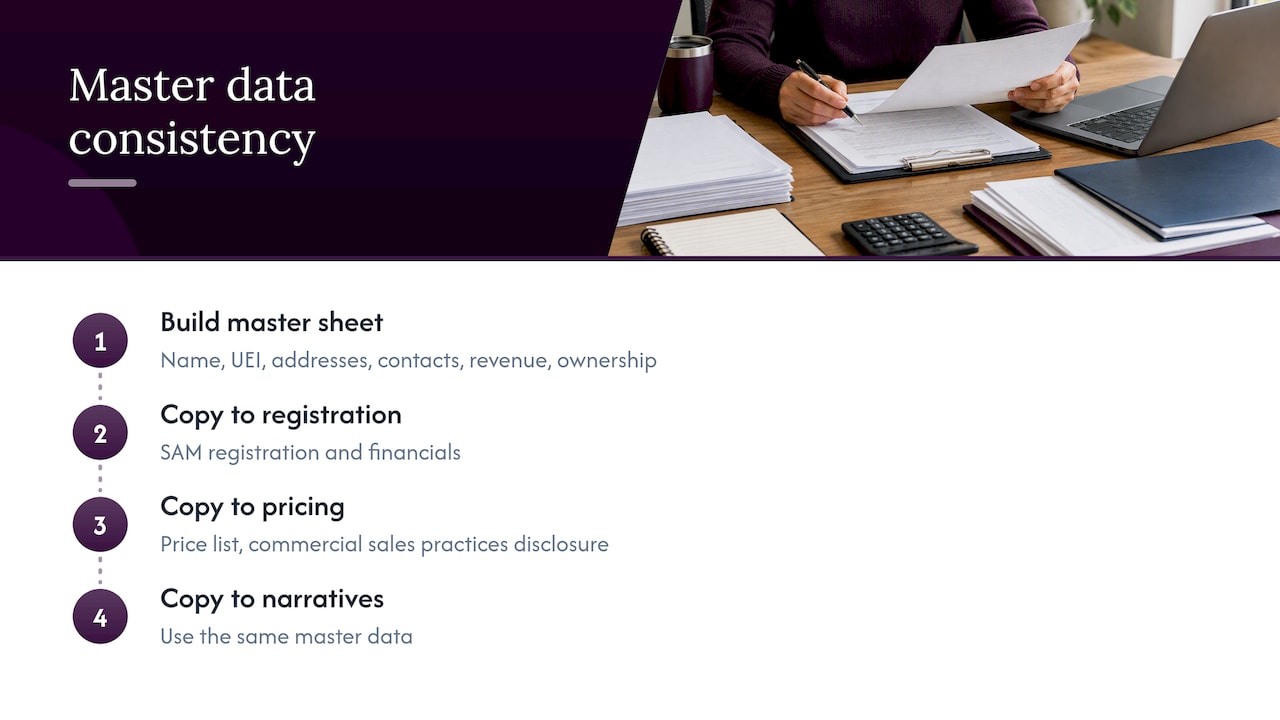
An offer is dozens of data points across SAM registration, financials, the price list, the commercial sales practices disclosure and the narratives. Small mismatches look like carelessness, and sometimes like misrepresentation. Typical examples are a legal name that differs by a comma, a revenue figure that doesn’t reconcile, or a different point of contact in each form.
Our earlier posts on common vendor mistakes and the 25 reasons contracts are rejected catalog many of these smaller errors.
Fix: Build a single master data sheet (legal name, UEI, addresses, contacts, revenue, ownership) and copy from it every time.
Our perspective: rejections are a process problem, not a quality problem
We see the same pattern again and again. The company is good. It has real customers, real revenue and real capabilities. The offer fails anyway, because nobody on the team does federal paperwork for a living, and the offer was assembled between other jobs.
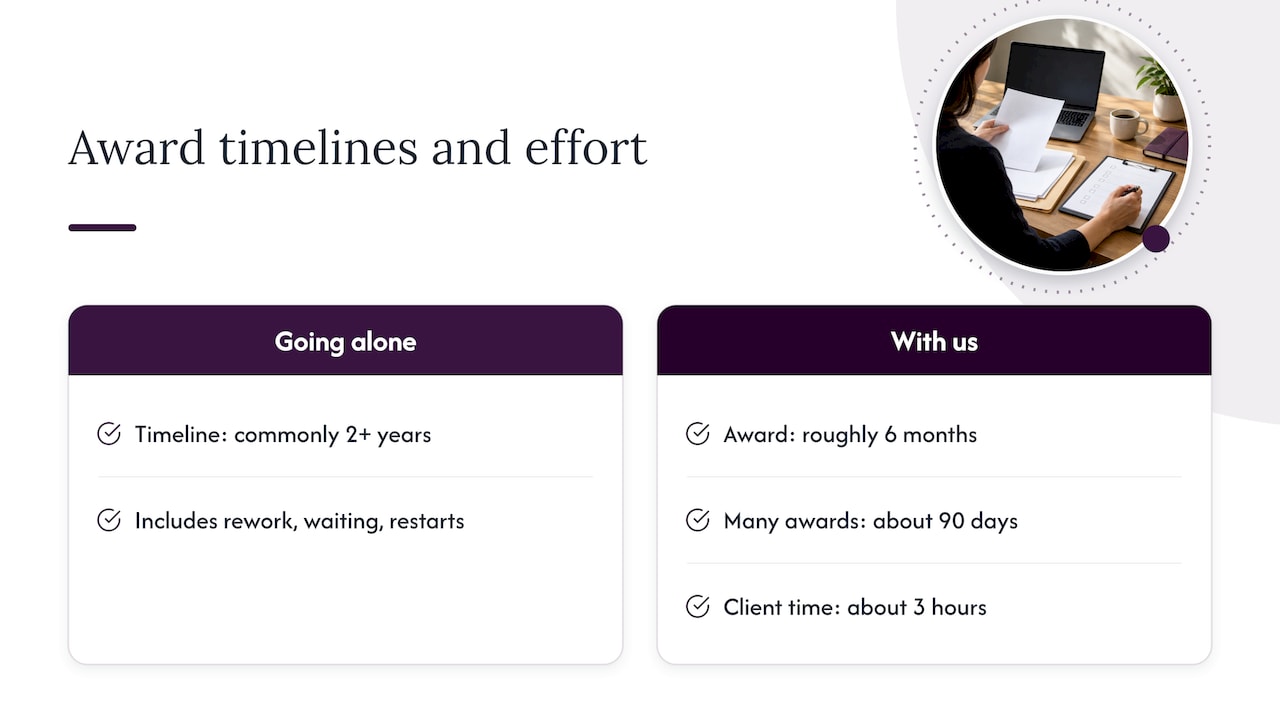
That is also why the timelines look so different. We tell clients that going alone commonly takes two years or more, once you count the rework, the waiting and the restart after a rejection. Working with us, clients are awarded in roughly six months, and many reach award in about 90 days, while spending about 3 hours of their own time. Those are our figures from our own client work, not an industry benchmark.
Our advice to any owner is to treat the offer like a bid you only get to submit once. Check it against the solicitation line by line, make the numbers match the commercial reality and give each narrative the evidence it asks for. If the gaps feel larger than your bandwidth, that is a good moment to hand it to specialists.
— Josh
Should you fix this yourself or bring in help?
Both are legitimate. The honest question is how much your time is worth and how many attempts you can afford.
| Factor | Doing it yourself | Working with a specialist |
|---|---|---|
| Cash outlay | Low | Fee, plus time saved |
| Your time | Many weeks, often months | About 3 hours with our model |
| Typical timeline | Commonly 2+ years including rework | Often about 6 months, sometimes about 90 days |
| Rejection risk | Higher on a first attempt | Lower, with expert review before submission |
| Best for | Owners with spare time and a simple offering | Owners who want revenue sooner |
If you want to attempt it alone, our GSA DIY Quick Start gives you structure. If you’d rather have it done for you, our full-service offers cover startups, specialty and streamlined cases. Our model is payment after approval, so there is no award, no fee, and we back it with a money-back guarantee. We report a 98% first-application approval rate for our clients.
Already holding a contract? Rejections also hit modifications. Our maintenance plans start at 99 USD per month for one modification per year, and a retainer is listed at 1,500 USD per year.
A pre-submission checklist
- Training and Readiness Assessment completed within 12 months, by the right person.
- Two years of balance sheet and income statement, or a documented exception.
- Price list that matches your commercial list, with invoices or catalogs behind it.
- Entire solicitation read, with exceptions identified in eOffer.
- Technical narratives written into the fields, under 10,000 characters each.
- Each SIN supported by a project, a price line and a quality control description.
- Ownership chart and country-of-origin confirmations ready.
- Master data sheet reconciled across every form.
- A reviewer who didn’t write the offer reads it against the solicitation.
For more reading, we also cover the top reasons applications get rejected, why bids fail and how to avoid proposal rejections.
Want a free eligibility check before you submit?
Before you spend months on paperwork, find out whether your company is ready. We’ll review your eligibility, financial history and offering and tell you plainly what stands between you and an award. Start your free eligibility check.
FAQ
How do I know if my offer was rejected?
You’ll hear from the contracting officer through eOffer, usually by email notification. Check the messages tied to your offer regularly, and respond within the stated deadlines to any request for clarification.
Can I resubmit after a rejection?
In general you can prepare and submit a new offer, but you should fix the underlying causes first. Repeating the same gaps just produces the same result, so get a fresh review against the solicitation.
Does a small business need two years of financials?
The standard expectation is two years of balance sheet and income statement. Some newer businesses can qualify for an exception such as Startup Springboard, so confirm eligibility on GSA’s template page before assuming either way.
Is the Pathways to Success training mandatory?
Yes. GSA’s offer instructions require you to complete it, along with the Readiness Assessment, within the prior year and acknowledge both in eOffer. It’s free and takes about 3 to 4 hours.
Sources
- GSA solicitation instructions, SCP-FSS-001 Refresh 33 (draft)
- GSA: What to expect during the award process
- GSA: Pathways to Success training document
- GSA: Roadmap to get a MAS contract
- GSA: Required templates for a MAS offer
- Acquisition.gov: GSAM subpart 538.2
- Acquisition.gov: FAR 15.305 Proposal evaluation
- GSA eOffer user guide: Creating and submitting an eOffer
- SAM.gov
- Won2Build: Types of subcontractor bids
Recommended
- Why GSA Bids Fail: Key Issues
- How to Avoid GSA Proposal Rejections
- Common GSA Vendor Mistakes
- What Happens If Your GSA Schedule Proposal Gets Rejected? 4 Points You Should Know