
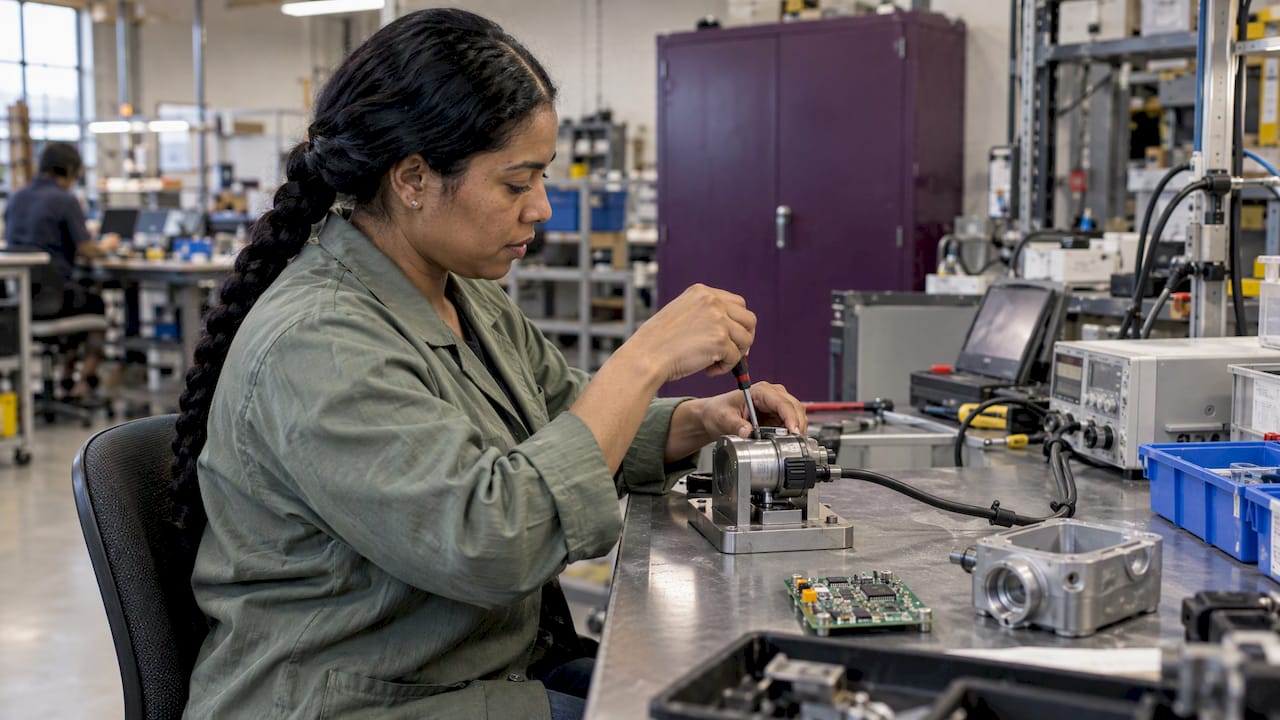
GSA decides country of origin under the Trade Agreements Act (TAA). A product qualifies if it is made in the United States or a designated country, or was substantially transformed there into a new and different article. A service qualifies when the firm providing it is established in one of those countries. You certify this for every item you offer.
TL;DR
- The TAA applies to Multiple Award Schedule offerings unless the solicitation says otherwise, and it covers every item you list, whether you offer one or 10,000.
- Goods pass if they are wholly made, or substantially transformed, in the U.S. or a TAA-designated country. Services pass based on where the provider is established.
- Verify against FAR Subpart 25.4 and GSA’s lookup page, never against a supplier’s word alone.
- If sourcing changes, tell your contracting officer right away and request a modification to remove the item.
- Wrong origin claims create False Claims Act risk, so get the mapping right before you submit.
Table of Contents
- What does “country of origin” mean on a GSA Schedule?
- How is a product’s country of origin determined?
- How does country of origin work for services and software?
- Which countries are TAA-designated, and where do I verify the list?
- When does the TAA apply, and how is it different from the Buy American Act?
- What if my product’s origin changes after award?
- How do I prepare my offer so origin is not the thing that slows me down?
- Perspective
- How can we help with the GSA Schedule application and upkeep?
- FAQ
- Sources
What does “country of origin” mean on a GSA Schedule?
Country of origin is the country a product is considered to come from for purposes of the Trade Agreements Act. It is a legal test, not the “Made in” label on the box and not the country where your company is incorporated or where the item ships from.
GSA’s guidance says the TAA applies to all Schedule contracts unless otherwise stated in the solicitation or contract. In general, you may sell articles that are wholly the growth, product, or manufacture of the U.S. or a designated country, or that were substantially transformed there into a new and different article of commerce with a distinct name, character, or use.
GSA’s Multiple Award Schedule (MAS) buying guidance adds that contractors certify the country of origin for each product displayed on GSA Advantage, the online catalog agencies buy from. U.S.-made products are highlighted there with an American flag icon.
If you are new to federal sales, the practical takeaway is simple: origin is something you document item by item, and it is reviewed as part of your offer.
How is a product’s country of origin determined?
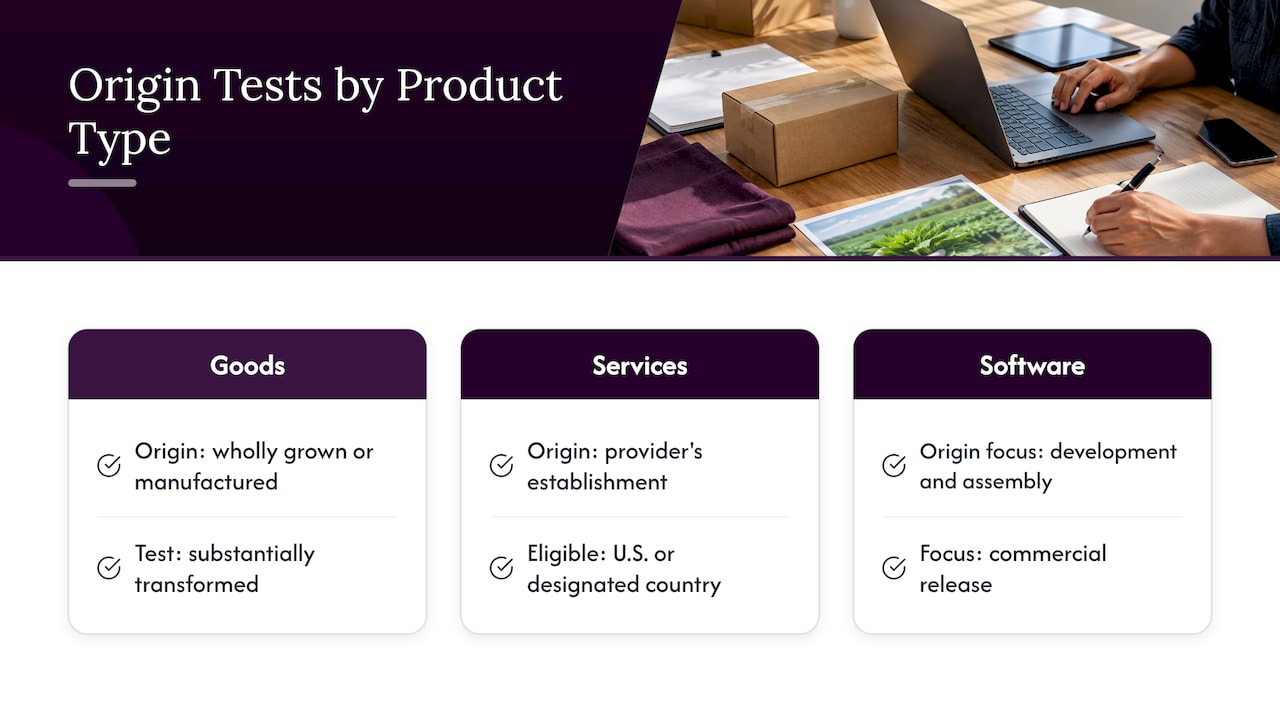
The governing definition sits in 19 CFR 177.22. An article is a product of a country if it is wholly the growth, product, or manufacture of that country. If it includes materials from another country, it must have been substantially transformed into a new and different article of commerce with a distinct name, character, or use.
That second test is where most questions come from. Here is how to apply it:
- Map the supply chain. List where each major component is made and where the final assembly or processing happens.
- Ask whether the final step changed the item. Simple packaging, labeling, or minor assembly generally does not create a new article. A process that turns inputs into something with a different name, character, or use does.
- Identify the country of that transformation. That country is the origin, even if some inputs came from elsewhere.
- Compare it with the designated list. If the country is the U.S. or a designated country, the item can be offered.
- Record the evidence. Keep manufacturer statements, bills of materials, and sourcing records in your file.
A worked example
Say you sell a branded industrial sensor. The housing is molded in a non-designated country, but the circuit board is built, programmed, and assembled with the housing into a finished, calibrated unit in a designated country. The question is whether that final work created a new and different article. If it did, the designated country is the origin. If the factory merely boxed a finished sensor made elsewhere, the origin stays with the country that made the finished sensor.
Cases at the margin are why contractors document the reasoning and not just the conclusion. Our guides on how to calculate domestic content for GSA contracts and how to source materials for GSA compliance walk through the record-keeping side.
If you resell someone else’s product
Resellers do not get to guess. GSA’s Contractor Reference Guide says resellers must obtain origin information from the original equipment manufacturer, and that you compare where items are produced or substantially transformed against the designated-country list in FAR 25.003. Get that statement in writing before you build your price list.
How does country of origin work for services and software?
Services follow a different test than goods. A GSA change order published on acquisition.gov explains that for services, the country of origin is where the service provider is established, citing FAR 25.402(a)(2). A U.S. company staffing a project with its own U.S.-established firm is on solid ground. A service delivered through a provider established in a non-designated country is not.
The Congressional Research Service summarizes the same split: for goods the question is wholly made or substantially transformed, and for services the question is whether the providing firm is established in the U.S. or a designated country. It also lists exclusions, such as small-business set-asides, arms and war materials, and certain services like research and development and utilities.
Software sits between the two. Contractors selling software or software-as-a-service should expect the origin question to center on where the product is developed and assembled into its commercial release. Because that treatment can turn on facts specific to your engineering team, map where your developers are established before you list the offering, and confirm the position against the solicitation language.
Which countries are TAA-designated, and where do I verify the list?
Do not rely on a blog’s list, including a summary like ours. The authoritative source is FAR Subpart 25.4, and GSA maintains a page to look up Trade Agreements Act-designated countries. That page points to FAR Subpart 25.4 and notes there are exceptions to the TAA under FAR 25.401(a).
Designated countries fall into four groups, per the CRS report: parties to the WTO Government Procurement Agreement, certain U.S. free trade agreement partners, least developed countries, and Caribbean Basin countries. Membership changes over time, so check the current FAR text on the day you prepare an offer. Countries that are not on the list, such as China and India, are the ones most often behind a rejected product.
For a readable country-by-country reference, see our TAA compliant countries list and the overview what businesses must know about trade agreement countries. Treat them as a starting point and confirm against FAR.
When does the TAA apply, and how is it different from the Buy American Act?
Both laws deal with where products come from, but they work differently.
| Trade Agreements Act | Buy American Act | |
|---|---|---|
| What it does | Bars products and services from non-designated countries in covered purchases | Gives domestic end products a price preference |
| Covers services | Yes | No |
| Typical trigger | Estimated value above the TAA threshold | Above the micro-purchase threshold, generally $10,000, and below the TAA threshold |
| Result for a foreign item | Generally cannot be supplied | May still be bought if cheaper after the price evaluation |
These distinctions come from the CRS report on government procurement and international trade, which describes the Buy American price preference as 20% or 30% depending on whether the lowest domestic offer comes from a large or small business.
The TAA thresholds are set by the U.S. Trade Representative every two years. The CRS report shows that for the 2022 to 2023 period the WTO GPA threshold was $183,000 for supplies and services, with lower thresholds for certain free trade agreement partners. Later periods carry different figures, so look up the current numbers in FAR 25.402 rather than relying on an older table.
The point for a Schedule holder: GSA applies the TAA at the contract level. GSA’s reference guide states the TAA is incorporated in all MAS contracts under FAR clause 52.225-5 and applies whether you offer one product or thousands. You cannot assume a small order escapes it.
What if my product’s origin changes after award?
Manufacturers move production. A product that qualified when you were awarded can stop qualifying later, and the duty to catch that is yours. GSA’s Vendor Support Center says it is each Schedule contractor’s responsibility to make sure product information is accurate in the contract and on GSA Advantage for the life of the contract, and recommends reviewing country of origin periodically.
When you find an item that is not compliant, GSA’s Steps to Success guide says to immediately notify your contracting officer and request a modification to remove the product. Here is a routine that keeps you ahead of it:
- Set a review cycle. Re-confirm origin with each manufacturer on a fixed schedule, for example quarterly for fast-moving lines.
- Require notice from suppliers. Ask them in writing to tell you about any change in manufacturing location.
- Pull the item first, then fix it. If an item may be non-compliant, stop offering it while you verify.
- Submit the modification. Remove or correct the item through your modification process and update your catalog files so they match.
- Re-offer only when corrected and documented.
The same reference guide notes that products removed by GSA for listing origin inaccurately as “US” may be re-offered on a future modification once the origin is corrected. Our walkthroughs on removing products from a GSA Schedule and validating GSA contract data for compliance cover the mechanics.
Why accuracy matters more than speed
An origin certification is a representation to the government. A wrong one is not just a catalog error: it can raise False Claims Act exposure, and in serious cases suspension or debarment. If you are unsure whether a product qualifies, resolve it before you submit, not after an agency or a competitor raises it. For a legal opinion on a specific product, speak with a government contracts attorney.
How do I prepare my offer so origin is not the thing that slows me down?
Origin problems are one of the most common reasons an offer stalls, because every line item is a separate claim. Build the file around the product list:
- One row per item. Part number, manufacturer, country of origin, and the basis for that country.
- Written manufacturer confirmation for every item you resell.
- A bill of materials for anything you assemble or finish yourself.
- A services statement showing the firm that provides each service and where it is established.
- Consistent data everywhere. The country on your price list, product file, and catalog must match.
This is also where a first-time applicant benefits from help. Mapping products to the right categories, building the price list, and assembling the documentation is the work we do for clients. Our model is that clients spend roughly three hours of their own time, and we handle the paperwork.
Perspective
Most origin trouble we see in the application process starts before anyone touches a form. A business assumes that “we assemble it in the U.S.” or “the supplier says it’s fine” settles the question. Then the product list grows, the supplier changes factories, and the file no longer says what the contract says.
Our view is that origin should be built into the offer from day one: every item mapped, every claim backed by a document, every change routed through a modification. Done that way, the TAA is a checklist you finish once and maintain, not a risk that sits over your contract.
That is why we pair application work with maintenance. Our modification plans, from one modification a year at $99 per month, exist so that a sourcing change becomes a routine update rather than an emergency.
Josh
How can we help with the GSA Schedule application and upkeep?
If your products and services pass the origin test and you want an award without spending months on paperwork, our application services cover eligibility assessment, documentation, price list development, category mapping, and negotiation support. Our offering is structured as payment after approval, no award, no fee. See the full-service GSA contract options or the application packages.
After award, our maintenance plans cover contract modifications for $99 per month with one modification a year, $159 with two, $219 with three, $279 with four, and from $339 for a custom number. A modification is how you add, correct, or remove products when sourcing changes.
If you prefer to run the process yourself, our GSA DIY Quick Start is built for that.
Not sure your products qualify? Start with a free eligibility check at gsascheduleservices.com.
FAQ
Does the TAA apply to every item on my GSA Schedule?
Yes, in general. GSA states the TAA applies to MAS offerings unless the solicitation or contract says otherwise, and it covers every product you offer, whether one or 10,000. Services are covered too. Exceptions exist under FAR 25.401(a), so confirm the exception applies to your case before relying on it.
How do I find out if a country is TAA-designated?
Use GSA’s lookup page, which points to FAR Subpart 25.4 and the country list in FAR 25.003. Check it on the day you prepare your offer, because the list can change. Our TAA compliance overview explains how to read it.
Can I sell a product made in China or India on a GSA Schedule?
Not if China or India is the country of origin under the substantial transformation test. Neither is a designated country. A product can qualify if it was substantially transformed into a new and different article in the U.S. or a designated country, which is why the origin analysis is done per item with documentation.
What should I do if a supplier moves production?
Stop offering the affected item until you confirm its new origin. If it no longer qualifies, notify your contracting officer immediately and request a modification to remove it. A maintenance plan lets us handle that modification for you.
Can you check whether my business is ready before I apply?
Yes. We offer a free eligibility check, including a first look at whether your products and services meet the origin requirements. Start from our home page.
Sources
- Trade Agreement Act (TAA) Compliance, GSA Vendor Support Center
- Trade Agreements Act compliance and supply chain security on MAS, GSA
- 19 CFR 177.22 Definitions, eCFR
- GSA order on the Trade Agreements Act, acquisition.gov
- Look up Trade Agreements Act-designated countries, GSA
- U.S. Government Procurement and International Trade, Congressional Research Service (PDF)
- U.S. Government Procurement and International Trade, Congressional Research Service (HTML)
- Contractor Reference Guide, Steps to Success, GSA
Recommended
- TAA Compliance 2026: Countries List, Rules & Checklist
- Trade Act Agreement Countries: What Businesses Must Know
- TAA Compliant Countries: Complete Designated List (2026)
- Navigating Buy American Act Exceptions in GSA