

Trade Act agreement countries are nations designated under the U.S. Trade Agreements Act (TAA), whose products qualify for federal government procurement when wholly manufactured or substantially transformed within their borders. For business owners and trade professionals pursuing GSA Schedule contracts, knowing which countries fall under this designation is not optional. It determines whether your products are even eligible to sell to the federal government. The TAA currently recognizes over 60 nations with reciprocal government procurement agreements, including the United Kingdom, Japan, Singapore, Canada, and all WTO Government Procurement Agreement member states.
Which countries are designated under the Trade Agreements Act?
The TAA-compliant country list is built from four distinct categories, and understanding each one matters because the rules governing them differ. According to the TAA country framework, the full list spans roughly 120 to 140 nations when all categories are combined. That number surprises most business owners who assume the list is short.
The four categories are:
- WTO Government Procurement Agreement (GPA) parties. These are countries that have signed the WTO’s plurilateral agreement on government procurement, including the European Union member states, Japan, South Korea, Singapore, Canada, and the United Kingdom. GPA membership is the most common path to TAA designation.
- Free Trade Agreement (FTA) partners recognized under TAA. Not every U.S. FTA partner qualifies automatically. The TAA specifically recognizes FTA partners whose agreements include government procurement provisions. Australia, Chile, Colombia, and Morocco are examples.
- Caribbean Basin countries. Nations designated under the Caribbean Basin Economic Recovery Act, such as Jamaica, Barbados, and Costa Rica, receive TAA-compliant status for most federal procurement purposes.
- Least Developed Countries (LDCs). The United Nations-designated LDCs, including Afghanistan, Haiti, and several sub-Saharan African nations, are included as a matter of U.S. trade policy to support economic development.
| Category | Examples | Basis for Designation |
|---|---|---|
| WTO GPA parties | UK, Japan, South Korea, EU states | Multilateral procurement agreement |
| FTA partners | Australia, Chile, Colombia, Morocco | Bilateral trade agreement with procurement chapter |
| Caribbean Basin countries | Jamaica, Barbados, Costa Rica | Caribbean Basin Economic Recovery Act |
| Least Developed Countries | Haiti, Afghanistan, Tanzania | UN LDC designation |
The USTR and the Federal Acquisition Regulation (FAR) maintain and update these lists. The FAR updated TAA thresholds effective March 13, 2026, which means contract applicability thresholds shifted slightly, affecting which procurements trigger TAA requirements at all. Staying current with FAR updates is not a one-time task. It requires ongoing attention.
Pro Tip: Check the USTR’s official designated country list at least twice a year. Countries can gain or lose status based on trade negotiations, and a sourcing decision made in January may be non-compliant by July.
How do Trade Act agreements affect eligibility for U.S. federal procurement?
TAA compliance for federal procurement rests on one central rule: a product must be either wholly manufactured in a designated country or substantially transformed there. Substantial transformation means the product undergoes a fundamental change in name, character, or use within that country. This is where most compliance failures happen.

Consider a laptop assembled in China using components sourced from South Korea and Germany. Even if the final assembly occurs in a TAA-compliant country, the product’s country of origin for TAA purposes depends on where the transformation that created the laptop as a distinct product occurred. Simply routing components through a compliant country does not satisfy the rule. The most common compliance error is assuming that transit or minor assembly in a TAA country is sufficient. It is not.
For your supply chain, this means documentation is everything. You need records showing:
- Where each major component was manufactured
- What transformation occurred in the designated country
- How that transformation changed the product’s name, character, or use
- Supplier certifications confirming country of origin at each stage
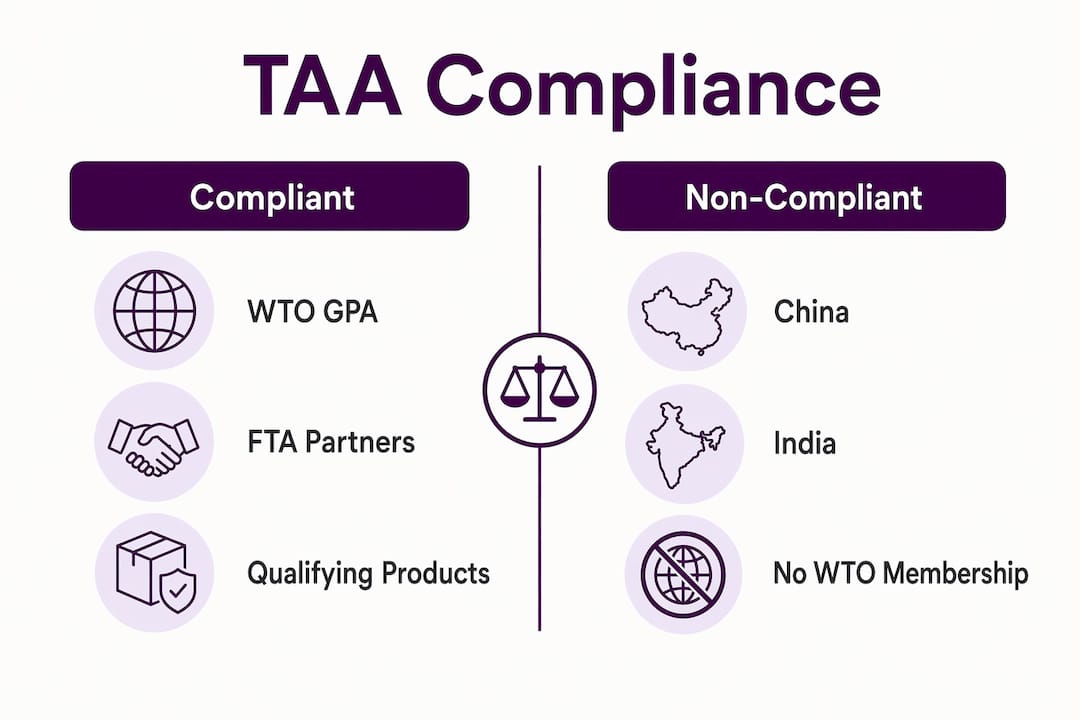
China, India, Russia, and Brazil are not TAA compliant because they lack WTO GPA membership and do not have qualifying FTAs with the U.S. Products assembled primarily in these countries are ineligible for TAA-covered federal contracts, regardless of where the components originated. This disqualifies a significant portion of global manufacturing capacity from federal procurement channels.
The consequences of non-compliance are serious. Contract termination, repayment demands, and debarment from future federal contracting are all possible outcomes. Agencies like the GSA conduct audits, and false certifications can trigger False Claims Act liability.
Pro Tip: Commission a supply chain audit before submitting your GSA Schedule offer. Map every product back to its country of origin and document the transformation process. Fixing compliance gaps after award is far more costly than preventing them upfront. The TAA compliance guide from Gsascheduleservices walks through this process step by step.
What are key differences between compliant and non-compliant nations?
The distinction between TAA-compliant and non-compliant countries is not about economic size or trade volume. China is the world’s largest goods exporter, yet it is non-compliant. The determining factor is whether a country has a reciprocal government procurement agreement with the United States, either through the WTO GPA or a qualifying FTA.
| Country | TAA Compliant? | Reason |
|---|---|---|
| United Kingdom | Yes | WTO GPA member |
| Japan | Yes | WTO GPA member |
| Australia | Yes | U.S.-Australia FTA with procurement chapter |
| Germany | Yes | EU member, WTO GPA party |
| China | No | Not a WTO GPA member, no qualifying FTA |
| India | No | Not a WTO GPA member, no qualifying FTA |
| Brazil | No | Not a WTO GPA member, no qualifying FTA |
| Russia | No | Not a WTO GPA member, sanctioned |
The Section 301 of the Trade Act of 1974 adds another layer of complexity. USTR uses Section 301 to investigate and impose tariffs on countries engaged in unfair trade practices. As of March 2026, four active investigations address excess industrial capacity in 14 countries and forced labor practices in 59 countries plus the EU. This means a country could be TAA-compliant for procurement purposes while simultaneously facing Section 301 tariffs on specific product categories. Trade professionals must track both frameworks independently.
For businesses, the practical implication is clear. If your manufacturing base is concentrated in China or India, you face a structural barrier to federal contracting that cannot be resolved through paperwork alone. Shifting production or finding compliant subcontractors in GPA member states is the only path forward. This is a supply chain strategy decision, not just a compliance checkbox.
How do evolving international trade agreements shape the designated country list?
The list of trade act agreement countries is not static. Global trade partnerships shift, new bilateral trade agreements enter force, and geopolitical realignments change which nations qualify. Business owners who treat the TAA country list as fixed are operating on outdated assumptions.
Several trends are reshaping the list right now:
- Reciprocal regionalism is replacing unilateral preferences. Developing nations are increasingly pursuing reciprocal regional trade agreements over unilateral preference schemes, prioritizing permanent market access through frameworks like CPTPP accession. This shift could bring new countries into TAA-eligible status as they formalize reciprocal procurement commitments.
- Modern trade deals go beyond tariffs. The UK-GCC agreement in 2026 is a clear example. That deal addresses digital trade, labor mobility, and sustainability alongside traditional tariff reduction, and it is projected to add £3.7 billion annually to UK trade. Deals structured this way signal that future TAA-eligible countries may enter through digital trade frameworks rather than traditional goods-focused agreements.
- Technology and data flow commitments are becoming standard. Modern trade deals now integrate commitments on digital data flow and sustainability, which means the scope of what trade agreements govern is expanding well beyond physical goods.
- CPTPP expansion is worth watching. Countries like the United Kingdom have formally joined the Comprehensive and Progressive Agreement for Trans-Pacific Partnership. As more nations accede, the web of reciprocal trade relationships grows, potentially creating new pathways to TAA designation.
- Geopolitical shifts can remove countries from the list. Russia’s removal from favorable trade status following 2022 sanctions is a recent example. A country’s TAA status can disappear quickly when diplomatic relationships deteriorate.
For trade professionals, the strategic move is to build sourcing flexibility into your supply chain. Locking into a single manufacturing country creates vulnerability when trade relationships shift. Diversifying production across multiple TAA-compliant nations, particularly GPA members, provides a buffer against designation changes.
Key takeaways
TAA compliance for federal procurement depends entirely on whether your products originate in designated countries and whether substantial transformation occurred there, not on where components were sourced or assembled.
| Point | Details |
|---|---|
| Know your four categories | TAA-compliant countries span WTO GPA parties, FTA partners, Caribbean Basin nations, and LDCs. |
| Substantial transformation is the core test | Products must change in name, character, or use within a designated country to qualify. |
| China, India, and Brazil are excluded | These major manufacturing hubs lack WTO GPA membership and qualifying FTAs with the U.S. |
| FAR thresholds updated in 2026 | New threshold values effective March 13, 2026 affect which contracts trigger TAA requirements. |
| The list changes with global trade shifts | New agreements and geopolitical events can add or remove countries from TAA-eligible status. |
Why compliance strategy matters more than the country list itself
I have worked with dozens of businesses that spent months building a GSA Schedule offer, only to discover their flagship product was manufactured in a non-compliant country. The frustration is real, and it is almost always avoidable. The country list is publicly available. The substantial transformation rule is documented in FAR Part 25. The problem is not access to information. It is the assumption that compliance is someone else’s job until it becomes a crisis.
What I have found actually works is treating TAA compliance as a supply chain design constraint from day one, not a legal review at the end. When you source a new product or engage a new manufacturer, the first question should be country of origin, not price. Businesses that build this habit catch problems before they become contract disqualifications.
The other mistake I see constantly is over-relying on supplier certifications without verification. A supplier in a compliant country can still produce a non-compliant product if the actual transformation occurred elsewhere. Certificates of origin are a starting point, not a finish line. The common compliance mistakes I see repeat across industries because businesses trust paperwork over process.
One more thing worth saying directly: the evolving nature of international trade agreements means your compliance status today is not guaranteed tomorrow. The UK’s post-Brexit GPA accession, CPTPP expansion, and ongoing Section 301 investigations all have the potential to change the rules. Build a review cycle into your procurement calendar. Staying current with compliance during expansion is a discipline, not a one-time task.
— Josh
How Gsascheduleservices helps you get TAA compliance right
Gsascheduleservices specializes in helping small and medium-sized businesses secure GSA Schedule contracts with full TAA compliance from the start. If you are unsure whether your products qualify under the Trade Agreements Act, or if you need help documenting substantial transformation for your supply chain, Gsascheduleservices provides readiness assessments, compliance audits, and paperwork support designed to get you to award faster. Explore the GSA contract eligibility guide to understand where your business stands, or visit the discovery page to connect with a specialist who can map your products to the right compliance pathway.
FAQ
What are trade act agreement countries?
Trade act agreement countries are nations designated under the U.S. Trade Agreements Act whose products are eligible for federal government procurement. The designation covers WTO GPA members, qualifying FTA partners, Caribbean Basin countries, and UN-designated Least Developed Countries.
Is China a TAA-compliant country?
China is not TAA compliant. It is not a WTO GPA member and does not have a qualifying free trade agreement with the United States, making products primarily manufactured there ineligible for TAA-covered federal contracts.
What does substantial transformation mean for TAA compliance?
Substantial transformation means a product undergoes a fundamental change in name, character, or use within a designated TAA country. Simply assembling or routing components through a compliant country does not satisfy this requirement without documented evidence of that transformation.
How often does the TAA-compliant country list change?
The list updates when new trade agreements enter force, countries join or leave the WTO GPA, or U.S. trade policy shifts. The USTR and FAR maintain the official lists, and businesses should review them at least twice a year to catch any changes affecting their sourcing decisions.
What happens if a contractor sells non-compliant products on a GSA Schedule?
Selling non-compliant products on a GSA Schedule can result in contract termination, repayment of government funds, and potential False Claims Act liability. Agencies conduct audits, and false certifications of TAA compliance carry serious legal and financial consequences.
Recommended
- Which Countries are Trade Agreement Act Compliant End Products?
- TAA Compliant Products: Everything You Need to Know
- 5-Step TAA Compliance Mastery: Get GSA Products Approved
- What does my company need to do to become TAA compliant? A Comprehensive Guide