

Bid only when three conditions line up: you can meet every mandatory term in the solicitation, you have a credible win story against the stated evaluation criteria, and the numbers and cash flow work in your favor. If any one of those fails, write down why, then redirect that capture effort toward subcontracting, a GSA Schedule, or a better-fitting opportunity down the road.
TL;DR:
- If you are not confident in meeting all mandatory requirements and differentiating factors, it is better to avoid bidding and consider subcontracting or GSA Schedule options.
- When evaluating a bid opportunity, assess compliance, technical fit, competitive landscape, and financial feasibility to avoid pursuing contracts that could harm your business.
- In a sealed bid process, price is the decisive factor, while negotiated contracts favor strong technical value with higher proposals; tailor your strategy accordingly.
- Running accurate cost, cash flow, and capacity checks before bidding ensures you do not overestimate your ability to deliver profitably, especially with tight working capital.
- Relying on bid protests as a backstop is risky because procedural strictness often prevents success if proposals are incomplete or late.
Table of Contents
- A 10-Minute Bid/No-Bid Checklist
- A Repeatable 6-Step Bid/No-Bid Decision Framework
- How Does the Government Actually Evaluate Your Proposal?
- What Financial and Capacity Checks Should You Run First?
- What Should You Know About Protests and Timeliness Before You Rely on One?
- How Do Experienced GSA Consultants Screen Opportunities Before Bidding?
- What Do Most Contractors Get Wrong About This Decision?
- How Can We Help You Screen Opportunities and Build a GSA Strategy?
- FAQ
- Sources
A 10-Minute Bid/No-Bid Checklist
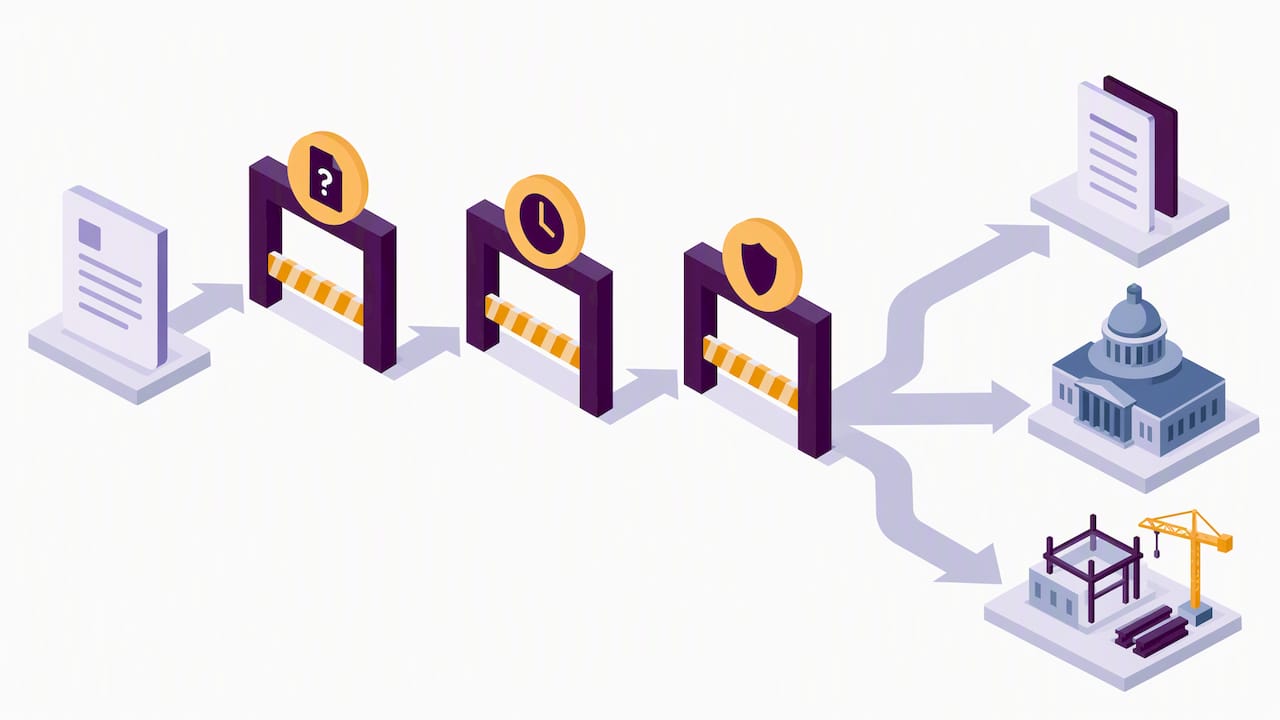
Before you spend capture hours on a solicitation, run it through a fast triage. This will not replace a full decision process, but it tells you in minutes whether an opportunity deserves more time at all.
- Mandatory requirement gate: Check certifications, bonding capacity, and delivery or performance windows against what the solicitation actually demands.
- Capability fit: Confirm your technical scope, past performance, and key personnel match what the agency is asking for, not what you wish they were asking for.
- Win factors: Identify at least one differentiator that maps directly to the stated evaluation criteria, not a generic strength.
- Cost-to-bid and margin check: Estimate what the proposal will cost you to write and whether the likely award supports an acceptable margin.
- Resource availability: Verify your team has the bandwidth to both write the proposal and deliver the work if you win.
- Procurement type: Note whether this is a sealed bid (IFB) or a negotiated procurement (RFP), since that changes what actually wins.
- Alternate pathways: Consider whether subcontracting or pursuing a GSA Schedule gets you closer to the same revenue with less risk.
If you fail the mandatory gate or can’t name a real differentiator, stop there. No amount of pricing cleverness fixes a proposal that is non-responsive or indistinguishable from the next ten bidders. The remaining items, cost, resources, and procurement type, matter most when the first two checks pass and you’re deciding how hard to push.
A Repeatable 6-Step Bid/No-Bid Decision Framework
A checklist catches obvious disqualifiers. A framework gives you something you can run the same way every time, score consistently, and defend later when someone asks why you passed on an opportunity.
- Compliance quick-scan. Read the solicitation’s mandatory terms first: certifications, security clearances, bonding, delivery timelines, set-aside eligibility. This is pass or fail. A single missed mandatory term usually ends the pursuit regardless of how attractive the contract looks.
- Capability scoring. Assign simple weights to technical match, past performance, and staffing availability, something as basic as a 1 to 5 scale on each factor works fine. A contract that scores low across all three rarely becomes a strong bid no matter how much effort you add later.
- Competitor and market intelligence. Look at who else is likely bidding, whether an incumbent holds the work now, and what pricing posture has won similar awards before. This step keeps you from overestimating your odds against a well-entrenched incumbent.
- Proposal and delivery economics. Estimate your direct bid cost (capture hours, subcontractor quotes, proposal writing time) against your margin floor and working capital needs once you’re performing the contract. A contract you can win but can’t finance isn’t a win.
- Decision gate. Set a minimum win-probability threshold and an acceptable margin floor before you start, not after you’ve already sunk hours into the proposal. If the opportunity doesn’t clear both, it’s a no-bid, even if it’s tempting.
- Decision documentation and fallback plan. Record why you bid or didn’t, and note the fallback: team with a prime as a subcontractor, pursue the same agency’s needs through a GSA Schedule, or wait for the next cycle.
Pro Tip: Score every opportunity the same way, even the ones that feel like obvious yeses. The discipline catches the deals that look good on the surface but fail your own thresholds underneath.
This process does double duty. It filters out bad pursuits before they cost you money, and it builds a record you can review later to see which win-probability signals actually predicted outcomes. Teams that skip step 6 tend to repeat the same mistakes, chasing contracts that felt promising for reasons that never held up.
How Does the Government Actually Evaluate Your Proposal?
The evaluation method the agency uses changes what wins, and that should shape your bid/no-bid call before you write a single page.
- Sealed bidding (FAR Part 14) is strictly price-driven. The lowest responsive, responsible bidder wins, and a bid that doesn’t conform exactly to the invitation’s terms gets rejected as non-responsive, no exceptions for a compelling narrative.
- Negotiated procurements (FAR Part 15) allow tradeoffs. An agency can accept a higher-priced proposal if it demonstrates better technical value, and the source selection authority documents that tradeoff under 48 CFR § 15.308.
- Evaluation formats vary. Agencies score proposals using adjectival or color ratings, numerical weights, or ordinal rankings, and the method is usually spelled out in Section M of the solicitation.
An agency can lawfully pay more for a proposal it judges a better value, under the tradeoff process documented in 48 CFR § 15.308, which matters directly to your pricing strategy.
The practical takeaway: in a negotiated procurement, a sharp value proposition can beat a lower-priced competitor. In an IFB, it can’t. If you’re pricing aggressively to win a sealed bid, that’s the only lever that matters. If you’re writing a technical proposal for an RFP, your differentiation has to show up in the evaluation criteria itself, not just in your cover letter.
What Financial and Capacity Checks Should You Run First?
The technical fit question gets most of the attention, but the financial math is what actually determines whether winning the contract helps your business or drains it.
- Estimate your real bid cost, including capture hours, proposal writing time, and any subcontractor quotes you need to assemble before submission.
- Map the delivery model’s cash flow: billing cadence, mobilization costs, and payment terms all affect how long you’re carrying costs before the government pays you.
- Check bonding and insurance requirements against your current capacity. A performance bond or increased insurance limit can tie up working capital you didn’t plan for.
- Set a minimum acceptable margin before you bid, and weigh the opportunity cost of pursuing this contract against other pipeline work your team could chase instead.
- Consider whether a GSA Schedule or subcontracting role gets you comparable revenue with lower upfront cost and risk, which the SBA’s contracting guidance points to as a common early-stage strategy for firms building a federal track record.
A contractor evaluating its cost model might lean on dedicated construction proposal software to speed up estimating and keep bid costs from eating the margin before work even starts. If your working capital is tight, winning a contract you can’t finance through to the first payment milestone is often worse than not bidding at all.
What Should You Know About Protests and Timeliness Before You Rely on One?
Many contractors treat a bid protest as a backstop if they lose. That’s a risky assumption, because protest rules are strict and unforgiving.
- Protest timelines are rigid. In many cases you must protest before bid opening to preserve certain rights, and GAO’s bid protest guidance lays out the procedural windows that apply.
- GAO routinely denies protests tied to proposal defects. A GAO decision involving RKE Contractors confirmed that the burden sits with the offeror to submit a complete, clearly written proposal. Missing resumes, dates, or points of contact can justify exclusion outright.
- Late submissions and missing information are common, avoidable grounds for rejection. Courts and GAO usually uphold these rejections when the agency followed its own procedural rules.
- Protect yourself procedurally: keep submission receipts, request a debrief regardless of outcome, and document every communication with the contracting officer.
A well-documented no-bid is itself a strategic tool. Skipping a bad-fit opportunity and redirecting that capture time toward a stronger pursuit protects your win rate better than chasing every solicitation that crosses your desk, and it avoids relying on a protest process that was never designed to fix a weak proposal.
How Do Experienced GSA Consultants Screen Opportunities Before Bidding?
When we evaluate whether a prospective client is ready to pursue federal work, we start with the same fundamentals every contracting officer checks first: active Sam registration, a valid Unique Entity ID, small business status if applicable, and any mandatory certifications the target agencies require.
From there, we flag the same red flags that should concern any contractor: solicitations missing clear deliverable requirements, unrealistic performance timelines, or bonding and insurance jumps that would strain a firm’s working capital. When those signals show up, we often recommend pursuing a GSA Schedule or a subcontracting role instead of bidding directly, since both paths build past performance with less upfront financial exposure.
We typically provide readiness assessments, full documentation preparation, negotiation guidance with the contracting agency, and marketing strategy once a schedule is in place to help reduce the guesswork in these decisions before committing resources to a bid.
What Do Most Contractors Get Wrong About This Decision?
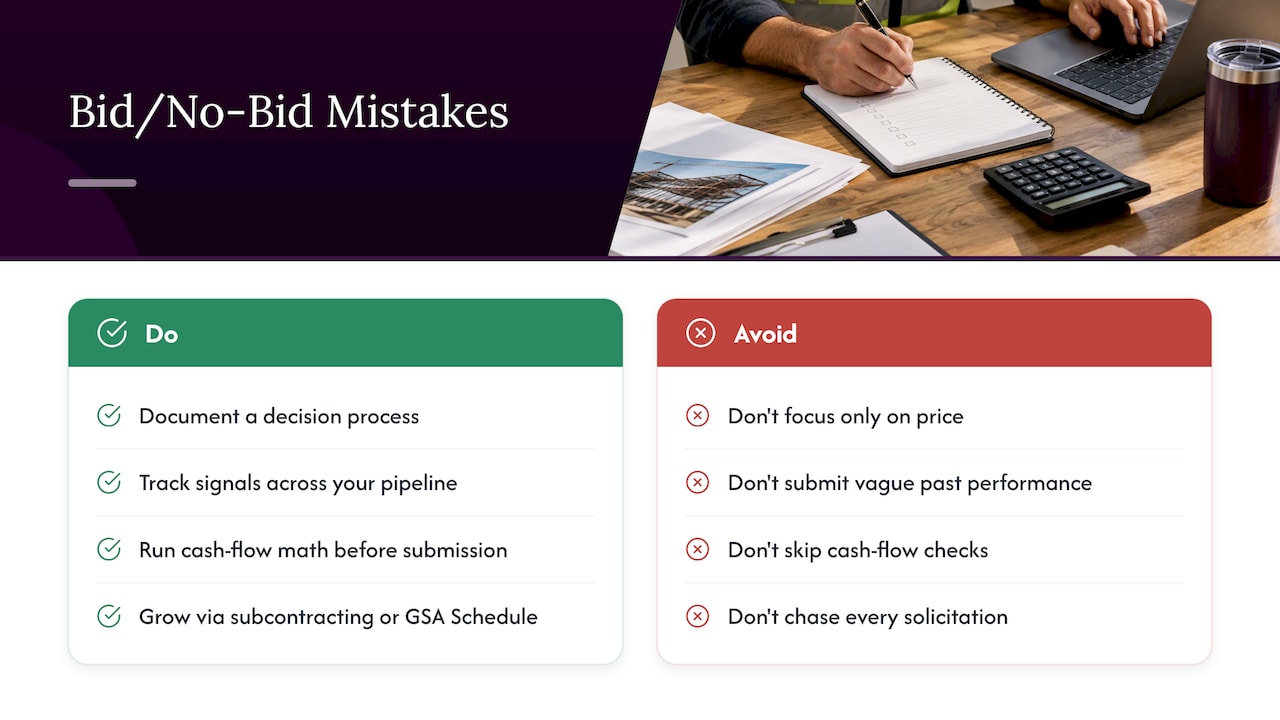
The most avoidable mistakes I see are not pricing errors. They’re unclear past performance narratives and underestimating the cash a contract actually requires once you win it. A proposal can score well technically and still fail because the past performance section doesn’t connect to the specific evaluation factors, or because nobody ran the cash flow math before submission.
A documented decision process fixes more than any single bid. It builds a record you can study across your pipeline, showing which signals actually predicted a win and which ones just felt promising. Growing into larger federal work through subcontracting or a GSA Schedule, rather than chasing every open solicitation, tends to build a sturdier track record over time.
— Josh
How Can We Help You Screen Opportunities and Build a GSA Strategy?
Running the bid/no-bid framework above takes real time, and getting your GSA Schedule in place to support it takes most small businesses two or more years when handled alone. Clients who work with us often experience an accelerated award process and reduced time spent on documentation, negotiation, and compliance tasks because we handle these services directly.
- Readiness assessments that confirm your SAM registration, certifications, and eligibility before you invest more time.
- Full documentation and negotiation support through our Startups, Specialty, and Streamline packages, built for small and medium businesses pursuing their first schedule.
- Ongoing maintenance and modification support once your schedule is active, so compliance doesn’t become its own bid/no-bid problem later.
If you’re unsure whether a GSA Schedule fits your bid strategy, start with a free eligibility check and we’ll walk through what makes sense for your business before you commit to anything.
FAQ
Are no-bid decisions illegal for government contractors?
No. Declining to bid on a solicitation is a normal business decision and carries no legal risk for a contractor. The only legal concerns arise around collusion or anticompetitive agreements between competitors, not an individual firm’s choice to pass on an opportunity.
What are the three types of bids in government contracting?
The main categories are sealed bids (IFBs) under FAR Part 14, which are price-driven and require strict conformance, and negotiated proposals (RFPs) under FAR Part 15, which allow tradeoffs between price and technical value. A third common path is simplified acquisitions for smaller-dollar purchases, which use streamlined procedures outside full IFB or RFP processes.
How do I start bidding on government contracts in the United States?
Register your business in SAM.gov and obtain a Unique Entity ID, then review solicitations through official procurement channels to find opportunities matching your NAICS codes. Many small businesses build initial past performance through subcontracting or a GSA Schedule before pursuing prime contracts directly, a path the SBA’s contracting guidance recommends for firms new to federal work.
What are the typical steps in the government bidding process?
The general sequence runs from identifying a relevant solicitation, through a bid/no-bid decision, proposal preparation and submission, agency evaluation, and finally award or debrief. Evaluation methods differ by procurement type: sealed bids are judged on price and responsiveness, while negotiated proposals are scored against weighted or adjectival criteria documented under 48 CFR § 15.308.
Does GSAScheduleServices help with bid/no-bid decisions directly?
Our core services focus on GSA Schedule acquisition and maintenance rather than bidding on individual solicitations, but a GSA Schedule often removes the need to bid at all for many commercial sales to federal buyers. We also offer readiness assessments that help contractors judge whether pursuing a schedule is a better fit than chasing a specific open bid.
Sources
- 48 CFR § 15.308 – Source selection decision
- FAR Part 14 — Sealed bidding
- RKE Contractors (B-421465.3) GAO decision
- SBA contracting guide — how to win contracts
- GAO — Bid Protests at GAO: A Descriptive Guide
Recommended
- 90 Minute GSA Bid or No Bid Checklist for U.S. SMBs
- Go / No-Go Decision for a Government Bid
- Avoid These Common Mistakes When Bidding on a U.S. Government Contract
- Small Business Set Aside: What Owners Need to Win