

A small business set-aside reserves a federal procurement so only qualified small businesses can compete, under authority spelled out in FAR Subpart 19.5. Three things matter immediately. First, dollar thresholds control when set-asides apply: the micro-purchase threshold sits at $15,000 and the simplified acquisition threshold at $350,000. Second, above the micro-purchase threshold and up to $350,000, contracting officers must set aside the work unless they determine there’s no reasonable expectation of getting offers from at least two responsible small businesses at fair prices, a standard known as the Rule of Two. Third, you need to act before you bid, not after.
Thresholds that trigger a set-aside:
- Below $15,000 (micro-purchase threshold): no set-aside requirement, though many agencies still favor small businesses informally
- $15,000 to $350,000 (simplified acquisition threshold): set-aside is generally mandatory when the Rule of Two is met
- Above $350,000: contracting officers still apply the Rule of Two, but must first weigh socioeconomic set-aside programs like 8(a), HUBZone, SDVOSB, and WOSB
Do these three things before you spend another hour chasing a solicitation:
- Confirm your NAICS code and size standard in SAM.gov and make sure your certification is current.
- Check the solicitation itself for a set-aside designation, don’t assume based on the agency or past awards.
- Build or update a one-page capability statement with defensible pricing before you submit anything.
Key Takeaways
Winning small business set-aside work comes down to matching your NAICS-specific size status to the solicitation, proving a fair price, and showing up in market research before the RFP posts.
| Point | Details |
|---|---|
| Know your thresholds | Set-asides are generally mandatory for acquisitions above the micro-purchase threshold and up to the simplified acquisition threshold when the Rule of Two is met. |
| Verify NAICS-specific status | Size standards vary by NAICS code, confirm eligibility for each solicitation separately in SAM.gov. |
| Watch the clause numbers | Look for 52.219-6 (total) or 52.219-7 (partial) in the solicitation to confirm set-aside type. |
| Price defensibly | Fair market price is a hard guardrail; keep comparables and cost justification ready before you bid. |
| Get expert help when it counts | Gsascheduleservices maps NAICS/SIN codes, builds capability statements, and develops defensible pricing for set-aside readiness. |
Table of Contents
- What FAR Subpart 19.5 and SBA Guidance Require
- When Must Agencies Set Work Aside?
- Total, Partial, and Reserve Set-Asides Explained
- Who Decides and How the Process Unfolds
- What Small Businesses Must Prove to Compete
- Building a Competitive Bid Position
- When a Set-Aside Decision Feels Wrong
- Where to Find Set-Aside Opportunities and Award Data
- What I’ve Seen Trip Up Otherwise Strong Bidders
- Get Your GSA Schedule and Set-Aside Strategy Aligned
- Where to Verify the Rules Yourself
- Sources
- FAQ
What FAR Subpart 19.5 and SBA Guidance Require
The regulatory backbone here is short, but it rewards careful reading. FAR Subpart 19.5 covers total set-asides, partial set-asides, and reserves, and it tells contracting officers exactly when they’re required to restrict competition to small businesses.
Section 19.502 does the heavy lifting. It establishes that acquisitions between the micro-purchase and simplified acquisition thresholds should be set aside automatically when the Rule of Two is satisfied, and it gives contracting officers authority to set aside larger acquisitions too, provided the same two-bidder expectation holds. The same section also covers partial set-asides, splitting a requirement so one portion goes to small businesses while the rest is open, and reserves, which hold back a portion of a multiple-award vehicle for small business orders.
Section 19.504 addresses withdrawal and modification: if a contracting officer sets aside a procurement but later can’t justify the decision (say, market research turns up only one qualified small business), the set-aside can be pulled back. Section 19.505 deals with subcontracting limitations, and 19.506 covers modifications to set-asides already underway.
A set-aside cannot be used to justify an award above fair market price. If the small business offers come in too high relative to what the government would otherwise expect to pay, the contracting officer has grounds to reconsider the set-aside entirely.
That guardrail matters more than most bidders realize. It’s not enough to be the only qualified small business in the room. Your price still has to hold up against what a full and open competition would likely produce, which is why GSA Schedule pricing discipline carries weight even outside schedule-specific competitions.
On the clause side, contracting officers insert 52.219-6 for total set-asides and 52.219-7 for partial set-asides directly into the solicitation, per FAR 19.501. If you see neither clause, the acquisition isn’t set aside, no matter what informal signals suggest. SBA’s contracting officials guidance reinforces the same standard from the agency side: set aside when two or more responsible small businesses can perform at a fair price, and lean on set-asides and sole-source awards to help meet statutory small business procurement goals.
When Must Agencies Set Work Aside?
The math is simpler than it looks, but the judgment call underneath it isn’t. Below $15,000, agencies have no set-aside obligation, though many still default to small business sources informally. Between $15,000 and $350,000, the Rule of Two effectively makes set-asides the default; a contracting officer needs a documented reason to go a different direction. Above $350,000, the Rule of Two still applies, but the agency must first work through the ordering of socioeconomic programs, since FAR Part 19 requires considering 8(a), HUBZone, SDVOSB, and WOSB set-asides before falling back to a general small business set-aside.
“Reasonable expectation” is the phrase that decides everything, and it’s judged on more than headcount. The SBA’s own explanation of the Rule of Two makes clear that contracting officers assess capability, quality, and delivery capacity, not just whether two small firms exist on paper. A contracting officer looking for two “responsible” small businesses wants evidence they can actually perform, not just that they’re registered under the right NAICS code.
Market research indicators that push a contracting officer toward a set-aside include:
- Multiple small businesses holding relevant contracts on similar past requirements
- Active small business responses to a Sources Sought notice or RFI
- Strong small business presence visible in FPDS award history for the same NAICS code
- SAM.gov registrations showing qualified firms with matching size standards and past performance
- Industry day attendance skewed toward small business representation
If none of that shows up, a contracting officer has cover to proceed unrestricted, and no amount of post-hoc lobbying from a small business changes that after the solicitation posts. This is exactly why showing up early in market research, before the solicitation is drafted, matters more than most owners assume.
Total, Partial, and Reserve Set-Asides Explained
These aren’t interchangeable terms, and mixing them up leads to wasted bid effort.
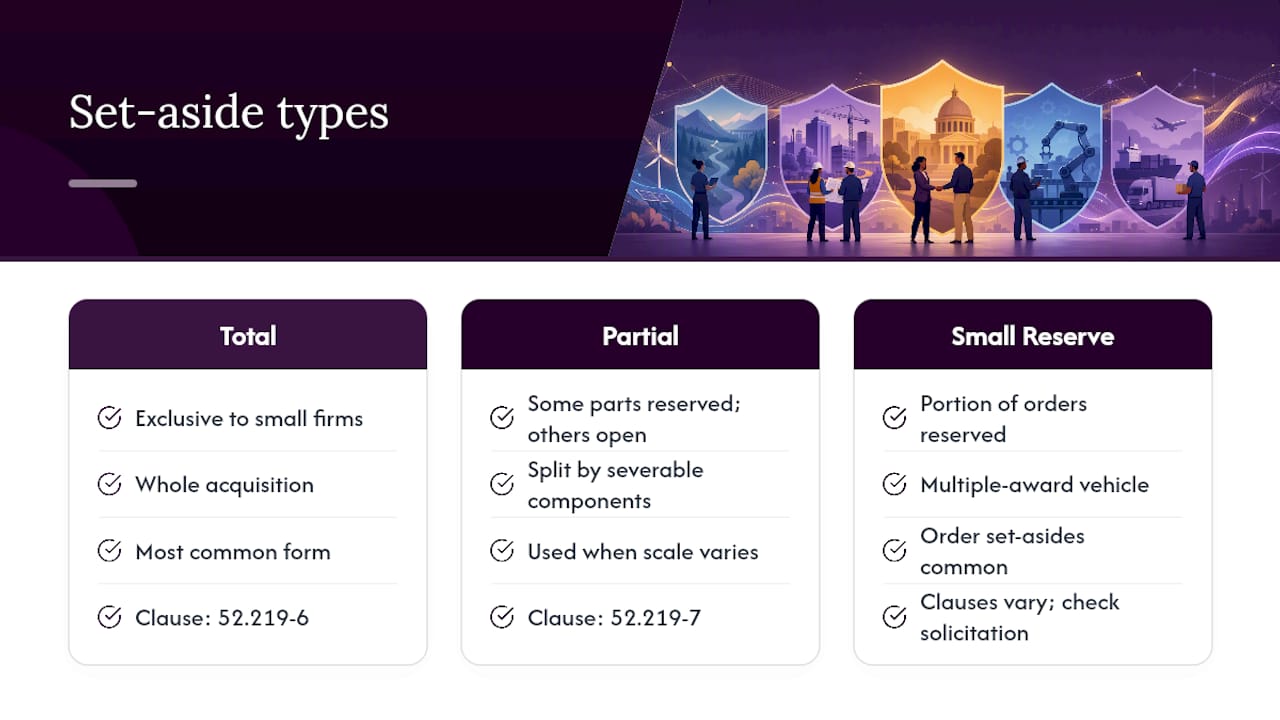
A total set-aside restricts the entire acquisition to small businesses. Nobody outside that pool can even submit a proposal. This is the most common form and the one most owners picture when they hear “set-aside.”

A partial set-aside splits a requirement into two or more parts, at least one reserved for small businesses and the rest open to all offerors. Agencies use this when a requirement has distinct, severable components, some suited to small business capacity and others requiring scale a small business can’t match.
A small business reserve works differently. It applies to multiple-award contracts, where a portion of future orders under the vehicle is set aside for small businesses even though the underlying contract itself was competed on a full and open basis. Order set-asides are the practical expression of this: individual task or delivery orders under an existing multiple-award contract get restricted to small business awardees among those already holding the contract.
The clauses tell you which category you’re in. FAR 19.501 requires 52.219-6 for total set-asides and 52.219-7 for partial set-asides. You’ll also see 52.219-13 for HUBZone-specific set-asides, 52.219-31 for the same in a WOSB context, and 52.219-33, the nonmanufacturer rule, whenever the acquisition involves supplies rather than services. Each clause changes your compliance obligations, so read the actual clause list in the solicitation rather than assuming based on the agency’s typical patterns.
Who Decides and How the Process Unfolds
The contracting officer makes the final call, but rarely in isolation. Agency small business specialists weigh in during acquisition planning, and the SBA assigns a Procurement Center Representative (PCR) to many agencies specifically to review proposed set-aside decisions and, where warranted, to recommend that an unrestricted acquisition be set aside instead. Per Subpart 19.5, agencies also document these recommendations and may apply internal thresholds for when SBA review is triggered.
The typical procedural sequence:
- Market research begins well before the solicitation drafts, often through Sources Sought notices or RFIs posted on SAM.gov
- The contracting officer, informed by that research and any PCR input, determines whether the Rule of Two is met
- The solicitation posts with the appropriate set-aside clause and NAICS code baked in
- Offers come in and get evaluated against the size standard tied to that NAICS code
- Award goes to the winning small business, or the set-aside gets withdrawn if the results don’t hold up
Withdrawal happens more often than owners expect. If a total set-aside draws no acceptable small business offers, the contracting officer must withdraw the set-aside and resolicit on an unrestricted basis if the requirement still stands. If exactly one acceptable small business offer comes in, the contracting officer can still award to that firm rather than resoliciting, provided the price is fair. Timelines vary widely by agency and complexity, but simplified acquisitions often move from posting to award in four to eight weeks, while larger set-asides can stretch several months once discussions and evaluations are factored in.
What Small Businesses Must Prove to Compete
Eligibility isn’t a one-time checkbox. It’s a status you have to defend every time you bid, and mismatches here are one of the most common reasons capable firms lose set-aside work they should have won.
Work through this sequence for every set-aside opportunity:
- Identify the exact NAICS code assigned to the solicitation, not just the code closest to your general business description.
- Confirm your size standard against that specific code. Size standards vary by industry, some based on employee count, others on average annual receipts, and a firm that’s “small” under one NAICS code can be “other than small” under another.
- Verify your small business status is current and accurate in SAM.gov, since self-certification errors are a leading cause of protests.
- Check whether the opportunity is further restricted to a socioeconomic category like 8(a), HUBZone, SDVOSB, or WOSB, and confirm your certification if you’re pursuing one of those.
- Review any applicable subcontracting limitations before you finalize your team.
The most common practical failure isn’t fraud, it’s carelessness. A firm checks its general “small business” designation once, forgets that size standards are NAICS-specific, and bids on a set-aside where it no longer qualifies under that particular code. That mismatch can disqualify an otherwise winning proposal.
The nonmanufacturer rule, implemented through clause 52.219-33, applies when a set-aside covers supplies rather than services. It allows a small business that doesn’t manufacture the end item itself to still qualify as the prime, provided it supplies the product of a small business manufacturer and meets other conditions in 19.505. A small office-supply reseller bidding on a set-aside for furniture, for instance, can rely on this rule instead of manufacturing furniture itself.
Subcontracting limitations work alongside this. Depending on the acquisition type, prime contractors on set-asides generally must perform a defined share of the work themselves rather than passing most of it to larger subcontractors. Misrepresenting size or status to get around these limits carries real consequences: contract termination, suspension or debarment, and potential False Claims Act exposure. Competitors can also file a size protest with the SBA if they believe an awardee misrepresented its status, and that protest can unwind an award after the fact.
Building a Competitive Bid Position
Rules only matter once you turn them into a plan you can execute this week. Here’s the order that actually moves the needle, based on what contracting officers consistently look for during market research and evaluation.
Start with registration and codes. An active, accurate SAM.gov registration is non-negotiable, and it needs to reflect every NAICS code your business realistically competes under, each mapped to the correct size standard. Sloppy or outdated SAM data is one of the fastest ways to get filtered out of consideration before a human even reads your proposal.
Build a one-page capability statement that does real work. A strong capability statement covers four things without padding: core competencies stated in plain language, past performance with contract numbers and dollar values where possible, differentiators that separate you from other small businesses in your NAICS space, and company data (UEI, CAGE code, socioeconomic certifications, size status). Contracting officers and small business specialists often use this single document to decide whether your firm belongs in their market research pool at all.
Get your pricing defensible before you need it. Because fair market price is a hard guardrail on every set-aside award, pricing that looks arbitrary or padded invites scrutiny, and pricing that’s too aggressive invites questions about your ability to deliver. Firms that already maintain disciplined GSA Schedule price lists tend to walk into set-aside competitions with a pricing structure they can already justify line by line, since the same commercial-pricing logic and market-based rate analysis applies. A service business pricing strategy built around comparable market rates, rather than internal cost-plus guesswork, holds up far better under evaluation.
Understand where a GSA Schedule fits and where it doesn’t. Holding a GSA Schedule doesn’t automatically make you eligible for every set-aside, but it interacts with set-asides in specific ways. Order set-asides under multiple-award vehicles, including certain GSA Schedule buys through GSA eBuy, let agencies restrict competition to small business schedule holders for individual task orders. If you already hold a schedule, that’s a faster path to set-aside work than competing from scratch on the open market, since your pricing and terms are pre-negotiated. If you don’t hold one yet, a schedule is worth evaluating as a longer-term play rather than something to chase for a single upcoming set-aside deadline.
Pro Tip: Keep a standing “price justification” file for every SIN or service line you offer, market comparables, past award data pulled from FPDS, and your own cost buildup. When a contracting officer questions your price on a set-aside, having that file ready turns a potential disqualification into a two-day clarification request.
When a Set-Aside Decision Feels Wrong
If you believe a solicitation should have been set aside and wasn’t, or that a set-aside was applied incorrectly, you have real options, but timing determines which ones stay open.
An agency-level protest goes to the contracting officer or the agency’s protest official and is usually the fastest route, often resolved in weeks. A GAO bid protest is the more common formal path for set-aside disputes and must generally be filed within 10 days of when you knew or should have known the basis for protest, or within 10 days of a required debriefing if you requested one. A protest at the Court of Federal Claims is available too, typically reserved for higher-stakes disputes or cases where GAO relief wasn’t sufficient.
Before filing anything, collect:
- Copies of the solicitation and any amendments showing set-aside designation or lack thereof
- Evidence of your own past performance and capability relevant to the NAICS code at issue
- Any market research documentation you can obtain, including Sources Sought responses
- Price comparisons showing your bid was reasonable relative to market rates
Weak documentation sinks otherwise valid protests more often than weak legal arguments do.
Where to Find Set-Aside Opportunities and Award Data
Three sources cover almost everything you need. SAM.gov is where solicitations post, and you can filter by NAICS code, set-aside type, and place of performance to narrow results fast. GSA eBuy is the place to watch if you hold a Schedule, since many order-level set-asides for services and products run exclusively through that portal. FPDS (Federal Procurement Data System) holds historical award data, contract values, and awardee names, which makes it the single best tool for benchmarking what similar set-asides actually paid.
Practical search filters worth setting up now:
- NAICS code plus set-aside indicator (Total Small Business, 8(a), HUBZone, SDVOSB, WOSB) in SAM.gov’s advanced search
- Agency and place-of-performance filters to spot recurring buyers in your sector
- FPDS pulls by NAICS code and fiscal year to see award value ranges and how many small businesses actually won
Pulling three to five recent FPDS awards in your NAICS code before you bid gives you a realistic price band and lets you cite real precedent in your capability statement, something most competitors skip.
What I’ve Seen Trip Up Otherwise Strong Bidders
The single most common failure isn’t a weak proposal, it’s a NAICS mismatch nobody caught until after the fact. A firm assumes its general small business status covers a solicitation, submits a strong technical response, and gets bounced in evaluation because its size standard under that specific code disqualified it. Fixing that took one phone call to reclassify a secondary NAICS code in SAM.gov, and the next bid went through clean.
Price defensibility trips up almost as many people, usually in the other direction. Owners price aggressively to win, then can’t explain the number when a contracting officer asks how they arrived at it. Subcontracting limits catch teams too, particularly when a small prime leans too heavily on a larger sub without checking the applicable performance percentage.
None of this requires perfection on day one. It requires getting your NAICS codes, SAM registration, and pricing logic right before you submit, and knowing when the compliance layer is complex enough that outside help pays for itself.
Get Your GSA Schedule and Set-Aside Strategy Aligned
Reading the FAR and mapping your NAICS codes is one path forward, and plenty of owners handle it themselves with SAM.gov and a spreadsheet. But if you’re trying to compete for set-aside work while also building a repeatable federal sales channel, doing both at once eats time you probably don’t have.
Gsascheduleservices handles the parts that slow most small businesses down: eligibility assessment, NAICS and SIN code mapping, capability statement development, and defensible price list construction, all built to hold up under the same fair-market-price scrutiny that governs set-aside awards. Choosing a consultant for this work comes down to three things worth checking before you sign anything: direct experience with your specific NAICS or SIN category, a clear explanation of how they build defensible pricing rather than just filling out forms, and a track record of ongoing compliance support rather than a one-and-done application. If you’d rather have someone map your readiness gaps and pricing posture than piece it together alone, start a discovery conversation and find out where you actually stand before your next solicitation deadline.
Where to Verify the Rules Yourself
- FAR Subpart 19.5: the primary rule text governing total, partial, and reserve set-asides.
- SBA’s Contracting Officials guidance: agency-facing policy explanation of when and why to set aside work.
- CRS In Focus on Federal Contract Set-Asides: concise legal background and award statistics.
- SAM.gov: the live source for posted solicitations and set-aside indicators.
- FPDS: historical award data for benchmarking pricing and past small business wins.
- GSA eBuy: order-level set-aside opportunities for GSA Schedule holders.
This article is general information, not a substitute for advice from a qualified lawyer. Consult a qualified legal professional about your own circumstances before acting on anything here.
Sources
- Subpart 19.5 – Small Business Total Set-Asides, Partial Set-Asides, and Reserves
- Contracting officials – Small Business Administration
- Federal Contract Set-Asides for Small Businesses
FAQ
Are small business set-asides going away?
No. Set-asides remain a core procurement tool, with CRS reporting over $117 billion in FY2024 federal contract dollars awarded through set-aside and restricted competitions.
What qualifies as a small business set-aside?
It’s a procurement restricted, in whole or in part, to small businesses under FAR Subpart 19.5, triggered when a contracting officer expects at least two responsible small businesses can perform at a fair price.
What does total small business set-aside FAR 19.5 mean?
A total set-aside under FAR 19.5 restricts the entire acquisition to small business offerors only, marked in the solicitation by clause 52.219-6, with no participation allowed from larger businesses.
How do I check if a solicitation is actually set aside?
Look for the set-aside clause directly in the solicitation text, 52.219-6 for total or 52.219-7 for partial, rather than assuming based on the agency or the NAICS code alone.
Can I get help preparing a set-aside bid?
Yes. Gsascheduleservices works with small businesses on NAICS mapping, capability statements, and pricing hygiene that apply directly to set-aside readiness, separate from its core GSA Schedule consulting work.
Recommended
- What Every Contractor Should Know About The SBA’s New Rules
- Knowing the FAR – Some resources for Small Businesses
- Woman Owned Small Business Federal Contract Program
- Certifying Your Small Business Size in 4 Simple Steps | GSA Focus