
Federal year-end buying is the surge of contract awards and obligations that happens before September 30, when agencies’ expiring one-year funds must be committed. For a small business, the window is predictable: orders build through summer and peak in September. Vendors already on a contract vehicle with a published price list can be bought from fastest.
TL;DR
- Agencies obligate expiring funds before September 30, so a large share of awards lands in the last quarter of the fiscal year.
- Fiscal year 2027 began on October 1, 2026, which means the next rush is roughly 11 months away and the preparation window is open now.
- Year-end money rewards vendors who are already known to a buyer and already on a vehicle. Cold outreach in September rarely beats that.
- A GSA Schedule award takes about six months with our help and often 2+ years alone, so starting this fall is the realistic way to be ready for next September.
- A free eligibility check tells you whether your business qualifies and how long the path would take.
Table of Contents
- What is federal year-end buying and why does it happen?
- When does the federal fiscal year end, and where are we in the cycle?
- How big is the year-end rush?
- Is year-end spending good or bad for small businesses?
- How can a small business prepare for year-end buying?
- Why does a GSA Schedule help during the September rush?
- How long does it take to get on a GSA Schedule before next September?
- What do we tell businesses before the next September rush?
- What does GSA Schedule support cost?
- FAQ
- Want to be ready before the next September?
- Sources
What is federal year-end buying and why does it happen?
Most federal appropriations are one-year money. If an agency has not obligated it by the end of the fiscal year, the agency’s authority to use it expires. The U.S. Office of Personnel Management describes the result plainly: a rush to spend or allocate unused funds before they expire on September 30, driven by a wish to avoid returning money to the Treasury and to avoid criticism or tighter budgets later for underspending. The same OPM piece notes that contractors have coined the term “sweep-up awards” for grabbing funds before they lapse.
Timing also comes from Congress. A Congressional Research Service brief points out that heavy year-end obligations can follow late reprogramming requests or the timing of appropriations under continuing resolutions. When a year starts under a continuing resolution, program offices often wait for full-year funding, and the buying gets pushed later.
For you as a seller, the takeaway is practical rather than political. Money has to move, and buyers need vendors they can contract with quickly.
When does the federal fiscal year end, and where are we in the cycle?
The federal fiscal year runs from October 1 to September 30. The White House budget documents confirm that fiscal year 2027 began on October 1, 2026, and ends on September 30, 2027.
That gives you a simple way to read the calendar:
| Period | What usually happens | What you should do |
|---|---|---|
| October to December (Q1) | New year starts, often under a continuing resolution; agencies plan and hold new starts | Research agencies, update capability statements, start any contract-vehicle paperwork |
| January to March (Q2) | Budgets settle, requirements are written | Meet program offices and contracting officers |
| April to June (Q3) | Requirements become solicitations and quotes | Be visible, respond to requests, build past performance |
| July to September (Q4) | Peak obligation activity, internal cut-off dates | Be ready to quote fast on a vehicle buyers can use |
We are in the first quarter right now. That is the quietest time for buying and the best time to get ready.
How big is the year-end rush?
Big enough to plan around. Bloomberg Government reported that civilian agencies spent more than $291 billion in the first 11 months of fiscal year 2026 as the market prepared for a final push in September.
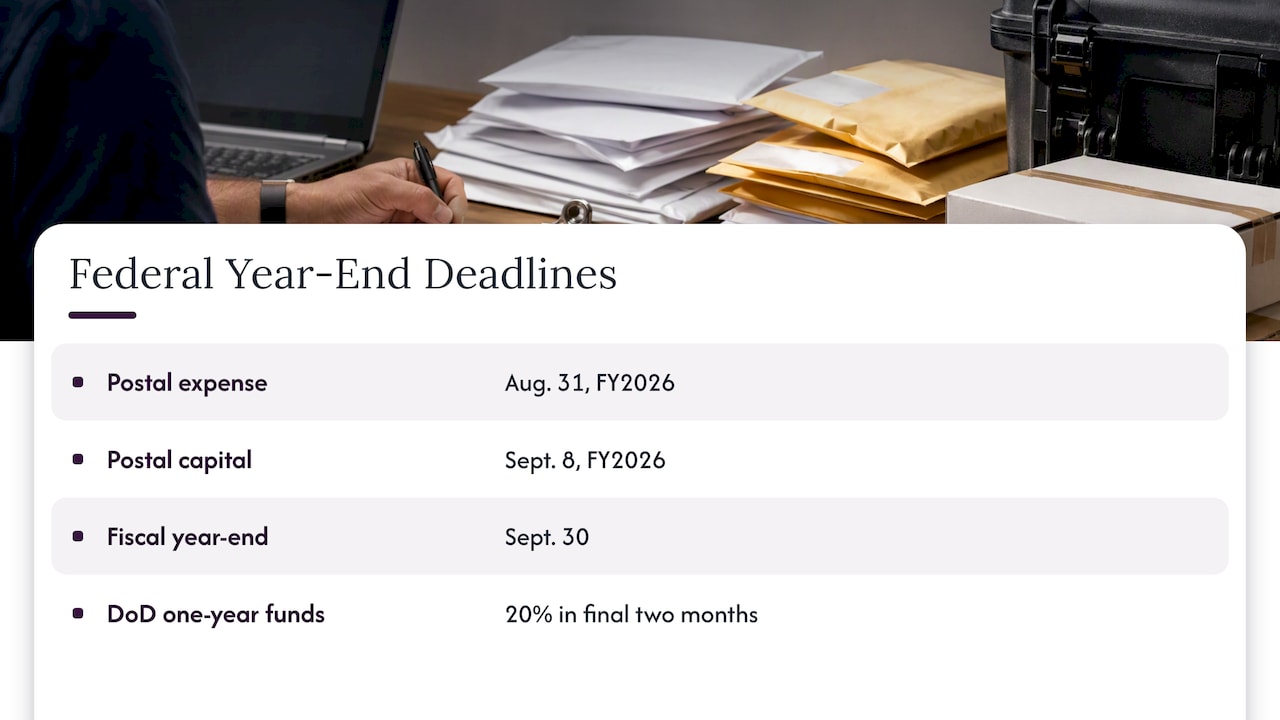
The rush has guardrails, though. Defense appropriations generally carry a “20 percent rule” that, according to CRS, limits one-year funds obligated in the last two months of the fiscal year to 20 percent. So at the Department of Defense, activity is spread earlier than many newcomers expect, and you should not assume everything waits until September.
Civilian agencies have their own internal deadlines, often well before September 30. The Postal Service, for instance, publishes requisition cut-offs: for its fiscal year 2026 contract actions, expense requisitions were due August 31 and capital requisitions September 8. The Interior Business Center posts recurring year-end cut-off dates for procurement packages and encourages contractors to work with contracting officers early on acquisition strategies and milestones. Both examples show the same thing: the real deadline for a buyer is usually weeks before the calendar one. Check each agency’s current schedule on its own site.
Is year-end spending good or bad for small businesses?
It is a mix, and knowing both sides makes you a better seller.
The upside is obvious: more orders, faster decisions, and buyers who are motivated to close. The downside is that year-end purchasing has a long record of criticism. A GAO report found that year-end spending can lead to noncompetitive or sole-source awards, unneeded or overpriced purchases, and invalid obligations. A 2013 study cited by CRS found that federal IT contracts with end-of-year obligations tended to be lower-quality acquisitions.
Rules push back on abuse. Under 41 CFR 101-26.104, purchase documents sent to GSA at or near the close of a fiscal year must reflect actual agency requirements and cannot be used to exhaust appropriation balances.
What that means for you:
- Sell real requirements. A buyer who can document a genuine need is a safe buyer. Position your offer around outcomes the program office already wants.
- Do not pitch “use it or lose it.” It invites scrutiny and can sour a relationship you want for years.
- Expect speed over negotiation. Buyers in Q4 favor vendors whose terms and prices are already settled.
How can a small business prepare for year-end buying?
The companies that win September work do the groundwork in the first half of the fiscal year. Here is a sequence that fits a small team.
- Register and stay current in SAM.gov. Federal opportunities are posted there (FedBizOpps was retired and replaced by it), and you need an active registration to be awarded anything. Check that your entity information and representations are accurate.
- Pick three to five target agencies. Choose where your services or products are already bought. Use past award data on SAM.gov and USAspending.gov to see who buys what you sell.
- Meet contracting officers and program offices early. The Interior Business Center’s guidance explicitly encourages early engagement on acquisition strategies and milestones, especially for large or complex requirements. Spring conversations produce summer quotes.
- Write a one-page capability statement. Lead with what you deliver, past performance, and the contract vehicles you hold.
- Get on a vehicle buyers already use. In Q4, a contracting officer with a short clock wants the simplest legal path to place an order. We cover that below.
- Keep your pricing ready. Have rates, discounts and terms documented so you can quote within a day.
- Calendar the cut-offs. Ask each target agency when its last day to accept requisitions is. Build backward from that.
If you are new to government work and want the bigger picture of how awards are found and won, our guide on navigating federal buying cycles walks through the rhythm of the fiscal year in more detail.
Why does a GSA Schedule help during the September rush?
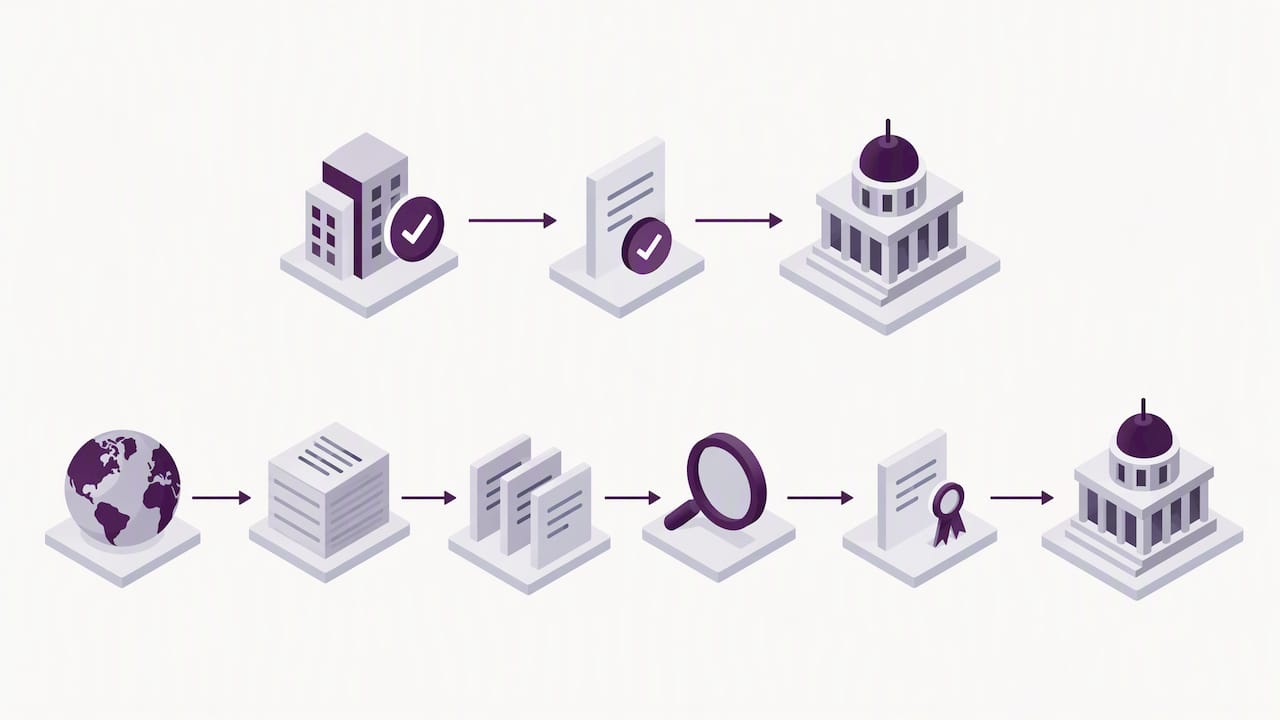
A Federal Supply Schedule is a pre-negotiated vehicle. The Federal Acquisition Regulation describes the program as giving agencies a simplified process for obtaining commercial supplies and services at prices associated with volume buying. Schedule contractors publish a pricelist with offerings, prices, terms and conditions, and orders follow the procedures in FAR Subpart 8.4.
For a buyer with weeks left in the fiscal year, that matters. The vendor has already been vetted, the terms already agreed, and the order can be placed without running a full open-market solicitation. Agencies also tend to ask about security posture for cloud and software offerings, so it helps to understand FedRAMP security requirements if your product touches federal data.
Scale is another reason. Schedule holders reach a very large buying base, and we have written about how GSA contract holders access $50 million a day and which federal agencies use GSA to award contracts. A Schedule does not guarantee sales; you still have to market to buyers. But it removes a major barrier at the moment buyers are least willing to take risks on a new vendor.
If you want to see how past awards have played out, our review of GSA contract trends is a good companion.
How long does it take to get on a GSA Schedule before next September?
This is where timing decides everything. Applying alone commonly takes 2+ years, because the offer package, pricing justification, past performance and negotiation each go through rounds of review and correction. With a consultant who handles the paperwork, our clients are typically awarded in about six months, spending about three hours of their own time.
That difference changes what is possible:
| Path | Typical time to award | Your time | Ready for next September’s rush? |
|---|---|---|---|
| Apply on your own | 2+ years | Heavy, ongoing | Unlikely |
| Apply with our full-service support | About 6 months | About 3 hours | Yes, with time to market |
If you begin this quarter and are awarded in roughly six months, you would hold the contract by spring and have a full quarter or two to introduce yourself to buyers before the fourth quarter opens. Start in the spring instead, and you would probably miss the season.
DIY or consultant: how should you decide?
Both are legitimate. Consider doing it yourself if you have a person who can spend many hours a week on federal paperwork, you have no deadline, and you are comfortable with the pricing and compliance rules. Consider a consultant if your goal is to be selling by a certain season, your team is busy delivering, or you have already had an application stall or get rejected. For self-starters we offer a GSA DIY Quick Start with tiered guides and toolkits.
What do we tell businesses before the next September rush?
We talk to owners every year who call in August or September asking how to “get on GSA this month” because a buyer has asked for it. We have to tell them the truth: it cannot be done that quickly, and the order often goes elsewhere. The owners who do well called in the fall or winter, long before the pressure.
Our view is simple. Year-end buying is not a trick, it is a calendar. The agencies that spend in September had their requirements months earlier, and the vendors they pick are almost always ones they already know and can contract with easily. Spend the first half of the fiscal year on three things: getting qualified, getting your price list right, and getting in front of the buyers who use your category.
We also see a common mistake after award. Companies get the Schedule and stop. A Schedule is a license to sell, not a lead source. Keep your price list current, track which agencies are buying, and plan modifications so you are never out of compliance when an order arrives in Q4.
Our approach is built to remove the part of this that wears owners out. We assess eligibility first, prepare the documentation, map your offering to the right categories, build the price list, support the negotiation, and set up sales tracking. You pay only after approval, and we back the work with a money-back guarantee.
— Josh
What does GSA Schedule support cost?
We organize our help by what you need. For getting awarded, we offer packages for startups, specialty businesses and streamlined applications, and the model is no award, no fee. Our turnkey full-service program covers the whole process end to end.
After award, maintenance plans handle the modifications that keep you compliant:
| Plan | Price |
|---|---|
| 1 modification per year | $99 per month |
| 2 modifications per year | $159 per month |
| 3 modifications per year | $219 per month |
| 4 modifications per year | $279 per month |
| Custom number of modifications | From $339 per month |
We also offer a retainer at $1,500 per year. Our federal marketing packages run $10,700 (Lite), $15,700 (Standard) and $27,700 (Plus) per year, and you can see what each includes. Our proposal pages list the details.
Before you commit anywhere, you can estimate what a Schedule might be worth to you with our GSA Schedule savings calculator.
FAQ
When does federal year-end buying happen?
The fiscal year ends September 30, so activity builds through the fourth quarter, July through September. Many agencies set internal cut-off dates for requisitions earlier than that, sometimes in August. Ask each target agency for its current dates.
Can a new business win year-end work?
Sometimes, but the odds favor vendors the agency already knows and can contract with quickly. New businesses do best by building relationships in the spring and holding a vehicle like a GSA Schedule before the fourth quarter starts. Cold pitches in September rarely close in time.
Is year-end spending required to be competitive?
Agencies must follow the procurement rules that apply to the vehicle and dollar value. Orders under the Federal Supply Schedules follow FAR Subpart 8.4 procedures. GAO has also warned that year-end purchasing can lead to noncompetitive awards, which is why documented, real requirements matter.
What is the next federal fiscal year?
Fiscal year 2027 began on October 1, 2026, and ends on September 30, 2027. Fiscal year 2028 will begin on October 1, 2027.
How long would it take me to get on a GSA Schedule?
Applying alone often takes 2+ years. With our support, clients are typically awarded in about six months and spend about three hours of their own time. A free eligibility check will show you where your business stands.
Want to be ready before the next September?
Start with a free eligibility check. We will tell you whether your business qualifies for a GSA Schedule, what the path looks like, and whether you can be on contract before the next fourth-quarter rush. Request your free eligibility check.
Sources
- OPM: You Had One Job, Spend the Money
- CRS: End-Year DOD Contract Spending
- GAO: Government Agencies Need Effective Planning (PSAD-80-67)
- Budget of the U.S. Government, Analytical Perspectives FY 2027
- Bloomberg Government: Federal Procurement Rises Ahead of Fiscal Year Closeout Rush
- USPS Postal Bulletin: Finance
- Interior Business Center: Recurring Year-End Cut Off Dates
- FAR Subpart 8.4, Federal Supply Schedules
- 41 CFR 101-26.104, End-of-year submission of purchase documents
- FedRAMP overview
Recommended
- 5 Tips for Navigating Federal Buying Cycles
- Federal Contract Award Lifecycle Explained
- Ultimate Guide to Federal Procurement Trends 2025
- Top Federal Contractor Services for 2024 | Expert Guide