

The Davis-Bacon Act applies to federal construction, alteration, and repair work. The Service Contract Act (SCA) applies to contracts whose principal purpose is services performed by service employees. Check what the contract mainly buys: a building or a service. Mixed contracts can carry both, and the wage determinations in the contract settle it.
TL;DR
- Davis-Bacon covers construction, alteration, or repair of public buildings and works above $2,000. The SCA covers service contracts above $2,500.
- Building a federal office is Davis-Bacon work. Maintaining it afterward is SCA work.
- Both laws require you to pay the wage determination rate, including fringe benefits, but the records and reporting differ.
- Violations can mean withheld payments, contract termination, and debarment of up to three years.
- If you are heading toward a federal sales contract, knowing which law attaches to your work tells you how to price and staff it before you bid.
Table of Contents
- What is the difference between Davis-Bacon and the Service Contract Act?
- How do I tell whether my federal contract is construction or service work?
- What if a contract mixes both kinds of work?
- What are the coverage thresholds and exemptions?
- How do wages and fringe benefits differ?
- What paperwork does each law require?
- What happens if you get it wrong?
- What changed recently?
- Why does this matter if I want federal sales?
- How should I price a federal contract that carries these wage laws?
- What do we recommend for first-time federal contractors?
- Where can we help with the next step?
- FAQ
- Sources
What is the difference between Davis-Bacon and the Service Contract Act?
Both laws do the same basic job: they make sure workers on federal contracts are paid at least the local going rate, so that government spending does not push down wages. They differ in which work they cover.
The U.S. Department of Labor (DOL) states that the Davis-Bacon Act applies to federal and District of Columbia contracts above $2,000 for construction, alteration, or repair, including painting and decorating, of public buildings and public works. The same fact sheet explains that the SCA covers contracts above $2,500 whose principal purpose is furnishing services in the United States through service employees.
A simple way to remember it: Davis-Bacon is about laborers and mechanics who build or fix a structure. The SCA is about people who perform ongoing services, such as janitorial work, food service, security, or administrative support.
| Davis-Bacon Act | Service Contract Act | |
|---|---|---|
| Covers | Construction, alteration, or repair of public buildings and works | Contracts principally for services |
| Workers | Laborers and mechanics | Service employees |
| Threshold | Prime contract above $2,000 | Contract above $2,500 |
| Wage source | Davis-Bacon wage determination | SCA wage determination |
| Payroll reporting | Weekly certified payroll | Records kept three years, notice posted |
How do I tell whether my federal contract is construction or service work?
Start with the principal purpose of the contract. DOL’s guidance on determining which labor standards apply says Davis-Bacon covers construction, alteration, or repair of public buildings and works, while the SCA covers contracts principally for services.
The hard cases sit on the line between maintenance and repair. Per that same DOL page:
- Maintenance (SCA): routinely scheduled work that keeps something in its current condition and uses non-construction skills.
- Repair (Davis-Bacon): work that restores or improves something, uses construction-trade skills, and improves structural strength, safety, capacity, or efficiency.
A worked example: an agency buys a new warehouse build-out. That is Davis-Bacon work. Later it buys quarterly cleaning and routine upkeep for the same warehouse. That is SCA work. If the agency then asks for a new loading dock, you are back to Davis-Bacon.
DOL’s coverage page defines construction broadly. Under 29 CFR 5.2, construction includes work on a building or work at the site by laborers or mechanics: altering, remodeling, painting and decorating, on-site installation of items fabricated elsewhere, and in certain circumstances demolition or removal.
What if a contract mixes both kinds of work?
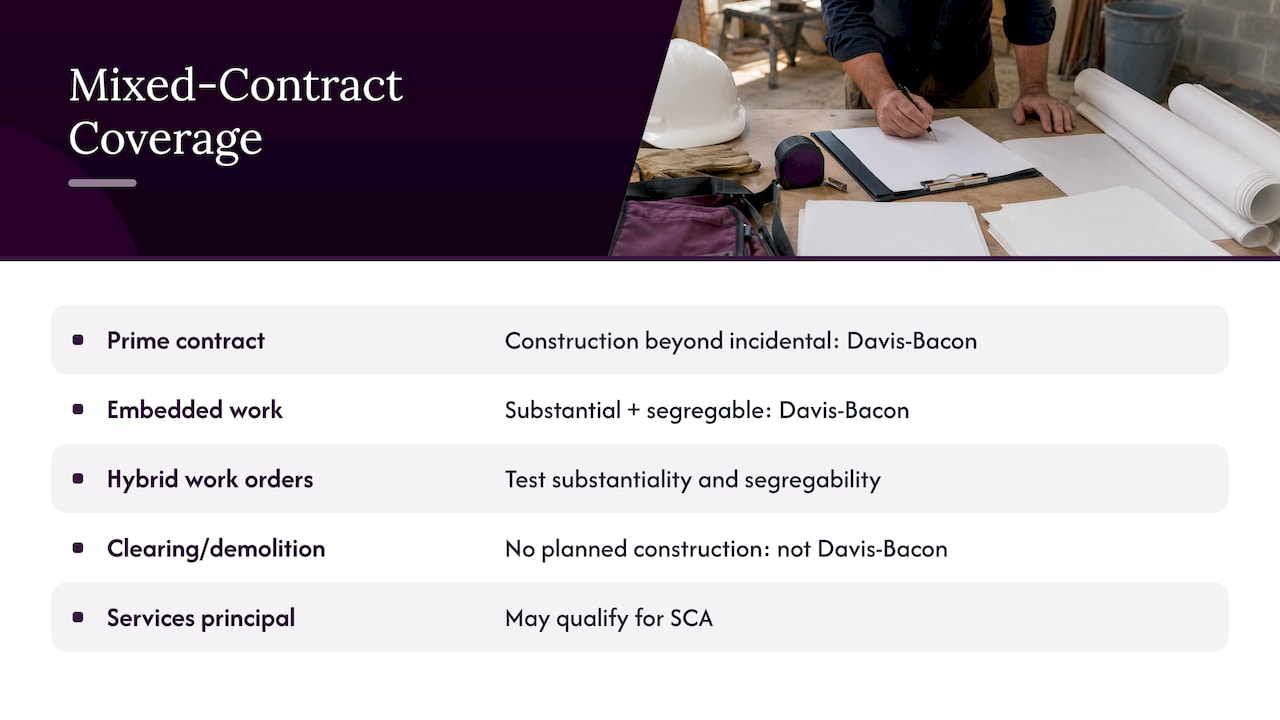
Mixed contracts are common. DOL explains that a prime contract counts as construction when it requires more than an incidental amount of construction, and that construction embedded in a service or supply contract can still be covered if it is substantial and segregable. The factors in 29 CFR 4.116©(2), substantiality and physical or functional segregability, apply to hybrid contracts and to individual work orders, as described on the DOL guidance page.
The reverse also matters. Under 29 CFR 4.116(b), work such as clearing or demolition where no further construction is planned is not Davis-Bacon construction, but it is not exempt from the SCA either. It may be SCA-covered if its principal purpose is services.
Practical rule: do not assume one law governs a whole contract. Read the clauses and the attached wage determinations for each work order.
What are the coverage thresholds and exemptions?
Davis-Bacon thresholds
The $2,000 threshold applies to the prime contract amount, not to individual subcontracts. DOL’s coverage page says that once the prime exceeds $2,000, all work on the prime and its subcontracts is covered. If you are a subcontractor, the size of your piece does not take you out of coverage.
SCA elements and exemptions
DOL lists three elements for SCA coverage: the contract is principally for services, the work is performed in the 50 states, D.C., or a listed U.S. territory, and it is performed through SCA-defined service employees.
DOL’s Fact Sheet #67 lists exemptions, including:
- Construction, alteration, or repair of public buildings or works covered by Davis-Bacon
- Work under the Walsh-Healey Public Contracts Act
- Freight or personnel transport under published tariff rates
- Public utility services and certain communications services
- Direct individual employment contracts
- Services performed outside the U.S., except in U.S.-administered territories
On SCA contracts of $2,500 or less, the same fact sheet says the federal minimum wage of $7.25 per hour applies instead of a wage determination.
How do wages and fringe benefits differ?
Both laws require you to pay at least the wage and fringe benefits in the wage determination that applies to the job, as Fact Sheet #66B notes. Contracting officers must put the right clauses and wage determinations into covered contracts, and both laws’ determinations are published online at SAM.gov, the federal contracting site that replaced the old FedBizOpps listings.
The mechanics of fringe benefits differ:
- Davis-Bacon: DOL’s compliance principles page explains the prevailing wage has two interchangeable parts, a basic hourly rate and fringe benefits. If no fringe benefit is listed for a classification, the basic hourly rate alone is the requirement.
- SCA: Fringe benefits, usually health and welfare, vacation, and holidays, are separate from and in addition to the hourly wage.
If you price service labor, those fringe amounts must be built into your rates. Our guide to fringe benefits in GSA pricing walks through the common questions.
What paperwork does each law require?
This is where the two laws feel different day to day.
Davis-Bacon paperwork
According to DOL’s Field Operations Handbook, contractors and subcontractors submit a weekly Statement of Compliance, the certified payroll (usually Form WH-347), to the contracting agency. Payrolls and basic records stay available for DOL inspection and worker interviews, and the prime contractor is responsible for submission. Georgia’s housing agency, summarizing HUD guidance, adds that the prime must review each subcontractor’s payroll before submitting it. Wage determinations must be posted at the work site in a prominent, accessible place.
The 2023 rule update added recordkeeping requirements, including contracts and worker contact information, with at least three years of retention after the prime contract work is complete. It also permits electronic certified payrolls, per DOL’s small-entity guide.
SCA paperwork
Per the same Field Operations Handbook chapter, SCA contractors keep three years of records: name, address, classification, rates, fringes, hours, compensation, and deductions. They notify employees of the compensation due, post the WH-1313 notice at the worksite, and make the contract available to the Wage and Hour Division on request. There is no weekly certified payroll submission like Davis-Bacon’s.
Where contractors slip
DOL’s Fact Sheet #67 names the most common SCA violations: misclassifying workers, treating workers as exempt without checking the rules, paying wages or fringes late, failing to post the notice, skipping the conformance procedure for job titles not on the wage determination, and not applying rate increases in multi-year contracts.
What happens if you get it wrong?
The consequences are similar in kind. For the SCA, Fact Sheet #67 states that violations may lead to withheld contract payments to cover underpayments, contract termination with liability for the government’s resulting costs, legal action to recover back wages, and debarment from future contracts for up to three years.
For Davis-Bacon, failure to submit required records can lead to suspension of payments and debarment. The 2023 rule applies the Davis-Bacon debarment standard to the Related Acts, removing the heightened aggravated-or-willful test, according to the DOL small-entity guide. Debarment can extend to any firm in which the violator holds a substantial interest.
For a company that depends on federal revenue, a debarment is a business-ending risk, which is why it pays to classify the work correctly before you bid.
What changed recently?
DOL’s August 23, 2023 final rule, effective October 23, 2023, was the first comprehensive review of the Davis-Bacon regulations in nearly 40 years. It applies to contracts entered into after that date. The Labor Department has also offered free prevailing wage training seminars for federal contractors, and one report puts combined annual federal spending under Davis-Bacon and the SCA at an estimated $217 billion, affecting an estimated 1.2 million workers. Check DOL’s Wage and Hour Division site for current seminar dates and any further rule changes, since these schedules move.
Why does this matter if I want federal sales?
Most small businesses entering federal contracting are not building anything. They sell products, professional services, or support services. That means the SCA is far more likely to touch you than Davis-Bacon, and only when your services use SCA-defined service employees. Davis-Bacon appears mainly if your work involves on-site construction or repair.
It helps to understand this before you write a price list. A federal buyer will expect your labor rates to reflect any applicable wage determination, and a rate built too low can become a compliance problem after award. Our federal contractor requirements guide and federal contract terms explainer cover the clauses you will see, and the federal contract terms glossary defines the vocabulary.
You can find open opportunities and the wage determinations attached to them on SAM.gov. Reading the solicitation for the labor standards clauses is the quickest way to see which law your target work falls under.
How should I price a federal contract that carries these wage laws?
- Identify the law. Read the solicitation and decide whether each work item is construction or service work.
- Pull the wage determination. Find the classifications that match your workers and note both the hourly rate and the fringe amount.
- Map your roles. Match each position to a classification. If a job title is missing on an SCA contract, a conformance request is the route, not guessing.
- Build in fringes. Cash fringe and benefits both count, so keep records of what you pay.
- Plan your records. Davis-Bacon needs weekly certified payrolls. The SCA needs three-year records and a posted notice.
- Recheck at each option year or work order. Wage determinations and work scope can change over a multi-year contract.
These steps are the same whether you hold a contract or are preparing your first offer. Mistakes here are costly because they surface after award, when your pricing is already fixed.
What do we recommend for first-time federal contractors?
Most owners who come to us are not asking about Davis-Bacon at all. They are asking why winning federal work feels so slow. The wage laws are one more piece of a process that rewards preparation.
Our approach is to settle the questions that can derail an offer early: what you sell, which labor categories and codes fit it, how the price list is built, and which clauses will follow you after award. When the price list reflects the right labor structure from the start, there is far less to unwind later.
We handle the paperwork, negotiation support, and price list development for clients, and our clients typically spend about 3 hours of their own time on it. Our clients are typically awarded in about 6 months, where going alone often takes 2 years or more. We work on a no-award, no-fee basis, with a money-back guarantee.
If you are unsure whether your work touches the SCA or Davis-Bacon, bring us the scope. We will tell you how it shapes your pricing.
Josh
Where can we help with the next step?
If your goal is a long-term federal sales contract, our Startups, Specialty, and Streamline packages cover the application end to end: eligibility assessment, documentation, price list development, and negotiation support. Once you hold a contract, our maintenance plans handle contract modifications, from $99 per month for one modification a year. Our Lite, Standard, and Plus marketing programs help you turn the contract into sales. Not sure which fits? Start at our home page.
FAQ
Can one contract be covered by both Davis-Bacon and the SCA?
Yes. A hybrid contract can include substantial, segregable construction work and service work. DOL applies the substantiality and segregability factors to the contract and to individual work orders, so each piece of work is judged on its own. The wage determinations in the contract show which rates apply to which work.
Does Davis-Bacon apply to subcontractors?
Yes. The $2,000 threshold is measured on the prime contract. Once the prime exceeds it, all work on the prime and its subcontracts is covered. The prime contractor is responsible for submitting certified payrolls, and the HUD guidance says it must review subcontractor payrolls first.
Which law applies to maintenance of a federal building?
Routinely scheduled maintenance that keeps a building in its current condition, using non-construction skills, falls under the SCA. Work that restores or improves the structure using construction trades is repair and falls under Davis-Bacon. Many facility contracts include both kinds of work.
How long do I keep records?
Both laws call for three years. For Davis-Bacon, DOL’s 2023 rule requires retention for at least three years after all prime contract work is completed. SCA contractors keep payroll and related records for three years as well.
How do I find out if my company qualifies for a federal contract?
We offer a free eligibility check. We review what you sell, your company’s history, and your readiness, and tell you where you stand. You can also read our guide on GSA contract eligibility first, then contact us through our home page to request the check.
Sources
- Fact Sheet #66B: Interplay Between the Davis-Bacon and Related Acts and Other Labor Standards
- Determining Which Labor Standards Apply
- Davis-Bacon and Related Acts Coverage
- 29 CFR 4.116, Contracts for construction activity
- Coverage Under the Service Contract Act
- Fact Sheet #67: The McNamara-O’Hara Service Contract Act
- Davis-Bacon Compliance Principles
- Federal Contractor Requirements: Wage Requirements
- Field Operations Handbook, Chapter 15
- Davis-Bacon and Labor Standards: Contractor Guide Addendum
- Updating the Davis-Bacon and Related Acts Regulations: Small Entity Guide
- Know Before You Build: Labor Department Opens Free Prevailing Wage Training
Recommended
- SCA Wage Determinations: How to Find, Read and Follow Them
- Beat the 30 Day Clock: SCA Conformance Process for U.S. Contractors
- Service Contract Labor Standards (SCLS), formerly Service Contract Act (SCA)
- Wage Determination Penalties