
The nonmanufacturer rule says that if you win a small business set-aside for products you don’t make, you must supply products made in the U.S. by another small business, unless SBA has waived the requirement. It applies to resellers and distributors. On GSA offers, you prove compliance with supplier documents such as letters of supply.
TL;DR
- If you resell products on a set-aside, the items must come from a U.S. small business manufacturer, or a waiver must cover them. SBA explains the rule in plain terms.
- A nonmanufacturer generally can’t exceed 500 employees. IT value-added resellers under NAICS 541519 are capped at 150 (13 CFR 121.406).
- Check the SBA class waiver list for your product’s NAICS code before you bid. Individual waivers go through the contracting officer and must come before the solicitation closes.
- Keep supplier paperwork current. GSA publishes a letter of supply template for exactly this purpose.
- Reselling a large manufacturer’s product can still be a sound business. It just changes which opportunities you can win as a small business.
Table of Contents
- What is the nonmanufacturer rule, in practice?
- Who has to follow it, and on which contracts?
- What size standard applies to a nonmanufacturer?
- Does your product come from a small U.S. manufacturer?
- How do waivers work?
- How does the rule show up in a GSA offer?
- A worked example
- Common mistakes that cost resellers awards
- Our perspective: where resellers trip up
- Should you hire help or do it yourself?
- Not sure your products qualify? Start with a free check
- FAQ
- Sources
What is the nonmanufacturer rule, in practice?
The rule exists to keep set-aside dollars flowing to the small business industrial base. SBA describes three ways a small business can qualify on a set-aside or sole-source supply contract: make the product itself, supply a product made by another small business, or supply any-size manufacturer’s product when SBA has granted a waiver. The governing regulation is 13 CFR 121.406.
Think of it as a test on the item, not only on your company. You can be a small business by every other measure and still be ineligible for a particular set-aside if the product you plan to ship comes from a large manufacturer.
A few terms matter:
- Manufacturer: the firm that makes, processes or produces the end item. The FAR clause defines a nonmanufacturer as a concern, including a supplier, that provides an end item it did not manufacture, process, or produce.
- End item: the product you are actually delivering. It can be finished or semifinished, but firms that perform only minimal operations on an item do not qualify as its manufacturer.
- Waiver: SBA’s permission to supply a product made by a firm of any size. More on this below.
Who has to follow it, and on which contracts?
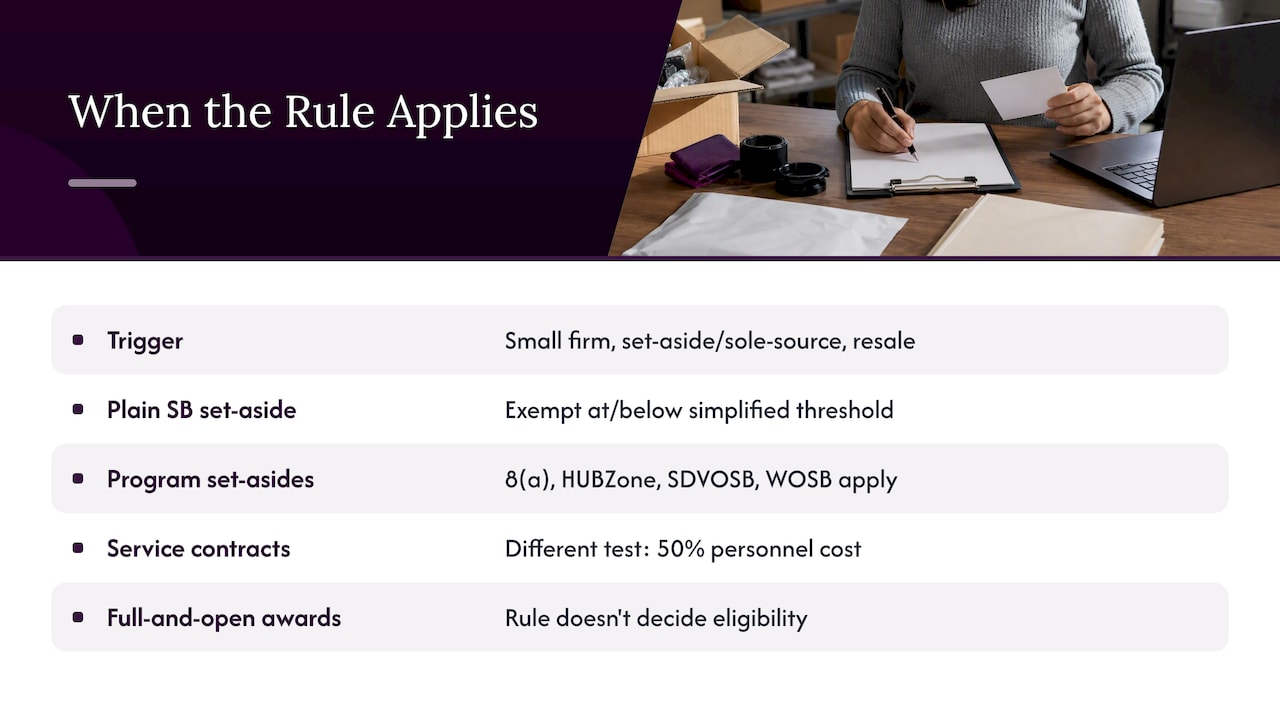
The rule matters when three things line up: you are a small business, the award is a set-aside or sole-source, and you are supplying products you didn’t make.
SBA states that the rule does not apply to small business set-aside contracts at or below the simplified acquisition threshold, but it does apply to all set-aside contracts under the 8(a), HUBZone, SDVOSB and WOSB programs. So an 8(a) reseller can’t treat a small order as exempt the way a plain small business set-aside reseller can.
It does not apply to services. Service contracts follow a different test: SBA’s guide notes that on service contracts the small business prime must provide at least 50% of the contract cost for personnel. If you sell a mix, read our breakdown of subcontracting rules for GSA Schedules alongside this article.
Full-and-open awards are a different story. If you are bidding unrestricted, the rule doesn’t decide whether you are eligible. That is why many resellers who can’t meet it still build a healthy federal business, and why a broader contract vehicle is worth considering. Our guide to small business set-aside contracts shows where the line falls.
What size standard applies to a nonmanufacturer?
This is where many resellers get caught. The size test for a nonmanufacturer is not the revenue or employee cap attached to your primary NAICS code. Under 13 CFR 121.406, a nonmanufacturer must not exceed 500 employees, or 150 for the IT value-added reseller exception under NAICS 541519.
The FAR points to the same framework in FAR 19.505, which covers limitations on subcontracting and the nonmanufacturer rule, including how it applies to kit assemblers who are nonmanufacturers.
The regulation also expects you to be primarily engaged in the retail or wholesale trade and to take ownership or possession of the item in a manner consistent with industry practice, for example by storing, handling or delivering it. A drop-ship arrangement where you add nothing, never hold the goods and merely pass an order along is the pattern SBA’s guidance warns about.
Does your product come from a small U.S. manufacturer?
Work through this in order before you price a set-aside.
- Identify the manufacturer of each end item. Not the distributor you buy from, the firm that made it.
- Check that manufacturer’s size against the standard for the NAICS code of the product. Size is determined relative to that industry.
- Confirm the item is made in the United States. The rule requires a small business manufacturer’s product made here, not just a small brand name on the box.
- Get it in writing. A manufacturer’s or authorized distributor’s letter confirms you may sell its products.
- Repeat for every line item you offer. Compliance is item by item, so a catalog with fifty products from ten manufacturers needs fifty answers.
If any item fails, you have two choices: drop it from set-aside bids, or see whether a waiver exists.
How do waivers work?
There are two waiver routes under 13 CFR 121.406: individual waivers for a specific contract and class waivers for a category of products. The regulation grounds waivers in SBA’s determination that no small business manufacturer or processor of the product or class of products is available to participate in the Federal procurement market.
Class waivers
SBA maintains a class waiver list that displays the waived categories. To see whether your item is covered, find it under the relevant NAICS code on that list (the version we reviewed was dated May 2023, so confirm you are reading the current list). If a class waiver covers your product, the requirement doesn’t apply and you may supply the product of a manufacturer of any size.
Don’t assume a specialized product is exempt. Check the list instead of guessing.
Individual waivers
If there is no class waiver and you believe no small business manufacturer can meet the need, the contracting officer is the one who requests an individual waiver, not the vendor. According to SBA’s guidance for contracting officials, the CO must first determine through market research whether a small business manufacturer exists. Your role is to hand over evidence early: manufacturer searches, quotes, and correspondence showing nobody small can deliver.
Timing matters. A request has to be in before the solicitation closes. One filed after award does you no good.
How does the rule show up in a GSA offer?
On Multiple Award Schedule offers, the practical question is whether you can demonstrate where your products come from. GSA publishes a letter of supply template. It is a verification from a manufacturer, wholesaler or authorized partner or distributor that a vendor is authorized to distribute specific products.
Treat those letters as living documents:
- Keep one for every supplier whose products are on your price list.
- Make sure the letter names the products or product lines, not just your company.
- Calendar renewals. A supplier relationship that lapses can leave catalog items with no paper behind them.
- Update your file whenever you add or drop a manufacturer. On an awarded contract, additions often mean a modification. Our GSA modification documentation guide lists what to prepare.
Our GSA bid documentation checklist puts supplier letters in context with the rest of an offer, and our piece on key GSA compliance examples shows how sourcing questions come up after award.
A worked example
Say you run a 40-person office-products distributor and you want to bid a small business set-aside for desk organizers.
- Your company is well under 500 employees, so the nonmanufacturer size test is not your problem.
- The organizers come from a U.S. plant. You confirm that the plant is a small business for its manufacturing NAICS code and obtain a supplier letter.
- The cheaper imported line you also stock fails the made-in-the-U.S. test, so it stays out of the set-aside bid.
- A third item, from a large U.S. manufacturer, isn’t on the class waiver list. You cannot supply it on the set-aside unless the contracting officer obtains an individual waiver before closing. You decide to leave it off.
The result is a narrower but compliant offer. You can still sell the excluded items under unrestricted competition, where this rule does not decide eligibility.
Common mistakes that cost resellers awards
- Assuming small business status settles it. It doesn’t. The product must come from a small U.S. manufacturer or be waived.
- Relying on the distributor, not the manufacturer. A small distributor’s size tells you nothing about the maker.
- Ignoring the waiver list until after a bid is lost. Check before you bid.
- Waiting too late for an individual waiver. After award is too late.
- Passing orders through without adding value. Ownership or possession consistent with industry practice is part of the test.
- Letting supplier letters go stale. Old paperwork raises questions in reviews. Our list of top GSA compliance risks for small businesses covers more of these.
Our perspective: where resellers trip up
We help small and medium-sized businesses get onto and stay on a federal buying vehicle, and the reseller conversation almost always starts the same way: “I’m a small business, so I’m fine.” Then we map the product lines and find that half the catalog comes from large manufacturers.
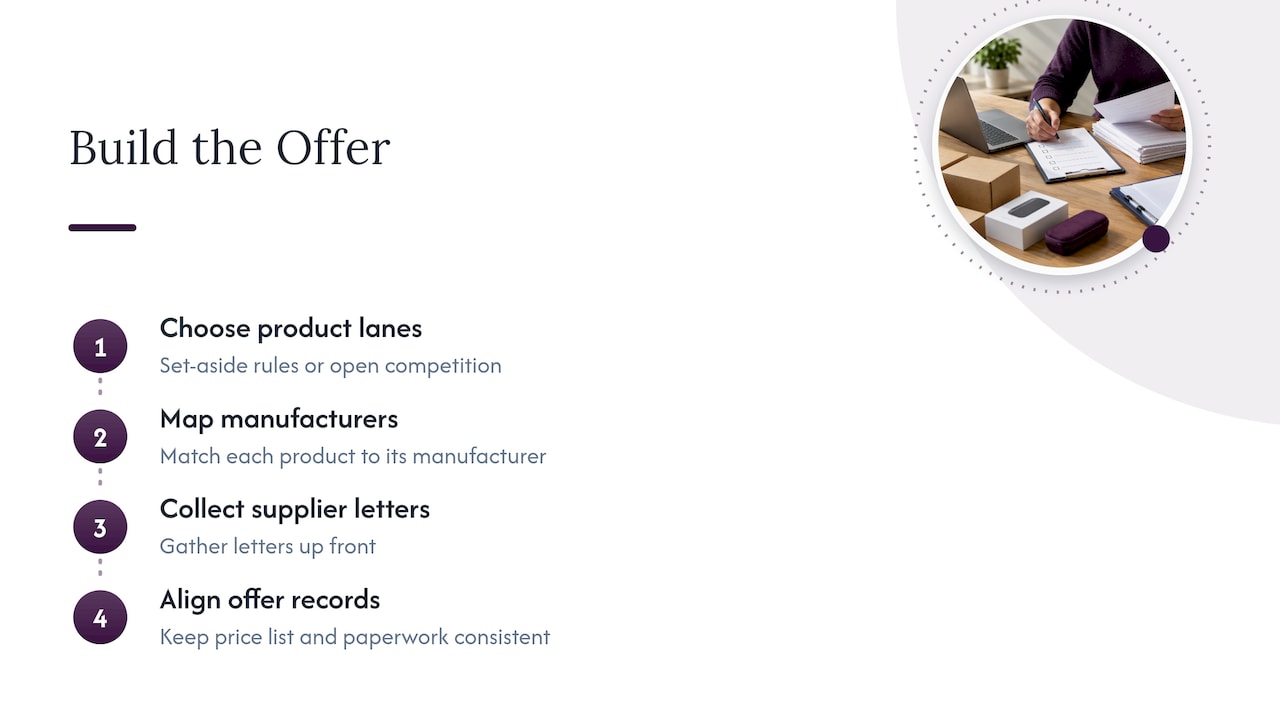
That isn’t a dead end. It means the offer has to be built deliberately. We map each product to its manufacturer, collect the supplier letters up front, and keep set-aside-sensitive items organized so the price list and the paperwork agree. Our claim, which we back with a guarantee, is that clients are typically awarded in about six months while spending around three hours of their own time. Going alone usually takes two years or more, largely because of this kind of back-and-forth over documents.
Our advice: decide early which of your products you want to sell under set-aside rules and which under open competition. Then build your documentation around that decision, not the other way around.
— Josh
Should you hire help or do it yourself?
If you have one or two products from a single small manufacturer, you can probably assemble the supplier letter and check the waiver list yourself. Set aside a few evenings and read the SBA and GSA pages linked here.
Help pays off when:
- You carry many product lines from many manufacturers.
- Your suppliers include large firms, and you need to separate set-aside-eligible items from the rest.
- You’ve been through an offer that stalled on documentation.
- Your time is better spent selling than reading regulations.
We offer a DIY Quick Start for owners who prefer self-service, and full-service tiers for those who don’t. Our model is no award, no fee, with a money-back guarantee. Our consulting overview explains how the process runs.
After award, upkeep matters. Our maintenance plans start at 99 USD per month for one modification a year, and the maintenance plan page lists the higher tiers. For a first look at what happens next, see our post-award checklist.
Not sure your products qualify? Start with a free check
Tell us what you sell and who makes it. We will review your product lines, your supplier setup and your eligibility, and tell you plainly whether a federal schedule fits your business and what it would take. Request your free eligibility check and we will walk you through the next steps.
FAQ
Does the nonmanufacturer rule apply to services?
No. It applies to supply contracts for products. Service contracts are governed by a separate limitation: SBA’s guide says the small business prime must provide at least half of the contract cost for personnel. If you sell both, each contract line is tested by its own rule.
Can I resell a large company’s product on a small business set-aside?
Only if the product is covered by an SBA waiver. That means either a class waiver for the product’s NAICS category or an individual waiver requested by the contracting officer before the solicitation closes. Without a waiver, you must supply a U.S.-made product from a small business manufacturer.
Is a small business under my NAICS code automatically small under this rule?
No. The nonmanufacturer test uses its own cap: generally 500 employees, or 150 for IT value-added resellers under NAICS 541519. Your usual NAICS size standard doesn’t substitute for it.
Do I need the rule to hold a GSA vehicle at all?
No. The rule matters on set-asides and sole-source awards. You can sell under full-and-open competition without it deciding your eligibility, though you still need to document where your products come from.
Sources
- SBA: Nonmanufacturer rule
- SBA: Guidance for federal contracting officials
- SBA: Non-manufacturer rule class waiver list
- 13 CFR 121.406 (Cornell LII)
- FAR 19.505
- FAR 52.219-33 Nonmanufacturer Rule
- GSA: Letter of supply template
Recommended
- The Role of Resellers in GSA: A Practical SMB Guide
- The GSA Rule of Three: How Federal Buyers Pick Vendors
- GSA Ordering Rules: What to Know
- How GSA Ordering Works