

Most small and medium-sized businesses entering federal contracting treat resellers as an afterthought, or worse, as a cost they are trying to avoid. That framing misses something significant. The role of resellers in GSA procurement goes far beyond moving products from manufacturer to agency. Today’s value-added resellers (VARs) handle systems integration, cybersecurity compliance, technical training, and full procurement lifecycle management. Understanding what resellers actually do, and how GSA policy is reshaping their function, can mean the difference between winning federal contracts and watching opportunities pass you by.
Table of Contents
- Key takeaways
- Role of resellers in GSA: beyond the middleman label
- How GSA’s OneGov initiative is reshaping reseller roles
- Reseller pricing models and markup scrutiny
- Leveraging reseller partnerships for GSA success
- My take on what most businesses get wrong here
- How Gsascheduleservices can help you move forward
- FAQ
Key takeaways
| Point | Details |
|---|---|
| Resellers do far more than resell | VARs deliver integration, compliance support, training, and lifecycle management that agencies depend on. |
| GSA is anti-fragmentation, not anti-reseller | OneGov centralizes contracts but explicitly preserves reseller roles as subcontractors and mission-support partners. |
| Markup transparency is now mandatory | GSA scrutinizes reseller pricing on SIN 33411; markups must be backed by documented value-added services. |
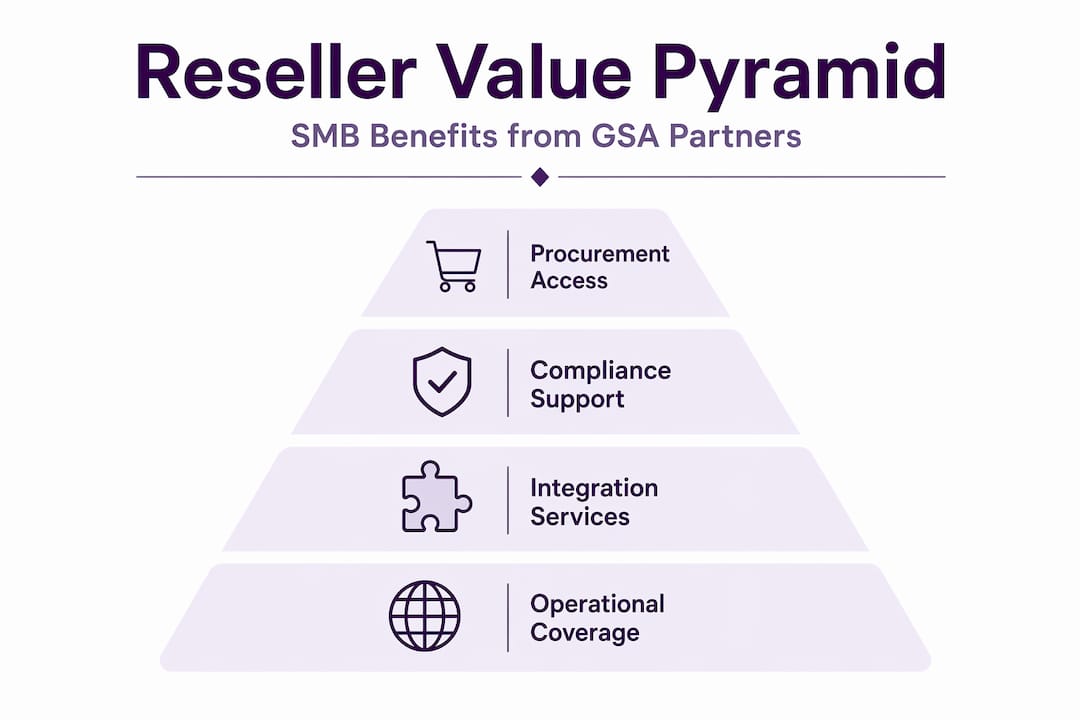
| SMBs can gain through reseller partnerships | Partnering with experienced resellers gives small businesses faster procurement access and compliance coverage. |
| Adaptation determines survival | Resellers that shift from transactional selling to integrated service delivery will remain indispensable under evolving GSA rules. |
Role of resellers in GSA: beyond the middleman label
The phrase “value-added reseller” shows up constantly in federal IT procurement, but the functions of resellers in GSA contracts are frequently misunderstood. A VAR is not simply buying a Cisco router and marking it up before handing it to a federal buyer. These companies are doing work that original equipment manufacturers (OEMs) often cannot or will not do at the agency level.
GSA-acknowledged reseller services span a wide operational spectrum, including:
- Systems integration: Combining hardware, software, and networking components from multiple vendors into a single, functional environment tailored to agency needs.
- Customization: Modifying off-the-shelf products to meet specific security configurations, data standards, or mission requirements.
- Technical training: Equipping agency staff to operate and maintain new technology after deployment.
- Security and compliance support: Helping agencies meet FedRAMP, FISMA, and NIST standards throughout the procurement lifecycle.
- Procurement lifecycle management: Managing ordering, delivery, asset tracking, refresh cycles, and contract modifications from start to finish.
Each of these functions represents real labor and real expertise. A federal IT director does not want to call Dell to troubleshoot why their new servers are not communicating with a legacy network from three contracts ago. They call the VAR who built the integration. That relationship is the core of why resellers enable faster deployment than piecemeal OEM procurement ever could.
Pro Tip: If you are a small business evaluating a GSA reseller partnership, ask the prospective reseller to document every service they provided on their last three federal contracts. Vague answers about “support” are a red flag. Specific answers about integration scopes, compliance audits, and training deliverables are what you want.
Understanding the basics of GSA contract schedules first will help you evaluate which reseller services actually align with your agency’s requirements before you begin conversations.
How GSA’s OneGov initiative is reshaping reseller roles
When GSA announced the OneGov initiative, resellers across the federal IT channel braced for displacement. The anxiety was understandable. But the reality is more nuanced, and actually more favorable to resellers who are paying attention.
OneGov is designed to consolidate fragmented federal IT contracts under unified agreements with major technology vendors. The results have been real. GSA saved $1.1 billion in taxpayer money within its first year by eliminating duplicate contracts and negotiating enterprise-level pricing with OEMs. That kind of outcome gets political attention, and it gives GSA leadership confidence to push the model further.
“We’re not anti-reseller. We’re anti-fragmentation.” — GSA leadership, as reported by FedScoop
That quote deserves more attention than it typically gets. GSA is not trying to cut resellers out of the equation. It is trying to cut out the sprawl of redundant contracts that bloat costs without adding value. Resellers who provide genuine, differentiated services are not what OneGov is targeting.
What does change under OneGov is the structure. Rather than holding their own prime GSA schedule contracts for commodity products, many resellers will shift to subcontractor or partner roles under OEM prime vehicles. OEM primes under OneGov are expected to demonstrate meaningful subcontracting plans that include small businesses, which preserves SMB reseller participation while fitting within the consolidated framework.
The practical implication for small and medium-sized businesses is this: if your GSA strategy depends entirely on being the product reseller at the prime level, your position is under pressure. But if your strategy is to position yourself as the integration, customization, and support layer that OEM primes cannot replicate, your value proposition is stronger than ever. Resellers that prove measurable cost savings and operational efficiencies will stay relevant regardless of how contract structures shift.
Reseller pricing models and markup scrutiny
Pricing is where many resellers stumble, and where GSA is now paying close attention. The importance of GSA resellers getting this right cannot be overstated, because the rules are shifting in real time.

Traditionally, reseller markups vary significantly based on the scope of value-added services, backend incentives from OEMs, and commercial market norms. A reseller doing basic product fulfillment might mark up 5 to 10 percent above OEM pricing. A reseller managing full system integration with ongoing cybersecurity monitoring could justify markups well above that range, because the services bundled into that price are substantial.
GSA recognizes this distinction, but it is now formalizing its scrutiny. Through a Request for Information (RFI) focused on reseller transparency, GSA is analyzing markups on SIN 33411 and considering controls for cases where markups cannot be substantiated by documented services. This is not punitive toward well-run resellers. It is punitive toward those charging significant premiums for services they are not actually delivering.
Here is how to protect your pricing position under this scrutiny:
- Document every service in the contract. If you provide cybersecurity configuration, write it into the statement of work with deliverables and timelines. Vague service descriptions will not hold up under audit.
- Tie markup directly to service cost. Calculate your internal cost to deliver each value-added component and use that to anchor your markup justification. A 20-percent markup is far easier to defend when you can show it reflects 15 percent in labor and overhead plus a 5 percent margin.
- Avoid cost-reimbursement framing. As noted by industry analysts, overly rigid cost-reimbursement models risk undermining the commercial-like, outcome-focused nature of GSA contracts. Price based on value delivered, not just costs incurred.
- Benchmark against comparable commercial agreements. GSA’s pricing standard for schedules is “most favored customer” pricing. If your GSA pricing is higher than what comparable commercial clients pay for the same scope, that gap needs a documented justification.
Pro Tip: Before your next GSA contract renewal, build a one-page service value summary that maps each markup dollar to a specific service output. This document will serve you in negotiations, audits, and competitive differentiation with agency contracting officers.
Leveraging reseller partnerships for GSA success
For small and medium-sized businesses, GSA reseller partnerships offer something the contract alone cannot: operational capacity. Getting onto a GSA Schedule contract is one challenge. Delivering on that contract in a way that generates repeat orders and grows your federal revenue is a different challenge entirely.
Here is what effective GSA reseller partnerships actually look like in practice:
- Integration support: A manufacturing SMB selling specialized equipment through GSA partners with a VAR that handles installation, calibration, and integration with existing agency infrastructure. The SMB closes more contracts because it is offering a complete solution, not just a product.
- Compliance coverage: A cybersecurity SMB with strong technical capabilities but limited contracting experience partners with a VAR that has existing agency relationships and understands compliance documentation requirements. The SMB handles the technical work; the VAR handles the procurement mechanics.
- Customer support continuity: A software company uses a VAR as the primary point of contact for agency support tickets, leveraging the VAR’s established presence and trust with the customer while the SMB focuses on product development.
When selecting a reseller partner, the comparison below helps clarify what to look for:
| Factor | Strong partner | Weak partner |
|---|---|---|
| GSA experience | Active prime schedule with multiple agencies | Newer to federal, limited agency relationships |
| Service documentation | Clear statements of work, measurable deliverables | Vague descriptions, minimal past performance |
| Small business commitment | Documented subcontracting history with SMBs | No formal subcontracting plan or history |
| Compliance knowledge | Current on FedRAMP, FISMA, CMMC requirements | General awareness but no specific certifications |
| Pricing transparency | Willing to share cost structure and markup rationale | Resistant to pricing discussions or justification |
The advantages of a GSA Schedule multiply when you have the right partner standing alongside you through the procurement process. Do not pick a reseller the way you would pick a distributor. Pick one the way you would pick a co-contractor.
My take on what most businesses get wrong here
I have watched businesses walk away from strong reseller partnerships because they saw the markup and nothing else. That is a costly mistake. What they missed was that the markup was paying for something they would have had to build internally anyway: agency relationships, compliance infrastructure, integration expertise, and procurement staff.
The resellers I have seen thrive under the OneGov shift are the ones who stopped thinking of themselves as product sellers years ago. They recognized that federal agencies do not actually want to manage complex multi-vendor environments on their own. Agencies want outcomes. They want systems that work, stay compliant, and get refreshed on schedule without requiring a procurement officer to become a systems engineer.
The businesses that struggle are the ones still pitching products in an era when agencies are buying capabilities. If you are an SMB exploring GSA schedule consulting as a path forward, think about what problem you solve at the operational level, not just what product you sell at the catalog level. That framing shift changes how you position yourself, how you price, and who you partner with.
The uncomfortable truth is that GSA’s increased scrutiny of reseller markups is not bad for well-prepared businesses. It is actually a market-clearing event. It will push out commodity resellers who add no real value, and it will reward those who do the hard work of delivering integrated, secure, lifecycle-managed solutions. That is a better competitive environment for serious SMBs.
— Josh
How Gsascheduleservices can help you move forward
Understanding the impact of resellers in GSA is the first step. The harder part is building a contracting strategy that actually puts you in the right position, whether you are pursuing your own GSA Schedule, partnering with a VAR, or trying to manage an existing contract more effectively.
Gsascheduleservices works directly with small and medium-sized businesses to do exactly that. From readiness assessments that evaluate your fit for a GSA Schedule to negotiation support and marketing strategies that help you generate consistent federal revenue, the team brings the kind of hands-on expertise that turns GSA contracts from paperwork exercises into real business assets. If you are ready to take the next step, start with a no-obligation discovery session to find out where you stand and what is possible. You can also explore strategies to grow revenue through GSA schedules to see how businesses like yours are putting these principles into practice.
FAQ
What does a GSA value-added reseller actually do?
A GSA value-added reseller provides services beyond product delivery, including systems integration, customization, security compliance, technical training, and procurement lifecycle management. These services help federal agencies implement and operate technology solutions effectively, which is why GSA considers resellers essential to mission success.
Does OneGov eliminate the need for resellers?
No. GSA’s OneGov initiative consolidates redundant contracts but explicitly preserves reseller roles as subcontractors and integration partners. GSA leadership has stated the program is anti-fragmentation, not anti-reseller, and OEM primes under OneGov are expected to maintain subcontracting plans that include small businesses.
How does GSA evaluate reseller markup pricing?
GSA is actively scrutinizing markup percentages on GSA Schedule SIN 33411 and may institute controls for markups that lack documented justification. Resellers must tie their pricing to specific, deliverable value-added services to satisfy GSA’s markup transparency standards.
How can an SMB benefit from partnering with a GSA reseller?
SMBs gain faster procurement access, compliance support, and operational coverage by partnering with established VARs. This is especially valuable when an SMB has strong technical capabilities but limited experience managing federal contracting requirements and agency relationships.
What should I look for when choosing a GSA reseller partner?
Prioritize resellers with active GSA prime schedules, documented past performance with federal agencies, a clear subcontracting history with small businesses, and demonstrated knowledge of current compliance frameworks like FedRAMP and CMMC. Pricing transparency and a willingness to document their service scope are non-negotiable.
Recommended
- Government procurement strategies that help SMBs win GSA bids
- 5 Useful Roles of a GSA Schedule for Small Business
- GSA Procurement Guide: Streamline Your Buying
- How Small Businesses Can Get Started With A GSA Contract? 5 Steps!