
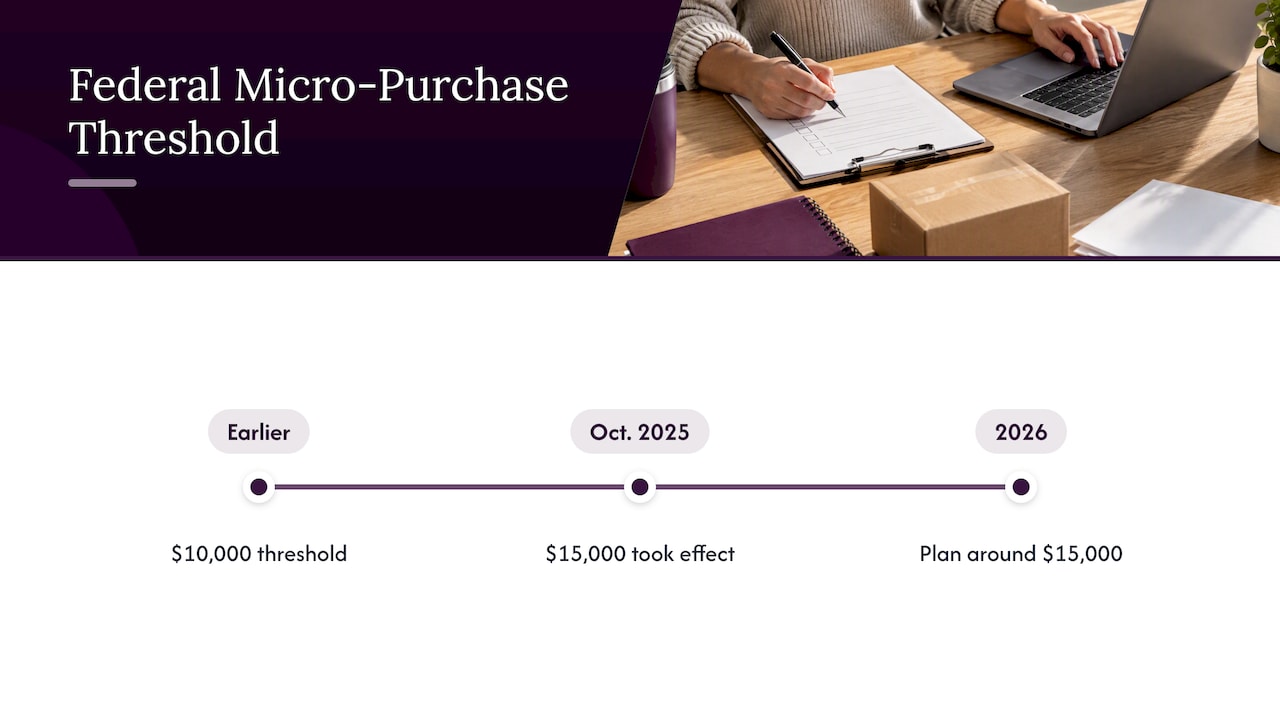
The federal micro-purchase threshold is $15,000. It rose from $10,000 for awards made on or after October 1, 2025. Agencies can buy up to that amount with a government purchase card and little competition. The simplified acquisition threshold, the next tier, is $350,000. Both shape how a small business gets found and paid.
TL;DR
- The micro-purchase threshold (MPT) is $15,000 as of October 1, 2025, and the simplified acquisition threshold (SAT) is $350,000.
- Higher limits apply in contingency operations and outside the United States, and grant recipients follow 2 CFR 200 instead of the FAR.
- Micro-purchases are quick card buys, so being visible to the person holding the card matters more than writing a long proposal.
- Bigger, repeatable federal sales usually need a contract vehicle that buyers can order from without a new competition. A GSA Schedule is the most common one.
Table of Contents
- What is the federal micro-purchase threshold in 2026?
- How does the micro-purchase threshold differ from the simplified acquisition threshold?
- Are there different limits for contingency operations or purchases abroad?
- What is the micro-purchase threshold for grants under 2 CFR 200?
- Which other thresholds changed on October 1, 2025?
- How do you actually win micro-purchases?
- How do you win contracts above the micro-purchase level?
- What is the difference between selling by micro-purchase and selling through a GSA Schedule?
- Should you apply on your own or hire a consultant?
- Our perspective: why thresholds should shape your strategy
- What does our help look like, and what does it cost?
- FAQ
- Find out if you qualify
- Sources
What is the federal micro-purchase threshold in 2026?
The threshold is $15,000 for most purchases made inside the United States. Acquisition.gov lists the change among the threshold adjustments that took effect October 1, 2025, when the number moved from $10,000 to $15,000. Nothing in the 2026 materials we reviewed shows a further change since then, so $15,000 is the figure to plan around today.
A micro-purchase is a buy of supplies or services at or below that amount. The FAR treats these as the lightest-touch purchases in federal buying. The rules sit in FAR Subpart 13.2, which names the governmentwide commercial purchase card as the preferred way to buy and to pay for them.
For you as a seller, the practical meaning is simple. An agency employee with a purchase card and a $15,000 need can often place the order without a formal solicitation. They still have to be sensible about price, but they do not need to run a bid.
How does the micro-purchase threshold differ from the simplified acquisition threshold?
The two thresholds are tiers of the same ladder. The SAT is $350,000. Purchases above the MPT and up to the SAT use simplified acquisition procedures: quotes, a basic price comparison and faster paperwork than a full competitive solicitation.
| Tier | Federal limit (inside the U.S.) | How it is usually bought |
|---|---|---|
| Micro-purchase | Up to $15,000 | Purchase card, minimal competition |
| Simplified acquisition | Up to $350,000 | Quotes or short solicitations |
| Above the SAT | Over $350,000 | Full FAR Part 15 style competition, with added requirements |
The simplified acquisition threshold is the answer to the question many people phrase as the federal small purchase threshold. Small purchase procedures and simplified acquisition procedures describe the same tier in everyday conversation.
Are there different limits for contingency operations or purchases abroad?
Yes. The standard numbers apply to ordinary purchases made and performed inside the United States. Special limits apply for contingency operations and similar situations. According to the table of effective dates for MPT and SAT on Acquisition.gov:
- The micro-purchase threshold is $25,000 inside the U.S. and $40,000 outside the U.S. for these situations.
- The simplified acquisition threshold rises to $1,000,000 inside the U.S. and $2,000,000 outside.
- A $650,000 threshold applies to humanitarian or peacekeeping operations outside the U.S.
The FAR text for these exceptions also covers purchases supporting defense against or recovery from cyber, nuclear, biological, chemical or radiological attack. You can read the full list in FAR Subpart 13.2. If you sell ordinary commercial goods and services to civilian agencies in the U.S., the $15,000 and $350,000 figures are the ones you will meet.
What is the micro-purchase threshold for grants under 2 CFR 200?
If the money is a federal grant or cooperative agreement rather than a federal contract, a different rule governs the buyer. Under 2 CFR 200.320, a recipient or subrecipient determines and documents its own micro-purchase threshold based on internal controls, risk and written procurement procedures. It can self-certify a threshold up to $50,000, or seek approval from the cognizant agency for indirect costs to go higher.
This matters if your customers are cities, school districts or nonprofits spending federal grant dollars. Oregon’s education department notes that local entities may set policies stricter than the federal limits but not looser. It also explains that the higher SAT carries over to grant-funded buying under the Uniform Guidance, and that sponsors can amend their policies to the new $350,000 figure where state or local law allows.
So the same $20,000 order can be a micro-purchase for one grant recipient and a quoted purchase for another. Ask each customer for its own written procurement policy.
Which other thresholds changed on October 1, 2025?
The MPT and SAT were not the only numbers to move. Several limits that affect growing contractors changed on the same date:
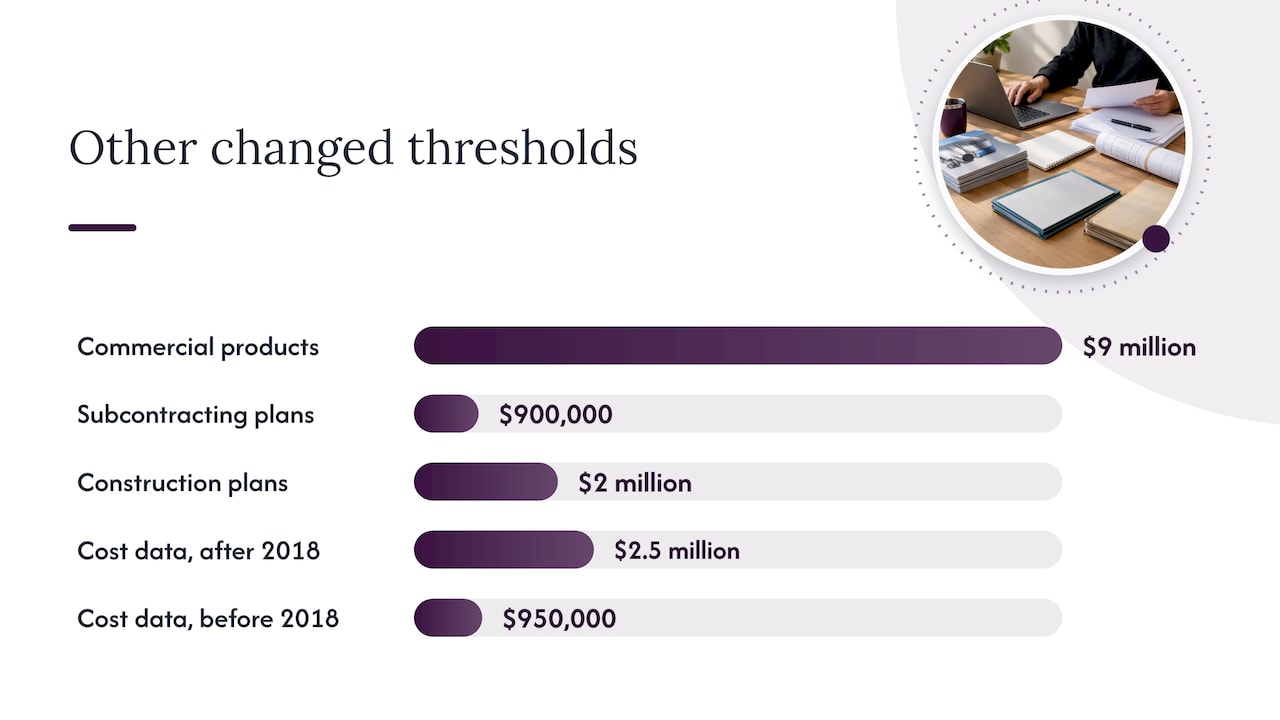
- Simplified procedures for certain commercial products and services: the ceiling under FAR 13.500(a) increased to $9 million.
- Subcontracting plans: the threshold requiring a prime contractor to submit one under FAR 19.702 rose to $900,000, or $2 million for construction.
- Cost or pricing data: the threshold rose to $2.5 million for contracts awarded after July 1, 2018, and $950,000 for those awarded before, per the same Acquisition.gov list.
We cover the downstream effects on small firms in more detail in our piece on how procurement threshold changes affect small businesses.
Manufacturers and suppliers who quote on federal buys also benefit from making bids easy to compare. A structured request, like the one in this RFP for contract manufacturing, shows how clear scope and eight consistent sections make quotes comparable. The same discipline helps when your buyer needs to document a fair price quickly.
How do you actually win micro-purchases?
Micro-purchases reward being easy to find and easy to buy from. A few habits make the difference.
- Register in SAM.gov. Most federal selling starts with an active registration, and SAM.gov is also where opportunities above the micro-purchase level are posted. FedBizOpps was retired, so SAM.gov is the one place to look.
- Describe what you sell in the words buyers search. Cardholders type product names and plain-language needs, not your internal service names.
- Publish clear, current prices. A buyer who can see a fair price in seconds is more likely to buy without asking for more.
- Keep your past performance easy to cite. Even a card buyer checks whether a vendor has delivered to government before.
- Build relationships with the people who hold the cards. Small-purchase demand is repeat demand, and the same office often buys the same thing every quarter.
None of this needs a consultant. It does take consistency, and it has a ceiling: $15,000 per transaction, with no promise of repeat orders.
How do you win contracts above the micro-purchase level?
Above $15,000, buyers need a documented basis for choosing you. Between $15,000 and $350,000, that usually means requests for quotes, and your competition grows quickly. A typical path for a newcomer looks like this:
- Win a few micro-purchases to build federal past performance.
- Respond to quotes posted on SAM.gov or sent to you directly.
- Target subcontracting roles with larger primes. Note that primes only need a subcontracting plan above the $900,000 level, so many smaller primes will be open to teaming without one.
- Get onto a contract vehicle so agencies can order from you without running a fresh competition.
That last step is where the numbers change. Our look at the GSA rule of three explains how buyers pick among vendors once they are ordering from a schedule, and the guide to federal procurement and how to secure a GSA Schedule walks through the route from first registration to award.
What is the difference between selling by micro-purchase and selling through a GSA Schedule?
The two are not rivals. They are different stages of the same federal business.
| Micro-purchases | Contract vehicle (GSA Schedule) | |
|---|---|---|
| Typical order size | Up to $15,000 | Anything the buyer’s authority allows |
| How buyers find you | Search, cold outreach, word of mouth | Listed on a vehicle agencies already use |
| Repeat business | Depends on each buyer | Built into the contract’s ordering process |
| Upfront effort | Low | Higher: an offer, pricing and negotiation |
| Growth ceiling | Low | Much higher |
Micro-purchases get you started. A schedule contract lets agencies order larger and repeat amounts from a price list that has already been negotiated. Our overview of how contract holders access $50 million a day gives the scale of that opportunity, and the sales opportunity estimator lets you size it for your own business.
Should you apply on your own or hire a consultant?
If you have time, a clean financial history and a patient temperament, you can apply yourself. Our experience is that it usually takes a company working alone two years or more, mostly because of paperwork rounds, pricing negotiations and unclear requirements. The work is not impossible. It is slow and easy to get wrong the first time.
Our own clients are typically awarded in about six months and spend around three hours of their time. Many reach award in roughly 90 days. Those are our figures from our own client work, not federal statistics. We also back them with a money-back guarantee and a no-award, no-fee payment structure.
Before deciding, run the numbers on both options:
- The eligibility calculator shows whether your company’s history fits the basic requirements.
- The pricing calculator helps you think through the price list you would submit.
- The benefits estimator puts a figure on what a contract could be worth to you.
Our perspective: why thresholds should shape your strategy
Every October we watch small business owners get surprised by threshold changes. A higher micro-purchase limit sounds like good news, and it is: more of an agency’s routine spending can go on a card with no formal competition.
But it also means the buyer’s first instinct is to grab whatever is easiest to find. If your company is not listed where buyers already look, the larger limit helps your competitors as much as it helps you.
What we see work is a two-part approach. Take the small, fast wins to build a record. At the same time, get onto a vehicle so that your next order is not a new competition. Our work is built around the second part: assessing eligibility, preparing the documentation, handling the negotiation and keeping the contract compliant afterward.
The mistake we try to prevent is waiting. Two years of trying alone is two years of orders that went to someone already on the schedule. With the right support, the effort on your side is measured in hours, not months.
Josh
What does our help look like, and what does it cost?
We handle GSA Schedule acquisition and maintenance, and nothing else. For new applicants, our Startups, Specialty and Streamline packages cover eligibility assessment, documentation, price list development, compliance guidance and negotiation support. If you prefer to do the work yourself, the GSA DIY Quick Start gives you a structured path.
Once you hold a contract, upkeep matters. Our maintenance plans are priced by the number of contract modifications you need each year:
| Plan | Price |
|---|---|
| 1 modification per year | $99 per month |
| 2 modifications per year | $159 per month |
| 3 modifications per year | $219 per month |
| 4 modifications per year | $279 per month |
| Custom number of modifications | From $339 per month |
There is also a retainer at $1,500 per year. For selling after award, our federal marketing tiers Lite, Standard and Plus are $10,700, $15,700 and $27,700 per year. Application packages do not have a published price. Request a proposal and we quote after reviewing your company.
FAQ
Is the micro-purchase threshold $15,000 or $10,000?
It is $15,000 for federal awards made on or after October 1, 2025. The earlier $10,000 figure applied before that date. Acquisition.gov lists the current figures.
What is the simplified acquisition threshold for 2026?
The SAT is $350,000 for ordinary purchases inside the United States. Special limits of $1,000,000 inside the U.S. and $2,000,000 outside apply for contingency operations and similar cases, as shown in the Acquisition.gov table of effective dates.
Do I need a GSA Schedule to sell below the micro-purchase threshold?
No. Agencies can buy below the threshold from any vendor with a purchase card, and SAM.gov registration is the usual starting point. A schedule becomes valuable when you want repeat and larger orders without competing from scratch every time.
Does the federal micro-purchase threshold apply to grant-funded purchases?
Not directly. Under 2 CFR 200.320, grant recipients set and document their own threshold. They can self-certify up to $50,000 or seek approval for a higher amount.
Find out if you qualify
If you already sell to government or want to start, the fastest next step is a free eligibility check. We review your company’s history, offerings and pricing, then tell you plainly whether a schedule is realistic and how long it should take. Start your free eligibility check.
Sources
- Threshold Changes, October 1, 2025 | Acquisition.GOV
- Table of effective dates for MPT and SAT | Acquisition.GOV
- FAR Subpart 13.2, Actions At or Below the Micro-Purchase Threshold | Acquisition.GOV
- 2 CFR 200.320, Procurement methods | Code of Federal Regulations
- Changes in the Federal Procurement Standards | Oregon Department of Education
Recommended
- How Procurement Threshold Changes Affect Small Businesses
- Legislation Impacting GSA Schedules 2025
- Ultimate Guide to Federal Procurement Trends 2025
- Government Contract Size Converter