
Start at SAM.gov, the official source for federal contracts over $25,000, and register immediately before setting up saved searches with your NAICS codes. If SAM.gov feels slow to produce leads, check SUBNet for subcontracting work and contact your local PTAC or APEX Accelerator for free, hands-on guidance.
TL;DR:
- Use FPDS or USASpending to verify NAICS codes against past awards, then narrow SAM.gov searches with specific keywords and set aside filters.
- The GSA Forecast lists estimated award quarters and contacts, giving months to approach agencies before solicitations appear; check it monthly and compare entries with FPDS.
- For subcontracting, search SUBNet by NAICS code and region, identify prime awardees through FPDS, and send them a one page capability statement soon after award.
- State and local portals often use region or ZIP code searches; simplified acquisitions can mean lighter paperwork, while APEX Accelerators provide free bid reviews.
- SAM.gov registration and a UEI can take weeks, while a first award often takes months; budget time for proposals, insurance, bonding, and required certifications.
Table of Contents
- Where should you search for official contract listings?
- How do you build a repeatable workflow for finding contracts?
- Can subcontracting get you into federal work faster?
- What makes contracting officers find you before you find them?
- How do you use forecasts and award data to plan ahead?
- Where do state and local contracts fit in?
- What tools and alerts keep you from missing opportunities?
- What should you expect for timeline and cost?
- What is a practical 30 to 90 day checklist to get started?
- How do experienced GSA schedule consultants speed up the process?
- Is persistence really the deciding factor here?
- Ready to check your GSA Schedule eligibility?
- FAQ
- Sources
Where should you search for official contract listings?
Federal agencies are required to advertise contracts over $25,000 on SAM.gov, which makes it the first and most important stop for any business chasing federal work. The Contract Opportunities search inside SAM.gov lets you filter by keyword, NAICS code, set-aside type, and agency, and it is where solicitations, amendments, and awards get posted in real time.
Beyond live solicitations, a handful of other government systems round out the picture:
- SAM.gov hosts active solicitations, registration records, and your business profile, which agencies search when looking for vendors.
- GSA Forecast of Contracting Opportunities lists planned procurements months before they hit SAM.gov, including estimated award quarter and acquisition strategy.
- FPDS (Federal Procurement Data System) and USASpending.gov hold historical award data, useful for seeing who won similar work and at what price.
- DSBS (Dynamic Small Business Search) pulls from your SAM.gov profile and is what contracting officers use to find small businesses for set-asides.
- SUBNet lists subcontracting opportunities posted directly by prime contractors.
Each tool answers a different question. SAM.gov tells you what is open right now. The Forecast tool tells you what is coming. FPDS and USASpending tell you what already happened and who usually wins. Used together, they turn blind bidding into informed targeting, which matters more than any single search trick. For a deeper walkthrough of navigating the federal portal itself, see our guide to Beta SAM.gov.
How do you build a repeatable workflow for finding contracts?
A one-time search rarely produces results. A repeatable process does. Here is the sequence that tends to work:
- Identify your NAICS codes by reviewing past awards in your industry on FPDS or USASpending, not just by guessing from a generic list.
- Run targeted SAM.gov searches using those codes plus two or three keywords specific to what you sell, rather than broad industry terms that return hundreds of irrelevant hits.
- Filter aggressively, prioritizing set-aside type, place of performance, and award status so you see opportunities you can realistically compete for and deliver on.
- Pull award history on the agencies you are targeting to see typical contract values, contract vehicle types, and whether an incumbent dominates the work.
- Save your searches and set alerts inside SAM.gov so new postings matching your criteria land in your inbox instead of requiring daily manual checks.
- Read the full solicitation summary, not just the title, since set-aside status, delivery timelines, and evaluation criteria often disqualify or qualify you before you write a word of a proposal.
- Contact the point of contact listed on the solicitation with a short, specific question if anything is ambiguous. This also puts your name in front of the contracting officer before submission.
Our guide to researching federal contract opportunities walks through the award-history mining step in more detail if you want to refine your keyword strategy further.
Can subcontracting get you into federal work faster?
Subcontracting is often the fastest door in for a business with no past performance record, because primes carry the compliance burden and you carry the delivery. SUBNet lists subcontracting opportunities that primes post looking for small business partners, and it is worth checking weekly.
- Search SUBNet by NAICS code and region to find postings matching your capabilities.
- Review award records on FPDS to identify primes who recently won large contracts in your field, since negotiated acquisitions above certain thresholds require subcontracting plans.
- Build a list of five to ten primes who have historically subcontracted work similar to yours.
- Reach out directly with a one-page capability statement, timed shortly after a prime wins a relevant award rather than months later.
Pro Tip: Follow up with primes every four to six weeks rather than once; subcontracting decisions often happen closer to performance start dates than to award dates.
What makes contracting officers find you before you find them?
Visibility works both directions. While you are searching SAM.gov, contracting officers and small business specialists are searching DSBS for vendors that match upcoming needs. An incomplete or generic profile gets skipped.
- Fill every relevant field in your SAM.gov and DSBS profile, including NAICS codes, keywords, and past performance, since these are exactly what officers search by.
- Contact your agency’s Small Business Specialist or OSDBU/OSBP office directly once you have a clear capability statement, rather than waiting for them to find you.
- Keep your capabilities statement to one page covering what you do, your NAICS codes, past performance highlights, and contract vehicle information.
- Send that capabilities statement to agency small business offices before a forecasted need turns into a live solicitation, not after.
A sparse profile with only your company name and address is functionally invisible. A profile populated with specific, searchable language is what gets you included in market research for a set-aside before the public solicitation even appears.
How do you use forecasts and award data to plan ahead?
The GSA Forecast tool lists planned procurements with estimated award quarter, acquisition strategy, and a point of contact, which gives you months of lead time most competitors ignore. Filter it by your NAICS code and set-aside type, then cross-reference with FPDS to spot agencies that buy your type of work repeatedly.
- Filter forecast entries by NAICS, estimated award quarter, and set-aside type to build a short list of upcoming opportunities worth tracking.
- Search FPDS and USASpending for recurring purchases in your category to identify which agencies buy consistently and who the incumbent contractors are.
- Reach out to the point of contact listed in a forecast entry with a brief note expressing interest, well before the solicitation posts.
Forecast entries include estimated award fiscal quarter and point of contact specifically to enable this kind of early engagement, according to GSA’s own forecast tools guidance. Our breakdown of the federal procurement forecast explains how to read these entries in more depth.
Where do state and local contracts fit in?
State and local governments run their own procurement portals, separate from federal systems, and each one filters differently, usually by region, county, or ZIP code rather than NAICS alone. Smaller, simplified acquisitions and micro-purchases at this level often carry less competition than federal work, which makes them a practical entry point for a new contractor still building past performance.
- Search state and local portals by region or ZIP code rather than assuming one statewide list covers every agency.
- Prioritize simplified acquisitions and micro-purchase thresholds early, since these typically require less documentation than full federal solicitations.
- Check whether your target municipality maintains a vendor registration list separate from its bid postings.
APEX Accelerators (formerly PTACs) provide no-cost, one-on-one counseling that includes bid reviews and local market intelligence, and their staff often know which local agencies are actively buying before that information shows up anywhere online.
What tools and alerts keep you from missing opportunities?
Manual searching does not scale once you are tracking multiple NAICS codes across several agencies. Set up alerts once and let the system do the watching.
- Save specific keyword and NAICS searches directly on SAM.gov so new matches trigger an email notification.
- Set recurring reminders to check the GSA Forecast tool monthly for new entries in your category.
- Consider a paid API or RSS pull only once your search volume or filtering needs outgrow what SAM.gov’s native alerts handle well.
- Use a light AI tool to summarize long solicitation documents, but never to decide whether you are eligible or compliant, since that judgment call still needs a human read of the actual requirements.
Pro Tip: A saved search with overly broad keywords buries real opportunities under noise; narrow terms paired with specific NAICS codes produce far more usable alerts.
What should you expect for timeline and cost?
Registering in SAM.gov and receiving a Unique Entity Identifier (UEI) typically takes a matter of weeks, not days, and a populated DSBS profile depends on how completely you fill it out. Getting your first award is the longer stretch, often requiring months of consistent searching, relationship building, and proposal writing.
- Budget for proposal preparation time, since even small bids require hours of writing and document gathering.
- Factor in bonding, insurance, or certification costs if your industry or target contracts require them.
- Use free PTAC/APEX support for bid reviews and registration help before paying for anything.
Some businesses are typically awarded a contract in a timeframe of several months while spending only a few hours of their own time; going it alone commonly takes much longer, but proper service contract tracking can help streamline performance and compliance. Deciding between DIY and paid help often comes down to how much of that timeline you can absorb yourself.
What is a practical 30 to 90 day checklist to get started?
A clear sequence beats scattered effort. Here is an order that moves you from zero to actively monitoring real opportunities:
- Register in SAM.gov and obtain your UEI, confirming your business information is accurate and complete.
- Populate your DSBS profile fully, including NAICS codes, keywords, and any past performance you can document.
- Identify two to three NAICS codes that best match your core offering, verified against past awards in your field.
- Set up saved searches and alerts on SAM.gov and bookmark the GSA Forecast tool for monthly review.
- Contact your local PTAC or APEX Accelerator to schedule a no-cost consultation and bid review.
- Draft a one-page capabilities statement covering your NAICS codes, differentiators, and any past performance.
- Shortlist two to three low-competition targets, whether a simplified acquisition, a subcontracting lead, or a set-aside opportunity, and pursue them directly.
Completing these steps does not guarantee a contract, but it puts you in the position to see opportunities as they open rather than discovering them after the deadline has passed.
How do experienced GSA schedule consultants speed up the process?
Paid help makes the most sense once you are ready to pursue a GSA Schedule specifically, since the application itself involves technical requirements that go beyond a basic SAM.gov registration. Tasks we handle for clients pursuing a schedule include:
- Readiness assessments to confirm your business qualifies before you invest time in the application.
- NAICS and SIN code mapping to align your offerings with the correct schedule categories.
- Commercial price list preparation and compliance documentation.
- Full submission handling and negotiation support with the assigned contracting officer.
- Ongoing contract maintenance, including modifications and compliance tracking after award.
Some businesses pair free PTAC guidance with DIY research for general contracting work, then bring in paid support specifically for the more technical GSA Schedule process.
Is persistence really the deciding factor here?
Most businesses give up on government contracting after a few quiet months, not because the opportunities dried up but because checking manually is tedious and progress feels invisible. Combining consistent forecast monitoring with PTAC support closes that gap faster than either alone. Subcontracting and simplified acquisitions remain the quickest wins for a new entrant with no track record yet. If building that pipeline alone sounds like more than you want to take on, a free eligibility check can tell you where you actually stand.
— Josh
Ready to check your GSA Schedule eligibility?
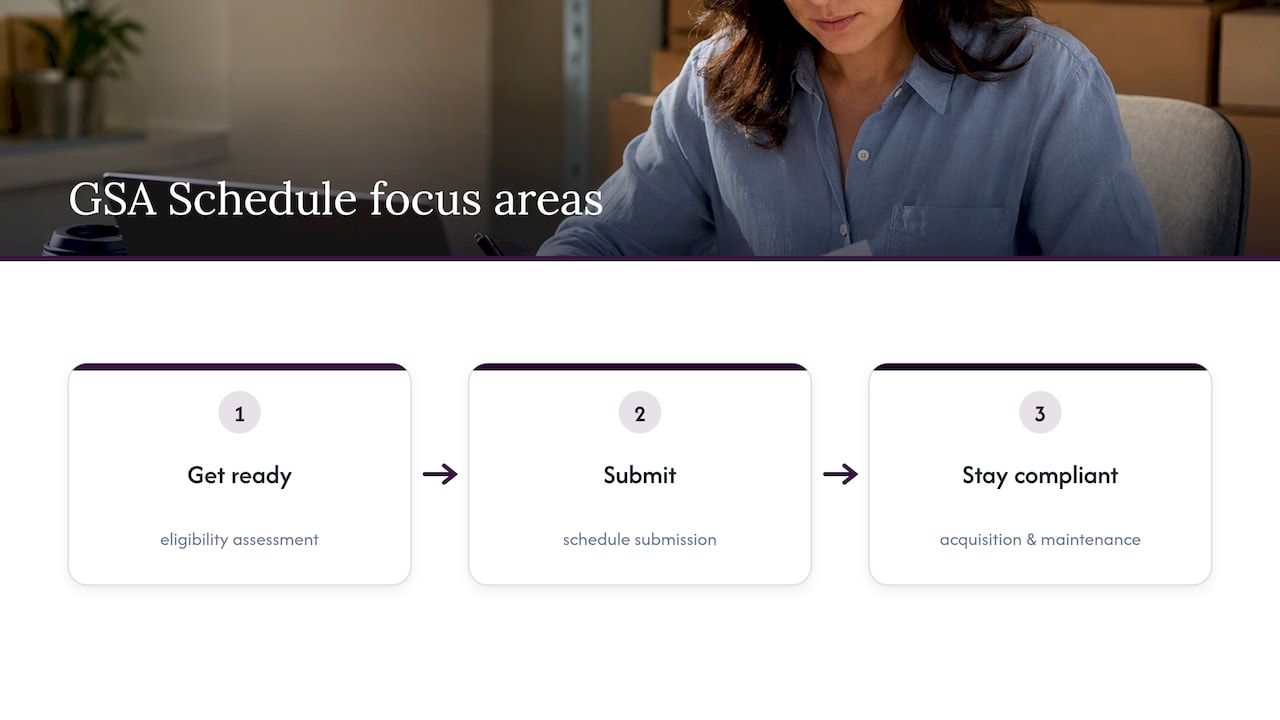
Finding federal work on your own through SAM.gov, forecasts, and subcontracting leads is entirely possible, but pursuing a GSA Schedule specifically involves its own paperwork, pricing documentation, and negotiation process that eats far more time than most owners expect. Our discovery offering gives you a straightforward eligibility assessment so you know within one conversation whether a schedule makes sense for your business and what the realistic timeline looks like.
We only work on GSA Schedule acquisition and maintenance, so every recommendation stays focused on getting you ready, submitted, and compliant rather than spread across unrelated services. If a schedule fits your sales strategy, start with our free eligibility check to see where you stand before committing any further time.
FAQ
What are the easiest government contracts to get?
Simplified acquisitions and micro-purchases, typically found at the state and local level or through subcontracting on an existing prime contract, tend to carry less competition and lighter documentation requirements than large federal solicitations. Set-aside contracts for qualifying small businesses also face a narrower competitor pool than full and open solicitations.
Is there a way to look up government contracts?
Yes, SAM.gov is the official federal source, listing all contract opportunities over $25,000 along with filters for NAICS code, agency, and set-aside type. State and local governments maintain separate portals searchable by region or ZIP code.
What is the best database for finding government contracts?
For live federal solicitations, SAM.gov is the primary and required source agencies must use. For planning ahead, the GSA Forecast tool and historical award data on FPDS round out a complete research approach.
Are government contracts public record?
Yes, federal contract solicitations and most award data are public and searchable through SAM.gov, FPDS, and USASpending.gov. Some details, like proprietary pricing in certain negotiated contracts, may be redacted, but the existence and general terms of awards remain publicly accessible.
Sources
- SAM.gov — Find Contract Opportunities
- SUBNet — Subcontracting Network (SBA)
- GSA — Forecast tools guide
Recommended
- Government Contracts for Small Businesses: Top 10 Strategies
- Discover Your Comprehensive List of Government Contracts
- Government Contract Vehicles: A Guide for Small Businesses
- Mastering Government Contracts: Professional Guide and Tips