

The government charges nothing for SAM.gov registration, the step every federal seller starts with. Your real costs are the 0.75% Industrial Funding Fee on Schedule sales, your own preparation time, and optional expert help. Our acquisition work is paid only after award, and maintenance plans start at $99 a month.
TL;DR
- SAM.gov registration is free. The recurring government cost is the Industrial Funding Fee (IFF), currently 0.75% of Schedule sales unless the solicitation says otherwise.
- The biggest cost for most owners is time, not fees. Working alone often takes 2+ years. Our clients are typically awarded in about 6 months and spend about 3 hours.
- Our published prices: maintenance plans from $99 a month, a $1,500 per year retainer, and annual federal marketing tiers from $10,700 to $27,700.
- For acquisition, our rule is no award, no fee. You pay after approval.
- Budget for the fee on sales, price list changes (called modifications) and sales reporting every quarter.
Table of Contents
- What does it cost to get a GSA Schedule contract?
- How much is the Industrial Funding Fee, and how is it paid?
- How does GSA Schedule pricing work?
- How much does a GSA Schedule consultant cost?
- What does it cost to keep a Schedule in good standing?
- Is a DIY route cheaper?
- Should you start with a Schedule or with open bids?
- Our perspective
- Ready to get a clear price for your business?
- FAQ
- Sources
What does it cost to get a GSA Schedule contract?
There are four buckets of cost, and only some are cash:
- Government fees to apply. Registration in SAM.gov, the federal system every contractor must be listed in, costs nothing. Be wary of any site that charges you to register there.
- Your preparation time. A Schedule offer needs a commercial price list, company experience, past performance, financial information and a clear map of what you sell to the right categories. This is where most first attempts stall.
- Professional help, if you use it. A consultant’s fee replaces months of your own learning curve.
- Fees after award. The Industrial Funding Fee and the cost of keeping the contract current.
The first two decide how fast you start selling. The last two decide your margin once you do.
Why does time matter more than the fee?
A Schedule that sits in review earns nothing. Businesses that go it alone often spend two years or more, in part because of rejected or incomplete submissions and slow back-and-forth. Our clients are typically awarded in about 6 months and give us about 3 hours of their time, because we prepare the documentation, map your offering to the right categories, build the price list and support the negotiation. If a Schedule could bring you even one federal order a year, every month of delay is a month of lost revenue. Our sales opportunity estimator helps you size that.
How much is the Industrial Funding Fee, and how is it paid?
The IFF is the government’s cut of your Schedule sales. GSA’s Vendor Support Center states that the MAS IFF rate is 0.75% unless the solicitation says otherwise, and that it reimburses GSA and VA for running the Federal Supply Schedules Program. The rate is set by GSA and can change with a new solicitation or refresh, so confirm it on that page before you price.
What does the fee look like on real numbers?
Here is a simple example. These are illustrative figures, not a forecast.
| Annual Schedule sales | IFF at 0.75% |
|---|---|
| $100,000 | $750 |
| $400,000 | $3,000 |
| $1,000,000 | $7,500 |
The fee scales with what you sell, so a quiet year costs little. Because the IFF is included in the sales you report, it is built into your Schedule prices rather than added on top for the buyer. Price with it in mind from the start. Our pricing calculator and cost calculator walk through the math.
When do you report sales and pay?
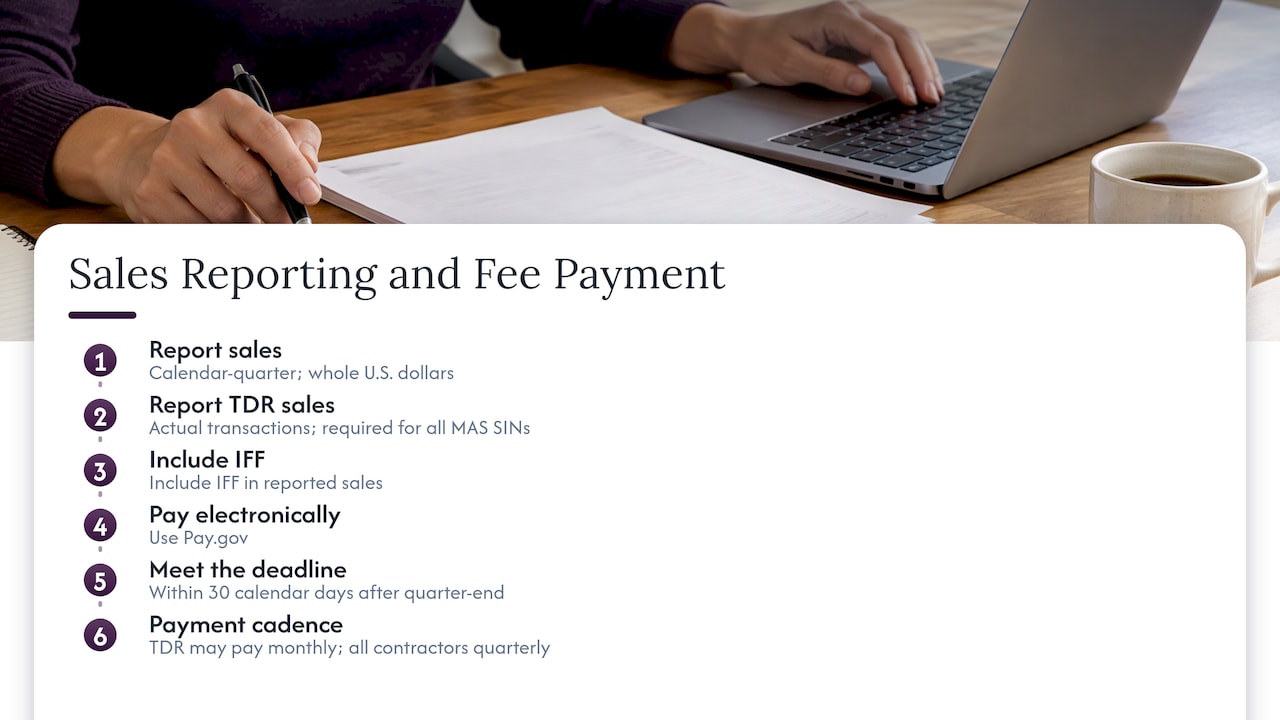
Under GSAR clause 552.238-80, you report all Schedule sales by calendar quarter in whole U.S. dollars, include the IFF in those sales, and send the fee within 30 calendar days after the quarter ends. GSA’s Sales Reporting Portal manual adds that payments go electronically through Pay.gov, and paper checks are not accepted.
One recent change matters here. Effective April 2, 2026, with MAS Refresh 31, Transactional Data Reporting is required for all MAS SINs. Transactional Data Reporting means you report the actual sales transactions instead of tracking them by other methods. Contractors who report this way may pay the IFF monthly, but all contractors must pay it quarterly. Missing a report or payment is an avoidable problem, which is why we set up sales tracking for clients at the start.
How does GSA Schedule pricing work?
Schedule prices are ceilings. GSA describes them as not-to-exceed prices, set with order size, type, complexity and region in mind. Contractors can discount at the order level, and ordering contracting officers can ask for lower prices.
To set that ceiling, the government compares you with your best commercial customer. GSAM Subpart 538.2 directs contracting officers to seek the offeror’s best price given to its most favored customer, and to compare commercial terms such as volume, discounts, contract length and warranties.
In practice that means:
- Your commercial price list is the starting point, so it has to be accurate and documented.
- Your discounts to other customers shape what GSA expects from you.
- A weak first price list costs you twice: in negotiation now and in margin for years.
This is where a prepared price list pays for itself. We develop it before the offer goes in, so the negotiation starts from a position you can defend. For how prices appear to buyers, see how GSA Advantage pricing works.
How much does a GSA Schedule consultant cost?
Consultant pricing varies by what is included: acquisition only, ongoing maintenance, or marketing to agencies. Here is what we publish.
| Service | Published price |
|---|---|
| Acquisition packages (Startups, Specialty, Streamline) | Quoted per proposal, paid only after approval |
| Retainer | $1,500 per year |
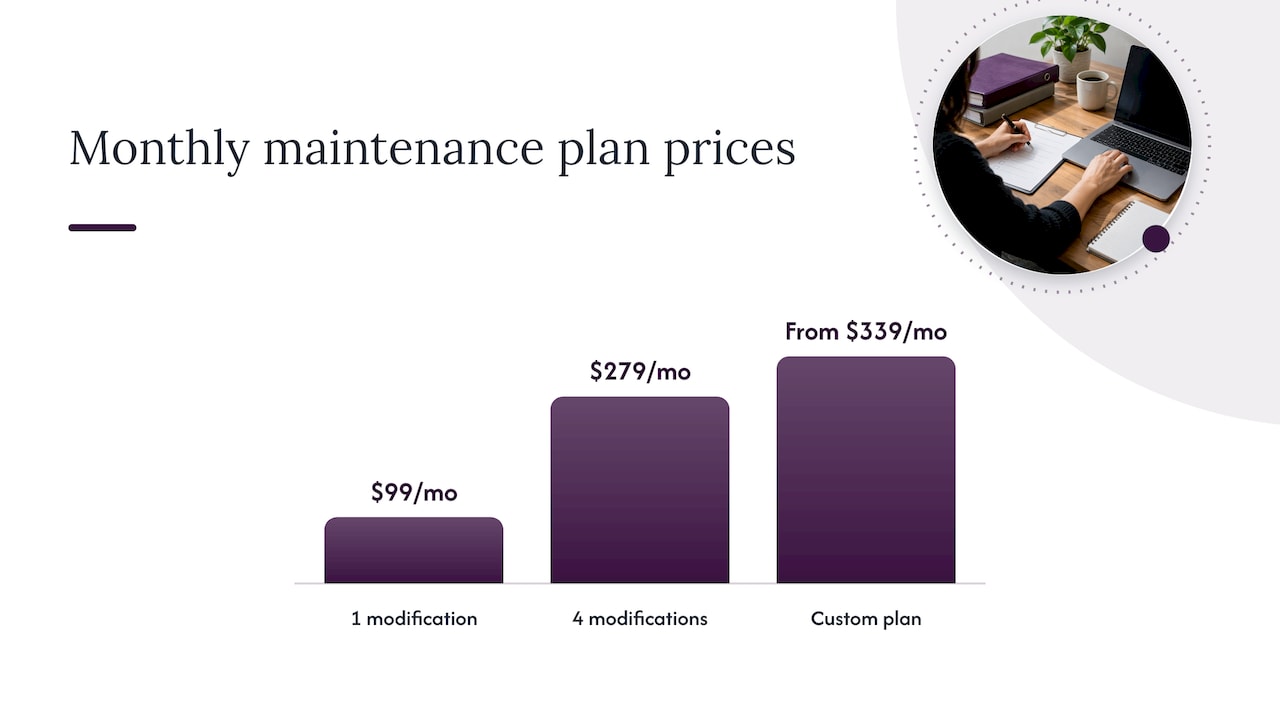
| Maintenance, 1 modification a year | $99 per month |
| Maintenance, 2 modifications a year | $159 per month |
| Maintenance, 3 modifications a year | $219 per month |
| Maintenance, 4 modifications a year | $279 per month |
| Maintenance, custom number of modifications | From $339 per month |
| Federal marketing, Lite | $10,700 per year |
| Federal marketing, Standard | $15,700 per year |
| Federal marketing, Plus | $27,700 per year |
You can see the details on our acquisition packages, maintenance plans, retainer and federal marketing tiers. For a broader view of what to expect from low to high five figures, read our guide to consultant costs.
What should the fee cover?
A fair fee covers the work that actually gets you awarded:
- An eligibility and readiness assessment before you spend anything else
- Complete documentation preparation
- Price list development and mapping your products or services to the right categories
- Compliance guidance and negotiation support
- Sales tracking setup so reporting and fee payments are not a surprise
All of these are part of how we work, and the structure is built around your results: you pay after approval, not before.
Is a consultant worth the money?
The test is simple. Compare the fee with the revenue you expect and the months saved. If working alone takes two years and a guided process takes about six months, the difference is roughly 18 months of selling time. Our ROI guide explains why the 0.75% fee is only the start of that calculation. For a closer look at what the work involves, see what a consultant does.
What does it cost to keep a Schedule in good standing?
Award is the beginning. After that you pay the IFF on sales, report on time and update the contract as your business changes. Typical changes are new products or services, new prices and updated terms. Each is a modification, and each needs to be done correctly to stay compliant.
Our maintenance plans are priced by how many modifications you expect each year, from $99 a month for one to $279 a month for four, with custom plans from $339 a month. If your needs are smaller, price list changes are handled as Simple, Basic or Advanced changes. Pick the plan that matches how often your catalog changes. A company that adds products each quarter needs more modifications than one with a fixed service list.
Is a DIY route cheaper?
On paper, yes: you avoid a consulting fee. In practice, you trade cash for time, and time is the expensive part. Each rejected or incomplete submission restarts a slow review. The preparation also pulls the owner or a senior manager away from selling.
If you want to prepare the paperwork yourself, our DIY Quick Start gives you a structured toolkit. If you want the process handled for you, our acquisition packages are built for about 3 hours of your time. Our consulting page explains how the two fit together.
Should you start with a Schedule or with open bids?
If you are brand new to federal sales, you may be wondering whether to bid first. Federal opportunities are posted on SAM.gov, which replaced the retired FedBizOpps. A Schedule adds a second channel: agencies can order from it without running a full open competition. That is why the two work best together. Open bids build past performance, and a Schedule gives agencies a faster way to buy from you again.
Before you invest, make sure your business is ready. Companies usually do best when they have a clear offering, commercial sales history and the capacity to deliver. A readiness check at the start tells you where you stand and saves cost later.
Our perspective
Owners ask us what a Schedule costs, and the honest answer is that the government fee is the smallest line. SAM.gov is free and the IFF is a fraction of sales, so the cost that really hurts is the time lost to a slow first attempt.
That is why we built our acquisition work so you pay after approval. We prepare the documents, build the price list, map your offering and support the negotiation, so you spend about 3 hours and our clients are typically awarded in about 6 months. Our model is no award, no fee.
After award, we keep the contract healthy with maintenance plans that scale with the number of changes you make, so reporting and modifications never become a distraction from selling.
Josh
Ready to get a clear price for your business?
Your cost depends on what you sell, how you price it and how fast you want to start. We review your readiness, recommend the right acquisition package and give you a proposal. Start with the acquisition packages, or use the landing page to tell us about your business.
FAQ
Is there a fee to apply for a GSA Schedule?
SAM.gov registration, which every federal seller needs, is free. Your main costs are preparation time, optional consulting and, after award, the Industrial Funding Fee on your sales. With us, you pay for acquisition only after approval.
How much is the fee on each sale?
GSA lists the current MAS rate at 0.75% unless the solicitation states otherwise. On $400,000 in Schedule sales that is $3,000. You report sales and pay each quarter, within 30 days of quarter-end.
Can I lower my cost by negotiating prices?
Schedule prices are ceilings, so ordering officers can seek lower prices at the order level. The goal in your own negotiation is a price list you can sustain after the fee and still earn a margin. We build that price list with you before submission.
What does ongoing support cost after award?
Our maintenance plans run from $99 a month for one modification a year to $279 a month for four, with custom plans from $339 a month. See the maintenance plans for the details.
How do I find out whether I qualify before paying anything?
Start with a free eligibility check. We review your business, tell you whether you are ready and outline the cost and timeline. Request it through our free eligibility check.
Sources
- SAM.gov training for small business (USDA ARS)
- MAS and VA FSS Industrial Funding Fee rates (GSA Vendor Support Center)
- GSAR 552.238-80 Industrial Funding Fee and Sales Reporting (acquisition.gov)
- Fee Payments Overview (GSA Sales Reporting Portal)
- MAS Refresh 31 and TDR (GSA Vendor Support Center)
- Pricing: Know More (GSA Interact)
- GSAM Subpart 538.2 (acquisition.gov)
Recommended
- How to Get on the GSA Schedule: Requirements, Steps & Cost (2026)
- GSA Consultant Costs for U.S. SMBs: Low to High Five Figures
- GSA Schedule Cost Calculator
- Understanding GSA Contract Pricing Strategies