

A GSA scope review checks that everything you sell under your Schedule contract fits the Special Item Numbers (SINs) and labor category descriptions GSA awarded you. To run one, list every offering and order, match each to your awarded SIN text, label anything else as open market, and fix gaps by modification.
TL;DR
- Scope means you may sell under the contract only what GSA authorized, and each item must fit an awarded SIN description.
- GSA reviews scope during contractor assessments, using your sales records, quotes, invoices, statements of work and modifications.
- Items outside your contract must be flagged as open market before the sale, in the quote and on the invoice.
- Frequently sold items that fall outside scope can be added by modification, and the contracting officer decides whether to approve them.
- Do your own review before each assessment window, and before you add any new offering to a quote.
Table of Contents
- What does a GSA scope review actually examine?
- When does GSA review your scope?
- What records does the reviewer ask for?
- How do you run a GSA scope review on your own contract?
- What happens if something is out of scope?
- Have the rules changed recently?
- Should you do this yourself or bring in help?
- Ready to check where you stand?
- FAQ
- Sources
What does a GSA scope review actually examine?
A scope review asks one question: does what you sold fit what GSA awarded you? GSA’s Contractor Reference Guide defines scope of contract this way. A contractor may provide only the specific products and services GSA authorized under the contract. Those items must fall within the descriptions of the SINs awarded. Anything not on the contract may not be represented as being on it.
If you are new to the program, a SIN is a numbered category of products or services on your Schedule. Your contract is made of the SINs you were awarded, and each one has a written description. Our overview of what the GSA Schedule is covers the basics.
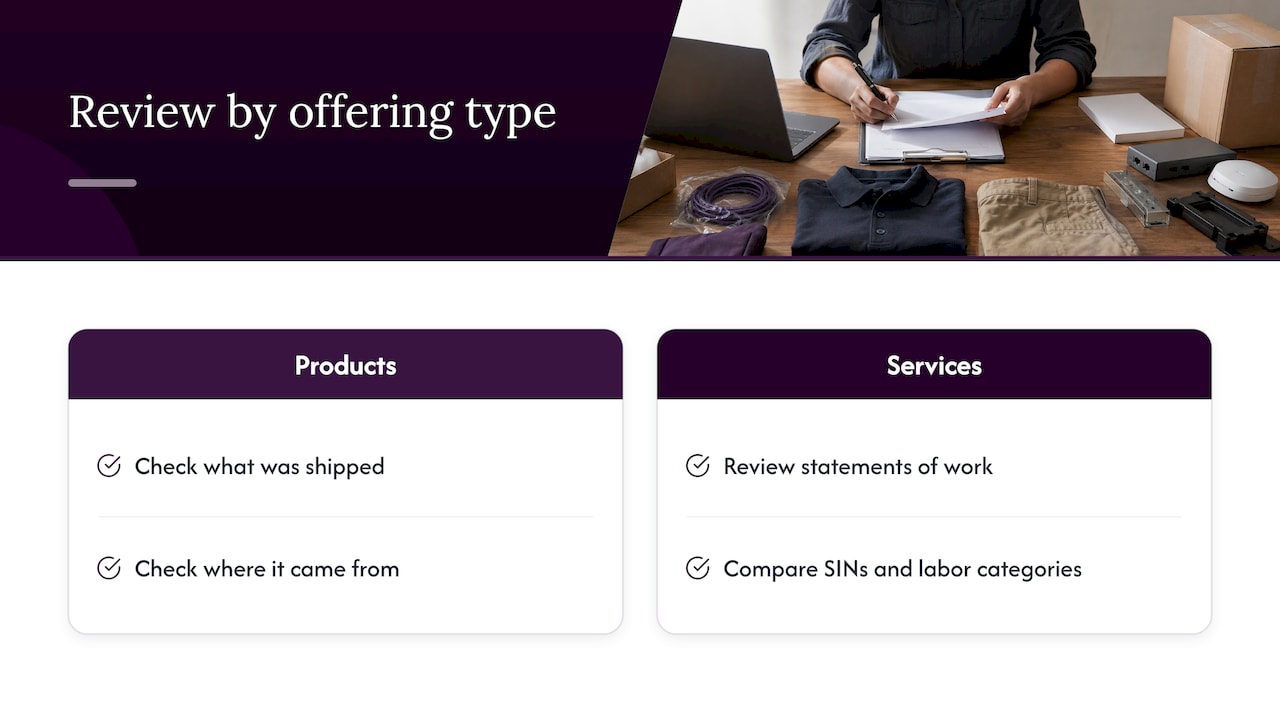
For products, the reviewer looks at what you shipped and where it came from. For services, GSA reviews statements of work against the awarded SIN and labor category descriptions. The question is not whether you can do the work. The American Bar Association’s Louis Chiarella writes that the relevant inquiry is whether the services or labor positions are actually included on the vendor’s contract as reasonably interpreted, not whether the vendor is willing or technically able to provide them.
GSA’s Scope Compliance page adds that staying within scope is a critical performance factor evaluated on the contractor assessment report. That makes it a scored item, not a formality.
When does GSA review your scope?
GSA does not wait for a complaint. Under the Contractor Assessment Reference Guide, annual assessments happen up to once a year. End-of-term assessments happen in the fourth year of each five-year contract period. Both are mandatory. Older GSA guidance says at least two compliance visits occur in each five-year term, around the third year and again in the final year, under the Steps to Success guide.
The assessment is run by an Industrial Operations Analyst (IOA). According to GSA’s vendor support page on who does what, the IOA independently conducts the assessments and submits a report to the responsible contracting officers. The Procurement Contracting Officer (PCO) negotiated your award and is the only person who can change the contract by modification.
The practical takeaway is simple. A review is on your calendar whether or not you ever get a warning letter, so the best time to find a scope problem is months before the IOA does.
What records does the reviewer ask for?
The IOA relies on the Examination of Records clause to request sales information for a specific period. The assessment guide lists sales documents, invoices, purchase orders, modifications, crosswalks and pricing documentation. The Steps to Success guide adds more items that may be needed:
- Your original contract and Final Proposal Revision
- All approved modifications and price lists
- Letters of supply and country-of-origin information for products
- Your list of GSA-authorized dealers, if you use any
- Written procedures for your sales tracking system
- GSA and non-GSA quotes, invoices and statements of work
The reviewer uses your original award and later modifications as the baseline for what is approved. Then the reviewer reads your orders to see whether open market items were properly marked on quotes and invoices. If your baseline is hard to reconstruct, you start the assessment behind. Our list of common GSA record-keeping mistakes shows where files usually fall apart.
How do you run a GSA scope review on your own contract?
You can do this in an afternoon for a small contract, or a few days for a large one. Follow these steps in order.

Step 1: Pull your baseline documents
Gather the awarded contract, every approved modification and your current price list. This is the only version of your scope that counts. Marketing pages, old proposals and what a customer asked for do not define it. The common failure here is working from a price list that was updated after a modification you never finished.
Step 2: Map every offering to an awarded SIN
Build a simple table with three columns: the item or service you sell, the SIN you believe covers it, and the SIN text that supports it. Read the SIN description itself, not just its title. If you are unsure which SIN covers what, our SIN selection guide and SIN lookup tool show how SINs are structured. Anything you cannot match to a SIN goes on a separate “out of scope” list.
Step 3: Test every labor category
For services, compare each labor category you actually staff against the labor category descriptions on your contract: title, duties, education and experience. GSA’s ordering guide says ordering activities may not allow deviations from labor category descriptions at the order level. It also says deviations from the qualifications by the selling contractor can result in unqualified labor and may be subject to the False Claims Act.
If you bill a title that differs from your contract, you need a crosswalk showing the similarity. The assessment guide says that if labor categories cannot be crosswalked, they are considered out of scope. Our labor category compliance guide goes deeper. A crosswalk helps you show fit, but Chiarella’s article notes it is a tool, not the test itself.
Step 4: Check the work excluded from Schedule orders
Some work cannot be ordered on a Schedule at all. The Ordering Quick Reference Guide says Schedule task orders must not include inherently governmental functions, personal services, certain architect-engineering work, most construction and some hazardous remediation. If a task order you hold or are quoting touches any of those, stop and have it reviewed before you deliver.
For products, check the general out-of-scope list in the solicitation. The Refresh 27 attachment names categories such as promotional products, sporting goods and musical instruments, and it lists ten SINs retired from the solicitation. Confirm none of your offerings sit in those groups.
Step 5: Audit your last year of quotes and invoices
Sample orders from each quarter. For each, ask whether every line item is on your price list. If an order includes an item that is not, the line must be identified as open market. The Scope Compliance page says the customer must know which items are contract items and which are open market before the sale. That has to be documented in a written quote or email and shown on the invoice as non-contract or open market.
This is the most common failure point. The assessment guide says that open market items not explicitly called out in the quote are considered out of scope, unless you can show through a quote, email or letter that they were not misrepresented as Schedule items. Our guide to GSA ordering versus open market purchasing shows how this looks on a real order.
Step 6: Decide how to close each gap
For each item on the out-of-scope list, pick one of three paths. Flag it as open market on future orders. Add it to the contract by modification. Or stop selling it under the contract. The next section explains how.
What happens if something is out of scope?
Findings are not automatically penalties. According to the assessment guide, scope compliance findings go to the PCO for resolution. That can mean contractor education, a modification to add frequently used open market items, sales adjustments or other remedies. GSA also states that non-Schedule items can be procured through the OLM or ANCILLARY SIN where applicable, through open market procedures, or by expanding the contract through modifications or Contractor Team Arrangements.
GSA frames the rule as protective. The Steps to Success guide says selling only awarded items helps ensure the integrity of the program and protects contractors from unintended consequences. It names Contractor Team Arrangements and modifications as the ways to sell more without leaving scope.
How does a modification add new items?
You submit a modification request to your contracting officer. GSA’s MAS Modification Guide says new items or services are not added until the contracting officer finds the prices fair and reasonable, the items within scope of the SINs, and the request responsive to the solicitation. The same guide says identical items with the same terms may sit under more than one SIN if the prices are the same and the items fit each SIN.
That means a modification is only as strong as your scope mapping. A request that shows the exact SIN language it relies on moves faster than one that asks the officer to guess.
Have the rules changed recently?
The scope concept itself is stable. What moves is the paperwork around it. A Federal Register final rule published January 12, 2024 clarified clause prescriptions, delegation, contract-file documentation and deviation procedures. GSA said it would not change how the roughly 13,000 contractors then using those clauses conduct business.
Transactional Data Reporting (TDR) is the bigger operational change. Holland & Knight reported that GSA announced on June 9, 2025 that all Schedule contractors must comply with TDR by fiscal year 2026. The Refresh 27 attachment says TDR participation is mandatory for any contract with one or more TDR-eligible SINs. If you added SINs recently, confirm which reporting rules attach to them. Always check the current solicitation refresh on GSA’s site for the latest terms.
Should you do this yourself or bring in help?
If your contract has one or two SINs and a handful of offerings, a careful owner can run the six steps above. The work gets harder when you have many labor categories, several subcontractors, or orders across multiple agencies. A scope error found late can mean sales adjustments and a rushed modification.
This is where we come in. Our consulting covers compliance guidance, price list development, SIN mapping, contract modifications and back-office maintenance. For holders who want steady upkeep, we publish maintenance plans starting at $99 per month for one modification a year, with higher tiers for more modifications. Our price list change services are described on our maintenance proposal page.
If you do not yet have a Schedule and you are weighing government sales, getting scope right at the start saves rework later. Our GSA Schedule application services build the SIN mapping and documentation into the application. Our own claim is that clients need about three hours of their time, pay only after approval under a no award, no fee approach, and are backed by a money-back guarantee.
Why we treat scope as a day-one decision
We see scope as the foundation of the whole contract, not a compliance chore that arrives in year three. The SINs you are awarded decide what you can quote, which labor categories you can bill and which modifications you will need later. When those choices are made carefully at the start, your sales team can sell with confidence and your records support them.
That is why our work starts with SIN mapping and a clean price list, and why our maintenance plans are built around modifications. A contract that grows by planned modification stays inside its scope. A contract that grows by improvisation eventually meets an assessment.
Our approach is designed to take the paperwork off your desk so you can spend your time on the buyers, not the binder.
Josh
Ready to check where you stand?
If you want a second set of eyes on your SIN mapping, labor categories or planned modifications, start with a free eligibility check through our home page. We will tell you where your offerings fit and what a clean scope looks like for your business.
FAQ
Is a scope review the same as a contractor assessment?
No. Scope is one of the areas a contractor assessment examines. The same assessment also covers sales reporting, pricing, Trade Agreements Act compliance, labor qualifications and administrative items, according to GSA’s assessment guide. Running your own scope review prepares you for the scope portion of that larger review.
Can I sell a product or service that is not on my contract?
Yes, but only as an open market item that you identify clearly. The customer must be told before the sale, in a written quote or email, and the invoice must label it non-contract or open market, per the Scope Compliance page. If you sell it often, a modification can add it to your contract.
What if my labor category title does not match my contract?
You need to show the similarity, usually with a crosswalk that compares duties and qualifications. If the categories cannot be crosswalked, GSA treats them as out of scope. Compare the full description, not just the title, and see our labor category guide for how to document it.
Does government open market bidding avoid scope issues?
Open market buys follow different procedures, so scope of a Schedule contract does not limit them. If you sell both ways, keep the two clearly separate on quotes and invoices. Our comparison of Schedules versus open market bidding explains the difference.
How do I find out whether my business qualifies for a Schedule at all?
Start with a free eligibility check. We review your business and offerings and tell you whether a Schedule fits and which SINs are likely to apply. You can request it at gsascheduleservices.com.
Sources
- GSA Contractor Reference Guide: Steps to Success
- GSA Vendor Support Center: Scope Compliance
- GSA Multiple Award Schedule Contractor Assessment Reference Guide
- GSA Vendor Support Center: Who do I deal with from GSA?
- American Bar Association: FSS Scope Determinations
- GSA Multiple Award Schedule Ordering Quick Reference Guide
- GSA MAS Solicitation Refresh 27 SF30 Attachment
- GSA MAS Modification Guide, October 2026
- Federal Register, Volume 89, Issue 9, January 12, 2024
- Holland & Knight: GSA Expands Transactional Data Reporting Requirements
Recommended
- Ultimate Guide to GSA Scope Change Requests
- How Proposal Errors Delay GSA Approval
- GSA Award Process Explained