

Protect your discount relationship while trading targeted, non-price concessions for margin. Document commercial discounts, set a defensible initial price, and know the rules behind GSAR 552.238-81, GSA eMod, and GAO pricing reviews before you sit down with a contracting officer.
TL;DR:
- Contractors should anchor their GSA pricing to documented commercial discounts and clear basis-of-award evidence to accelerate negotiations and protect margins.
- Bringing organized proof, including commercial price lists and specific discount data, reduces audit risk and supports quick, compliant price changes post-award.
- Using order-level discounts and trade-offs like value-added services rather than broad contract cuts helps maintain profitability during negotiations.
- Maintaining current, accurate disclosures and internal governance on pricing data prevents costly False Claims Act violations and facilitates smooth audits.
- Proper preparation, including a pre-negotiation checklist and prompt documentation of agreements, increases leverage and ensures compliance throughout the contracting process.
Table of Contents
- 1. Top negotiation tactics you can apply right now
- 2. How GSA decides what counts as fair and reasonable pricing
- 3. What documentation to bring to the table
- 4. Negotiation scripts and concession planning that protect margin
- 5. What happens after award: the eMod process and price changes
- 6. Managing audit risk and False Claims Act exposure
- 7. Your 72-hour pre-negotiation checklist
- Why documentation discipline beats aggressive tactics
- How GSA Schedule Services supports your pricing position
- Where these rules come from
- Sources
- FAQ
1. Top negotiation tactics you can apply right now
The strongest position in a GSA negotiation comes from evidence, not enthusiasm. A contracting officer wants to see that your Schedule price mirrors what your best commercial customers already pay, and every tactic below builds from that fact.
- Anchor on documented commercial discounts and a clear basis-of-award rather than a round number you think sounds fair.
- Offer order-level pricing moves instead of contract-wide cuts, so a single aggressive order doesn’t reset your baseline.
- Trade limited, conditional incentives (a pilot discount, a short-term volume break) rather than permanent price reductions.
- Push non-price value such as faster delivery, extended warranty terms, or higher support tiers when a buyer wants more than your list price allows.
- Flag concessions that draw audit attention: one-off rebates, side discounts, or anything not reflected in your commercial sales practices.
Pro Tip: Keep every order-level discount scoped in writing, including duration and conditions, so it never looks like an undisclosed change in commercial practice.
2. How GSA decides what counts as fair and reasonable pricing
GSA’s benchmark is the “most favored customer” concept: the price it wants is the best price you give a comparable commercial customer, with exceptions allowed only when you can justify a difference in volume, terms, or risk. Contracting officers lean on comprehensive pricing guides that compare your proposed price against commercial price lists, competitor Schedule pricing, and market benchmarks before they negotiate.
GAO reviews found that GSA has used pricing tools like pre-award audits and clearance panels inconsistently, which affects how much leverage a CO actually brings to the table. That inconsistency cuts both ways: a contractor with airtight commercial sales data can often move a negotiation faster than one hoping the CO skips a deeper review. Understanding what fair and reasonable means for your specific product or service line is the first step in setting realistic expectations.
3. What documentation to bring to the table
Negotiations move faster and stay cleaner when you show up with organized proof instead of promises. Bring:
- Commercial price lists and dated discount schedules that demonstrate your most-favored-customer relationships over time.
- Commercial Sales Practices disclosures or the equivalent transactional data, exported as CSVs, covering recent representative sales.
- A one-page basis-of-award memo that ties your GSA price to specific commercial customers, dates, and discount events, and explains any deviation.
A CO who sees a clean, dated paper trail has less reason to push back or request a pre-award audit. Treat the basis-of-award memo as your opening exhibit, not a backup document you produce only if asked.
4. Negotiation scripts and concession planning that protect margin
Set your initial price from your strongest defensible commercial data point, then explain the basis without handing over every internal spreadsheet you have. You only need enough detail to support the number, not your entire pricing history.
- When a buyer pushes for a lower price, propose an order-level discount scoped to that specific order rather than a contract-wide change: “We can offer a reduced rate on this order given the volume, but our Schedule pricing reflects our standard commercial terms.”
- When a CO questions your rate against a competitor, frame the value of your bundled services (support, delivery speed, warranty) rather than matching a stripped-down price.
- After any verbal agreement, restate it in writing the same day: what was traded, the scope, and the duration.
Before you walk in, identify three tradeable items: one high-value non-price concession (an extended warranty or faster delivery), one delivery or service term you can flex on, and one narrowly scoped discount you’re willing to offer only under specific conditions. Reviewing how to price your services before the meeting helps you know which of the three you can afford to give up first.
Pro Tip: Never lead with your biggest concession. Start with the non-price item, since it costs you the least and often satisfies the buyer’s real concern.
5. What happens after award: the eMod process and price changes
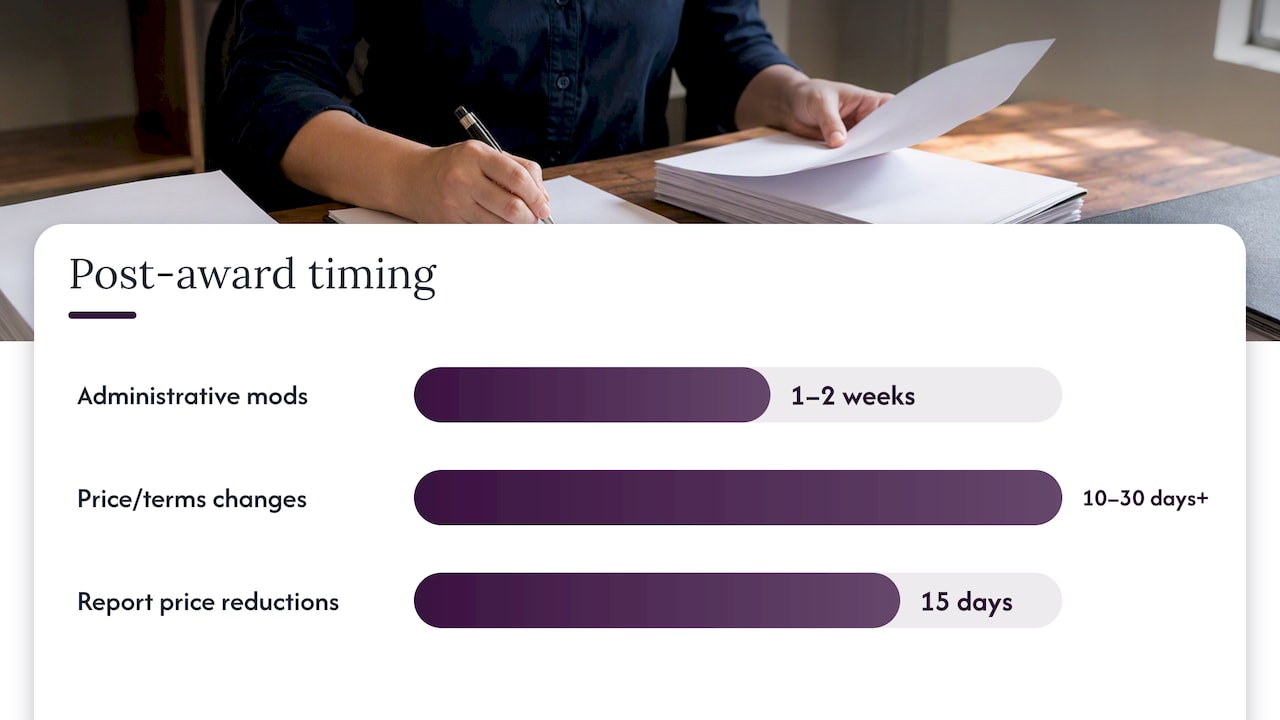
Most post-award price activity runs through GSA’s eMod system, and the mod type determines the path. Administrative modifications typically clear within about one to two weeks (https://www.gsa.gov/system/files/MULTIPLE-AWARD-SCHEDULE-MODIFICATION-GUIDE_January2025_0.pdf), while price or terms changes can take 10 to 30 days or more depending on completeness and the contracting officer’s workload. Combine compatible administrative changes into a single submission when possible, use complete templates, and make sure an authorized negotiator signs the request. GSA’s own guidance also recommends using Chrome for the eMod portal to avoid formatting errors that trigger rejections.
One clause you cannot treat as optional: GSAR 552.238-81 requires you to report any commercial price reduction that creates a less favorable relationship for the government within 15 calendar days of its effective date. Missing that window is one of the most common, and most avoidable, compliance failures on a Schedule contract. For a walkthrough of the mechanics, see our guide on changing your GSA contract pricing.
6. Managing audit risk and False Claims Act exposure
Defective pricing disclosures carry real consequences. DOJ settlements tied to GSA Schedule negotiations have resulted in multi-million-dollar recoveries under the False Claims Act, and the common thread in those cases is incomplete or outdated commercial sales disclosures at the time of negotiation.
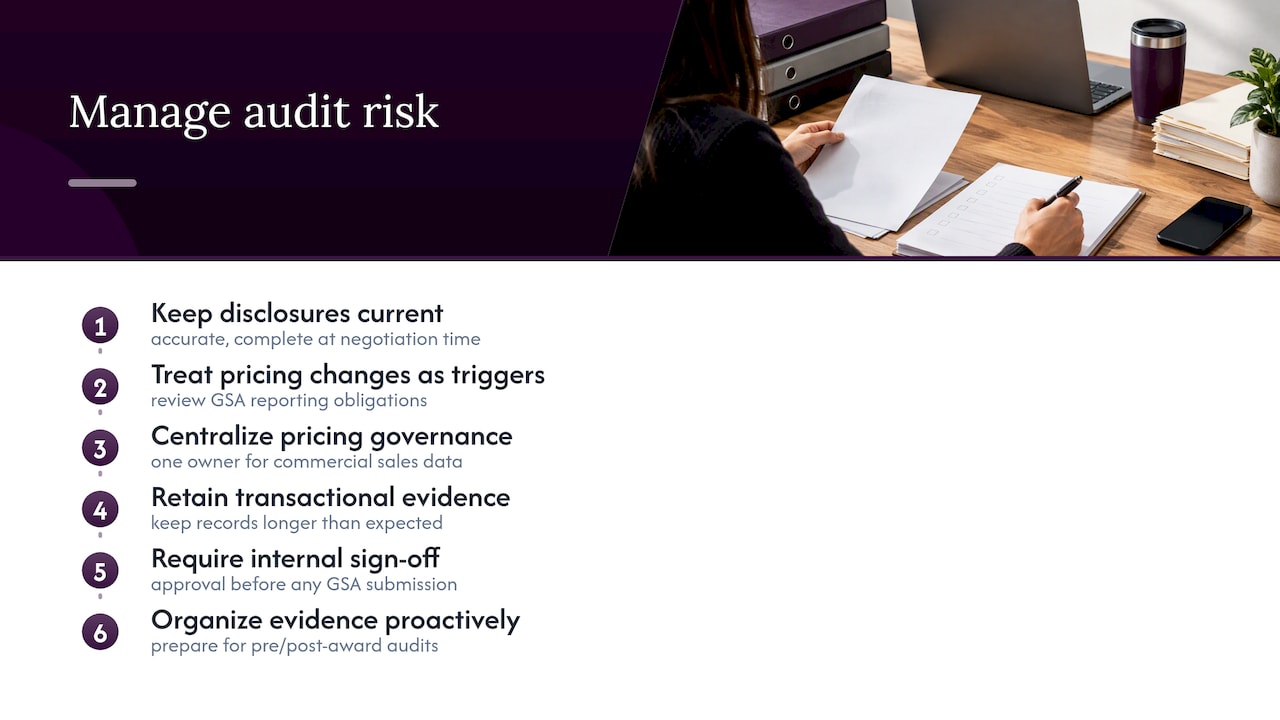
The practical defense is simple to describe and harder to maintain: keep your disclosures current, accurate, and complete, and treat any internal pricing change as a trigger to review your GSA reporting obligations. Centralize pricing governance so one person or team owns the commercial sales practice data, retain transactional evidence longer than you think you need to, and require an internal sign-off before any price submission goes to GSA. If a pre-award or postaward audit is likely given your sales volume, it’s often better to organize your evidence proactively than to scramble once the request lands. Our post-award pricing guide covers the ongoing recordkeeping habits that keep this manageable.
7. Your 72-hour pre-negotiation checklist
Before any negotiation meeting, work through this list:
- Assemble your commercial price evidence and finalize your basis-of-award memo.
- Define your walkaway point on price and your top three tradeable concessions.
- Get internal approvers to pre-clear your negotiating range so you’re not stalling mid-meeting.
During the session, ask your CO directly what pricing comparisons they’re using, whether a pre-award audit is planned, and how they’ll treat any order-level discounts you propose. Afterward, put every agreed item in writing the same day and start any eMod submission or follow-up documentation immediately, before details fade from memory.
Why documentation discipline beats aggressive tactics
Most advice about GSA negotiation focuses on scripts and leverage, but the contractors who consistently protect margin are the ones who treat documentation as the negotiation, not the paperwork that follows it. A basis-of-award memo built months in advance, updated as your commercial pricing shifts, does more for your outcome than any clever phrase you rehearse the night before a call.
The uncomfortable truth is that a lot of contractors negotiate reactively: they wait for the CO to push, then scramble for evidence they should have compiled at proposal time. That reactive posture is exactly what invites a longer audit cycle or a less favorable outcome. Discipline before the meeting, not charm during it, is what actually moves the number.
— Josh
How GSA Schedule Services supports your pricing position
We build negotiation packages around the documentation gap that trips up most contractors: our Startups, Specialty, and Streamline services under the GSA Schedule proposal packages include negotiation support and price-list development from day one, not as an afterthought once a CO pushes back.
For contractors already awarded and managing modifications, our price-list change services, including Simple, Basic, and Advanced Price List changes, handle the eMod submissions and documentation that keep you inside the 15-day reporting window. Our maintenance plans, from 1 Mod per year up to custom mod volumes, give you a team that already knows your basis-of-award instead of rebuilding it every time a price shifts. If you want a straight answer on where you stand, start with a free eligibility check and we’ll tell you exactly which service fits your contract stage.
Where these rules come from
Verify the details directly: the Price Reductions clause, GSA’s modification guide, GAO’s pricing review, and DOJ’s settlement record are the primary sources behind this guide.
Sources
- GSAM 552.238-81 Price Reductions clause
- GAO-05-229: Contract Management: Opportunities to Improve Pricing of GSA Multiple Award Schedules Contracts
- DOJ: Oracle/PeopleSoft settlement for defective pricing disclosures
FAQ
What is the most effective strategy for negotiating a GSA price?
Anchor your proposed price to documented commercial discounts and a clear basis-of-award memo rather than an arbitrary figure. Contracting officers compare your price against your best commercial customers, so the contractor with the cleanest paper trail typically negotiates faster and keeps more margin.
What does the 80/20 rule mean in GSA negotiation?
Outside of GSA-specific guidance, the idea generally means a small share of your concessions or customer relationships drive most of the negotiation outcome. In practice, focus your preparation on the commercial customers and discount data most likely to define your basis-of-award, rather than spreading effort evenly across every account.
What are five effective negotiation strategies for GSA contracts?
Anchor on documented commercial pricing, use order-level discounts instead of contract-wide cuts, trade non-price value like delivery or support terms, limit any discount’s scope and duration in writing, and avoid undocumented rebates that draw audit attention. Each of these keeps your margin intact while giving the CO something concrete to justify the award.
How long do contractors have to report a commercial price reduction?
Contractors must report a qualifying commercial price reduction to their contracting officer within 15 calendar days of its effective date under the Price Reductions clause. Missing that window is one of the more common compliance failures on an active Schedule contract.
How does GSA Schedule Services help with negotiation and pricing?
GSA Schedule Services offers negotiation support, price-list development, and eMod handling through its proposal and maintenance plan packages. These services are built for contractors who want documentation and compliance handled by a team already familiar with basis-of-award requirements, rather than managing the process alone.
Recommended
- The Recession-Proof Nature of GSA Sales: What You Need to Know
- Government procurement strategies that help SMBs win GSA bids
- 90 Day GSA Schedule Marketing Checklist for U.S. Schedule Holders
- An Essential Checklist to Maintain Your GSA Schedule Contract