
To win a federal contract, register in SAM.gov, pick the agencies and NAICS codes that fit what you sell, search SAM.gov for solicitations you can actually deliver, and submit a compliant, fairly priced offer with past performance behind it. Many small businesses shorten the wait by applying for a pre-negotiated vehicle such as a GSA Schedule instead of bidding one solicitation at a time.
TL;DR
- Get an active SAM.gov registration first. Nothing else moves without it.
- Bid where you have an edge: small business set-asides, purchases under the simplified acquisition threshold, and agencies that already buy what you sell.
- Agencies buy on “best value,” so past performance and a clear technical approach matter as much as price.
- Going alone commonly takes years to produce a first award. A pre-negotiated contract vehicle with expert help can compress that to about six months and roughly three hours of your time.
- Check your eligibility before you spend money on proposals.
Table of Contents
- How does the federal government actually buy things?
- What do you need before you can bid?
- How do you find contracts you can realistically win?
- How do you write an offer that wins?
- What if you lose a bid?
- Is it better to bid solicitation by solicitation or get a contract vehicle?
- Our perspective: where small businesses lose months
- How much does it cost to start government contracting?
- Should you hire a consultant or do it yourself?
- Ready to move from bidding to buying power?
- A 90-day plan for your first government sales push
- FAQ
- Check your eligibility for free
- Sources
How does the federal government actually buy things?
Before you chase a contract, it helps to know the mechanics. In the basic process, agency staff decide what they need, then post solicitations on SAM.gov, and interested companies respond. SAM.gov is the free, central place to find and bid on contract opportunities. FedBizOpps, the old posting site, is retired, so any guide that still sends you there is out of date.
Agencies choose between two main methods:
- Sealed bidding (FAR Part 14): a straightforward award, usually to the lowest responsible bidder.
- Negotiated contracting (FAR Part 15): common for complex work, and it allows “best value” trade-offs where technical strength and past performance are weighed against price.
The practical lesson: on most services work, you are not competing only on the lowest number. You are competing on how convincingly you show you can deliver.
What do you need before you can bid?
The SBA’s getting-started guidance lays out the groundwork. Work through it in this order.
- Confirm the government buys what you sell. Research which agencies purchase your product or service and how much they spend on it.
- Choose your NAICS codes. These classify your business and decide which opportunities you see and which size standard applies to you.
- Check your size status. Small business status is defined by SBA size standards for your industry.
- Register in SAM.gov. You will receive a Unique Entity Identifier (UEI). If your registration lapses, you cannot be awarded. Our walkthrough on how to verify your SAM.gov registration covers the common snags.
- Write a capability statement and profile. Treat your SAM.gov profile like a résumé: use descriptive, plain terms an agency would search for.
- Gather past performance. Contracting officers favor proven track records. If you are new, the SBA suggests drawing on relevant projects, including those of key personnel or predecessor companies.
If you are also weighing which registration steps come next, see our contractor registration guide.
How do you find contracts you can realistically win?
The biggest beginner mistake is bidding on everything. Pick a lane.
Search SAM.gov with intent
Filter SAM.gov contract opportunities by your NAICS code, set-aside type and place of performance, then save the searches. Read the whole solicitation, including the evaluation factors, before deciding to bid. Our Small Business Federal Opportunity Analyzer can help you screen what is worth a response.
Start with set-asides and small purchases
Thresholds shape how much paperwork a buy involves. Per Acquisition.gov’s table of effective dates, the micro-purchase threshold became $15,000 and the simplified acquisition threshold $350,000 as of October 1, 2025, with some statutory exceptions. Purchases in that range use lighter procedures, which makes them a sensible training ground for a first-time bidder.
Small business set-asides restrict competition to qualifying firms. We explain how they work in small business set-aside contracts explained. If you are a veteran-owned firm, SBA also runs a certification application for veteran-owned small businesses that opens sole-source and set-aside opportunities.
Market directly, not only through postings
The SBA notes you can market your business directly to agencies and prime contractors. Meeting small business specialists and offering to team with primes often puts you in the room before a solicitation is ever posted.
Use free help
The SBA points new contractors toward local counseling. APEX Accelerators, formerly PTACs, offer one-on-one help with readiness, registrations and finding bids. Our overview of the top contracting assistance programs shows what each one does well.
How do you write an offer that wins?
A winning offer is rarely the most creative one. It is the one that makes the evaluator’s job easy.
Mirror the solicitation
Build a compliance matrix: every requirement in the statement of work and every evaluation factor in one column, your response and page reference in the next. Missing a mandatory item is the fastest way to be rejected without anyone reading your pitch.
Show past performance that fits
Pick references that resemble the scope, size and agency type. Give outcomes in numbers you can document, such as on-time delivery and cost control. If you are new, lean on your team’s earlier work, as the SBA guidance suggests.
Price to be fair and reasonable
Contracting officials must find pricing fair and reasonable. On GSA’s Multiple Award Schedule, the government aims for pricing equal to or better than your most favored customer, and you must support your rates with documents such as commercial price lists or invoices. Unsupported prices are a common roadblock for new applicants. Our pricing calculator and pricing strategy generator help you test your numbers before you submit.
Be ready to invoice electronically
The SBA warns that you need to be e-commerce savvy, especially for Department of Defense work, where electronic invoicing and payment systems are required.
What if you lose a bid?
Losing is normal. First, ask for a debriefing and read what the evaluators said about your technical approach and price. Then decide whether a protest is justified. The GAO explains that protests generally must be filed within 10 days of when you knew or should have known the basis, and a timely filing can pause performance while GAO reviews. GAO is required to decide protests within 100 days. Protests cost time and money, so most small firms get more from improving the next offer.
Is it better to bid solicitation by solicitation or get a contract vehicle?
One-off bidding means each win starts from zero: a fresh proposal, fresh competition, a fresh wait. A pre-negotiated vehicle works differently. You negotiate pricing and terms once, and agencies can then order from you with less competition overhead. For many product and service companies, that is why applying for a GSA Schedule is the logical bridge between “I registered in SAM.gov” and “agencies are buying from me.”
The catch is the application itself. It asks for a detailed offer, commercial sales documentation, price lists and negotiation. Companies that handle it alone often spend years; the hard part is not eligibility, it is paperwork precision and rounds of clarification.
| Path | Best for | Typical effort | Main risk |
|---|---|---|---|
| Bid individual solicitations | Firms with a niche and strong past performance | Full proposal every time | Win rate is low until references build |
| Subcontract to primes | Brand-new contractors | Relationship building | Dependence on one prime |
| Contract vehicle, DIY | Firms with in-house compliance staff | Long, document-heavy | Rework and delays |
| Contract vehicle with a consultant | Owners with little spare time | About three hours of owner time | Choosing the right scope |
Our perspective: where small businesses lose months
We work only on acquiring and maintaining GSA Schedule contracts, so we see the same pattern repeatedly. Owners who register in SAM.gov and then wait for the phone to ring get frustrated. The ones who win treat government sales like any other channel: they pick a target customer, make themselves easy to buy from, and keep their paperwork clean.
On the application side, delays almost never come from the business being ineligible. They come from mismatched documents, price lists that do not tie to commercial sales, and slow responses to the contracting officer. Our clients are typically awarded in about six months while spending roughly three hours of their own time. Businesses working alone commonly take two years or more. Our model is built around that gap: we prepare the documentation, map your codes, develop the price list, support negotiation, and stay on after award so modifications and compliance do not become a second job. Winning the schedule is only the starting line, though. The real revenue comes from marketing it to buyers afterward, which we cover in our step-by-step guide to winning contract sales.
— Josh
How much does it cost to start government contracting?
The honest answer: registering in SAM.gov is free, and free counseling exists. The real costs are your time, proposal effort and, if you use outside help, professional fees. Our own published numbers are below so you can plan.
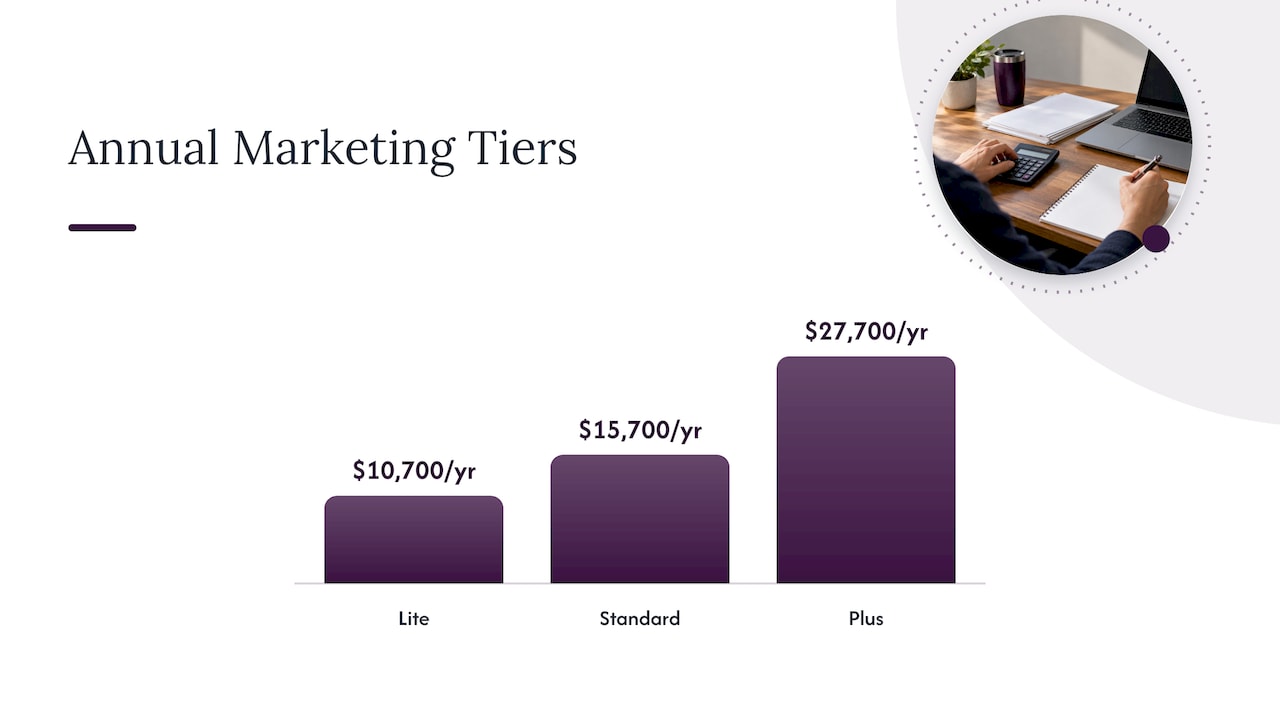
- Federal marketing programs: Lite is $10,700 per year, Standard is $15,700 per year, and Plus is $27,700 per year. See the marketing tiers.
- Retainer: $1,500 per year. See pricing.
- Maintenance after award: from $99 per month for one modification per year, up to $279 per month for four, and custom plans from $339 per month. Compare maintenance plans.
Application packages for startups, specialty businesses and streamlined cases are scoped to your situation. You can request a proposal here. If you prefer to do the work yourself, our DIY Quick Start is the self-service route.
Compare any option to the cost of your own time. Hours spent redoing forms are hours not spent selling.
Should you hire a consultant or do it yourself?
Do it yourself if you have someone in-house who knows federal compliance, a flexible timeline and patience for revisions. Hire help if any of these is true:
- You have already qualified but your application stalled or was rejected.
- Your time is better spent running the company.
- You want a fixed route to award rather than a learning curve.
- You need a price list that survives negotiation.
We lay out the differences in government contracts consulting services, and for broader tactics see government contracts for small businesses: top 10 strategies. If you sell professional services, the professional services page shows how that category works.
Ready to move from bidding to buying power?
Our approach is simple: no award, no fee, and a money-back guarantee backed by our own track record. We handle the eligibility assessment, documentation, price list, code mapping, negotiation and sales tracking setup, so you stay focused on delivery. Read about our full-service contract support, or start with a conversation on our discovery call page. More background is on our homepage.
A 90-day plan for your first government sales push
Days 1 to 30: foundation. Choose NAICS codes, complete SAM.gov, write your capability statement, and list three to five past performance references. Book a call with a local APEX Accelerator.
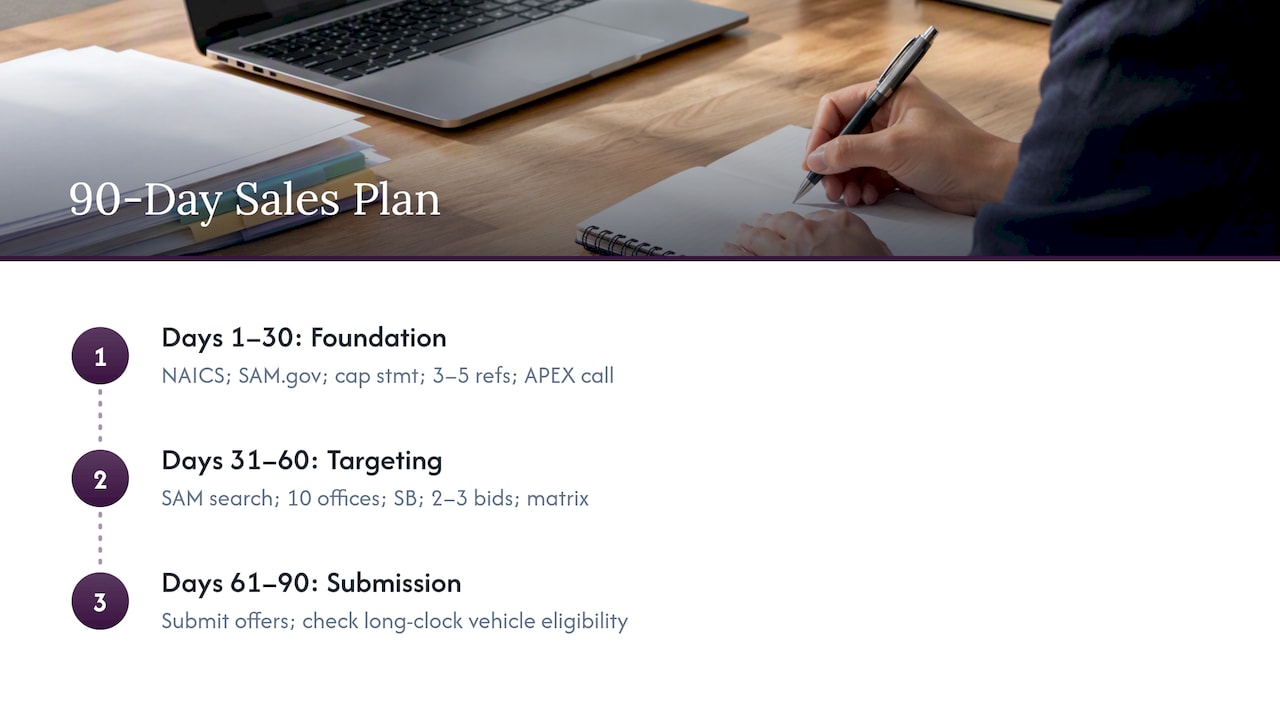
Days 31 to 60: targeting. Save SAM.gov searches, identify ten agencies or offices that buy your offering, and contact their small business specialists. Pick two or three set-aside or simplified-acquisition opportunities and build a compliance matrix for each.
Days 61 to 90: submission and vehicle. Submit your first offers. In parallel, check whether you qualify for a pre-negotiated vehicle, since that application runs on its own long clock and starts paying off only after award.
Treat the plan as a rhythm, not a one-time event. Compliance continues after the win: you still have reporting duties, and the GAO has highlighted that subcontracting goals are hard for many firms to meet and hard for contracting officers to assess.
FAQ
What is the best way to get a government contract?
Start with an active SAM.gov registration, then target set-asides and small purchases where you have a clear edge. Build past performance, and meet agency small business specialists before solicitations post. A pre-negotiated contract vehicle can then make repeat buying easier.
How long does it take to win your first federal contract?
It varies widely with your niche, references and how often you bid. Individual bids can resolve in weeks or months, but building a pipeline usually takes longer. For a contract vehicle application, our clients are typically awarded in about six months, versus two years or more when going alone.
Can a brand-new business win government contracts?
Yes, but past performance counts. The SBA suggests using relevant experience from key personnel or predecessor companies, and starting with small purchases, subcontracting or set-asides to build a record. Free counseling can help you assess readiness.
How much does it cost to start government contracting?
SAM.gov registration is free, and free counseling is available through SBA-backed programs. Your main costs are time and proposal effort, plus professional fees if you hire help. Our published plans are listed above.
Check your eligibility for free
If you already qualify and want a contract vehicle without a two-year learning curve, we will review your business and tell you honestly where you stand. Request your free eligibility check.
Sources
- Get started with contracting, SBA
- How to win contracts, SBA
- Find Contract Opportunities, SAM.gov
- Overview of the Federal Procurement Process and Resources, Congress.gov
- Table of effective dates for MPT and SAT, Acquisition.gov
- Veteran Small Business Certification, SBA
- Federal Contracts Are Highly Coveted, U.S. GAO
- GSA MAS solicitation document
Recommended
- Applying for Government Contracts: Step-by-Step Guide
- Guide to Becoming a Government Contractor: Your Path To Success
- Master How to Bid on Government Contracts – A Comprehensive Guide
- Win at Bidding on Government Contracts Easily