

You need an active SAM.gov registration, completed Pathway to Success training and Readiness Assessment, two years of financial statements, a technical proposal entered in eOffer, and pricing files built on GSA’s templates. Category-specific attachments and a commercial sales practices disclosure complete the package.
TL;DR
- Gather six core items: SAM.gov registration, training and Readiness Assessment, two years of balance sheets and income statements, the technical narratives, the pricing templates, and any SIN-specific attachments.
- Tax returns do not replace financial statements. Submit a balance sheet and an income statement for the previous two years.
- Three technical factors are typed into eOffer, not uploaded, and each has a 10,000-character limit.
- GSA can reject an offer without discussions, so treat the first submission as your best and final.
- Start with the SAM.gov registration, because new registrations can take at least 10 business days to activate.
Table of Contents
- What documents does a GSA Schedule offer require?
- Do you need a SAM.gov registration before you submit?
- What are the Pathway to Success training and Readiness Assessment?
- Which financial statements does GSA want?
- What goes into the technical proposal?
- What pricing documents and templates do you need?
- What category-specific attachments might apply?
- A document checklist you can print
- Why do offers get rejected for missing documents?
- Our perspective: the paperwork is the easy part
- Should you prepare the offer yourself or get help?
- How do you check whether your documents are ready?
- Get a free eligibility check
- FAQ
- Sources
What documents does a GSA Schedule offer require?
The offer is a package built inside GSA’s eOffer system. GSA’s own roadmap for a MAS contract says the solicitation and its category attachments are the formal request for offers. They spell out the required elements and how offers are evaluated. So the solicitation, not any blog post, is the final word on what goes in.
In practice the package breaks into these groups:
| Group | What it contains | How it goes in |
|---|---|---|
| Registration | Active SAM.gov entity record with a Unique Entity ID | Verified by GSA, not uploaded as a file |
| Readiness | Pathway to Success training, Readiness Assessment | Completed before or with the offer |
| Financial | Balance sheet and income statement, previous two years | Uploaded |
| Technical | Corporate Experience, Quality Control, Relevant Project Experience, plus one more factor | Three typed into eOffer, one handled separately |
| Pricing | Price proposal template, commercial sales practices or transactional data reporting information | Uploaded templates |
| Category-specific | SIN templates, labor category or product attachments | Uploaded where the solicitation requires |
GSA publishes a new offeror checklist that summarizes the minimum requirements, and it is worth downloading before you build anything. The checklist is linked from GSA’s required templates page.
For a longer walk through the portal itself, see our GSA bid documentation checklist and the eOffer step-by-step.
Do you need a SAM.gov registration before you submit?
Yes. You must hold an active SAM.gov registration to be eligible for any federal contract. Registration asks for your legal business name, a physical address and a Taxpayer Identification Number. Per SAM.gov’s entity registration page, a post office box cannot serve as your physical address, and the Unique Entity ID is assigned during the process.
Two timing facts matter here:
- New registrations can take at least 10 business days to become active.
- Registrations must be renewed every 365 days, so an offer that sits in review should never coincide with a lapsed record.
SAM.gov also publishes an entity registration checklist listing what to have on hand: core data, assertions, reps and certs, points of contact, and an SBA supplemental page if you are a small business. GSA’s register your business page adds that you should have any existing CAGE code and your banking details for electronic funds transfer ready.
The most common slip is a mismatch. If the business information in SAM.gov does not line up with what you put in the offer, you create a problem the contracting officer has no obligation to resolve for you. Our SAM registration guide and contractor registration tips cover the details.
What are the Pathway to Success training and Readiness Assessment?
Both are mandatory pieces of the offer. The Readiness Assessment for Prospective Offerors is the first document listed in the solicitation instructions that you must complete and upload to eOffer. GSA’s solicitation also requires the Pathway to Success training within one year of submission.
Do not treat either as a formality. They work as a self-audit: if you cannot answer honestly how you will track sales, set pricing policy and manage compliance, you are not ready for the contract that follows. We wrote about this in GSA readiness and why it matters.
Which financial statements does GSA want?
GSA asks for the previous two-year period, audited if available, with at least a balance sheet and an income statement. That wording comes from GSA’s required templates page. The same page says you can explain anything that could reflect negatively on your business.
A few practical points:
- Use financial statements, not tax returns. Tax returns are a different document and do not satisfy the financial responsibility review.
- Match the periods. Both statements should cover the same two-year window.
- Explain weak numbers up front. If you had a loss year or negative cash flow, add a short, plain explanation. Show other resources, such as a line of credit, if you have them.
- Know the startup route. GSA notes that a company submitting under the Springboard Startup path (FASTLane only) without two years of statements may be able to substitute other information.
Why this scrutiny? Financial statements are how GSA gauges whether you can perform if awarded. The agency’s Vendor Support Center frames the offer as a step where you compile company information such as financial statements, technical proposals and pricing. Reviewers read that information to judge your responsibility as a contractor.
If you are unsure whether you meet the two-year rule, read our GSA eligibility requirements explained first.
What goes into the technical proposal?
The technical proposal has four factors, set out in Section II of the SCP-FSS-001 instructions. According to GSA, Corporate Experience (Factor One), Quality Control (Factor Three) and Relevant Project Experience (Factor Four) must be completed through a narrative in eOffer with a 10,000-character limit.
That catches people who prepared everything as Word or PDF files. Typed fields cannot be satisfied by an upload, so draft the text separately, count characters, and paste it in.
A workable approach for each narrative:
- Corporate Experience: Describe what you have delivered, for whom, and for how long. Tie it to the specific SINs you are proposing.
- Quality Control: Explain how you check work before it reaches the customer: who reviews, what gets documented, how errors are fixed.
- Relevant Project Experience: Pick projects that match the SIN scope. Give the scope, the outcome and the timeframe. Avoid listing everything you have ever done.
Write for a reviewer who has dozens of offers and no obligation to ask you follow-up questions. Short, specific, and aligned to the solicitation language beats long and general. Our proposal templates article shows how to structure these.
What pricing documents and templates do you need?
For service offers, GSA requires a detailed price proposal on its templates, such as the Services Plus file. You also disclose your commercial sales practices. Both are described on GSA’s templates page.
The purpose is to let GSA decide whether your prices are fair and reasonable compared with what you charge commercial customers. Three things to prepare:
- Commercial sales practices (CSP) information. This shows your discounting practices and who gets your best price. Offerors that participate in Transactional Data Reporting are exempt from the traditional CSP disclosure, according to the same GSA source.
- A current price list. Pricing data must be current, accurate and complete as of 14 days before submission, so do not start the file and let it age for months.
- A fair and reasonable pricing narrative. Your discounts, volume terms and any commercial price variations need to tell one consistent story.
The regulatory basis for the sales-practice disclosure sits in the GSA Acquisition Manual, Subpart 515.4 on contract pricing, which covers the format offerors must use when the Industrial Funding Fee and Sales Reporting clause applies.
Building the price list is where many first-time offerors burn weeks. A government schedule price list has to be traceable to how you actually sell. Read our comparison of a GSA proposal versus a commercial proposal before you adapt your existing rate card.
What category-specific attachments might apply?
Beyond the common package, each Special Item Number (SIN) can carry its own templates and attachments. GSA tells offerors to look up their SINs in a look-up table on the required templates page. Some are optional and others are mandatory.
The solicitation instructions also list a previous FSS program template, where it applies, and a template for services. Read every attachment tied to your SINs. An offer that matches the common checklist but ignores a mandatory SIN attachment is an incomplete offer.
For compliance items that run alongside the offer, such as the representations and certifications you attest to, see our overview of GSA compliance requirements.
A document checklist you can print
Use this order. It follows the dependencies, so each item unlocks the next.
- Confirm you meet the two-year experience and financials threshold, or identify the startup route.
- Register or renew in SAM.gov and record your UEI.
- Complete the Pathway to Success training.
- Complete the Readiness Assessment.
- Download the current solicitation and every attachment tied to your SINs.
- Download GSA’s new offeror checklist.
- Produce the balance sheet and income statement for the previous two years.
- Draft the Corporate Experience, Quality Control and Relevant Project Experience narratives, each under 10,000 characters.
- Build the price list on GSA’s template within 14 days of submission.
- Prepare commercial sales practices information, or confirm Transactional Data Reporting.
- Collect any SIN-specific templates and past performance references.
- Upload and review everything in eOffer against the checklist before you click submit.
Why do offers get rejected for missing documents?
The solicitation instructions state that the government may reject offers without discussions. That makes your first submission the one that counts. A missing statement, a narrative that does not match the SIN scope, or a SAM.gov record that conflicts with the offer can end the review without any request for a fix.
The usual causes we see:
- Tax returns submitted in place of financial statements.
- Narratives written as uploads when eOffer expects typed text.
- Price lists older than the 14-day window.
- A SAM.gov entity whose information differs from the offer.
- Past performance or experience that does not map to the SINs requested.
- Skipped steps in the Readiness Assessment, which hides infrastructure gaps until after award.
GSA also says the entire process from submission to potential award can take up to 12 months and that submission does not guarantee an award. A rejected package means starting the clock over.
Our perspective: the paperwork is the easy part
We have worked on GSA Schedule offers long enough to know the documents are rarely what stops a business. The usual problem is that the company has never written down how it prices, who gets which discount, or what it can show as proof of past work. The paperwork exposes that gap.
That is why we start with an eligibility and readiness review, not a stack of templates. We check experience, financials, pricing practices and SIN fit before anyone builds a file. If something would sink the offer, it is far cheaper to find out in week one than after a rejection.
On effort, our clients typically spend about three hours of their own time, because we prepare the documentation, price list and narratives and take the offer through negotiation. In our experience, clients are awarded in roughly six months, and many reach award in about 90 days. Businesses working alone commonly take two years or more, mostly because they redo submissions. We operate on a no award, no fee basis, with a money-back guarantee.
If you want to do it yourself, that is a legitimate choice, and the checklist above is how to do it well. Just budget real time for the pricing file and the narratives.
— Josh
Should you prepare the offer yourself or get help?
The answer depends on three things: how much of your own time you can spend, how clean your financials and pricing records are, and how costly a rejected offer would be for your sales pipeline.
Doing it yourself fits when you have a finance lead who can produce statements quickly, a clear commercial price list, and weeks of focused time. Help fits when you have a pipeline waiting on the award, messy pricing history, or a previous attempt that failed.
We offer several routes. Our full-service GSA schedule offering covers eligibility assessment, documentation, price list development, SIN mapping and negotiation support. Startups, Specialty and Streamline engagements are described on our proposal page. If you prefer to self-serve, the GSA DIY Quick Start gives you a structured toolkit.
After award, upkeep matters. Our maintenance plans start at 99 USD per month for one modification a year, and the retainer is 1500 USD per year. Once you hold a contract, our guide on winning GSA contract sales explains how to turn it into revenue.
How do you check whether your documents are ready?
Before you submit, run a three-pass review.
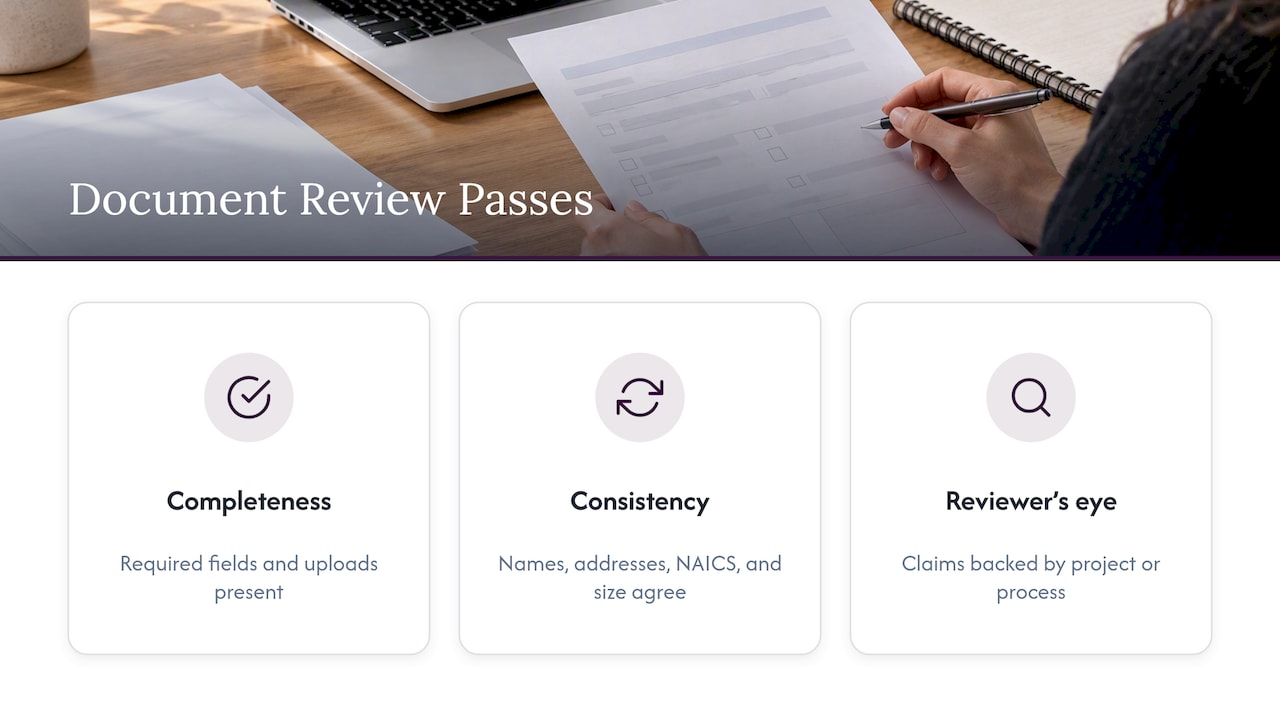
Pass one: completeness. Match every item against GSA’s new offeror checklist and your SIN attachments. Every required field and upload should be present.
Pass two: consistency. Compare names, addresses, NAICS codes and business size across SAM.gov, the financial statements, the narratives and the price list. They should all agree.
Pass three: reviewer’s eye. Read the narratives as someone who knows nothing about you. Can they tell what you do, for whom, and how you control quality? Is each claim backed by a project or a process?
If you have a government sales plan but are still new to federal buying, the same documents serve as a foundation. SAM.gov registration, clean financials and a documented pricing policy are what any federal buyer will ask for, whether through a schedule or another vehicle. Opportunities are posted on SAM.gov, which replaced the retired FedBizOpps.
Get a free eligibility check
Before you spend weeks on documents, find out whether your company qualifies and which SINs fit. We will review your years in business, financials and pricing practices and tell you plainly what stands between you and an award. Request your free eligibility check.
FAQ
How long does it take to gather the documents?
If your financial statements already exist and your pricing is documented, allow several weeks. A new SAM.gov registration alone can take at least 10 business days to activate. The narratives and the price list usually take the longest.
Can I submit tax returns instead of financial statements?
No. GSA asks for a balance sheet and an income statement covering the previous two years, audited if available. Tax returns do not meet that requirement. If your numbers look weak, add a clear explanation rather than leaving it out.
Do I need past performance references?
The technical proposal asks for Relevant Project Experience, and some SINs and solicitation attachments ask for more detail. Read the attachments for your SINs to see exactly what is required. Choose projects that match the scope you are proposing.
What happens if I forget a document?
GSA’s solicitation allows the government to reject an offer without discussions, so a missing item can mean rejection instead of a request to fix it. Use GSA’s new offeror checklist before submitting. Then recheck every SIN-specific attachment.
Sources
- Roadmap to get a MAS contract | GSA
- Required templates for a MAS offer | GSA
- SCP-FSS-001 Instructions Applicable to All Offerors
- SCP-FSS-001-N offeror instructions
- Entity Registration | SAM.gov
- Entity Registration Checklist | SAM.gov
- Register your business | GSA
- You’ve Decided MAS Is a Good Fit: Now What? | Vendor Support Center
- Subpart 515.4 – Contract Pricing | Acquisition.gov
Recommended
- GSA Bid Documentation Checklist
- Do You Qualify for GSA Bids? Checklist
- An Essential Checklist to Maintain Your GSA Schedule Contract
- GSA Schedule Award: Complete Checklist for Success