

Most GSA schedule consultants charge a project fee for acquisition work and a separate annual fee for ongoing maintenance. Acquisition support commonly runs from low to high five figures depending on scope, while maintenance retainers typically fall in the low thousands per year. Hiring a consultant tends to pay off most for a first schedule, complex pricing, or a compressed timeline.
TL;DR:
- Scope complexity, such as multiple SINs or customized pricing, significantly increases both acquisition and maintenance costs.
- The typical acquisition support ranges from low to high five figures, while ongoing annual retainers generally fall in the low thousands.
- Successful post-award maintenance involves quarterly reporting, catalog updates, and handling contract modifications, which can take from one week to over a month.
- Consultants usually charge flat fees based on scope, with phased billing for assessment, proposal, and negotiation, while hourly rates are less common.
- A free eligibility check helps determine the most suitable service tier and first-year costs, especially for businesses with straightforward or complex needs.
Table of Contents
- 1. What does a GSA schedule consultant actually do?
- 2. What are typical cost ranges and fee models?
- 3. What do post-award maintenance and annual costs look like?
- 4. Which factors make consultant pricing vary?
- 5. How long does the process take and how much of your time is required?
- 6. Is hiring a GSA schedule consultant worth it for your business?
- 7. How does GSA Focus price these services?
- 8. What should you know before signing a consultant proposal?
- 9. Ready to find out what your schedule will cost?
- Sources
- FAQ
1. What does a GSA schedule consultant actually do?
A consultant’s fee should map to a specific list of deliverables, not just “help getting a GSA contract.” Before signing anything, ask exactly which of these tasks are included.
- Readiness assessment: reviewing your revenue history, past performance, and SAM.gov status to confirm you qualify for the Multiple Award Schedule.
- Price proposal preparation: completing the required FCP product or service templates and making sure IFF is built into your rates, as outlined in GSA’s required templates for a MAS offer.
- NAICS and SIN mapping: matching your products or services to the correct Special Item Numbers.
- Proposal submission and CO clarification handling: responding to contracting officer questions without missing deadlines.
Once you’re awarded, many consultants also handle post-award setup: publishing your Vendor Support Center catalog, setting up sales tracking, and confirming your first IFF reporting cycle. Optional add-ons, like agency-facing marketing, modification support after the first year, or audit prep, typically raise the price above a bare-bones acquisition package.
2. What are typical cost ranges and fee models?
Pricing generally breaks into three tiers based on how much of the process the consultant handles.
- Entry-level support: covers readiness checks and template guidance, with you doing most of the writing. This tier suits a simple, single-SIN business with clean commercial pricing.
- Mid-tier full service: the consultant builds your price proposal, drafts the technical narrative, and manages CO communication from submission through award. This is the most common route for a first schedule.
- Full-service with post-award setup: adds catalog publishing, IFF setup, and initial sales tracking so you’re ready to sell the day the contract activates.
Fee structures vary by firm. Some charge a flat project fee for the entire acquisition. Others break the work into phases, billing separately for the assessment, the proposal, and negotiation support. Hourly billing exists but is less common for acquisition work, and any offer built around a success or contingency fee tied to “guaranteed award” deserves scrutiny, since no consultant controls a contracting officer’s decision.
Scope drives cost more than anything else. A single SIN with a simple, published price list costs far less to prepare than a catalog spanning multiple SINs, custom labor categories, or discount structures that need to be reverse-engineered into a compliant FCP template.
3. What do post-award maintenance and annual costs look like?
Winning the contract is the beginning of a recurring set of obligations, not the end of the spending. GSA requires contractors to report sales and remit the Industrial Funding Fee every quarter, and an assigned industrial operations analyst monitors your sales activity against expectations.
Annual maintenance retainers usually cover:
- Quarterly sales reporting and IFF remittance tracking.
- Routine price list updates and catalog maintenance in the Vendor Support Center.
- Standard contract modifications, such as adding an authorized negotiator or updating a socioeconomic status.
- Ongoing compliance monitoring so small issues don’t compound into audit findings.
Modifications split into two speeds. Administrative mods, like updating a point of contact, often process in 7 to 10 days. More complex mods, such as adding a SIN or changing pricing structure, can take 10 to 30 or more days, according to GSA’s MAS Modification Guide. The guide also lists the most common reasons mods get rejected: incorrect price proposal templates, missing documentation, and pricing errors, all of which a maintenance retainer is designed to catch before submission.
4. Which factors make consultant pricing vary?
Every quote reflects a handful of variables. Knowing them helps you compare proposals that look different on the surface but cover similar ground.
- Catalog size and SIN count: more products, services, or SINs mean more pricing documentation to prepare.
- Pricing complexity: fully burdened labor rates, tiered discounts, and IFF inclusion take longer to build correctly than a flat price list.
- Documentation readiness: incomplete financials or missing past performance records slow the process and can add cost.
- Consultant experience: firms that also handle agency marketing or capture work typically charge more than those focused purely on the paperwork.
- Timeline pressure: rushed applications or last-minute fixes to a rejected submission often carry a premium.
Pro Tip: Ask any consultant for their SIN-specific track record before asking about price. A firm that has priced your exact SIN before will usually cost less in rework than one that hasn’t.
5. How long does the process take and how much of your time is required?
Consultant-assisted applications generally move faster than solo attempts, though timelines still depend on how quickly you supply documentation and how complex your pricing is. A well-prepared application with a consultant handling the paperwork typically asks for a few hours of your time to review drafts and answer clarifying questions, compared with dozens of hours if you’re building the FCP templates and technical narrative yourself.
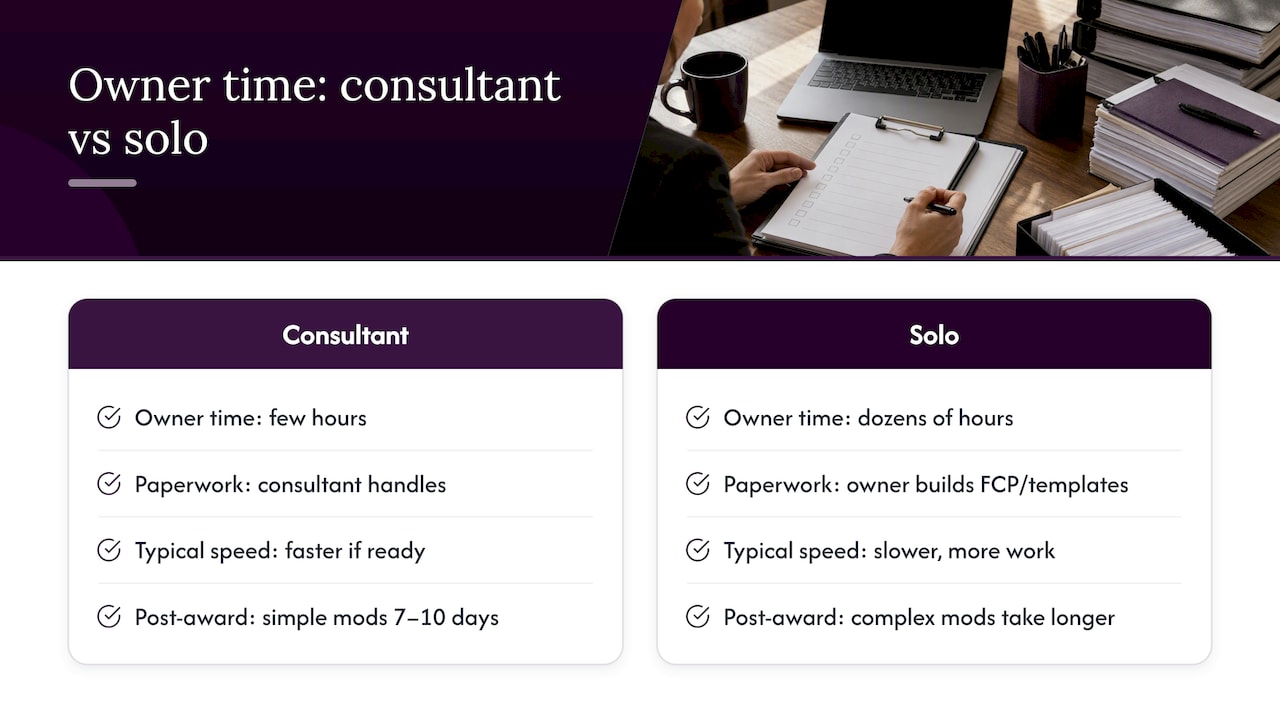
Once awarded, administrative modifications tend to clear in 7 to 10 days, while more involved changes, like adding a SIN, run longer, per the MAS Modification Guide. Response speed on your end matters just as much as the consultant’s speed: slow answers to contracting officer questions are one of the most common causes of delay. Any proposal promising an unusually fast award should spell out exactly what’s included and what happens if the contracting officer asks for revisions.
6. Is hiring a GSA schedule consultant worth it for your business?
The math usually comes down to comparing a one-time consulting fee against the cost of building this expertise internally. A part-time or full-time hire capable of preparing compliant FCP templates and managing CO negotiations carries a salary, benefits, and a ramp-up period before they’re productive, costs that often exceed a single consultant engagement.
Consultant support tends to deliver the most value when:
- This is your first schedule and you have no internal GSA experience.
- Your pricing model is complex, with multiple SINs or custom rate structures.
- You’re working against a compressed timeline and can’t absorb rework from a rejected submission.
DIY makes more sense for a simple, single-SIN business with straightforward commercial pricing and time to spare, and free resources like your local APEX Accelerator or PTAC can help with the SAM.gov registration itself at no cost. Watch for red flags in any proposal: vague deliverables, no mention of the required FCP templates, or an outright guarantee of award, since no consultant can promise a contracting officer’s decision.
7. How does GSA Focus price these services?
GSA Focus charges one flat fee, and if you are not awarded you don’t pay (see full pricing):
- Standard, $12,000: most businesses. Your full GSA offer prepared and submitted, award handling, and 3 months of maintenance after award.
- Simplified, $9,000: companies whose 20-year contract is ending and need a re-award.
- Specialized, $15,000: international companies, joint ventures or large catalogs.
- Maintenance after award: $1,500 per year, plus $1,000 to $3,000 for one-off price list modifications.
Payment plans are available on every tier, and clients spend about 3 hours of their own time in total. A free call confirms which tier fits your business before you commit.
8. What should you know before signing a consultant proposal?
The most common surprise clients report is not the acquisition fee itself, but the volume of post-award work: quarterly IFF reporting, catalog updates, and modification requests that get rejected because a template was filled out incorrectly. Budget for maintenance from day one instead of treating it as an afterthought.
When vetting a proposal, ask for a written timeline and a clear list of what happens if a modification gets kicked back. A free eligibility check is a low-risk way to see where your business actually stands before committing to a package.
— Josh
9. Ready to find out what your schedule will cost?
Once you know roughly where your business falls, from a straightforward single-SIN application to a full catalog with custom pricing, the next step is getting a quote built around your actual scope rather than a generic estimate.
- Compare federal marketing add-ons through Lite, Standard, and Plus.
A free eligibility check tells you which tier fits your business and what your first-year costs would realistically look like, before you spend anything. Start at GSA Focus’ discovery page to get a custom quote based on your SINs, catalog size, and timeline.
Sources
- MULTIPLE AWARD SCHEDULE (MAS) MODIFICATION GUIDE (June 2026)
- Requirements after getting a MAS contract | GSA
- Required templates for a MAS offer | GSA
- Sam
FAQ
What is a reasonable consulting fee for GSA schedule work?
A reasonable fee reflects the scope of your catalog and pricing complexity rather than a flat industry number. Compare quotes by matching them to the specific deliverables covered, such as readiness assessment, price template preparation, and post-award setup, rather than the total dollar figure alone.
How much does it cost to get a GSA contract?
Costs depend on whether you handle the application yourself or hire a consultant, and on how complex your pricing and catalog are. GSA Focus charges a flat $12,000 for most businesses ($9,000 for re-awards and $15,000 for international companies, joint ventures or large catalogs), with no fee if you aren’t awarded.
What is the cost of GSA maintenance after award?
Ongoing costs typically include an annual retainer plus modification fees, with plans ranging from a single mod per year up to custom mod volumes on the maintenance plans page. At GSA Focus, maintenance is $1,500 per year, plus $1,000 to $3,000 for one-off price list modifications. These cover quarterly IFF reporting and catalog updates required to stay compliant.
What is a GSA price list?
A GSA price list is the schedule of products or services and their prices that a contractor is authorized to sell to federal agencies under their contract. It’s built using GSA’s required FCP price proposal templates and must include the Industrial Funding Fee, as outlined in GSA’s templates guidance.
Recommended
- Are GSA Consultants Worth the Price?
- Top 5 Things to Consider in a GSA Consultant
- 3 Reasons Small Businesses Should Consider a GSA Schedule Consultant
- How Much Does GSA Schedule Consulting Cost?