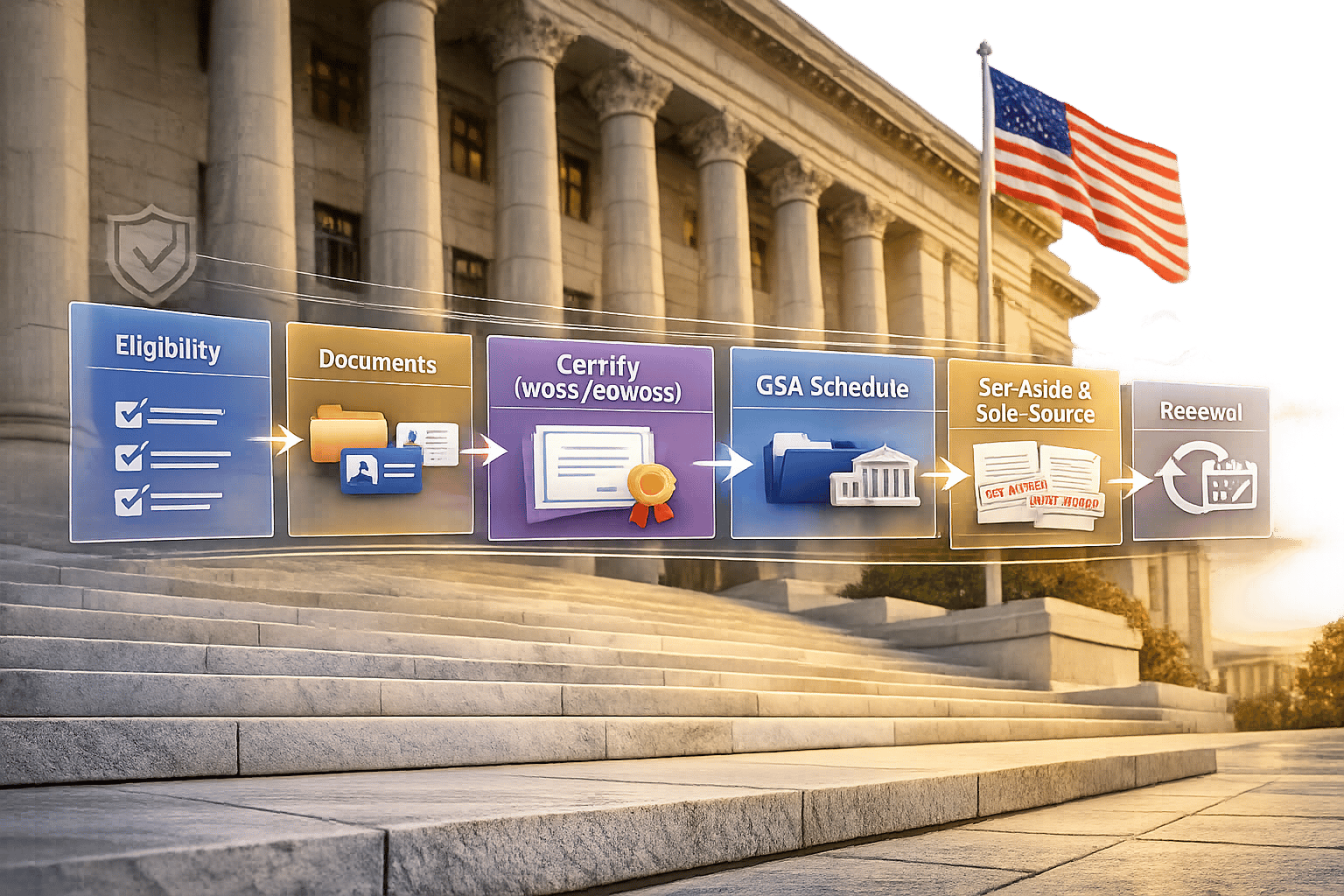
Want to win federal contracts as a Women-Owned Small Business (WOSB)? Here’s how to get certified and take advantage of exclusive opportunities.
The WOSB certification, managed by the SBA, ensures women entrepreneurs have access to federal contracts. Since October 2020, self-certification is no longer accepted – official certification is required. Key benefits include eligibility for set-aside contracts, improved visibility on platforms like SAM.gov, and access to billions in federal spending.
To qualify, your business must meet SBA standards for ownership (51%+ by women), control, and size. Economically Disadvantaged Women-Owned Small Businesses (EDWOSBs) face additional financial criteria. Certification is free through the SBA, or you can use approved third-party certifiers like WBENC (fees apply). Maintaining your certification requires compliance with SBA rules, including regular updates and recertifications.
Quick Steps to Certification:
- Register your business on SAM.gov and confirm your NAICS code eligibility.
- Apply online via the SBA’s MySBA Certifications platform.
- Submit required documents (proof of ownership, tax returns, etc.).
- Respond promptly to SBA requests to avoid delays.
Once certified, you can bid on set-aside contracts, access sole-source awards, and even combine certifications (e.g., WOSB + HUBZone) for more opportunities. Stay compliant by updating your SAM.gov profile yearly and preparing for three-year SBA reviews.
Ready to grow your business with WOSB certification? Start your application today at https://certifications.sba.gov.
Billions in Federal Contracts Reserved for Women-Owned Businesses
WOSB Certification Eligibility and Requirements
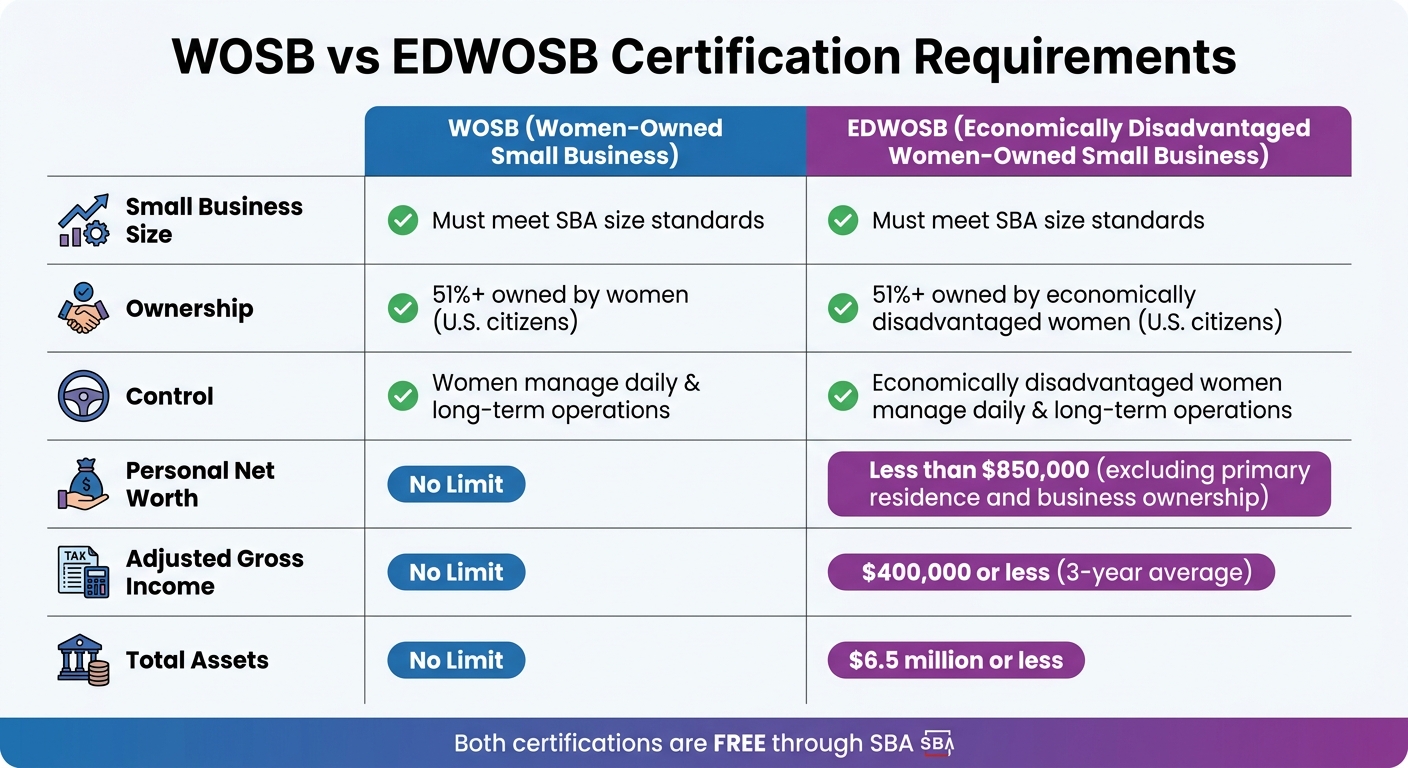
WOSB vs EDWOSB Certification Requirements Comparison
To qualify for WOSB set-aside contracts, your business must align with specific eligibility criteria established by the SBA. These requirements focus on ownership, operational control, citizenship, and industry classification. Understanding these standards is crucial before diving into the certification process, as they form the backbone of a successful application.
Who Qualifies for WOSB Certification
At the heart of WOSB certification is ownership. At least 51% of the business must be directly and unconditionally owned by one or more women who are U.S. citizens. This ownership must be absolute – free from conditional agreements or indirect arrangements that could shift benefits to another party (except in cases of death or incapacity). Women must hold their 51% stake directly, not through another entity or trust, except for certain revocable living trusts.
For corporations, women must also control the Board of Directors. This can be achieved by forming the majority of voting directors or owning at least 51% of all voting stock with the authority to override supermajority rules.
Ownership alone isn’t enough – operational control is equally important. Women must oversee daily operations and make long-term strategic decisions. The top female officer needs to have the necessary managerial experience and should generally dedicate full-time efforts to the business during standard operating hours.
"To be considered unconditional, ownership must not be subject to any conditions, executory agreements, voting trusts, restrictions on or assignments of voting rights, or other arrangements causing or potentially causing ownership benefits to go to another."
– eCFR, 13 CFR § 127.201
Beyond ownership and control, other key requirements include:
- Citizenship: Only U.S. citizens by birth or naturalization qualify. Resident aliens and visa holders are not eligible.
- Size standards: Your business must meet the SBA’s size standards for its primary NAICS code.
- Industry eligibility: Your business must operate within an industry where women-owned businesses are underrepresented.
For EDWOSB certification, the same rules apply with additional financial thresholds. Economically disadvantaged women owners must meet these limits:
- A personal net worth under $850,000 (excluding primary residence and business ownership)
- An adjusted gross income of $400,000 or less (averaged over three years)
- Total assets valued at $6.5 million or less
| Requirement | WOSB | EDWOSB |
|---|---|---|
| Small Business Size | SBA size standards | SBA size standards |
| Ownership | 51%+ by women (U.S. citizens) | 51%+ by economically disadvantaged women (U.S. citizens) |
| Control | Women manage daily & long-term ops | Economically disadvantaged women manage daily & long-term ops |
| Personal Net Worth | No limit | Less than $850,000 |
| Adjusted Gross Income | No limit | $400,000 or less (3-year average) |
| Total Assets | No limit | $6.5 million or less |
Contract Performance Standards
Certification is just the beginning. Once approved, your business must meet strict performance standards to retain eligibility for set-aside contracts. These rules ensure that the certified business – not subcontractors – handles the majority of the work.
Here’s how the benchmarks break down:
- Service contracts: Perform at least 50% of the total cost with your own employees.
- Supply contracts: Manufacture at least 50% of the goods in-house (excluding material costs).
- General construction: Complete 15% of the work in-house.
- Specialty construction: Perform 25% of the work in-house.
These percentages are calculated based on the total contract value and must be maintained throughout the contract’s duration. Contracting officers regularly monitor compliance, and failing to meet these standards can lead to severe consequences, such as contract termination, suspension from the program, or even legal action.
To prepare for certification, ensure your business is registered on SAM.gov and has an active Unique Entity Identifier (UEI). Additionally, confirm that your primary NAICS code is listed as eligible for WOSB or EDWOSB set-asides. If pursuing EDWOSB certification, complete SBA Form 413 (Personal Financial Statement) to verify your economic disadvantage status.
How to Apply for WOSB Certification
To apply for WOSB certification, you’ll need to use the MySBA Certifications platform at https://certifications.sba.gov. Before diving in, make sure your SAM.gov registration is up to date and that your Unique Entity Identifier (UEI) is active. You’ll also need a Login.gov account to access the portal.
Once logged in, the majority woman owner must claim the business by verifying details that match the SAM.gov profile. Have your UEI, Employer Identification Number (EIN), and Marketing Partner Identification Number (MPIN) ready to streamline the process.
After submitting your application, the SBA will notify you within 15 days if your package is complete. The review process typically takes 10 to 30 business days. If your application is denied, you’ll need to wait 90 days before reapplying, addressing any issues flagged by the SBA. Importantly, applying directly through the SBA is free of charge.
Achieving WOSB certification not only satisfies federal requirements but also opens doors to lucrative GSA contract opportunities. Below, you’ll find details on using the MySBA platform, required documentation, and an alternative route via Third-Party Certifiers (TPCs).
Using the MySBA Certifications Platform
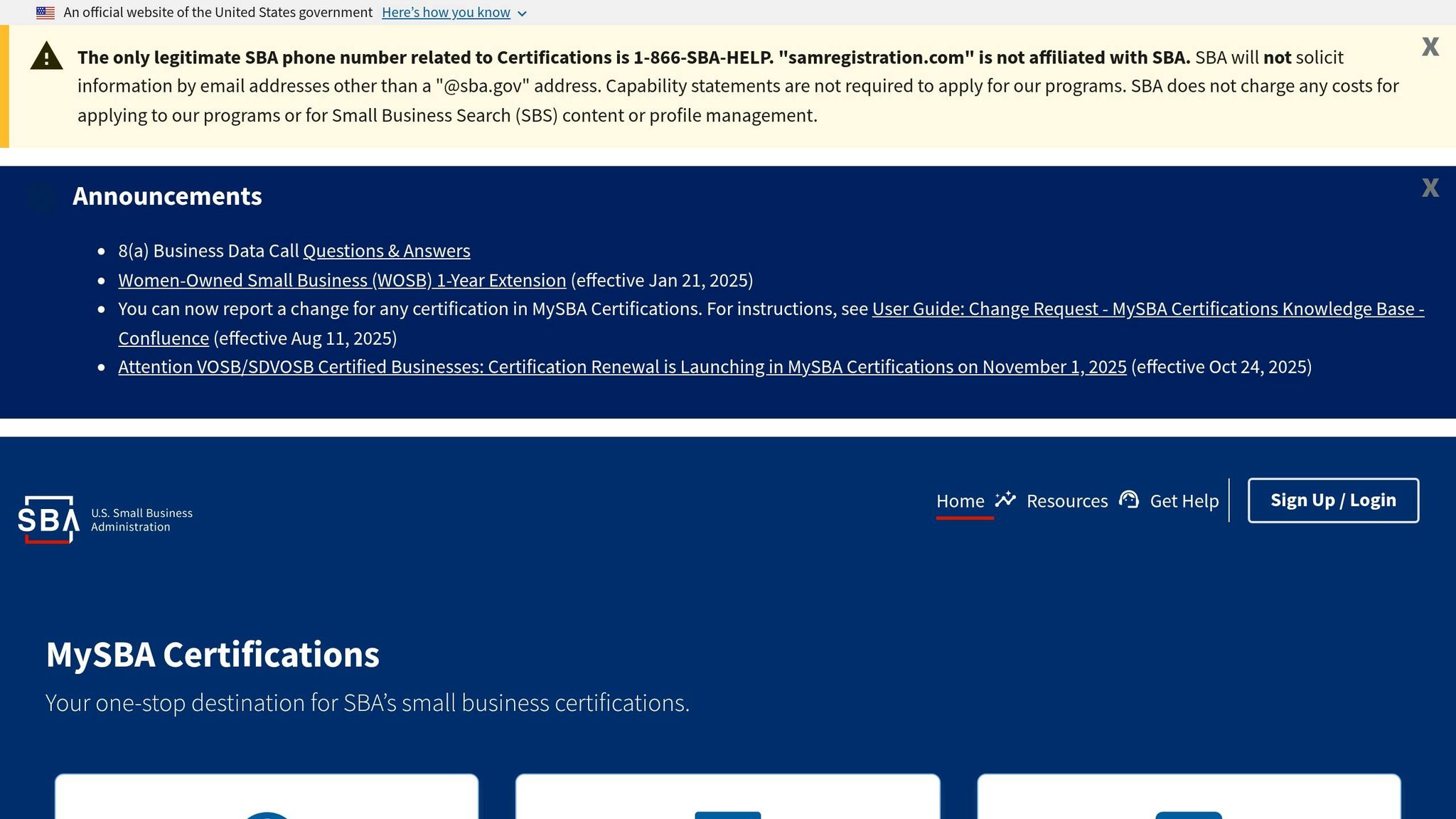
Start by visiting https://certifications.sba.gov and logging in with your Login.gov credentials. The platform will guide you through questions about ownership, control, and citizenship. Be sure to clearly label uploaded files (e.g., "2023-Business-Tax-Return.pdf") for easy reference.
It’s crucial to ensure that your business name, EIN, address, and ownership percentages are consistent across your SAM.gov profile, tax returns, and state filings. Inconsistencies are a common reason for application denials. Before submitting, double-check that your primary NAICS code is listed as eligible for WOSB set-asides. If the SBA asks for additional information, respond promptly to avoid delays or automatic denial.
If you need assistance, you can reach out to your local APEX Accelerator or an SBA Women’s Business Center for free guidance.
Documents Needed for WOSB Certification
Before starting your application, gather the following documents:
| Document Category | Specific Requirements |
|---|---|
| Proof of Citizenship | Birth certificate, U.S. passport, or naturalization certificate for each qualifying woman owner |
| Business Formation | Articles of Incorporation/Organization, Bylaws, or Operating Agreements |
| Ownership Proof | Stock ledgers, membership certificates, or cap tables |
| Financial Records | 3 years of business tax returns (all schedules) and 3 years of personal tax returns, including W-2s/1099s |
| Governance | Certificate of Good Standing from the Secretary of State |
| Management Proof | Resumes for all owners and key officers |
| EDWOSB Specific | SBA Form 413 (Personal Financial Statement) and supporting documents like bank statements and appraisals |
Your business formation documents must clearly show that women own 51% of the company without conditions. For EDWOSB applicants, complete SBA Form 413 in advance and gather documentation on your personal net worth, adjusted gross income, and total assets.
Using Third-Party Certifiers
Another option is to work with one of the four SBA-approved Third-Party Certifiers (TPCs):
- Women’s Business Enterprise National Council (WBENC)
- National Women Business Owners Corporation (NWBOC)
- U.S. Women’s Chamber of Commerce (USWCC)
- El Paso Hispanic Chamber of Commerce (EPHCC)
TPC certification costs range from $275 to $3,000, depending on the certifier and your business size. A major benefit of this route is dual certification – you can earn both WBE status for private-sector contracts and WOSB certification for federal opportunities with one application.
For example, WBENC uses a two-step process involving document review and a mandatory site visit with the female owners. However, even with TPC certification, you’ll still need to create a MySBA account and upload your TPC-issued certificate for SBA confirmation.
Keep in mind that not all TPCs, like WBENC, offer certification for the Economically Disadvantaged WOSB (EDWOSB) tier. Before committing to a TPC, verify that your primary NAICS codes are eligible under the WOSB Federal Contract Program.
Maintaining and Renewing WOSB Certification
Securing your WOSB certification is a big step, but keeping it requires ongoing attention to compliance. The SBA follows a three-year program examination cycle, meaning your business will be reviewed every three years to confirm it still meets all ownership, control, and eligibility standards. Additionally, you’ll need to update your SAM.gov profile annually to keep your Small Business Search (SBS) profile both active and accurate.
Previously, the SBA required an annual attestation within 30 days of your certification anniversary. However, this requirement is currently on hold, so you don’t need to submit it for now. That said, keep an eye on SBA updates, as this could change. If your business undergoes any major changes – such as shifts in ownership, management, or structure – you must report these updates within 30 days through the MySBA Certifications platform. Failing to do so could put your certification at risk.
Staying Compliant with SBA Requirements
During the three-year review, the SBA or an approved third-party certifier will confirm that your business still meets the program’s criteria, including the 51% women-ownership requirement and proof that women owners maintain daily control. The SBA generally takes 90 calendar days to issue a decision once your recertification package is complete.
One common issue businesses face is inconsistent data between their SAM.gov profile and SBA certification records. Discrepancies in details like your business name, EIN, address, or ownership percentages can slow down the renewal process and even delay federal contract opportunities. Ensuring your records match is key to avoiding unnecessary setbacks.
Another critical area is control. The SBA will examine your governing documents to verify that the woman owner holds the highest officer position and has clear authority over tasks like hiring, firing, signing financial documents, and setting company policies. If your documents include clauses requiring non-owner consent for daily operations, you’ll need to revise them before renewal.
With compliance in check, here’s how to tackle the renewal process.
How to Renew Your WOSB Certification
To renew, submit your recertification application through the MySBA Certifications platform, along with updated documents. These include three years of business and personal tax returns, current financial statements, and any revised governing documents. Make sure all documents reflect your ongoing compliance with SBA standards.
If your three-year renewal date falls between June 1, 2024, and May 31, 2026, the SBA has granted you a one-year extension, giving you extra time to meet the new deadline.
For businesses certified through a third-party certifier like WBENC, you’ll first need to renew your certification through their platform. Afterward, upload the updated TPC certificate to the MySBA Certifications system to stay eligible for federal set-asides. WBENC charges renewal fees ranging from $350 for businesses earning under $1 million in revenue to $1,250 for those with revenue exceeding $50 million. If your renewal is denied, you’ll need to wait 90 days and address any issues flagged by the SBA.
Using WOSB Certification to Win GSA Contracts
Once you’ve secured your WOSB certification, the next step is putting it to work to win GSA contracts. This certification opens doors to exclusive set-aside contracts and sole-source awards, giving you a real advantage in the federal marketplace. Beyond qualification, it also streamlines procurement processes, making it easier for agencies to work with your business.
With sole-source contracts, contracting officers can award contracts directly – up to $4.5 million for services and $7 million for manufacturing – without the need for competitive bidding.
WOSB Set-Aside Contracts Under GSA Schedules
Getting listed on a GSA Multiple Award Schedule (MAS) ensures your WOSB remains visible to federal buyers. Agencies can purchase directly from you without going through a lengthy open competition process. For contracts valued between $10,000 and $250,000, Simplified Acquisition Procedures automatically set them aside for small businesses. As a WOSB, you’re well-positioned to benefit from these streamlined opportunities. Larger contract vehicles, like OASIS+, also include tracks specifically for WOSB firms, creating chances to compete for substantial task orders worth millions.
However, WOSB set-asides are limited to specific NAICS codes where women-owned businesses are underrepresented. To maximize your chances, confirm that your NAICS codes and SAM.gov profile are aligned before bidding.
Additionally, large prime contractors with contracts exceeding $750,000 are often required to include small business subcontracting plans. This creates opportunities for WOSBs to form joint ventures or participate in the SBA Mentor-Protégé program, allowing you to pursue larger GSA contracts while maintaining your set-aside eligibility.
If you’re looking to further expand your opportunities, stacking your WOSB certification with other SBA programs can be a powerful strategy.
Combining WOSB with Other SBA Programs
You don’t have to stop at WOSB certification. Many businesses hold multiple certifications – such as WOSB, 8(a), and HUBZone – to broaden their access to set-aside contracts. Each certification unlocks additional opportunities. For example, a firm with WOSB, 8(a), and HUBZone status can compete in multiple set-aside categories.
The SBA has made it easier for 8(a) firms to add EDWOSB certification by aligning economic disadvantage standards between the two programs. If you’re already in the 8(a) program, you can use your most recent annual review or acceptance letter to apply for EDWOSB certification through MySBA Certifications. Even after your nine-year term in the 8(a) program ends, you can retain certifications like WOSB, SDVOSB, or HUBZone to continue competing for set-aside contracts.
All SBA certifications, including WOSB, 8(a), HUBZone, and SDVOSB, are free to apply for and maintain through the SBA. Once certified, update your capability statement and your GSA eLibrary profile to showcase your WOSB/EDWOSB status. This helps agency buyers easily identify your business credentials. It’s also smart to review small business scorecards for your target agencies to pinpoint those actively working to meet their WOSB or HUBZone goals.
If managing the GSA Schedule process feels overwhelming, companies like GSA Focus can simplify it for you. They offer full-service solutions, handling everything from document preparation and compliance to negotiation support, making it easier for you to tap into federal contracting opportunities.
Next Steps for WOSB Certification and GSA Contracts
Earning your WOSB certification gives you access to $32 billion in federal contracting opportunities. In fiscal year 2023, the federal government surpassed its 5% contracting goal for women-owned businesses for the fourth year in a row, highlighting the strong demand for certified WOSBs across agencies.
Now that you’re certified, it’s time to update your business presence and marketing materials to reflect your new status. Add the WOSB or EDWOSB logo to your capability statement, and ensure that your business name, address, and contact details in SAM.gov are an exact match with your SBA certification records. Even small discrepancies can cause delays in procurements. Also, double-check that your DSBS profile accurately displays your certification, as contracting officers rely on this to verify eligibility.
Focus on NAICS codes designated for WOSB set-asides. Not all industries are eligible – these set-asides apply only to sectors where women-owned businesses are underrepresented. Consult the SBA’s official NAICS list and search SAM.gov for solicitations specifically reserved for WOSB or EDWOSB participants. And don’t forget to update your SAM.gov profile annually to remain active in the Small Business Search tool.
If navigating the GSA Schedule process feels daunting, consider working with a service like GSA Focus. They handle everything from document prep to compliance checks and negotiations, helping you tap into federal contracts without the administrative hassle.
Lastly, remember that certification is just the starting point – staying compliant is essential. The SBA will conduct program examinations every three years, so keep your records in order and watch for any communications from them. With sole-source contract limits of up to $4.5 million for services and $7 million for manufacturing, your certification positions you to secure lucrative contracts without the need for competitive bidding.
FAQs
How do I know if my NAICS code is eligible for WOSB set-asides?
To determine if your NAICS code is eligible for WOSB set-asides, you’ll need to compare it to the official list of codes designated for the Women-Owned Small Business Federal Contracting Program. These codes represent industries specifically approved for WOSB opportunities.
Make sure to carefully review the list to confirm whether your NAICS code qualifies under the program’s guidelines and federal requirements. This step is crucial for accessing set-asides tied to your business’s industry classification.
What’s the fastest way to avoid delays or denials in MySBA?
To keep your MySBA application on track, make sure all required documents are fully completed, accurate, and saved in PDF format (with a maximum file size of 25MB each). Before hitting submit, double-check that your documents meet the SBA’s guidelines. Submitting your application early is also a smart move – it can help you navigate potential processing delays, which may take up to eight months. A careful and timely submission can go a long way in avoiding unnecessary complications or setbacks.
How does WOSB certification help me win a GSA Schedule contract?
Earning a WOSB certification can significantly improve your chances of landing a GSA Schedule contract. This certification qualifies your business for federal set-aside opportunities specifically reserved for women-owned small businesses. Since the federal government aims to allocate 5% of its contracting dollars to WOSBs, this designation makes it easier for contracting officers to find and choose your business. By holding this credential, you face less competition and gain a distinct edge in the bidding process.
Related Blog Posts
- Key Terms in GSA Contracts Explained
- GSA Contract Eligibility: Key Requirements
- How to Access GSA Small Business Support Programs
- 5 Steps to Meet GSA Prequalification Standards