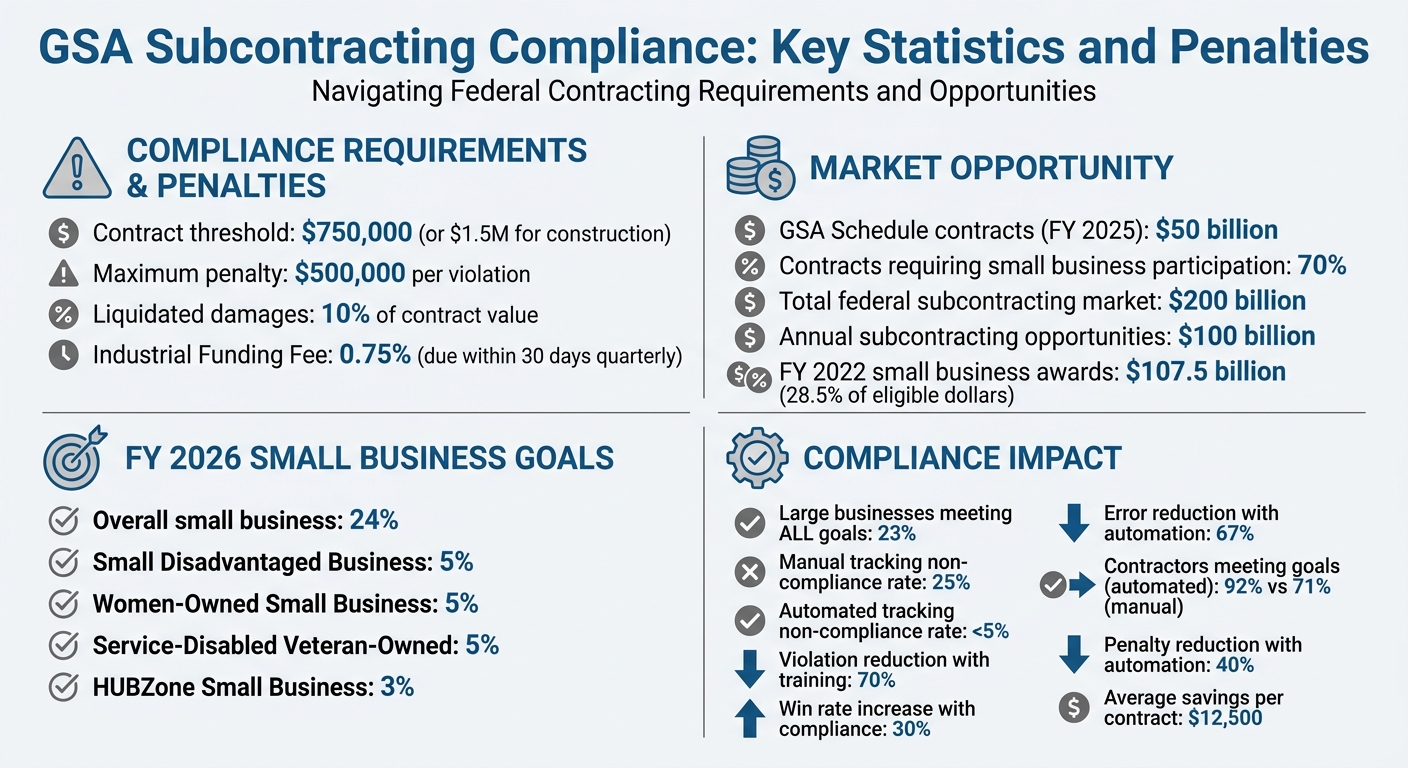
If your federal contract exceeds $750,000, you must comply with FAR Subpart 19.7 subcontracting rules. Non-compliance can lead to penalties up to $500,000 per violation, liquidated damages of 10% of the contract value, and even debarment. In 2023, one contractor lost a $5 million contract and faced debarment for failing to meet small business subcontracting goals. With over $50 billion in GSA Schedule contracts awarded in FY 2025, and 70% requiring small business participation, staying compliant is critical for protecting your business.
Key Takeaways:
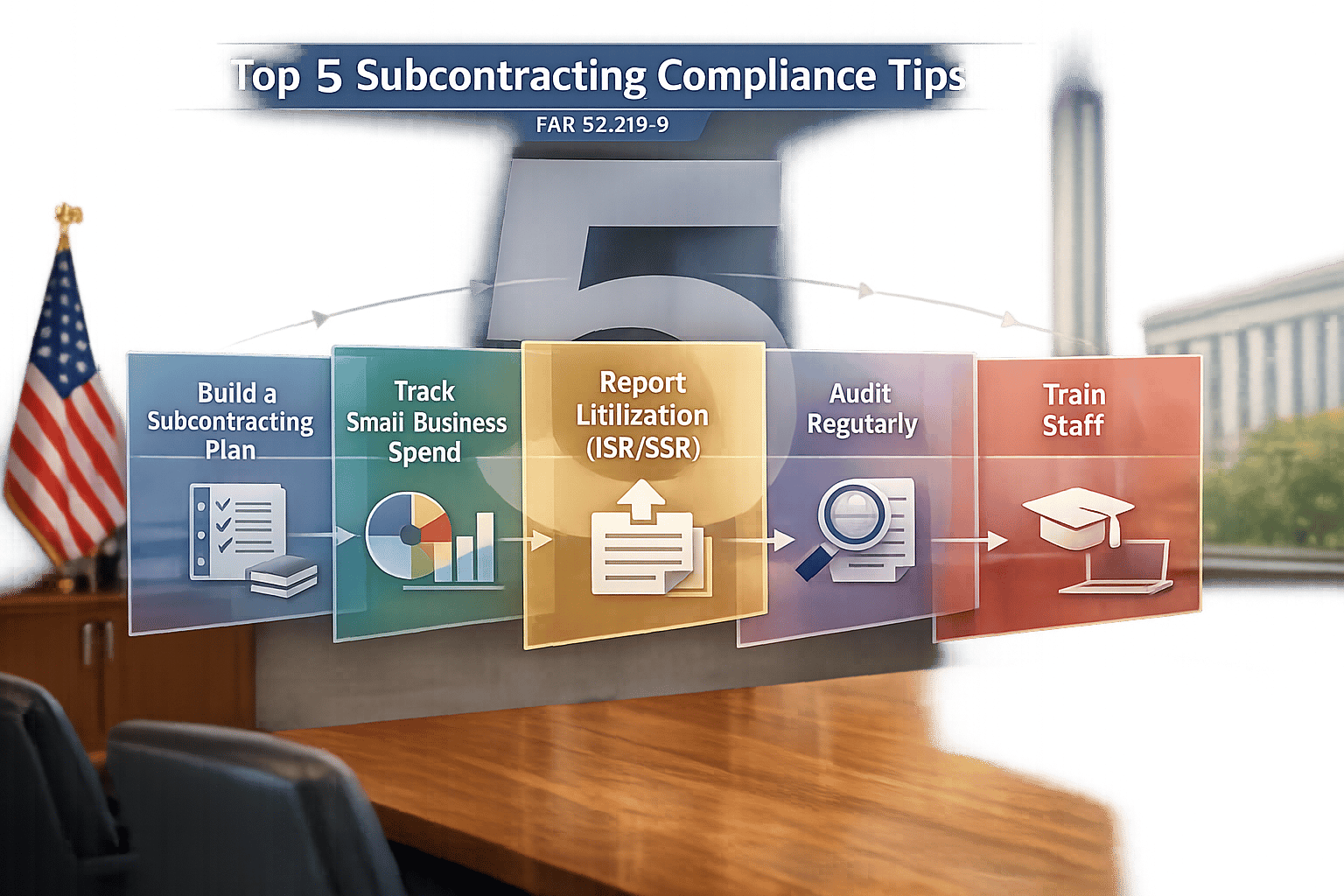
- Understand GSA subcontracting rules and maintain accurate records.
- Develop a subcontracting plan with small business goals (20–30% is typical).
- Use automated tools like eSRS to track and report small business spending.
- Conduct regular audits to identify and fix compliance gaps.
- Train your team and use clear contracts to ensure accountability.
Compliance isn’t just about avoiding fines – it’s about securing future opportunities in the $200 billion federal subcontracting market. By following these tips, you can protect your contracts and position your business for success.
GSA Subcontracting Compliance: Key Statistics and Penalties
Subcontracting Plan Compliance
1. Know the GSA Subcontracting Rules
Understanding these rules is key to safeguarding your contract and staying on top of compliance requirements.
Why GSA Subcontracting Compliance Matters
First things first: keep your SAM.gov registration up to date. Any changes to your business information? Update them immediately. This ensures you remain eligible for federal payments. On top of that, maintain your price list on the Vendor Support Center and keep active accounts on the Advantage PO Portal and OMS Vendor Portal. These tools help you monitor delivery performance and meet administrative requirements – an essential foundation for small business compliance.
Practical Tips for Small Businesses
Here’s a must-do: pay the 0.75% Industrial Funding Fee within 30 calendar days after each quarter. Setting up quarterly reminders can save you from missing deadlines.
Another critical step is ensuring TAA compliance. Double-check that all products – whether you or your subcontractors supply them – are either manufactured or substantially transformed in the U.S. or a TAA-designated country.
Staying Ahead to Avoid Penalties
Don’t let GSA mass modifications slip through the cracks. Sign and return them within 90 days of receipt. Using a flagging system can help you stay on top of these updates and avoid unnecessary penalties.
2. Create a Compliant Subcontracting Plan
Relevance to GSA Subcontracting Compliance
When it comes to federal contracts, having a well-prepared subcontracting plan isn’t just a formality – it’s a safeguard. For contracts exceeding $750,000 (or $1.5 million for construction), a formal subcontracting plan is mandatory under FAR 52.219-9. This plan, monitored by the Office of Small and Disadvantaged Business Utilization (OSDBU), must outline specific percentage goals for small business participation. These include categories like women-owned, veteran-owned, and service-disabled veteran-owned small businesses. To put things into perspective, in FY 2022, small businesses received $107.5 billion in federal subcontracting awards, which made up 28.5% of eligible dollars. Yet, only 23% of large businesses managed to meet all their small business goals. These numbers highlight the importance of creating a plan that not only complies with regulations but also sets you up for success.
Practicality for Small Businesses
The good news? You don’t need a legal team to craft a compliant plan. The SBA offers free templates and tools that make this process manageable. Aiming for realistic targets – typically 20–30% small business participation – is a great starting point. Tools like SAM.gov can help you find qualified subcontractors. Once your plan is in place, establish a system for regular monitoring, such as quarterly reviews. For instance, a small manufacturer in Virginia leveraged this structured approach to secure a $2 million GSA contract. Not only did they meet their targets, but they exceeded them by 110%.
Effectiveness in Avoiding Penalties
A solid, documented plan is your best defense against costly penalties. Failure to comply can lead to liquidated damages of up to 10% of your contract value – or, in extreme cases, debarment. In 2023, one contractor faced a $500,000 fine for submitting falsified small business subcontracting reports. However, companies that implemented quarterly audits saw an 85% reduction in liquidated damages claims during SBA disputes. To stay on track, submit your plan via eSRS and review it quarterly. If your performance deviates by more than 10%, adjust accordingly. These proactive steps not only protect your contract but also reinforce the compliance measures discussed earlier.
For those seeking extra support, GSA Focus offers a full-service solution to streamline subcontracting plan development, ensure compliance, and assist with negotiations – helping you make the most of federal contracting opportunities.
3. Use Automated Tracking Systems
Relevance to GSA Subcontracting Compliance
Tracking subcontracting data manually can be a recipe for mistakes. Under 15 U.S.C. § 637(d) and FAR 52.219-9, prime contractors must submit quarterly Individual Subcontract Reports (ISR) and annual Summary Subcontract Reports (SSR) via the Electronic Subcontracting Reporting System (eSRS). Automated tools like Deltek Costpoint or GovWin IQ simplify this process by integrating directly with eSRS. These systems track subcontractor spending, categorize small business expenditures, and generate compliant reports – all while reducing the errors common with traditional spreadsheets. For context, SBA data from FY 2022 revealed that manual tracking methods resulted in a 25% non-compliance rate for GSA subcontracting plans. In contrast, automated systems brought that rate down to below 5%. This highlights how automation can significantly improve compliance accuracy.
Practicality for Small Businesses
Cloud-based automation platforms are surprisingly accessible, even for smaller firms. Subscriptions often start at just $99 per month, with setup completed in as little as one to two weeks thanks to plug-and-play integrations with tools like QuickBooks or Excel. For example, a small IT company slashed its tracking time from 20 hours a month to just 2 hours by adopting Binergy’s platform, which automatically categorizes subcontractors by NAICS codes and flags any deviations from the subcontracting plan. Initial setup costs are typically under $5,000, while monthly fees range from $50 to $300. Services like GSA Focus also offer full-service integration, making the transition to automated tools both quick and affordable. These systems not only save time but also help small businesses steer clear of costly penalties.
Effectiveness in Avoiding Penalties
One of the biggest advantages of automation is its ability to catch compliance issues early. Take the example of a Virginia-based engineering firm on GSA Schedule 871-1: by using PlanetBids‘ automated platform, they tracked $2.5 million in subcontracts and exceeded their small business participation goal – achieving 28% against a target of 23%. This helped them avoid a $50,000 penalty during a 2024 DCMA audit, thanks to the platform’s ability to auto-generate ISR and SSR reports. Before automation, their manual spreadsheets led to 15% underreporting, but the switch ensured 100% accuracy with complete audit trails. According to a 2023 SBA report, contractors using automated solutions reduced reporting errors by 67%, with 92% meeting small business goals, compared to just 71% for those relying on manual processes. Additionally, GSA data shows that automated users face 40% fewer penalties, saving an average of $12,500 per contract.
4. Perform Regular Compliance Audits
Relevance to GSA Subcontracting Compliance
Internal compliance audits play a critical role in staying on track with federal requirements and avoiding penalties. Each year, the General Services Administration (GSA) collaborates with the Small Business Administration (SBA) to establish subcontracting goals, and contractor performance is assessed through the annual Small Business Procurement Scorecard. For Fiscal Year 2026, the goals include 24% subcontracting with small businesses, alongside specific targets: 5% for Small Disadvantaged Businesses, 5% for Women-Owned Small Businesses, 5% for Service-Disabled Veteran-Owned Small Businesses, and 3% for HUBZone Small Businesses. Conducting regular audits ensures your subcontracting activities align with these benchmarks before Contracting Officers (COs) and Contracting Officer’s Representatives (CORs) evaluate your records. These officials have the authority to adjust contracts and ensure compliance, making internal reviews a practical and cost-efficient necessity.
Practicality for Small Businesses
You don’t need to hire expensive consultants to conduct effective internal audits. By reviewing your subcontracting data quarterly, you can identify gaps early and make adjustments to meet the FY 2026 goals. Take advantage of free resources provided by the GSA, such as the Forecast of Contracting Opportunities, database tools, small business specialists, and webinars, to align your data with the required targets. If you’re part of the Transactional Data Reporting program, regularly monitoring your transactional data will also help you maintain accurate reporting of government purchases.
Effectiveness in Avoiding Penalties
Regular audits are a proactive way to catch potential issues before they turn into costly mistakes. For example, GSA contractors under the Multiple Award Schedule (MAS) must pay a 0.75% Industrial Funding Fee every quarter, within 30 days. Internal reviews help ensure you meet this deadline consistently. Missing small business subcontracting targets could lead to contract modifications or other consequences. By conducting reviews every three months, you can adjust your subcontracting efforts in real time – whether that means finding additional HUBZone partners or redistributing spending to meet Women-Owned Small Business goals. This ongoing process not only keeps you aligned with the Small Business Procurement Scorecard but also shows federal auditors that you’re committed to compliance. Ultimately, these audits help you avoid penalties and maintain smooth operations throughout the life of your contract.
5. Train Your Team and Use Clear Contracts
Relevance to GSA Subcontracting Compliance
Making sure your team understands subcontracting rules is a cornerstone of staying compliant. FAR 52.219-9 requires prime contractors to train their staff on small business subcontracting goals and include flow-down clauses, like FAR 52.219-14, to hold subcontractors accountable for meeting those goals.
GSA officials emphasize the importance of a "train-before-sign" approach, where staff training happens before awarding contracts. This method ensures that everyone involved is equipped to follow the necessary subcontracting rules. Additionally, using straightforward language in contracts has been shown to improve compliance rates by 50%.
Practicality for Small Businesses
For small businesses, leveraging GSA’s free contract templates can simplify the process. These templates already include crucial clauses like FAR 52.219-9 and consent to subcontract provisions (FAR 52.244-2). By using these, you can clearly outline and enforce your small business subcontracting goals.
Consider taking advantage of free OSDBU webinars or hosting quick, in-house training sessions. Role-playing scenarios can help your team assess subcontractor eligibility under the correct NAICS codes. For example, a small IT company avoided a $50,000 fine by conducting quarterly training sessions on subcontract limits. As a result, they achieved 40% small business subcontract awards during a GSA Schedule audit.
These strategies, combined with automated tracking and routine audits, can strengthen your subcontracting compliance efforts.
Effectiveness in Avoiding Penalties
Structured training programs can significantly lower the risk of compliance issues. Teams with documented training see a 70% drop in violations, achieve 95% accuracy in reporting subcontract awards on time, and face fewer penalties. On the other hand, untrained teams are more likely to encounter issues, with unclear contracts contributing to 62% of violations.
Conclusion
Navigating GSA subcontracting requirements doesn’t have to be overwhelming. By understanding the regulations outlined in FAR 52.219-9, creating a detailed subcontracting plan, utilizing automated tracking tools, conducting regular audits, and ensuring your team is well-trained with clear contracts, you can establish a framework that safeguards your business from penalties and keeps federal contracting opportunities within reach.
Key Points to Remember:
- Understand GSA Rules: Familiarize yourself with FAR 52.219-9 and other key regulations to mitigate risks.
- Develop a Compliant Subcontracting Plan: Set clear goals and procedures to encourage small business participation.
- Leverage Automated Tracking Tools: Use software to monitor compliance in real time and avoid manual errors.
- Conduct Regular Compliance Audits: Routine reviews help identify gaps and ensure your processes stay on track.
- Train Your Team Effectively: Provide ongoing training and maintain precise contract language to reduce mistakes.
Compliance isn’t just about avoiding penalties – it’s also an opportunity to improve your business outcomes. Non-compliance can lead to fines, contract loss, and reputational harm, but staying proactive can increase your win rates by 30% and cut errors by up to 50%. Plus, with around $100 billion in subcontracting opportunities available annually, the stakes couldn’t be higher.
Keep in mind that regulations are always evolving. For instance, updates like the 2024 NDAA changes make it critical to review your subcontracting plan annually and provide your team with continuous training to stay ahead of shifting requirements.
If you’re looking for expert guidance, GSA Focus (https://gsascheduleservices.com) offers comprehensive support. Their services include document preparation, automated compliance audits, and negotiation assistance, all designed to simplify GSA Schedule contracts. With a 98% success rate, they can help you streamline compliance and tap into lucrative federal contracting opportunities. Take a moment to assess your current subcontracting plan and consider reaching out to GSA Focus for a smoother path to compliance.
FAQs
Do I need a subcontracting plan for my contract?
Yes, if you’re working on federal contracts exceeding $750,000 – or $1.5 million for construction contracts – you’ll need a subcontracting plan. This plan lays out your objectives and strategies for collaborating with small and disadvantaged businesses to ensure compliance with federal requirements.
What happens if I miss my small business subcontracting goals?
Missing your small business subcontracting goals can have serious repercussions. These can include penalties, potential contract termination, and damage to your reputation within the federal contracting space. To steer clear of these risks, focus on maintaining solid internal controls, keeping a close eye on subcontracting activities, and ensuring your reports are both accurate and submitted on time. By staying ahead of requirements and meeting compliance standards, you can protect your business and set the stage for lasting success in federal contracts.
What records should I keep for a GSA subcontracting audit?
For a GSA subcontracting audit, it’s crucial to keep thorough and organized records. This includes sales reporting, contract modifications, and ensuring GSA contract numbers are clearly noted on quotes. Additionally, track order-level materials (OLMs) and all subcontracting efforts.
Your documentation should cover key areas such as:
- Sales reports: Include detailed records to verify reported figures.
- Pricing: Ensure compliance with agreed-upon terms and conditions.
- Price Reduction Clause (PRC): Maintain evidence that pricing aligns with PRC requirements.
- Subcontracting plans: Keep records of your efforts and results related to subcontracting commitments.
Staying on top of these records is essential to prove compliance and avoid potential penalties during the audit process.
Related Blog Posts
- Top 5 Compliance Issues in GSA Contracts
- Incentives vs. Penalties in Subcontracting Compliance
- Checklist for Subcontracting Plan Compliance
- Subcontracting Rules for GSA Schedules