

Getting a GSA Multiple Award Schedule (MAS) contract is a real achievement, but for many small and medium-sized business owners, the work that actually matters starts the day after approval. The hard truth is that a GSA Schedule does not deliver a steady stream of government buyers to your door. Without a disciplined, proactive approach, even a well-negotiated contract can sit dormant for months, producing little revenue and putting your eligibility at risk. This guide walks you through the preparation, execution, and tracking habits that turn your GSA contract from a credential on paper into a reliable, accelerating source of federal sales.
Table of Contents
- Why GSA Schedules are a springboard — not a guarantee — for sales
- Tools, resources, and compliance essentials for sales acceleration
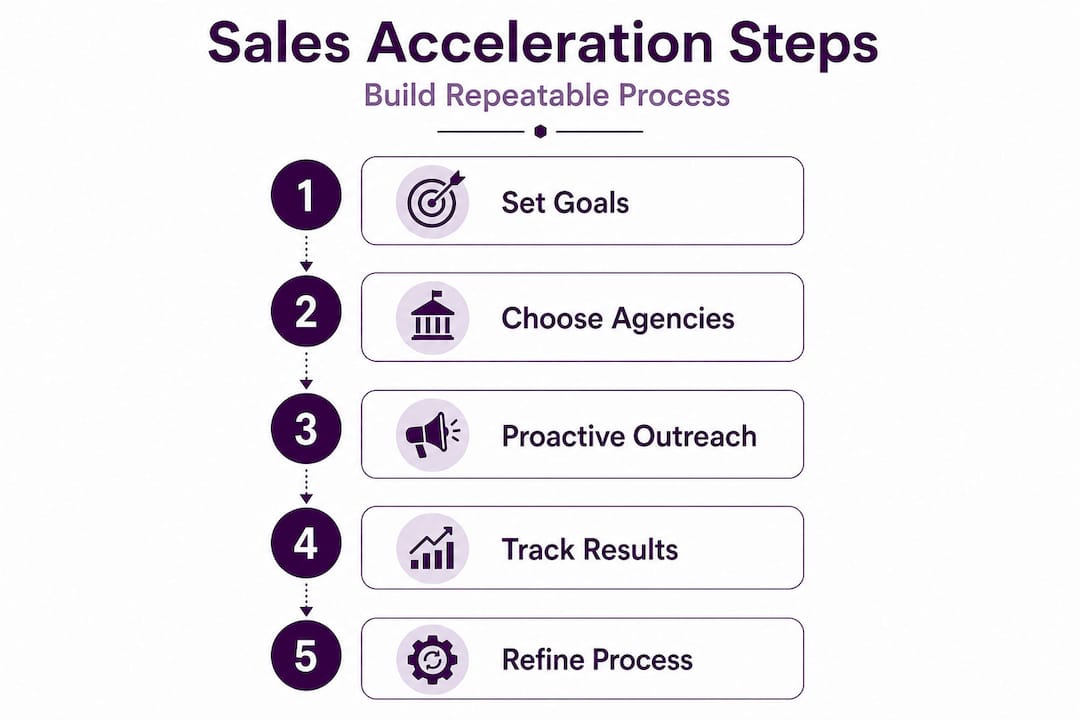
- Step-by-step: Building a repeatable acceleration process
- Tracking your results and adapting for growth
- Why fast, repeatable process beats one-time tricks
- Ready to accelerate your government sales journey?
- Frequently asked questions
Key Takeaways
| Point | Details |
|---|---|
| Proactive outreach matters | GSA Schedules open doors but only lead to sales with targeted marketing and outreach efforts. |
| Compliance ensures longevity | Meeting contract sales thresholds and staying compliant with MAS rules protects your eligibility and growth. |
| Internal process is key | A repeatable, disciplined sales process outperforms shortcuts or total reliance on outside tools. |
| Industry benchmarks guide growth | Using real sales benchmarks by category helps set realistic targets and identify new opportunities. |
Why GSA Schedules are a springboard — not a guarantee — for sales
The GSA Multiple Award Schedule is the federal government’s primary vehicle for buying commercial products and services. It simplifies procurement for agencies and, in theory, makes your business easier to find and buy from. But “easier to find” is not the same as “automatically found.” That distinction trips up thousands of small business contractors every year.
When you are growing with a GSA Schedule, the contract itself is simply your entry ticket. Federal contracting officers and program managers are managing full workloads, competing priorities, and tight deadlines. They are not browsing GSA Advantage waiting to discover new vendors. You have to put yourself in front of them, consistently and deliberately. As one industry resource puts it, accelerating sales after a MAS contract is primarily about proactive marketing to the specific buyers who can place orders, not waiting for opportunities to appear.
What does “proactive” actually look like in practice? It means:
- Re-engaging past contacts in federal agencies where you already have relationships
- Reaching out to new contracting officers in target agencies, using tools like the GSA Contractor Directory and USASpending.gov to identify buyers in your category
- Attending agency industry days and small business outreach events to get face time with acquisition staff
- Keeping your GSA Advantage profile updated with current pricing, capabilities, and past performance highlights
- Responding to every relevant eBuy Request for Quote (RFQ) even when your chances feel uncertain
The numbers make the upside clear. In fiscal year 2024, small businesses earned $18.2 billion in sales through the GSA MAS program, which works out to roughly $1.5 million average sales per small business contractor across approximately 12,300 small business participants. That benchmark is your target, and some businesses far exceed it. But none of them got there by waiting.
The GSA Schedule is a door. Proactive outreach is the hand that opens it. Without one, the other is just wood and hinges.
Tools, resources, and compliance essentials for sales acceleration
Before you ramp up outreach, you need the right infrastructure in place. Trying to accelerate without the proper tools and compliance habits is like pressing the gas before checking the oil. You will move fast in the wrong direction.
Core resources every MAS contractor should use:
- GSA Vendor Support Center (VSC): Your central hub for contract management, modifications, and reporting. If you are not logging in monthly, you are behind.
- GSA eBuy: The platform where agencies post RFQs to schedule contractors. This is where real purchase opportunities show up, often with tight turnaround windows.
- GSA Advantage: Your public-facing storefront. Buyers browse here, and a complete, keyword-rich profile significantly improves your discoverability.
- SAM.gov: You must keep your System for Award Management registration current. An expired SAM registration can halt your ability to receive payments or new orders.
- SBA’s Dynamic Small Business Search (DSBS): Allows agency small business specialists to find you. Keep your profile updated with accurate capabilities and NAICS codes.
GSA provides vendor training and a vendor support ecosystem specifically designed to reduce the learning curve and improve execution for schedule contractors. These include monthly webinars, on-demand tutorials, and one-on-one support from GSA Contracting Officers. Taking advantage of these GSA training resources is one of the fastest ways to eliminate rookie mistakes that stall sales.
Compliance is not optional. GSA has been actively right-sizing the MAS program by expiring contracts that fail to meet sales thresholds and addressing contractor non-compliance. This is not a threat, it is a real operational reality that every contractor needs to plan around.

Here is a quick compliance checkpoint table to keep you on track:
| Checkpoint | Frequency | What to verify |
|---|---|---|
| SAM.gov registration renewal | Annual | Active status, correct NAICS codes |
| GSA Advantage profile update | Quarterly | Current pricing, product/service listings |
| Sales reporting (72A Report) | Quarterly | Accurate IFF (Industrial Funding Fee) reporting |
| Contract modification review | As needed | Pricing changes, new SINs, scope updates |
| MAS sales threshold review | Annual | Meeting minimum sales requirements |
Pro Tip: Set calendar reminders 30 days before each compliance deadline. The businesses that lose their MAS contracts rarely do so on purpose. They simply let administrative tasks slip during busy periods, and the consequences catch up fast.
Bookmark the key contract resources you will need to manage your MAS contract efficiently. Having these links organized and accessible saves time when deadlines hit.
Step-by-step: Building a repeatable acceleration process
The biggest differentiator between GSA contractors who hit that $1.5M benchmark and those who fall short is not budget or connections. It is process discipline. Here is a practical, repeatable cadence you can run on a weekly and monthly basis without a massive team.
Your GSA sales acceleration cadence:
Market research (weekly, 1-2 hours): Use USASpending.gov and GSA eLibrary to identify which agencies are buying in your category. Look at recent awards to understand who is spending, how much, and on what contract vehicles. This gives you a prioritized target list.
Targeted outreach (weekly, 2-3 hours): Send personalized capability statements to contracting officers and small business specialists at your target agencies. Do not blast generic emails. Reference their specific procurement history and explain how your offerings fit their documented needs.
eBuy monitoring (daily, 15-20 minutes): Log into GSA eBuy every morning and scan for open RFQs in your categories. Many contractors miss opportunities simply because they are not checking consistently. Set up email alerts if the platform allows it, and respond to every relevant solicitation within 24 hours of posting.
Follow-up and relationship building (biweekly): Government contracting runs on relationships. Follow up with contacts who have received your capability statement. Attend virtual agency industry days. A soft relationship today often becomes a sole-source opportunity or a directed RFQ six months from now.
After-action review (monthly, 1 hour): Review what you quoted, what you won, and what you lost. Debrief on lost opportunities whenever possible. Contracting officers are often willing to share feedback, and that information is gold for refining your next proposal.
Here is a comparison that clarifies when to rely on your internal cadence versus when to bring in outside support:
| Approach | Best for | Trade-offs |
|---|---|---|
| Internal cadence only | Owners with existing federal relationships and time | Slower ramp-up, lower cost |
| Consultant-supported | Owners new to government sales or scaling fast | Faster results, higher investment |
| Automation tools only | High-volume RFQ environments | Risk of low-quality responses, still needs human review |
| Hybrid (cadence + support) | Most SMBs with growth ambitions | Balanced cost and speed |
The most effective approach for most small business owners is the hybrid model. Think of consultants and automation as force-multipliers, not replacements for your internal process. If you use government contract strategies without a consistent internal cadence, you are building on sand.
Pro Tip: When you are just getting started, pick two to three target agencies and focus all your outreach energy there. Shallow coverage of twenty agencies produces worse results than deep, relationship-driven engagement with three. Narrow focus beats scattered effort every time.
If you are still in the early stages and figuring out the process, reviewing guidance on getting started with GSA contracts will help you avoid the most common early mistakes before they become expensive habits.
Tracking your results and adapting for growth
Running a process without tracking it is guesswork. You need clear benchmarks and checkpoints to know whether your acceleration efforts are actually working, or whether you need to pivot.
Key metrics to track monthly:
- Number of RFQs responded to versus RFQs won
- Agency contacts added to your outreach pipeline
- Total MAS sales to date, compared to your annual threshold requirement
- Win rate by agency and category, so you can double down where you are strongest
- Days to proposal submission as a measure of your operational efficiency
Small businesses take approximately 35% of total MAS sales across large categories, but certain categories significantly outperform that average. Transportation and Logistics Services show a small business share of roughly 76%, while Facilities and Industrial Products also show strong small business concentration at around 61%. If you are in one of these high-concentration categories, your competitive environment is more favorable and your outreach should reflect that confidence.
Here is a category performance reference to use when setting your own targets:
| MAS Large Category | Approx. small business share | Opportunity level |
|---|---|---|
| Transportation and Logistics Services | 76% | Very high |
| Facilities and Industrial Products | 61% | High |
| Office Management | ~45% | Moderate to high |
| Information Technology | ~30% | Moderate |
| Professional Services | ~28% | Moderate |
Use this table as a directional guide when deciding where to invest your outreach energy. Categories with higher small business share typically have buyers who are accustomed to, and often required to prefer, small business vendors.
Remember that GSA actively monitors contract performance. Because non-compliant contracts face expiration under the MAS right-sizing initiative, tracking your sales totals and compliance status is not just a growth exercise. It is a risk management necessity.
Pro Tip: If your sales are lagging at the mid-year point, treat it as a trigger to review your GSA Advantage profile for completeness, check whether your pricing is competitive within your SIN (Special Item Number), and increase your eBuy response rate immediately. Mid-year corrections are far more effective than year-end scrambles. Reviewing how to use the GSA process strategically in your business can also help you spot structural gaps you might be overlooking.
Why fast, repeatable process beats one-time tricks
Here is our honest take, having watched many businesses navigate the MAS program: the ones who struggle the most are the ones who treat their GSA Schedule like a one-time effort. They sprint to get the contract, then coast. They try a few high-effort marketing tactics, get inconsistent results, and conclude that “government sales is slow” or “federal buyers are hard to reach.”
That conclusion is wrong. Government buyers are reachable. Federal sales can be fast. But the businesses that consistently perform well share one trait: they run a predictable, repeatable process every single week, regardless of whether last week felt successful.
Conventional wisdom in this space tends to push automation and outsourcing as the primary levers for speed. And yes, the right consultant or tool can accelerate your ramp-up meaningfully. But automation without a strong internal process is like putting a turbocharger on an engine with no oil. It runs harder and breaks faster.
The contractors who build lasting revenue streams are disciplined about their cadence, curious about their losses, and methodical about compliance. They use leveraging the Federal Supply Schedule as an ongoing strategy, not a one-time checkbox. They treat every debrief as valuable market research. They earn relationships over months, not just chase transactions.
Process protects your contract. Discipline drives sustainable growth. That is not exciting advice, but it is the most accurate description of what separates top MAS performers from the rest.
Ready to accelerate your government sales journey?
You now have a practical framework covering the key steps from setting realistic expectations to building a disciplined weekly cadence to tracking your performance against real benchmarks. Putting this into action takes commitment, but you do not have to figure out every detail alone. At GSA Schedule Services, we work specifically with small and medium-sized businesses to help them move faster, stay compliant, and turn their MAS contracts into consistent federal revenue. Whether you need help mapping your target agencies, sharpening your capability statement, or understanding where your contract stands today, our team is ready to support your next steps. Explore our resources and services to see how we can help you close the gap between contract approval and real government sales growth.
Frequently asked questions
How long does it take to ramp up sales after getting a GSA Schedule contract?
Most businesses see meaningful results within 6 to 12 months if they consistently execute outreach and use available GSA vendor training to sharpen their approach from the start. The more targeted and disciplined your process, the faster you typically see your first wins.
What happens if I don’t meet my MAS contract sales minimums?
GSA may let your contract expire if you fail to meet required annual sales thresholds, as the agency has been right-sizing the MAS program by removing underperforming contracts. Monitoring your cumulative sales throughout the year gives you time to course-correct before expiration becomes a real risk.
Which GSA Schedule categories offer the most potential for small businesses?
Transportation and Logistics Services and Facilities/Industrial Products are standout categories, with small business sales share reaching 76% and approximately 61% respectively. If you operate in these spaces, buyers in your category are already conditioned to work with small businesses.
Are vendor support centers or consultants necessary for accelerating sales?
They function best as force-multipliers supporting an internal process you already run consistently, rather than substitutes for your own sales cadence. Relying entirely on outside support without building internal discipline leaves you vulnerable when that support is not available.
Recommended
- Winning Strategies for GSA Government Contracts
- Boost Your Federal Sales ASAP with GSA MAS: 17 Strategies
- 5 Ways to Leverage GSA’s Federal Supply Schedule to Grow Your Revenue
- 6 Reasons GSA Schedules Appeal to Federal Buyers?