
Pricing your services for the GSA Schedule is a balancing act between compliance, competitiveness, and profitability. Missteps can lead to penalties, contract termination, or even debarment. Here’s a quick guide to help you navigate the process:
- Research Market Rates: Use tools like GSA eLibrary and CALC to analyze competitors’ pricing and set rates that are competitive yet profitable.
- Follow Most Favored Customer (MFC) Rules: Offer GSA rates equal to or better than your best commercial customer’s rates to stay compliant.
- Manage the Price Reductions Clause (PRC): Monitor and document all discounts to avoid triggering mandatory price reductions.
- Use Economic Price Adjustment (EPA) Clauses: Protect against rising costs by choosing the right clause for your business model.
- Set Profitable Margins: Account for task order discounts and compliance costs when determining your profit margins.
These strategies ensure your pricing aligns with GSA requirements while keeping your business competitive and profitable. Let’s explore each step in detail.
Top 10 GSA FAQs – GSA Contracts for Beginners!
1. Research Market Rates to Set Competitive Prices
The GSA eLibrary is an invaluable resource for understanding what competitors charge. This free database features over 1.2 million contracts across 12 Schedules, updated daily. By searching with SINs (Special Item Numbers), contractor names, or keywords, you can uncover details like unit prices, discounts, and contract terms. For instance, if you’re offering consulting services under SIN 541611, you can filter for contracts awarded in the last 2–3 years, download them, and analyze how competitors price their services. This research forms the backbone of competitive and accurate pricing.
Once you’ve gathered competitor data, calculate a weighted average of their prices. Multiply each competitor’s price by their volume, sum it all up, and divide by the total volume. According to a 2022 GAO report, 75% of GSA Schedule offers relied on eLibrary data for pricing justification, which contributed to 20% faster awards for proposals backed by solid research. Pricing your services 5–10% below the average can make you competitive while maintaining healthy margins. Keep in mind that FY 2023 data revealed GSA service prices typically averaged 10–15% below commercial rates.
To validate your findings, use tools like GSA CALC for labor rate comparisons, Schedule Sales Query Plus (SSQ+) to track competitor performance by region, and USAspending.gov for federal award insights. Cross-check this information against your commercial pricelists to ensure compliance with Most Favored Customer rules. Be thorough – GSA evaluators expect your pricing decisions to be based on credible market analysis, not guesswork.
When submitting your proposal, include a detailed pricing analysis. This should outline your methodology, a competitor comparison table, and a written explanation for your pricing strategy. If your prices are higher, justify them with evidence of added value or expertise. If they’re lower, explain how your cost structure supports reduced pricing without sacrificing quality.
For small businesses, navigating eLibrary data and crafting a pricing strategy can be daunting. GSA Focus offers services to help interpret this data and develop pricing strategies that strike the right balance between competitiveness and compliance.
2. Apply Most Favored Customer (MFC) Pricing Principles
The Most Favored Customer (MFC) principle ensures the government gets pricing that’s equal to – or better than – what your best commercial customer receives. Essentially, you need to match the discounted rates offered to your top clients. The General Services Administration (GSA) uses this as a benchmark to guarantee fair pricing for taxpayers. To comply, start by identifying your basis of award customers – the top five non-GSA customers based on sales volume from the past year.
Once you’ve done your market research, applying the MFC principle can strengthen your position in the marketplace. Organize your pricing into three tiers: your published price list, the MFC rate, and the GSA rate. This structure allows room for volume discounts or special promotions, as long as you document the terms that justify each pricing level. Tying your MFC approach to solid market data not only keeps you compliant but also helps you stay competitive.
If you offer better deals to your basis of award customers than to the government, this could lead to a GSA price reduction. To avoid issues, make sure your proposal clearly outlines exceptions – like special rates for new clients, short-term promotions, or transfers within your company. Noncompliance could result in contract modifications or even termination.
When preparing your GSA proposal, transparency is key. Share your commercial price list and several years’ worth of pricing data to prove your MFC compliance. Use the eOffer system for submission, and think about integrating AI-powered tools to track commercial discounts in real time. GSA is placing more emphasis on these tools, especially as of 2026. Conduct quarterly reviews of your commercial sales to catch any “one-off” deals that might inadvertently cause compliance problems before they escalate into audit risks.
For small businesses, GSA Focus offers services to pre-validate pricing data and craft MFC-compliant proposals. This can help minimize negotiation delays and ensure your pricing strategy stands up to scrutiny. Keeping a close eye on commercial pricing trends not only helps you maintain compliance but also prepares you for future adjustments.
3. Manage the Price Reductions Clause (PRC) Correctly
The Price Reductions Clause (PRC) is a critical part of GSA contracts. It requires you to lower your GSA prices if you offer a better discount to your Basis of Award (BOA) customer than what you initially disclosed. This clause ensures the government consistently receives “fair and reasonable” pricing throughout the contract’s duration. However, not all commercial discounts lead to PRC adjustments – only those that change the benchmark relationship established in your contract.
Before diving into tracking commercial discounts, make sure you understand your contract’s pricing model. As of 2026, GSA operates under two systems: the traditional CSP/PRC model and the newer Transactional Data Reporting (TDR) model. If your contract falls under TDR, the PRC does not apply; instead, you’ll report monthly sales data. To avoid missteps, confirm which award clause version governs your contract. Getting this right is essential, as PRC-related noncompliance can result in hefty penalties.
For contracts governed by the PRC, the stakes are high. A recent case illustrates the risks: in March 2023, the United States ex rel. Morsell v. NortonLifeLock, Inc. case resulted in approximately $1 million in damages and $200,000 in civil penalties for failing to disclose commercial rebate programs.
To maintain compliance, document the context behind every commercial discount you offer. For example, if you provide a special rate for competitive reasons that doesn’t affect your BOA relationship, be prepared to explain and justify that decision. Before any major contract modification or option exercise, review your recent commercial pricing changes to ensure they align with your original CSP disclosure, current pricing, and benchmark data.
For added peace of mind, GSA Focus offers services to pre-validate your pricing data. Their compliance reviews are designed to catch potential issues before they escalate during contract modifications or renewals. This proactive approach can protect your revenue and reduce the risk of audits or penalties.
4. Choose the Right Economic Price Adjustment (EPA) Clause
Once you’ve mastered discount management under the PRC, it’s just as important to tackle rising costs effectively. The Economic Price Adjustment (EPA) clause is a tool designed to adjust GSA prices in response to cost increases. Without it, your pricing remains frozen while labor, materials, and overhead costs climb. The key is to choose the EPA clause that aligns with your pricing strategy and adheres to GSA requirements.
Clause 552.216-70 works best for businesses that rely on a published commercial price list or catalog. If you regularly update a rate sheet for your commercial customers, this clause allows you to adjust GSA prices when that list changes. Typically, annual increases under this clause are capped at 5% for services and 10% for products. However, the price list must already exist as a standalone document – it can’t be something created just for a GSA offer.
Clause I-FSS-969 is tailored for contractors who primarily serve government clients and lack a formal commercial catalog. This clause provides two options: fixed annual escalation and market indicator adjustments. With the fixed escalation option, you can propose a specific percentage increase each year. However, securing rates above 2.5% has been increasingly difficult since 2021. The market indicator option, on the other hand, ties your pricing to a public index – like the Bureau of Labor Statistics Employment Cost Index – offering protection against industry-wide cost shifts.
To implement an EPA adjustment, you’ll need to submit a formal request to the FSS Contracting Officer. They will evaluate your proposal using market research and have the authority to negotiate terms “in the best interest of the Government”. Approved adjustments apply only to orders placed after the modification’s effective date. This ensures your pricing remains both flexible and compliant as market conditions evolve.
When choosing an EPA clause, consider your business model. If you serve commercial clients and have an established rate sheet, Clause 552.216-70 offers greater flexibility. However, if your focus is on government contracts and you lack a commercial price list, Clause I-FSS-969 – either with fixed increases or index-based adjustments – can help safeguard your pricing in an unpredictable market.
5. Set Profit Margins That Balance Competition and Compliance
Your GSA contract rate is built on three key components: direct costs (like labor and materials), overhead expenses (facilities, administration, and indirect costs), and your profit margin. The tricky part? Setting a profit margin that supports your business while staying competitive enough to win contracts. For professional services, margins typically fall between 12-18%, IT services aim for 10-20%, and engineering services range from 15-25%. These figures account for the extra expenses tied to federal compliance and the stiff competition from larger contractors.
When planning your pricing, remember to factor in task order discounts. Federal buyers often negotiate discounts of 15-30% off your listed rates. For instance, if your catalog rate is $200 per hour and you agree to a 25% discount, you’ll end up with $150 per hour. If your fully burdened costs are $120, that leaves you with a 25% profit margin. However, if your initial margin is too slim, these discounts can quickly eat into your profits. To avoid this, aim for gross margins of 25-35% in your catalog pricing, which should leave you with 10-15% after typical reductions.
Instead of offering blanket discounts across all sales, structure your pricing smartly. A small general discount (under 5%) works well for most commercial sales, while deeper discounts should be reserved for larger volumes or long-term commitments. For example, you might charge $150 per hour for one-off commercial work, $135 per hour for a one-year contract with your Most Favored Customer, and $125 per hour for your GSA rate, which reflects a three-year term with consistent volume. This tiered strategy protects your margins and ensures GSA doesn’t automatically get your steepest discount. This approach ties back to the PRC and MFC principles discussed earlier.
Plan for the future. GSA limits how and when you can raise your prices, so your initial rates need to account for potential cost increases down the line. Regularly review your pricing – quarterly is a good rhythm – to avoid triggering the Price Reductions Clause. Tools like GSA CALC and GSA Advantage can help you compare your rates to competitors, allowing you to stay competitive while safeguarding your bottom line. Striking this balance is key to winning contracts and keeping your business financially healthy.
Comparison Table
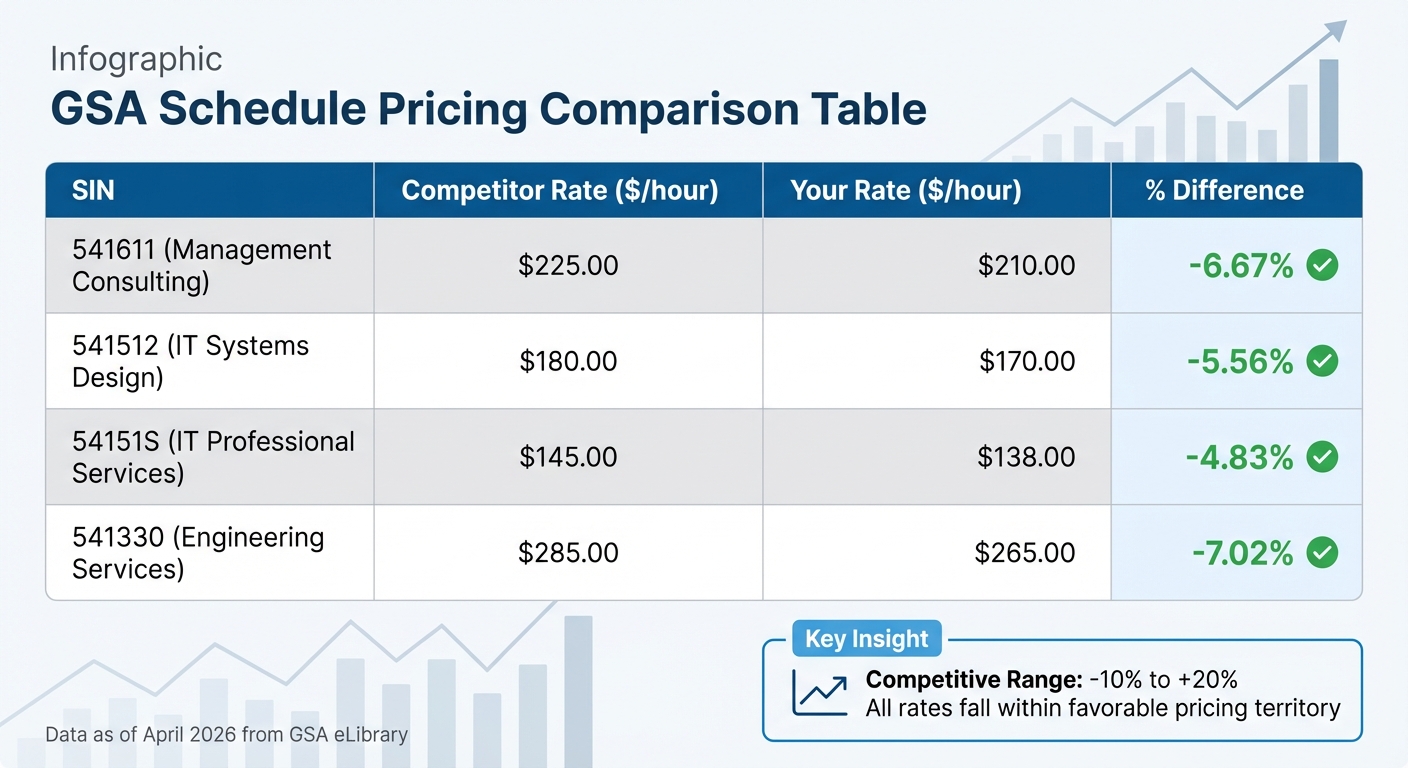
GSA Schedule Pricing Comparison by Service Category
To ensure your pricing strategy is competitive and well-documented, create a comparison table based on thorough market research. This table helps validate your rates while demonstrating compliance with GSA standards. Start by gathering hourly rates from active contracts in the GSA eLibrary using your SIN. Review the “Price List” attachments of 5–10 similar contractors, then average those rates to establish your benchmark. For quick calculations, use the GSA CALC Tool to find market averages by entering the labor category and location. Be sure to focus on contracts modified in the last 12–18 months to ensure the data reflects current market conditions.
Your table should include four columns: SIN, Competitor Rate ($/hour), Your Rate ($/hour), and % Difference. Calculate the percentage difference using this formula:
((Your Rate - Competitor Rate) / Competitor Rate) × 100.
A range of -10% to +20% generally indicates compliance. Negative percentages show you’re pricing below competitors, which can be a strategic advantage without sacrificing too much margin. For instance, if the average competitor rate for SIN 54151S (IT Professional Services) is $145.00 per hour and your proposed rate is $138.00 per hour, your percentage difference is -4.83%, a favorable position.
Here’s an example table using Q1 2026 data from the GSA eLibrary:
| SIN | Competitor Rate ($/hour) | Your Rate ($/hour) | % Difference |
|---|---|---|---|
| 541611 (Management Consulting) | $225.00 | $210.00 | -6.67% |
| 541512 (IT Systems Design) | $180.00 | $170.00 | -5.56% |
| 54151S (IT Professional Services) | $145.00 | $138.00 | -4.83% |
| 541330 (Engineering Services) | $285.00 | $265.00 | -7.02% |
Make sure your rates align with Most Favored Customer (MFC) and Price Reduction Clause (PRC) benchmarks to avoid compliance issues. For credibility, add a note below the table citing your data source and the search date, such as:
“Data as of April 2026 from GSA eLibrary.”
If limited data is available for a specific SIN, supplement your findings with information from the GSA CALC Tool and clearly explain your methodology. This transparency not only helps during audits but also builds trust with contracting officers who evaluate your proposal.
Keep the table concise – 5 to 7 rows is ideal for readability. Use bold headers and right-align numbers for a clean, professional presentation. This table, paired with your pricing strategy, strengthens your proposal by showcasing fair and competitive rates.
Conclusion
Pricing on the GSA Schedule is a tightrope act – balancing competitive rates with strict regulatory requirements. The five key strategies – market research, Most Favored Customer (MFC) compliance, Price Reductions Clause (PRC) management, Economic Price Adjustment (EPA) clause selection, and thoughtful profit margin planning – work together to protect your profits and prevent unexpected reductions.
GSA rates function as ceiling rates. If you price too low, you risk eroding profitability. Too high, and your offer might get rejected as unreasonable. The challenge lies in finding the perfect balance – pricing that aligns with market trends while leaving room for adjustments over the potential 20-year contract lifespan using EPA clauses.
Many small businesses underestimate these pricing challenges. For example, maintaining consistent relationships with Basis of Award customers or structuring volume discounts without triggering PRC complications can be tricky. If this feels daunting, GSA Focus offers a solution. They specialize in helping small businesses navigate the GSA Schedule process, handling complex documentation, providing expert negotiation support, and ensuring compliance with PRC, TDR, and EPA requirements. With over 600 satisfied clients, a 98% satisfaction rate, and an impressive average ROI of 87x, they reduce your time commitment from over 100 hours to just about 3 hours.
To succeed, apply these pricing strategies methodically, document your decisions, and review your discount structures regularly. Conduct quarterly market analyses and refine your discount management practices to stay compliant and competitive throughout your contract term.
FAQs
How do I pick my Basis of Award customer?
When picking your Basis of Award (BOA) customer for your GSA Schedule, it’s important to select one that mirrors your standard commercial pricing. This customer acts as the benchmark for determining your GSA rates. Typically, this would be the customer who benefits from your most favorable commercial pricing. Keep in mind, any discounts or lower rates you offer this customer could influence your GSA pricing. Make sure your GSA rates remain both competitive and compliant while aligning with this reference point.
Will discounts trigger the Price Reductions Clause?
Offering discounts can activate the Price Reductions Clause. This clause requires you to adjust your GSA prices if there are changes to your commercial rates. To stay compliant, it’s essential to keep a close eye on your pricing and ensure it meets GSA requirements, helping you avoid any potential complications.
Which EPA clause should I choose for services?
When choosing an Economic Price Adjustment (EPA) clause, it’s essential to pick one that reflects current market conditions. Consider using reliable indicators like the Consumer Price Index (CPI) or the Producer Price Index (PPI). These benchmarks help ensure your pricing stays aligned with economic trends while remaining compliant with the requirements of the GSA Schedule. By tying adjustments to these indices, you can better manage price changes for your services in a fair and predictable way.
Related Blog Posts
- How to Analyze GSA Competitor Pricing
- How to Update GSA Schedule Prices
- How to Set GSA Prices for Federal Contracts
- 5 GSA Discounting Rules for Compliance