

You need a GSA consultant if you’re a first-time offeror, your commercial sales practices are complex, or your business development team has no bandwidth for a multi-month application. You can likely skip one if you have clean pricing, an experienced proposal lead, and months to spare for the paperwork.
First-time submitters, companies with layered pricing or multiple SINs, and lean teams juggling other priorities tend to gain the most from hiring help, since a consultant can compress a process that often drags on for years into a matter of months. If your pricing is simple, you’ve written federal proposals before, and nobody is waiting on this contract to hit a sales target, doing it yourself is a realistic option.
TL;DR:
- A straightforward self filed offer can consume 200 to 400 staff hours, while consultant guided submissions often take a few months rather than multiple years.
- Every offeror must complete three to four hours of training, a Readiness Assessment within 12 months, SAM registration, and designation of an employee negotiator.
- Hiring is most defensible when at least three checklist answers are yes, especially for first time applicants, complex pricing, multiple SINs, or deadline pressure.
- The company must handle its own training, assessment, and employee negotiator designation; an awarded Schedule also requires active marketing to generate sales.
Table of Contents
- What GSA consultants actually do: services and deliverables
- GSA prerequisites you must complete no matter what
- DIY vs hire: realistic cost, timeline, and opportunity-cost trade-offs
- Decision checklist: 8 questions to decide now
- Case studies or examples illustrating successful outcomes with and without consultants
- Which businesses benefit most, and which don’t need the help
- Author perspective: when we recommend hiring GSA Schedule Services
- If you decide to hire help: how our packages map to your needs
- FAQ
- Sources
What GSA consultants actually do: services and deliverables
A GSA consultant’s job is narrower than it sounds. Most of the work falls into a handful of concrete deliverables rather than vague “guidance.”
- Building your pricelist and writing the Commercial Sales Practices (CSP) narrative that explains your pricing structure to the contracting officer.
- Preparing the Agent Authorization Letter required whenever a third party assists with your offer, as outlined in the MAS solicitation document.
- Managing FAS ID and multi-factor authentication setup, then handling the eOffer submission and responding to the contracting officer’s requests.
- Supporting negotiations, answering requests for information, and drafting contract modifications after award.
- Helping activate the contract once awarded, including pricing updates and ongoing maintenance.
The paperwork is only half the job. The other half is knowing which CSP framing avoids an evaluation notice and which negotiation responses satisfy a contracting officer on the first pass. That pattern recognition is what you’re really paying for, more than the form-filling itself.
Pro Tip: Ask any consultant you’re vetting to walk you through how they’d frame your specific pricing structure in the CSP narrative. Vague answers are a red flag.
GSA prerequisites you must complete no matter what
Whether you hire help or not, certain steps belong to you and can’t be outsourced. GSA requires every offeror, consultant or not, to clear these before submission.
- Complete Pathways to Success training, which takes roughly 3 to 4 hours, and acknowledge it in eOffer within 12 months of submitting.
- Finish a Readiness Assessment, completed by an authorized employee of your company within the 12 months prior to your offer.
- Register in Sam and obtain a FAS ID with multi-factor authentication, since eOffer access depends on both.
- Designate at least one Authorized Negotiator who is an actual employee, not a contractor, under the rules in the MAS roadmap.
Skip any of these and your offer stalls regardless of how polished your pricing or past performance looks. A consultant can prepare documents around these steps, but the training, the assessment, and the negotiator designation stay with your company.
DIY vs hire: realistic cost, timeline, and opportunity-cost trade-offs
The honest comparison isn’t consultant fee versus zero. It’s consultant fee versus your own team’s hours plus the sales you’re not closing while they’re buried in paperwork.
- Companies that go it alone often spend multiple years reaching award, while a consultant-guided timeline frequently takes a few months.
- Industry practitioner estimates put internal effort at 200 to 400 hours for a focused team handling a straightforward submission themselves.
- Reported consultant fees for a single-SIN submission commonly fall in a range often described as tens of thousands of dollars, according to practitioner commentary.
- Hiring tends to pay off most when it’s your first submission, your CSP is complicated, or you’re racing a deadline tied to a specific contract opportunity.
A straightforward submission handled internally can consume 200 to 400 hours of staff time. That’s the equivalent of a full-time employee spending five to ten weeks on nothing but your GSA offer, time that isn’t spent prospecting or closing other business.
Run the math for your own team: 300 hours at a loaded hourly rate for a mid-level proposal lead adds up fast, often rivaling or exceeding what a consultant charges, before counting the opportunity cost of what that person isn’t doing instead.
Decision checklist: 8 questions to decide now
Answer these honestly and count your “yes” responses. This isn’t a formal scoring system, just a fast way to see where you stand.
- Is this your first GSA Schedule submission?
- Do you lack two years of financial statements, and no Startup Springboard or similar substitute path is obviously available?
- Does your commercial pricing structure involve multiple tiers, discounts, or bundled services that would be hard to explain in a CSP narrative?
- Will your offer include more than one or two SINs?
- Does your internal team lack prior experience writing federal proposals?
- Do you lack an employee who can serve as an Authorized Negotiator?
- Is there a hard deadline, such as a specific contract vehicle or agency opportunity, pushing you to move faster than the typical timeline allows?
- Would 200 to 400 hours of internal staff time meaningfully disrupt your current sales or operations priorities?
Pro Tip: If you answered “yes” to three or more questions, hiring a consultant is almost always the cost-effective choice once you weigh staff time against fees.
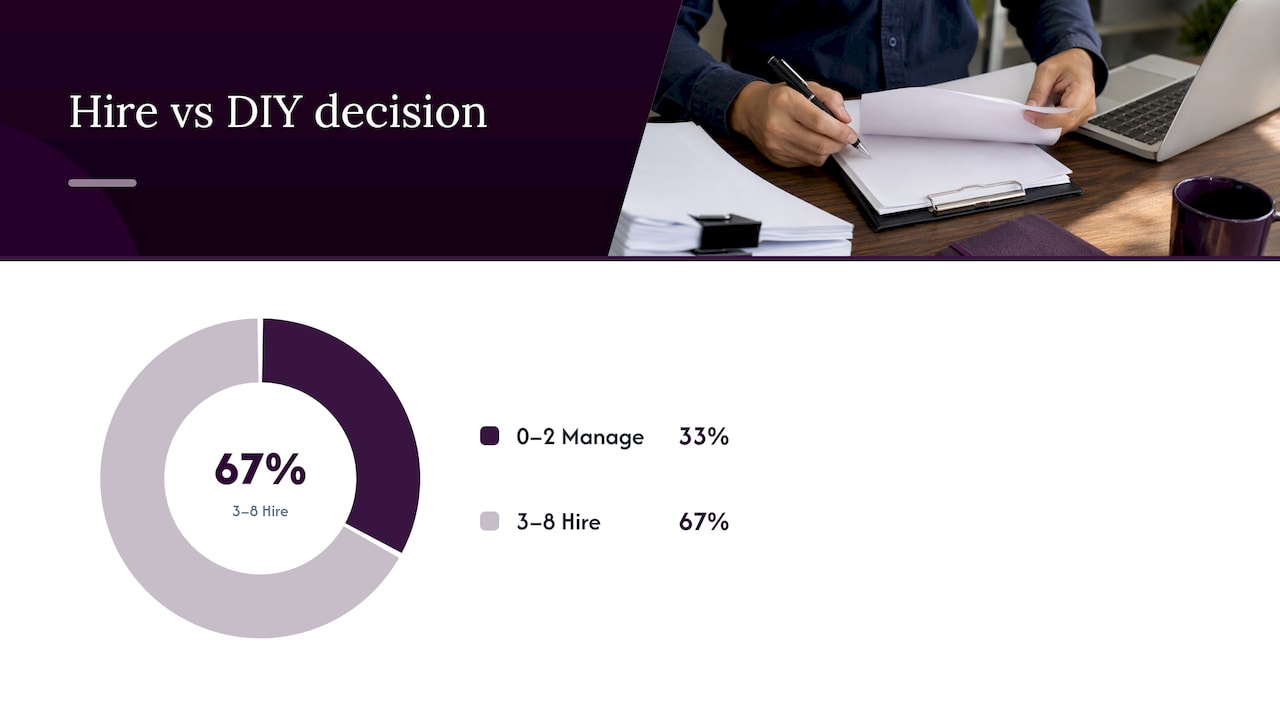
Three or more yeses point toward outside help. One or two suggests you might manage internally, especially if your pricing is simple and someone on staff has proposal experience.
Case studies or examples illustrating successful outcomes with and without consultants
Patterns show up consistently across companies that go each route. A first-time offeror with a simple commercial catalog and no complex discounting can and does succeed without a consultant, provided someone internally commits real hours to reading the solicitation carefully and following GSA’s roadmap step by step. These companies typically accept a longer timeline, often well beyond a year, in exchange for lower upfront cost.
Companies with layered pricing, several SINs, or a BD team already stretched thin tend to see a different outcome when they bring in outside help early. The common thread isn’t that a consultant guarantees approval. It’s that experienced help tends to catch CSP framing issues and documentation gaps before they turn into evaluation notices that add weeks or months to the process.
The companies that struggle most, with or without help, are the ones that underestimate the Readiness Assessment and Pathways to Success requirements, treating them as formalities rather than as gating steps. No consultant can submit an offer on your behalf past these prerequisites. Understanding how the MAS program actually works before you start, whether alone or with support, is what separates a smooth submission from a stalled one.
Which businesses benefit most, and which don’t need the help
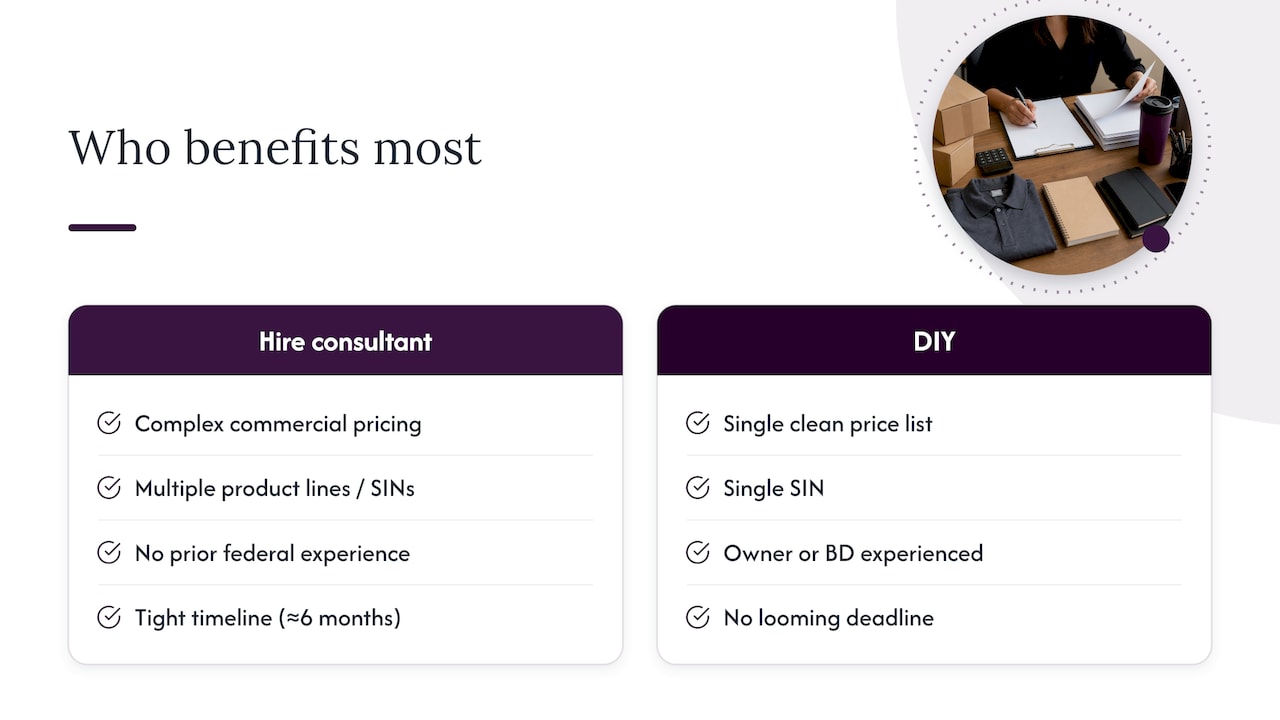
Businesses with complicated commercial pricing, multiple product or service lines under different SINs, or no prior experience writing federal proposals tend to see the clearest return from hiring a consultant. So do companies racing against a specific contract opportunity where a six-month timeline matters more than a two-year one. For these businesses, the fee is effectively insurance against costly delays.
On the other end, a small business with one clean price list, a single SIN, and an owner or BD lead who has handled federal paperwork before can often manage the three-step acquisition process without outside help. The savings in fees can be worth the extra months, especially if there’s no looming deadline.
Businesses that may not benefit as much include those with no near-term plan to actively market their contract once awarded. A GSA Schedule sitting unused doesn’t generate revenue, and no consultant changes that reality once the award is in hand. The value of hiring help is highest where complexity or time pressure is real, not just where budget allows for it.
Author perspective: when we recommend hiring GSA Schedule Services
We see the same patterns repeat across the businesses that come to us. First-time applicants, teams with no spare hours for a 200-plus hour paperwork project, and companies with multi-SIN or layered pricing structures are the ones who benefit most from bringing us in early, rather than after a stalled submission.
For companies in that position, different tiers map to different starting points: options for newer businesses, plans for ongoing federal marketing support, and a DIY Quick Start for those who want partial guidance rather than full-service help. Maintenance plans cover the modifications that follow award.
If you’re unsure which category you fall into, a free eligibility check is the fastest way to find out before committing to either path.
— Josh
If you decide to hire help: how our packages map to your needs
Once you’ve decided outside help makes sense, the next question is which tier fits. Newer businesses without two years of financials often start with our Startups or Streamline packages, while companies ready for full-service marketing support after award tend to land in Lite, Standard, or Plus, priced at $10,700, $15,700, and $27,700 per year.
The service works on a no award, no fee basis, and clients typically spend minimal time on their part while the remainder is managed by the consulting team. If you want a lighter touch first, our GSA DIY Quick Start is worth reviewing before you commit to full service.
FAQ
How much does it cost to get a GSA contract?
There’s no fee to GSA for submitting an offer, but preparation costs vary widely depending on whether you handle it internally or hire help. Reported consultant fees for straightforward submissions commonly run in the tens of thousands of dollars, according to practitioner estimates, while internal labor can consume 200 to 400 staff hours.
Is it better to be a GSA contractor or handle sales independently?
This depends on your business model rather than a universal answer. A GSA Schedule opens access to federal buyers using a pre-negotiated contract vehicle, but it requires ongoing compliance and active marketing, so it suits companies with a genuine plan to pursue government sales rather than those testing the waters.
How hard is it to get a GSA schedule?
The process is detailed but not impossible to manage internally if your pricing is simple and you have time. Mandatory steps like Pathways to Success training and the Readiness Assessment apply to everyone, and companies without proposal experience often find the Commercial Sales Practices narrative the hardest part to get right.
Who can buy off of GSA?
Federal, state, and local government entities that are authorized to use GSA Schedule contracts can purchase through them. Specific eligibility to order depends on the buyer’s agency authority, which is outlined in GSA’s MAS ordering guidance.
When should I hire a GSA consultant instead of applying myself?
Hiring tends to make sense for first-time submitters, businesses with complex or multi-tiered pricing, and teams facing a hard deadline tied to a specific opportunity. If three or more items on a short readiness checklist come back “yes,” bringing in outside help is usually the more cost-effective route once staff time is factored in.
Sources
GSA’s own materials spell out the non-negotiables, and they don’t change based on whether you hire a consultant.
- Roadmap to get a MAS contract | GSA
- Pathways to Success (GSA)
- MAS solicitation document (agent authorization & eOffer details)
- GSA Schedule consultants: when to hire one | Contractology
Consultants with experience can present an acceptable CSP narrative that avoids evaluation notices, while companies unfamiliar with the pattern often trigger them without realizing why.
Contractology
Agent authorization rules exist because GSA wants your company, not a contractor, holding signatory control over the offer at every stage.
Recommended
- GSA Consultant Costs for U.S. SMBs: Low to High Five Figures
- Top 5 Things to Consider Before Hiring a GSA Schedule 70 Consultant
- 3 Reasons Small Businesses Should Consider a GSA Schedule Consultant
- Getting Expert GSA Schedule Contract Help vs. DIY