

If your contract has reached its TDR effective date, you no longer submit a Commercial Sales Practices disclosure. Contractors who have not yet accepted the “Participate in TDR” mass modification still owe CSP and remain bound by the Price Reductions Clause. VA Federal Supply Schedule holders are the one notable exception, since TDR does not yet apply there, and many still need to file CSP-1.
TL;DR:
- Once the TDR effective date is reached, contractors are no longer required to submit CSP-1 disclosures unless they are still within the acceptance window or holding a VA FSS contract, which is exempt.
- Accepting the “Participate in TDR” mass modification triggers a 60-day window for acceptance, and the TDR effective date aligns with the start of the next sales-reporting quarter after acceptance.
- Contractors still in CSP must carefully document and retain sales data, discount schedules, and MFC determinations, as liabilities can retroactively impact pricing if discrepancies are discovered later.
- Moving to TDR requires system changes, including mapping data fields, testing upload procedures, and keeping old CSP records accessible for at least the duration of the audit window.
- Contractors with multiple schedules, such as VA FSS and MAS SINs, may have different exemption statuses, demanding check of each contract’s individual progress and modifications.
Table of Contents
- What Is CSP and What Does CSP-1 Capture?
- Who Is Exempt Now: TDR and the VA Exception
- How Does the Mass-Mod Timeline Work?
- How Do You Complete CSP-1 While It Still Applies?
- What Compliance Risks Come With Staying on CSP?
- What Should Your TDR Transition Checklist Include?
- What Are the Criteria for CSP Exemption Eligibility?
- Does the CSP Exemption Apply the Same Way Across All Schedules?
- How Do Enforcement and Penalties Differ Between CSP Filers and TDR Contractors?
- What Are the Risks in Transitioning From CSP to TDR?
- What Misconceptions Persist About CSP Exemption and TDR?
- What Should Small Contractors Prioritize Right Now?
- How Gsascheduleservices Helps You Handle CSP and the TDR Shift
- Sources
- FAQ
What Is CSP and What Does CSP-1 Capture?
Commercial Sales Practices disclosure existed to give GSA contracting officers a window into how a company priced its products or services in the open market before the government agreed to a price. The goal was fair and reasonable pricing, anchored to a concept called the Most Favored Customer (MFC), compared against the government’s proposed Basis of Award (BOA) customer.
The CSP-1 form, historically the standard vehicle for this, asked contractors to disclose specific data points covering roughly 12 months of commercial activity:
- Sales volume and discount structure for each customer category (retail, wholesale, state and local government, etc.)
- Identification of the MFC and the discount that customer received
- Any concessions, rebates, or nonstandard terms offered outside the published price list
That MFC and BOA data fed directly into Price Reductions Clause enforcement. If a contractor later dropped its price to the MFC customer, the government expected the same cut on the GSA contract. Auditors used CSP-1 as the baseline for that comparison, which is exactly why the disclosure carried so much administrative weight for small businesses juggling limited back-office staff.
Who Is Exempt Now: TDR and the VA Exception
Transactional Data Reporting exists specifically to replace this disclosure burden. Once a contract reaches its MAS-TDR effective date, the contractor no longer provides CSP-1, MFC data, or BOA information, and stops monitoring for price reduction violations under the older, non-TDR version of the clause.
That single rule is the entire exemption. There’s no separate waiver application, no additional form. Reaching your effective date under the mass modification is what triggers the exemption automatically.
A few situations keep contractors squarely inside CSP territory:
- The contractor has not yet accepted the “Participate in TDR” mass modification
- The contract is a VA Federal Supply Schedule award, where TDR does not currently apply and CSP-1 may still be required
- The contractor holds a non-MAS vehicle where TDR was never rolled out
Solicitation Refresh 31, issued April 2, 2026, made TDR mandatory across MAS Special Item Numbers and stripped CSP-1 references from the base solicitation entirely for TDR-covered SINs. VA FSS is the standout carve-out contractors keep asking about, because it runs on a separate track from the MAS modernization effort.
How Does the Mass-Mod Timeline Work?
The mechanics matter because your exemption date isn’t negotiable once you’ve triggered the clock. Here’s the sequence:
- GSA issues the “Participate in TDR” mass modification to your contract.
- You have 60 days from issuance to accept the modification through eMod.
- Your TDR effective date aligns to the first day of the next sales-reporting quarter after acceptance, not the acceptance date itself.
- CSP, MFC tracking, and non-TDR PRC monitoring stop as of that effective date.
Say you accept the mod on February 10. Your next sales-reporting quarter likely starts April 1, which becomes your TDR effective date and the point CSP obligations end. Accept it on March 25 instead, and you might miss that April 1 cutoff and roll into the following quarter. Timing your acceptance early in a quarter, rather than at the tail end, buys you a faster exit from CSP.
How Do You Complete CSP-1 While It Still Applies?
For contractors still inside a VA FSS award, a pre-TDR MAS contract, or a transition window, filing correctly still matters. Here’s the practical sequence:
- Pull 12 months of commercial sales data by customer category, matching the format the CSP-1 instructions on eOffer/eMod specify.
- Identify your MFC and confirm the discount that customer actually received, not the published list rate.
- Leave MFC/BOA fields blank only where GSA guidance explicitly permits it during a TDR transition, and document the reason in your files.
- Submit through eOffer or eMod using the current template. Older cached templates are a frequent source of rejected submissions.
- Retain the underlying sales ledger and discount schedule for at least as long as your contract’s audit lookback period.
Pro Tip: Don’t just save the CSP-1 form itself. Save the raw sales export it was built from. If a contracting officer questions your MFC determination two years later, the form alone won’t prove your math; the underlying ledger will.
GSA also recommends withdrawing any pending non-TDR offer and resubmitting under TDR terms, since unmodified offers risk outright rejection under the current solicitation structure.
What Compliance Risks Come With Staying on CSP?
The Price Reductions Clause creates retroactive exposure that catches contractors off guard. If your MFC customer gets a better deal after your CSP-1 filing and you don’t pass that discount to the government, liability accrues from the date of the price cut forward, not from the date GSA discovers it.
The errors that trigger audits tend to repeat across small businesses:
- Misidentifying the MFC because a sales rep gave an informal discount nobody logged centrally
- Reporting discount tiers that don’t match the actual invoices sent to customers
- Submitting incomplete CSP-1 templates missing required customer-category breakdowns
Reducing exposure comes down to unglamorous internal controls: a single person or team responsible for tracking every discount offered to any customer, retained documentation going back through your audit window, and proactive disclosure to your contracting officer the moment a pricing practice changes. Waiting for GSA to find it costs more than reporting it yourself. For a deeper look at how PRC obligations differ once you’re inside TDR, this comparison of PRC versus transactional reporting is worth a read.
What Should Your TDR Transition Checklist Include?
Moving off CSP isn’t just paperwork. It’s a systems change.
- Accept the mass modification as soon as your team can review it, and calendar the resulting effective quarter immediately.
- Map the required TDR data elements, order date, ship date for products, unit price, and customer type, into your ERP or invoicing system before your effective date arrives.
- Run a test upload into the Sales Reporting Portal before your first live reporting month to catch template mismatches early.
- Archive every CSP-era document, discount schedules, MFC determinations, prior CSP-1 filings, since PRC liability for pre-TDR sales can still surface after your effective date.
- Bring in a GSA schedule consultant or contracts attorney if your finance system can’t natively produce the line-item detail TDR requires; ask them specifically how they’d map your existing invoicing fields to the SRP schema.
Pro Tip: Test your Sales Reporting Portal upload with a small batch before your first real reporting month. Mismatched product identifiers and missing ship dates are the two most common reasons an early TDR submission bounces back.
Missing ship dates and inconsistent customer-type coding are the most frequent early-stage TDR reporting failures, and both are fixable weeks in advance if you test before you’re forced to report live.
What Are the Criteria for CSP Exemption Eligibility?
Eligibility for the CSP exemption isn’t a checklist you submit for approval. It’s a status you arrive at through your contract’s own mechanics. Three conditions determine it.
First, your contract vehicle has to be a Multiple Award Schedule SIN covered by the TDR rollout. Second, you have to have accepted the “Participate in TDR” mass modification, not simply received it. An unaccepted modification sitting in your eMod queue does nothing for your CSP status. Third, your contract has to have crossed its effective date, which as covered above lands on the first day of the sales-reporting quarter following acceptance, not the acceptance date itself.
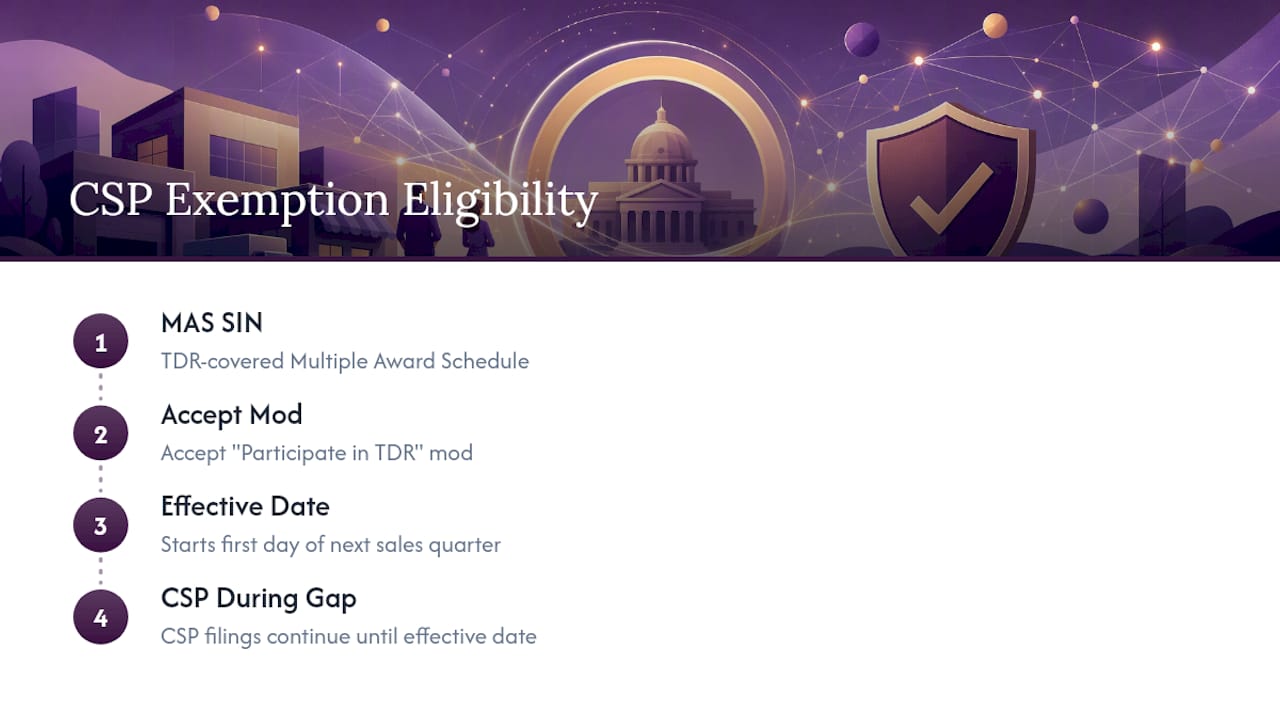
Miss any one of those three, and CSP still applies. A contractor who accepted the mod in January but whose effective date isn’t until April is still filing CSP-1 in February and March if a filing deadline falls in that window. This trips up businesses that assume “we said yes to the mod” is the same thing as “we’re exempt.” It isn’t, and the gap between those two dates is exactly where compliance mistakes happen.
There’s also no partial exemption. You don’t get to stop tracking MFC data for some product lines while continuing for others under the same SIN. The exemption applies at the contract level once your effective date arrives, cleanly and completely, which is part of why GSA frames TDR as a full replacement mechanism rather than a supplemental option.
Does the CSP Exemption Apply the Same Way Across All Schedules?
Not evenly. The Multiple Award Schedule rollout under Refresh 31 pushed TDR across essentially all MAS Special Item Numbers, so the exemption pattern looks similar whether you’re selling IT services, professional services, or facilities products under a mainstream MAS SIN.
VA Federal Supply Schedule contracts sit outside that pattern entirely, since TDR has not been extended to VA schedules on the same timeline. A janitorial supplies contractor on a mainstream MAS SIN and a medical equipment vendor on a VA FSS schedule can be in completely different compliance postures despite both selling into the federal market, simply because of which schedule houses their contract.
This matters most for businesses holding multiple schedules simultaneously, which is common among mid-sized contractors selling across several categories. A company with both a MAS IT Schedule 70 contract and a VA FSS medical supply contract will find itself exempt from CSP on one and still obligated on the other. Treating both contracts identically, assuming that accepting a TDR mod on one automatically covers the other, is a mistake that shows up during audits more often than it should.
Non-MAS vehicles outside the Schedule structure entirely, including some agency-specific contracts, were never part of the TDR modernization push in the first place. If your business holds one of those alongside a MAS Schedule, don’t assume the exemption logic transfers over. Check each contract’s own modification history independently.
How Do Enforcement and Penalties Differ Between CSP Filers and TDR Contractors?
Contractors still filing CSP face price reduction liability that’s calculated retroactively against a specific MFC customer relationship. If a discount to that customer changes and the contractor doesn’t flow the same reduction to the government, the exposure accrues from the date of the price change, sometimes discovered months or years later during an audit, and can require refunds covering the entire unreported period.
TDR contractors face a different enforcement posture entirely. Since MFC tracking and non-TDR PRC monitoring don’t apply once you’re TDR effective, the enforcement question shifts from “did you pass along a discount correctly” to “did you report accurate transactional sales data on time.” Late or inaccurate SRP submissions create their own compliance problems, but they don’t carry the same retroactive multi-year liability structure that price reduction violations under CSP can generate.
That distinction is a big part of why GSA has publicly framed the TDR expansion as a modernization step intended to cut compliance burden and shift toward data-driven pricing oversight rather than customer-by-customer discount policing. The two systems simply police different things. CSP filers are managing relationship-based pricing risk. TDR contractors are managing data accuracy and reporting timeliness risk. Neither is risk-free, but the shape of that risk changes substantially once you cross your effective date.
What Are the Risks in Transitioning From CSP to TDR?
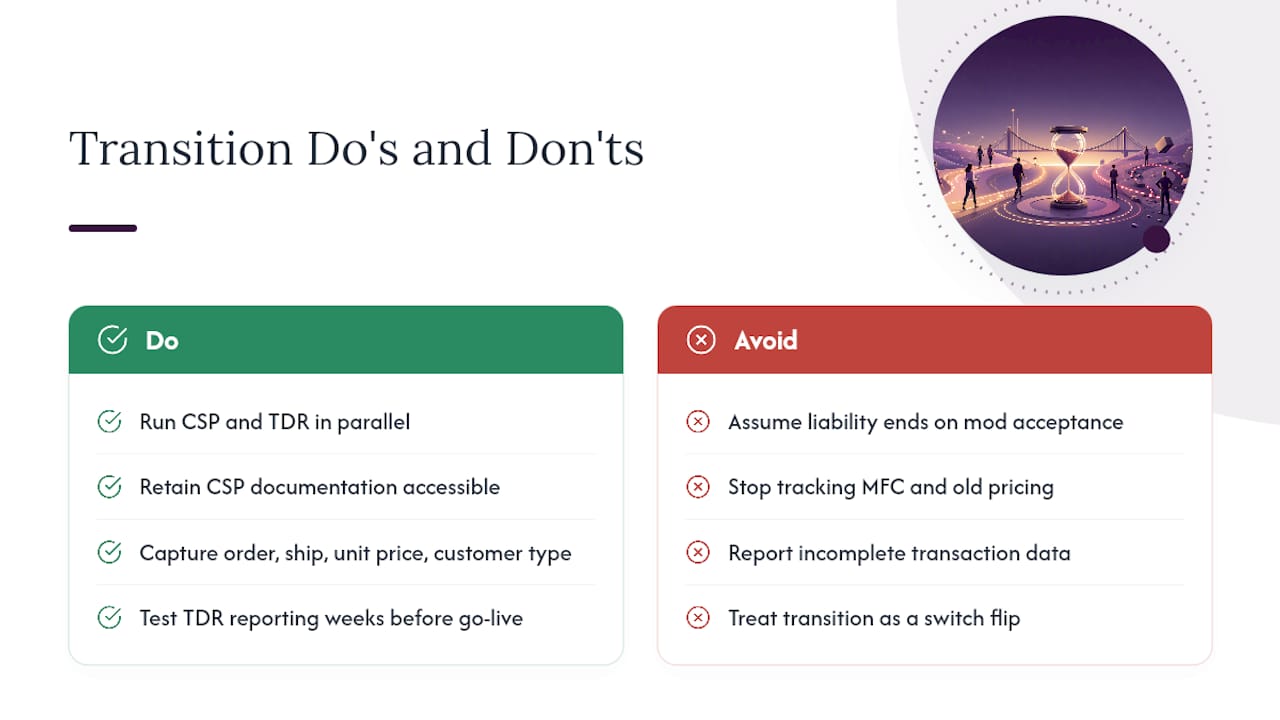
The transition window itself is where the most avoidable mistakes happen. Contractors sometimes assume that once they’ve accepted the mass modification, they can immediately stop tracking MFC data and old-style pricing records. That’s incorrect. The PRC liability for sales made before your effective date doesn’t disappear the moment you accept the mod. It remains tied to your prior CSP period until that liability window closes.
A second common risk involves reporting gaps. If your finance team isn’t ready to capture order date, ship date, unit price, and customer type at the transaction level by your effective date, you’ll either report incomplete data to the Sales Reporting Portal or scramble to reconstruct it after the fact from invoices never built for that purpose. Neither outcome looks good during a contract review.
The safest approach treats the transition as a parallel-running period rather than a hard cutover. Keep your CSP documentation intact and accessible even after your effective date passes, since old liability can still surface. Simultaneously, start testing your TDR data capture weeks before you’re required to report live, not on the effective date itself. Businesses that treat this like a switch flip, rather than a managed handoff, tend to be the ones facing awkward audit conversations eighteen months later. For guidance on the reporting mechanics your finance system needs to support, this explainer on GSA pricing structures covers how MAS pricing rules interact with these reporting obligations.
What Misconceptions Persist About CSP Exemption and TDR?
The most common misconception is that CSP disappeared entirely across the federal contracting landscape. It didn’t. It disappeared for contractors who’ve crossed their TDR effective date. VA FSS holders, contractors sitting in the acceptance window, and businesses on non-MAS vehicles can still be filing CSP-1 in 2026, sometimes right alongside competitors on the same schedule who are already fully exempt.
A second misconception treats “accepting the mass mod” and “becoming exempt” as the same event. They’re not. Acceptance starts a clock; exemption begins when that clock reaches the next sales-reporting quarter, which can be weeks or months later depending on when in the quarter you accepted.
A third misconception assumes TDR is strictly less work than CSP. It shifts the work rather than eliminating it. CSP required periodic, intensive disclosure. TDR requires continuous, monthly transactional reporting through the Sales Reporting Portal. Contractors with strong finance systems find that trade favorable. Contractors relying on manual invoice tracking often find the monthly cadence more demanding than the old annual CSP cycle, at least until their systems catch up. Sales training platforms focused on complex B2B cycles, like the resources outlined in this guide to sales training programs, can help contract managers build the internal discipline this reporting cadence demands, even though the guide itself isn’t GSA specific.
What Should Small Contractors Prioritize Right Now?
TDR genuinely reduces long-term paperwork, but it trades an annual disclosure headache for a monthly data-capture habit. That trade favors contractors with decent finance systems and punishes anyone still tracking sales in spreadsheets.
Triage the mass-mod acceptance first. Don’t let it sit in your eMod inbox past the 60-day window while you figure out your ERP mapping later. Identify your data gaps now, while you still have a CSP baseline to compare against. If you’re unsure whether your contract has reached TDR effective status or whether VA FSS rules apply to you, check your GSA eligibility before your next reporting deadline creates a problem you didn’t see coming.
— Josh
How Gsascheduleservices Helps You Handle CSP and the TDR Shift
Whether you’re still filing CSP-1, sitting inside the mass-mod acceptance window, or trying to get your finance system TDR-ready, Gsascheduleservices builds the compliance path around where your contract actually stands, not a generic template. That’s the real advantage over trying to interpret Refresh 31 timelines alone: less guesswork on effective dates, and someone who’s mapped this transition before mapping it for you.
The Startups, Specialty, and Streamline service tiers on the GSA contract proposal page cover full CSP-1 preparation and mass-mod acceptance support. For ongoing maintenance once you’re TDR reporting, the maintenance plans starting with 1 Mod /year at $99 per month keep your contract modifications current. Prefer to handle it yourself with structured guidance? The GSA DIY Quick Start option gives you templates without full-service pricing. Check your eligibility and current CSP or TDR status through the discovery page to see which path fits your contract.
Sources
FAQ
Can States Use GSA Schedules?
State and local governments can access certain GSA Schedule contracts through GSA’s Cooperative Purchasing program, though this applies mainly to IT, security, and disaster recovery categories rather than every schedule. Coverage varies by SIN, so check the specific contract before assuming state purchasing authority applies.
What Is GSA IT Schedule 70?
GSA IT Schedule 70 refers to the information technology-focused Special Item Numbers now folded into the broader Multiple Award Schedule structure. Most Schedule 70 SINs fall under the mandatory TDR rollout from Refresh 31, meaning CSP-1 disclosure requirements end once a contractor reaches TDR effective status.
Does the Privacy Act Apply to Federal Contractors?
The Privacy Act can apply to federal contractors when they operate a system of records on behalf of a federal agency, but it isn’t triggered by CSP or TDR reporting itself. Sales and pricing data reported through TDR is a separate compliance track from Privacy Act obligations tied to personal data handling.
Who Can Buy Off the GSA Schedule?
Federal agencies are the primary buyers, alongside eligible state and local entities under Cooperative Purchasing and certain other authorized organizations named in GSA’s ordering guidance. Holding a Schedule contract, whether through Gsascheduleservices or another path, opens that ordering channel; it doesn’t guarantee orders without active federal marketing.
Does Accepting the TDR Mass-Mod Cost Anything?
Accepting the mass modification itself carries no fee from GSA, but preparing your systems to report accurately can require real staff time or outside support. The company offers maintenance plans for ongoing modification support; current prices are available on their pricing page.
Recommended
- 90 Day GSA Schedule Marketing Checklist for U.S. Schedule Holders
- (Infographic) 25 Reasons GSA Contracts are Rejected
- What is a GSA IT Schedule 70 Contract?
- How to Grow a Small Business Through a GSA Schedule