

Winning a GSA Schedule contract feels like crossing a finish line. You survived the application, the negotiations, and the paperwork mountain. But here is the reality most business owners discover too late: that contract has an expiration date, and keeping it alive requires active effort, not passive waiting. The option extension process is what stands between your current government sales channel and losing it entirely. Understanding how it works, what GSA expects, and how to stay on the right side of every requirement is the difference between sustained federal revenue and starting over from scratch.
Table of Contents
- What is a GSA option extension?
- Why does the GSA option extension matter?
- How the GSA option extension process works
- Meeting GSA’s performance and compliance benchmarks
- Expert tips for securing your GSA option extension
- Real talk: What business owners miss about GSA option extensions
- How we can help with GSA Schedule success
- Frequently asked questions
Key Takeaways
| Point | Details |
|---|---|
| Extension not automatic | GSA must actively decide to extend your contract based on compliance and performance. |
| Compliance is critical | Staying current on Mass Mods, reporting, and catalog accuracy is required for renewal. |
| Sales thresholds matter | You must meet or exceed minimum sales during each 5-year window to qualify for an extension. |
| Plan ahead | Start preparing for your option extension well before the deadline to avoid last-minute shocks. |
What is a GSA option extension?
Before you can protect something, you need to understand exactly what it is. A GSA Multiple Award Schedule (MAS) contract is not structured as a single long-term agreement that runs indefinitely. Instead, it is built in stages. You receive a five-year base period when your contract is first awarded. After that, your contract can be extended through three additional five-year option periods, giving you a maximum contract lifespan of 20 years total.
The formal definition of what you are actually doing when you hit each of those renewal gates is important. As described in government procurement resources, “option extension” is the process of extending an existing Schedule contract for an additional five-year period, within the contract’s maximum total lifespan of up to 20 years. That sounds straightforward, but here is where many business owners stumble: the extension does not happen automatically. It is a deliberate decision point where GSA evaluates whether your contract deserves to continue.
| Contract period | Years covered | Duration | Renewal gate? |
|---|---|---|---|
| Base period | Years 1 to 5 | 5 years | Yes, before Option 1 |
| Option Period 1 | Years 6 to 10 | 5 years | Yes, before Option 2 |
| Option Period 2 | Years 11 to 15 | 5 years | Yes, before Option 3 |
| Option Period 3 | Years 16 to 20 | 5 years | Final period |
Each gate is a separate evaluation. Clearing one does not guarantee you clear the next. The MAS contracting lifecycle means every five years, you are essentially proving your value to the federal marketplace all over again.
“In the context of GSA Multiple Award Schedule (MAS)/Federal Supply Schedule (FSS) contracts, ‘option extension’ is the process of extending an existing Schedule contract for an additional five-year period, within the contract’s maximum total lifespan of up to 20 years.”
— GSA Procurement Glossary
With this foundation in place, let’s explore exactly why this process carries so much weight for your business.
Why does the GSA option extension matter?
The stakes here are higher than most small and medium-sized business owners realize going in. Your GSA Schedule is not just a document. It is your formal authorization to sell to federal agencies without going through individual competitive bid processes for every contract. Lose it, and you lose access to one of the most resilient, recession-resistant procurement channels in existence.

GSA does not automatically renew Schedule contracts. Exercising the option is entirely at GSA’s discretion and depends directly on whether the contractor has met performance and compliance expectations. That word “discretion” carries enormous weight. It means GSA holds the cards, and you need to give them every reason to play the option in your favor.
The agency uses the option window deliberately. It is their built-in mechanism to remove underperforming or non-compliant vendors from the Schedule. Think of it as a performance review that comes with termination authority. Common reasons GSA denies or skips exercising an option extension include:
- Reported sales falling below the required threshold for the option period
- Outstanding or overdue Mass Modifications that the contractor failed to accept
- Unresolved compliance issues, including pricing discrepancies or catalog inaccuracies
- Failure to submit required sales reports through the required government portals
- Corrective action notices that were ignored or not resolved in time
Sales thresholds are a hard line. GSA can and does decline to extend contracts when reported sales fail to meet expectations. Specifically, an FSS contracting officer may decide not to exercise the first option if sales don’t exceed $100,000 within the first 60 months. For subsequent option periods, that number rises to $125,000 per period.
These numbers might seem modest, but they catch businesses off guard when federal marketing efforts are neglected between renewal windows. Now that you understand what is on the line, let’s walk through how the actual process unfolds.
How the GSA option extension process works
The option extension is not a single event. It is the result of months of preparation and continuous contract management. GSA begins considering whether to extend your contract well before your current period ends. Waiting until the last quarter of year five to get your paperwork in order is a strategy that frequently backfires.
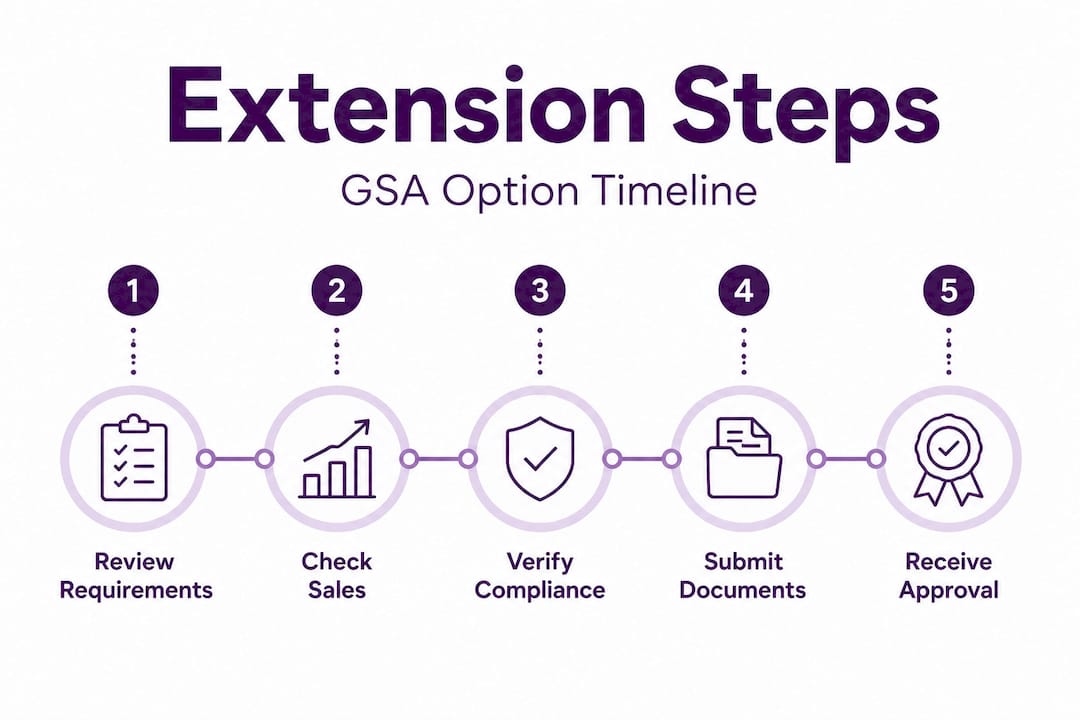
Here is a realistic breakdown of the key steps involved in the option extension process:
- Monitor your contract end date proactively. Know your base period expiration date the day your contract is awarded. Set calendar reminders 18, 12, and 6 months out.
- Ensure all sales are accurately reported. Every dollar sold through your GSA Schedule should be reported on time through the required government portal. Gaps in reporting hurt your standing significantly.
- Accept all pending Mass Modifications. The [GSA MAS Modification Guide](https://www.gsa.gov/system/files/MULTIPLE AWARD SCHEDULE (MAS) MODIFICATION GUIDE _ NOV_2025_508.pdf) makes clear that the government may not exercise an option if contract terms and conditions have not been met, and Mass Mod acceptance is a critical component of that.
- Respond to any compliance or corrective action notices promptly. Unresolved notices are red flags that can stop an option exercise in its tracks.
- Review your catalog for accuracy. Outdated pricing, discontinued items, or inaccurate descriptions can create compliance problems that delay or derail the extension.
- Work with your contracting officer. If you have questions about where your contract stands, a proactive conversation with your assigned CO is far better than a surprise denial.
Understanding how to maintain and renew your contract from the very beginning sets you up for smoother option windows. Businesses that treat compliance as a continuous practice rather than a pre-renewal scramble consistently have better outcomes. The GSA contract steps you followed to get awarded are only the beginning of a longer operational commitment.
Pro Tip: Download the official GSA maintenance checklist and review it quarterly, not just in the year before your option date. Quarterly reviews catch problems while they are still fixable.
Meeting GSA’s performance and compliance benchmarks
Now let’s talk numbers and specifics. The performance benchmarks GSA uses when deciding whether to extend your contract are not hidden or vague. They are documented, and your contracting officer is watching them. A key operational benchmark in GSA’s retention and option-to-extend determination is your reported sales performance during the relevant option window.
| Contract period | Required minimum sales | Timeframe |
|---|---|---|
| Base period (first option decision) | $100,000 | 60 months |
| Option Period 1 (second option decision) | $125,000 | 60 months |
| Option Period 2 (third option decision) | $125,000 | 60 months |
If your sales are trending below these numbers in year four of any period, that is your signal to act. Waiting until year five is leaving it too late. Consider proactive outreach to agency buyers, updating your GSA Advantage listings, and activating any federal marketing strategies you have been putting off.
Beyond sales, your federal sales strategies need to be backed up by solid operational compliance. Here is what that looks like in practice:
- Keep your GSA Advantage catalog current. Outdated product descriptions, expired pricing, or missing documentation are compliance gaps that accumulate quietly.
- Submit all required sales reports on time. The portal deadlines are firm, and missed reports create a paper trail that works against you at extension time.
- Accept Mass Modifications promptly. The [MAS Modification Guide](https://www.gsa.gov/system/files/MULTIPLE AWARD SCHEDULE (MAS) MODIFICATION GUIDE _ NOV_2025_508.pdf) is explicit: accepting overdue Mass Mods is a prerequisite for approval of a modification request, and option exercise considerations include acting upon all Mass Mods. A backlog of unaccepted Mass Mods is one of the most common and easily avoidable reasons contracts hit trouble at extension time.
- Maintain accurate Commercial Sales Practices disclosures. Your pricing must reflect what you actually charge commercial customers, and any changes need to be reflected in your contract terms.
- Address any inspector general or audit findings. If your contract has been flagged for any issues, resolution before your option date is essential.
Understanding why some contracts get rejected at the renewal stage often comes down to one or more of these compliance areas being neglected over time. None of these failures are dramatic. They are the quiet erosion of small tasks left undone, quarter after quarter.
Expert tips for securing your GSA option extension
The businesses that consistently clear option extension gates share one thing in common: they treat compliance as an ongoing operational function, not a periodic emergency. Here is what that looks like practically.
Pro Tip: Set a firm calendar reminder at least 12 months before your option date and use it to trigger a full contract health review. Look at your sales totals, Mass Mod status, catalog accuracy, and outstanding notices all at once. This single habit prevents the majority of extension problems.
Common pitfalls that derail option extensions include:
- Ignoring Mass Mod notices. These arrive via email and through the government portal. Many business owners filter them as routine notifications and never act. That is a serious mistake.
- Assuming the extension is automatic. The auto-renewal myth is one of the most dangerous misconceptions in government contracting. GSA will not remind you to stay compliant, and they will not warn you before declining an option exercise.
- Neglecting sales reporting. Gaps in your reported sales history, even if the sales actually occurred, create doubt about your contract’s viability.
- Letting catalog maintenance slide. A catalog that has not been updated in two years signals to GSA that the contractor is not actively engaged with the Schedule.
- Waiting for GSA to initiate contact. Your contracting officer manages hundreds of contracts. You cannot rely on them to prompt you into action.
For small and medium-sized businesses, the practical mechanics are mostly about [staying continuously compliant](https://www.gsa.gov/system/files/MULTIPLE AWARD SCHEDULE (MAS) MODIFICATION GUIDE _ NOV_2025_508.pdf), covering catalog accuracy, required reporting, portal obligations, and acting on overdue Mass Mods, so that GSA has sufficient basis to approve your option extension when the time comes.
If you are approaching the end of any option period and you are not confident about where you stand, this is not the moment to guess. Get expert eyes on your contract status immediately.
Real talk: What business owners miss about GSA option extensions
Here is something we see repeatedly, and it is worth saying plainly. The businesses that lose GSA contracts at option time rarely do so because they failed dramatically. They fail gradually, through months and years of small omissions. An ignored Mass Mod here, a missed quarterly report there, a catalog that was accurate in year one but never updated through years two, three, and four.
The “auto-renewal” myth persists because the initial contract award process is so rigorous. Business owners assume that once GSA approved them, the hard part is done. In reality, the evaluation never stops. Every period is its own performance window, and GSA is watching the data even when no one is knocking on your door asking for anything.
What actually works is treating option extensions not as a renewal deadline but as a scheduled business review. Every option window is a built-in opportunity to assess your federal sales strategy, update your offerings, and strengthen your compliance posture. The businesses that approach it this way do not just survive the option gate; they often emerge from it in a stronger competitive position.
Understanding why contracts get rejected is not about learning what to fear. It is about knowing exactly what to manage. The contractors who get blindsided are those who assumed compliance is binary: either you are approved or you are not. The reality is that compliance is a continuous spectrum, and where you sit on that spectrum on the day GSA evaluates your option extension is the result of every decision you made during the preceding five years.
Option extensions reward consistent process management. There are no shortcuts, but there is a clear path, and businesses that follow it reliably protect their most valuable government sales asset.
How we can help with GSA Schedule success
Navigating the GSA option extension process while running a business is genuinely demanding. Between managing sales reporting, staying ahead of Mass Mods, maintaining catalog accuracy, and monitoring your performance benchmarks, the compliance workload is real and ongoing. That is exactly the kind of work we specialize in at GSA Schedule Services.
Whether you are approaching your first option gate or trying to recover from compliance gaps before a critical renewal window, our team provides expert support tailored to small and medium-sized businesses. We handle the details so you can focus on delivering value to federal customers. If you are ready to protect your contract and extend your reach in the federal marketplace, explore our GSA Schedule services and take the next step today.
Frequently asked questions
How long can a GSA Schedule contract last with all option extensions?
A GSA Schedule contract can last up to 20 years if all three five-year option extensions are successfully exercised. MAS contracts are structured as a five-year base plus up to three five-year option periods.
Is the GSA option extension process automatic?
No, GSA must actively decide to extend your contract, and only does so if performance and compliance standards are met. GSA does not automatically renew Schedule contracts, and the decision rests entirely with the agency.
What are the minimum sales requirements for a GSA option extension?
You need at least $100,000 in reported sales during the first 60 months and $125,000 for each subsequent 60-month period. A contracting officer may decline to extend your option if sales fall below these thresholds.
Can overdue Mass Mods prevent an option extension?
Yes, unaccepted Mass Mods can directly block your extension approval. [Accepting overdue Mass Mods](https://www.gsa.gov/system/files/MULTIPLE AWARD SCHEDULE (MAS) MODIFICATION GUIDE _ NOV_2025_508.pdf) is an explicit prerequisite for modification approvals, and option exercise considerations include acting upon all pending Mass Mods.
If I miss an option extension, can I still do business with the government?
Not through your expired GSA Schedule. An expired contract cannot be reactivated, meaning you would need to submit an entirely new application and go through the full award process again to regain access to the Schedule marketplace.
Recommended
- An Essential Checklist to Maintain Your GSA Schedule Contract
- The Basics of GSA Contract Schedule
- GSA Schedule Contracts: Your Guide to Success
- Navigating GSA Schedule Compliance