

GSA eligibility is your business’s gateway to becoming a pre-approved vendor for federal agencies. It involves meeting strict qualifications to secure a GSA Multiple Award Schedule (MAS) contract, giving you access to streamlined procurement, long-term contracts (up to 20 years), and opportunities to work with federal, state, and local governments. Here’s a quick breakdown:
- Key Benefits: Access to GSA Advantage (government’s online shopping hub), reduced competition, and exclusive contracts for small businesses with certifications like WOSB or HUBZone.
- Basic Requirements: 2+ years of business history, financial stability (Profit & Loss statements, Balance Sheets), compliance with Trade Agreements Act (TAA), and SAM.gov registration.
- Application Process: Prepare documents, submit via eOffer, and undergo a 6–12 month review (financial, pricing, and compliance checks).
- Common Challenges: Pricing transparency, incomplete financial records, and TAA violations.
Navigating this process can be complex, but meeting the requirements opens doors to significant federal contracting opportunities.
Basic Requirements for GSA Eligibility
Business and Operational Criteria
To qualify for GSA eligibility, your business must meet several foundational criteria. First, you need at least two years of operational history, supported by verifiable sales and revenue records.
Financial stability is another key factor. Be prepared to submit Profit and Loss statements and Balance Sheets for the past two fiscal years. According to GSA.gov:
"Profit and loss statements, bank reference letters, and irrevocable letters of credit are documents which can be provided to support a favorable determination of financial responsibility".
Additionally, you must demonstrate commercial availability by providing at least six invoices per product or service line. Your business must also be legally registered in the U.S. – as an LLC, corporation, or similar entity – and maintain a physical office with staff based in the U.S.
If you’re a newer IT company, the IT Springboard Program offers some flexibility, allowing you to use key personnel experience to meet the two-year operational requirement.
Once these basics are covered, you’ll need to focus on mandatory registrations and compliance measures.
Registration and Compliance
Before applying, complete all required registrations. Start with SAM.gov, the central database for federal contractors, where you’ll obtain your Unique Entity Identifier (UEI). Keep in mind, SAM.gov registration must be renewed annually, as it expires every 365 days.
You’ll also need a FAS ID to access the eOffer and eMod systems. Fortunately, since March 8, 2021, GSA has removed the need for costly digital certificates, simplifying the process.
Compliance with the Trade Agreements Act (TAA) is non-negotiable. This means your products must be manufactured or “substantially transformed” in the U.S. or a TAA-designated country. Items originating from China or Russia are generally not allowed. Additionally, a company officer must complete the "Pathways to Success" training as part of the application process.
Another important consideration is the Industrial Funding Fee (IFF), which is currently set at 0.75% of reported sales under MAS contracts. This fee supports GSA’s operations and should be factored into your pricing.
Once these steps are complete, you’ll need to provide evidence of your past performance to demonstrate your reliability.
Past Performance and Experience
Proving your ability to deliver is essential. For each Special Item Number (SIN) you’re applying for, include a project summary from the past two years or evidence of a project that has been active for at least one year. Your commercial sales history will serve as a pricing benchmark. GSA uses this to compare your proposed government rates with your "Most Favored Customer" rates, ensuring fair pricing for federal agencies.
If you’ve worked with the government before, GSA may review your Contractor Performance Assessment Reporting System (CPARS) ratings or contact your customer references directly. Having three CPARS ratings or equivalent client references will strengthen your application. Make sure to inform your current customers that GSA might reach out to verify your performance.
Top 10 GSA FAQs – GSA Contracts for Beginners!
Pricing and Documentation Requirements
Once you meet the basic eligibility criteria, getting your GSA offer approved hinges on two key factors: pricing that aligns with government expectations and thorough documentation.
Fair and Reasonable Pricing
Your GSA pricing needs to align with the rates you offer your best commercial customers. To ensure this, GSA Contracting Officers conduct a Most Favored Customer (MFC) analysis, comparing your proposed government rates to the prices you extend to your top-tier commercial clients.
A critical part of this process is disclosing your Commercial Sales Practices (CSP). This includes sharing your standard price lists, discount structures, and any special pricing arrangements. Transparency in this area allows the government to assess whether your pricing is competitive. Michael Perch, CEO of Road Map Consulting, explains:
"Negotiations tend to slow down when pricing explanations are vague. They tend to move forward when the pricing story is simple: who gets discounts, when they apply, and why government pricing is structured the way it is".
Your final GSA price must also account for the 0.75% Industrial Funding Fee (IFF), which funds the GSA Schedules program. This price serves as a ceiling; while you can offer lower prices for specific quotes, you cannot exceed the established rate. Additionally, GSA restricts annual price increases to 10% per category item, unless you provide a valid justification.
For vendors seeking an alternative approach, the Transactional Data Reporting (TDR) option allows you to report detailed monthly sales data at the line-item level instead of submitting traditional Commercial Sales Practices disclosures.
Along with competitive pricing, your application must include detailed documentation to validate your financial health and track record.
Required Documentation
To support your GSA application, you’ll need to provide balance sheets and income statements from the past two years. While audited financials are preferred, unaudited statements are acceptable for small businesses. If your balance sheet shows negative equity, include a brief explanation of how your business remains financially stable.
You’ll also need to submit two dated copies of your current commercial price lists or catalogs, backed by invoices. Alongside these, include a price narrative that outlines your discount tiers and Most Favored Customer arrangements. For companies classified as "other than small", a Small Business Subcontracting Plan is mandatory.
Your application must also include past performance documentation – examples of projects from the last two years that demonstrate your ability to deliver. If you’re offering products, ensure all Manufacturer Part Numbers (MPN) and Universal Product Codes (UPC-A) are accurate, as errors in this data can lead to rejection.
Lastly, a company officer must complete the "Pathways to Success" training within a year of submitting your offer. This step underscores your readiness to navigate the GSA process effectively.
Application Process for GSA Eligibility
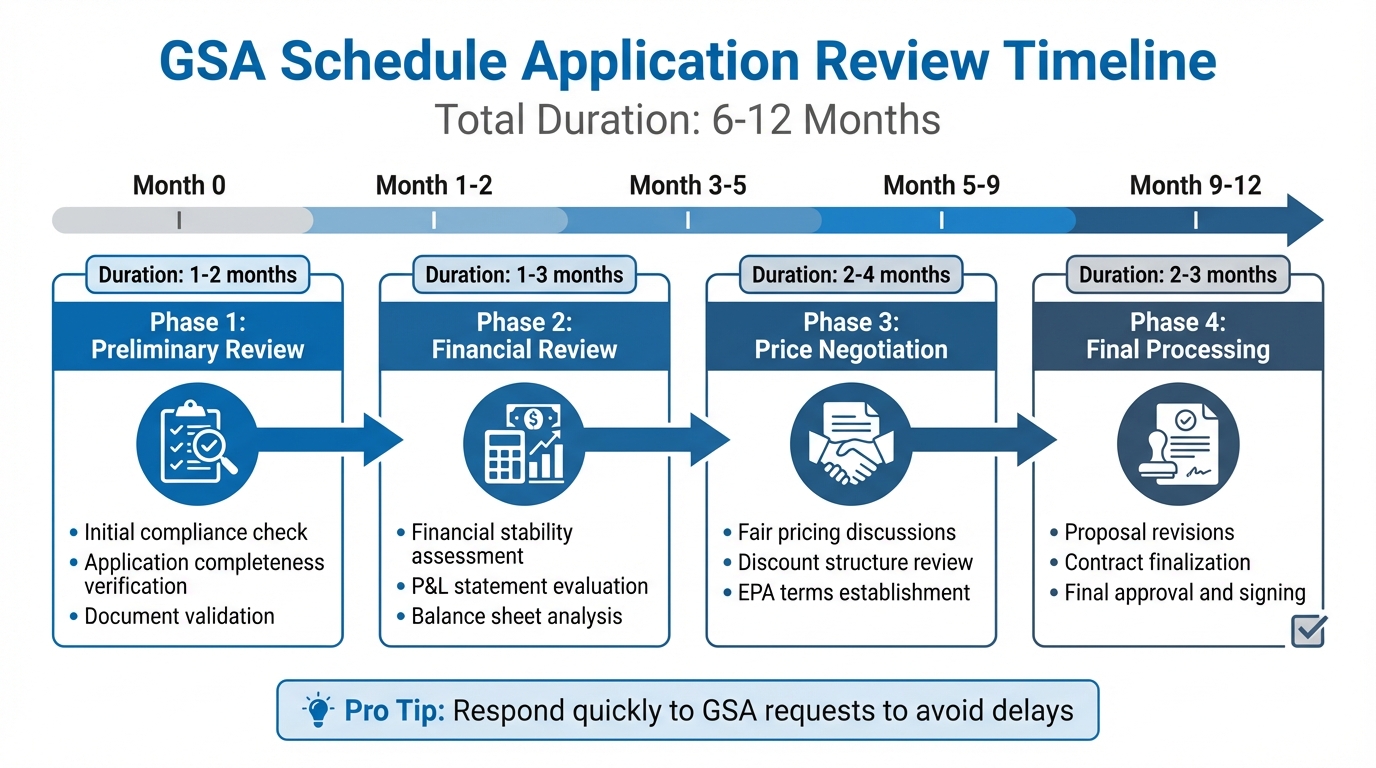
GSA Schedule Application Timeline and Review Process
Once you’ve gathered your documents and nailed down your pricing strategy, the next step is submitting your application through the eOffer system. This process is divided into three main stages: preparation, submission, and review.
Preparing Your Application
Before diving in, make sure all required trainings are completed. You’ll also need to set up your FAS ID credentials – a centralized system that replaced costly digital certificates. This FAS ID gives you access to essential tools like eOffer, eBuy, and the GSA Vendor Portal.
Get all your financial statements, price lists, and supporting documents ready before logging into the system. Being organized from the start saves time and helps you avoid hiccups during the upload process. Once everything is in order, head to the eOffer submission portal.
Submitting via eOffer
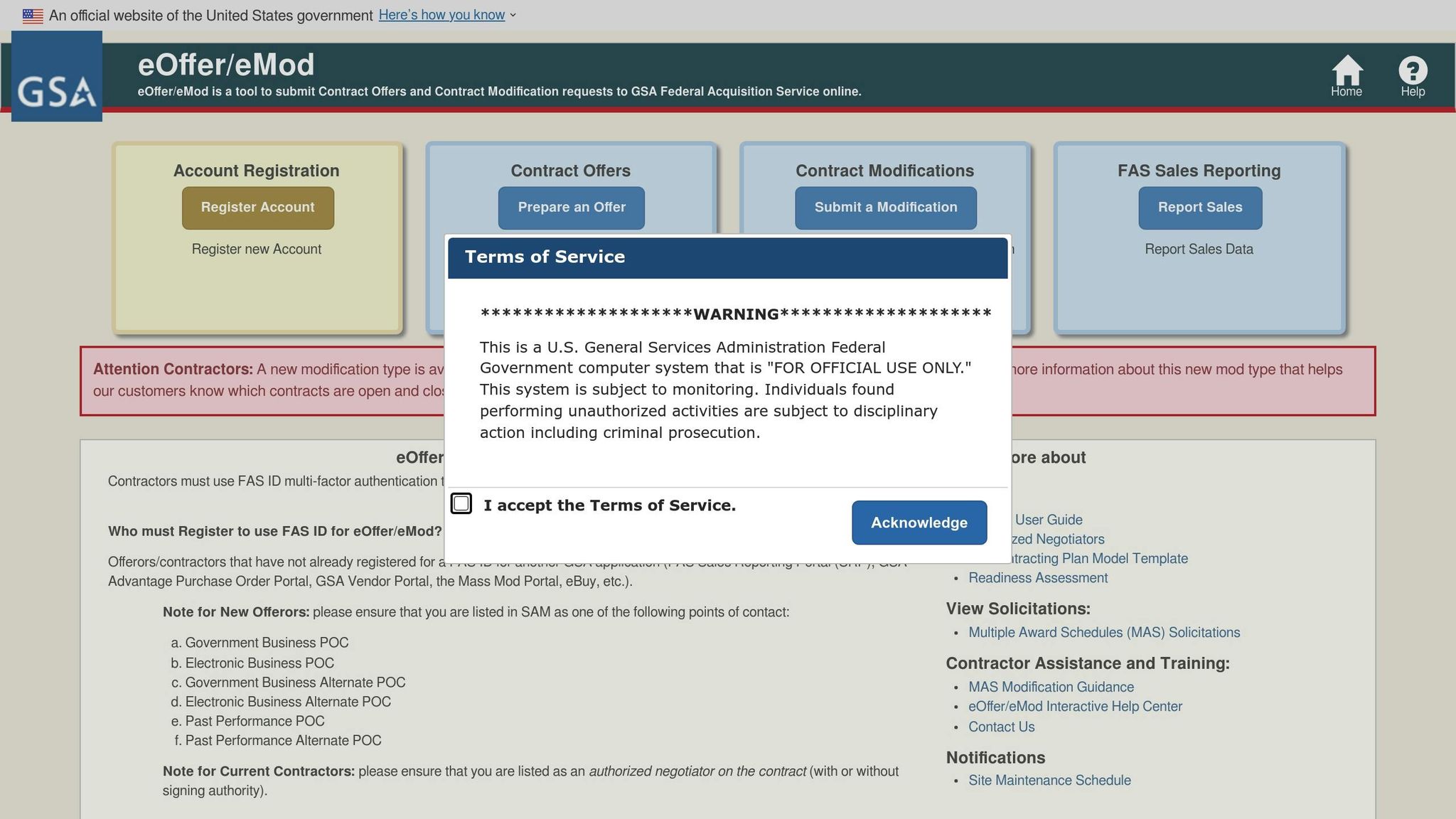
With your preparation done, it’s time to submit. Log into the eOffer platform using your FAS ID credentials. The system will guide you through uploading your financial statements, price lists, and other required documents. You’ll also complete certifications and input your pricing details.
Double-check that your pricing complies with the guidelines you’ve previously reviewed. Verify everything before hitting submit to ensure accuracy.
Timeline and Review Process
Once your application is submitted, the review process begins. This step can take 6 to 12 months and is divided into four phases:
- Preliminary Review (1–2 months): Contracting officers check your application to ensure it’s complete and meets compliance standards.
- Financial Review (1–3 months): Your financial stability is assessed, including an evaluation of profit and loss statements and balance sheets.
- Price Negotiation (2–4 months): Discussions focus on fair pricing, discounts, and terms like the Economic Price Adjustment (EPA).
- Final Processing (2–3 months): This phase involves revising your proposal based on feedback, finalizing the contract, and receiving approval.
| Review Phase | Typical Duration | Key Activities |
|---|---|---|
| Preliminary Review | 1–2 months | Initial check for compliance and completeness |
| Financial Review | 1–3 months | Evaluation of financial stability (P&L, balance sheets) |
| Price Negotiation | 2–4 months | Establishing fair pricing, discounts, and EPA terms |
| Final Processing | 2–3 months | Contract finalization, signing, and approval |
To keep things moving, respond quickly to any requests or questions from the GSA team. Delays in communication can slow down the process, so staying proactive is key.
Common Challenges and Solutions
Even with thorough preparation, navigating the GSA eligibility process can be tricky. Below, we break down common hurdles and practical ways to overcome them, building on the eligibility criteria discussed earlier.
Financial and Documentation Gaps
One frequent issue is submitting incomplete financial records. The GSA requires two full years of audited Profit and Loss statements and Balance Sheets, but many businesses provide unaudited or partial records, which won’t suffice. If your company is relatively new, bolster your application by maintaining cash reserves of 15–20% of the proposed contract value to demonstrate financial stability.
Another stumbling block is a high debt-to-equity ratio. The GSA typically looks for a ratio under 3:1 and expects at least six quarters of positive cash flow. If your financials fall short, collaborate with your accountant to improve your balance sheet before applying.
Additionally, businesses often fail to provide sufficient commercial documentation. To avoid delays, submit at least six commercial invoices per product or service line, and ensure you clearly outline discount tiers and Most Favored Customer (MFC) pricing. Keeping all invoices, contracts, and customer references organized will help prove commercial availability and fair pricing.
Pricing and Compliance Errors
Violations of the Trade Agreements Act (TAA) are another common problem. Many businesses unknowingly include products made in non-designated countries like China, Russia, or Iran, which leads to rejection. To avoid this, verify the country of origin for all products against FAR clause 52.225-5 before submitting your product list.
Lack of pricing transparency also creates roadblocks. The GSA requires detailed documentation of your MFC pricing and discount structure to ensure your rates are fair and reasonable. Without clear proof of your commercial pricing practices, your application will likely stall.
Errors in your SAM.gov registration can halt your progress as well. Double-check that your business entity information matches your SAM.gov profile, including accurate NAICS codes. If there are changes to your entity, update them within three business days. Additionally, remember that your SAM.gov registration expires every 365 days, so set reminders to renew it on time.
| Category | Common Error | Solution/Requirement |
|---|---|---|
| Financials | High debt-to-equity ratio | Maintain ratio below 3:1; ensure 6+ quarters of positive cash flow |
| Compliance | TAA violations | Verify products are from U.S. or designated countries (e.g., Canada, EU) |
| Experience | Less than 2 years operation | Use IT Springboard Program or provide 2 years of commercial invoices |
| Performance | Missing references | Provide 3 CPARS ratings or equivalent client references |
| Registration | Expired SAM profile | Renew SAM.gov registration every 365 days |
How GSA Focus Simplifies the Process
The path to GSA eligibility can feel overwhelming, but GSA Focus (https://gsascheduleservices.com) is here to make it manageable. They take over the complexities of the entire application process, letting you focus on what you do best – running your business. Here’s how they make each step of the journey smoother.
Services Offered by GSA Focus
GSA Focus handles every aspect of the GSA Schedule process, ensuring nothing falls through the cracks. During the pre-submission phase, they take care of document preparation, help you choose the right SIN and NAICS codes, and conduct compliance audits to catch potential issues early. When it’s time to submit, they manage the eOffer system, compile your technical proposal, and organize all necessary administrative records.
Their expertise shines in the negotiation phase, where they develop pricing strategies that meet GSA’s "fair and reasonable" standards while protecting your profit margins. They also handle clarification requests from contracting officers, ensuring the process stays on track. After your contract is awarded, their post-award services include contract maintenance, federal marketing guidance, and compliance updates to keep your Schedule in good standing.
| Service Category | Specific Offerings |
|---|---|
| Pre-Submission | Document preparation, SIN/NAICS selection, compliance auditing |
| Submission | eOffer management, technical proposal assembly, administrative records |
| Negotiation | Negotiator support, pricing strategy, clarification responses |
| Post-Award | Contract maintenance, federal marketing, compliance updates |
This comprehensive approach addresses many of the compliance and documentation hurdles that often complicate the GSA Schedule process.
Benefits of Working with GSA Focus
One of the biggest perks of partnering with GSA Focus is the time you’ll save. Instead of spending months trying to decode GSA regulations and compile documents, you can simply upload your basic information through their secure online portal. From there, they handle the rest. Their 98% success rate speaks volumes about their ability to navigate the intricate requirements of the GSA process. Plus, they offer a refund guarantee if your contract isn’t awarded.
Their team brings deep knowledge of what contracting officers expect, helping you sidestep common pitfalls like incomplete financial documentation, pricing missteps, or compliance issues. This expertise significantly reduces the risk of delays or rejections, getting you closer to securing your GSA contract without unnecessary headaches.
Conclusion
Securing a GSA Schedule Contract can unlock extensive federal contracting opportunities, but meeting the eligibility criteria requires close attention to detail. To qualify, businesses must adhere to operational, financial, and compliance standards, including offering TAA-compliant products and completing the mandatory "Pathways to Success" training before submitting their application.
The application process itself involves confirming your commercial sales history, establishing pricing that aligns with GSA’s fair and reasonable standards, and navigating the eOffer system without mistakes. After being awarded a contract, businesses are subject to a 0.75% Industrial Funding Fee on reported sales.
While the steps are clear, the process can feel overwhelming. This is where GSA Focus (https://gsascheduleservices.com) steps in. They handle everything from document preparation and compliance checks to pricing strategies and negotiation support. With a 98% success rate and a refund guarantee, they offer a way to pursue federal contracts with confidence, minimizing the risk of application rejection.
FAQs
Can a startup qualify for a GSA Schedule?
Yes, startups can apply for a GSA Schedule through the GSA Startup Springboard program. This initiative is designed for businesses with less than two years of operation, giving them a chance to enter the federal contracting space earlier. To qualify, startups need to meet specific criteria, such as offering commercially available products or services, adhering to federal regulations, and providing the required documentation. This program opens the door to federal contracting opportunities, including access to all GSA Large Categories.
How do I prove my pricing is fair to GSA?
To prove your pricing is fair to the GSA, you’ll need to show that your rates align with current market trends and are reasonable. Start by conducting thorough market research – platforms like SAM.gov can help you analyze pricing trends and competitor rates. Make sure your pricing complies with the Most Favored Customer (MFC) rule, ensuring that GSA receives pricing comparable to or better than your other clients.
Additionally, document your pricing strategies in detail. This includes breaking down your costs, providing past invoices as evidence, and explaining how you arrived at your rates. Keep in mind that GSA uses tools like historical pricing data and guidelines from the Federal Acquisition Regulation (FAR) to evaluate whether your prices are reasonable.
What counts as TAA-compliant country of origin?
A TAA-compliant country of origin refers to a location where a product is either entirely manufactured in the United States or in a country that has a trade agreement with the U.S. Alternatively, the product can qualify if it undergoes substantial transformation in one of these approved locations. These designated countries are recognized under the Trade Agreements Act to meet federal contracting standards.
Related Blog Posts
- Who Qualifies for a GSA Schedule?
- 5 Key Requirements for GSA Schedule Eligibility
- GSA Contract Eligibility: Key Requirements
- 5 Steps to Meet GSA Prequalification Standards