
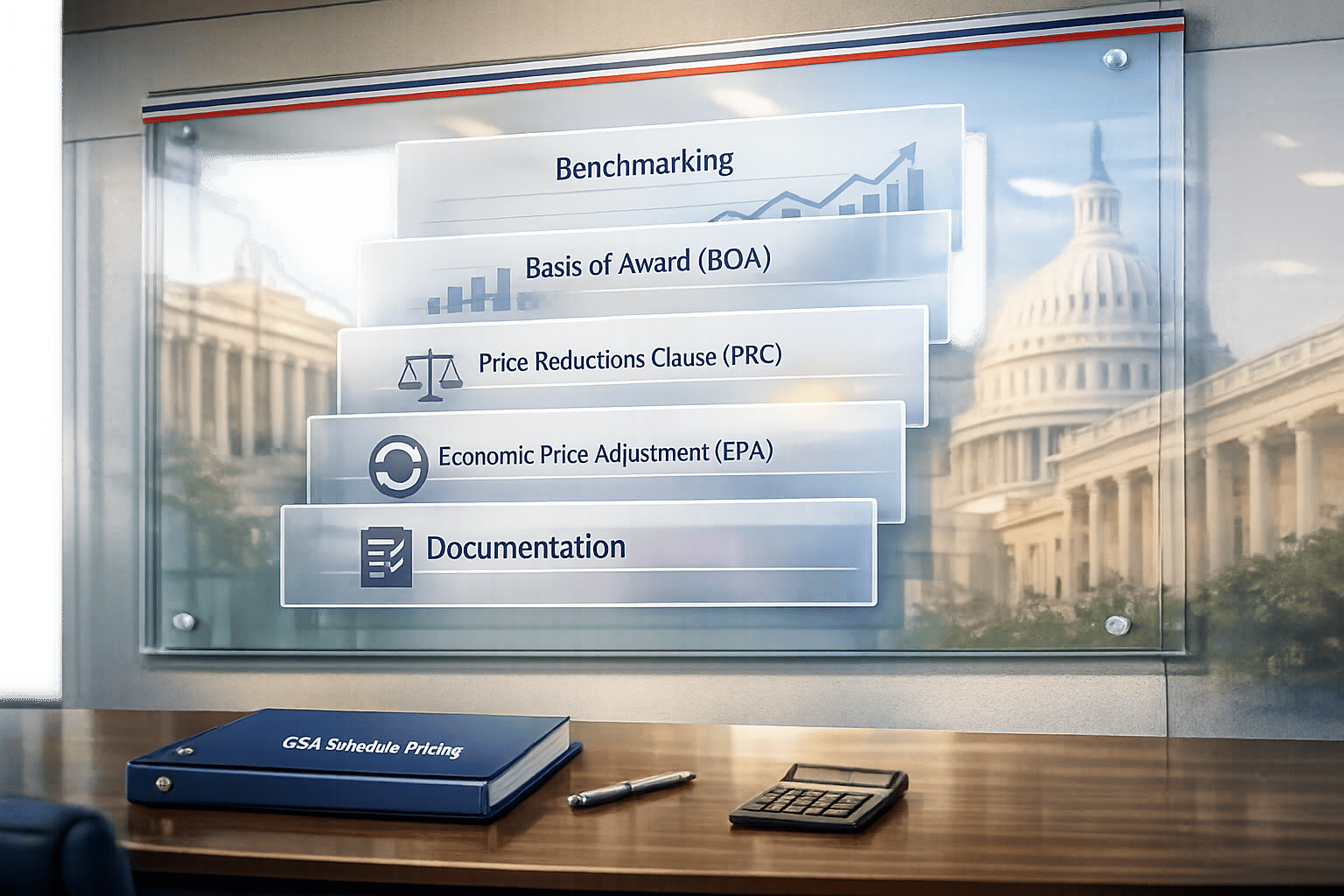
Setting competitive GSA rates is crucial for winning federal contracts while protecting your profit margins. Your GSA rate serves as a ceiling price – charging the government more isn’t allowed. Missteps in pricing can lead to profit losses, compliance issues, or forced rate reductions. Here’s what you need to know:
- Pricing Basics: Rates must be “fair and reasonable,” aligning with market standards. GSA evaluates competitor pricing, past purchases, and commercial discounts to ensure compliance.
- Key Rules: The Price Reductions Clause (PRC) requires you to lower GSA rates if better discounts are offered to your Basis of Award (BOA) customer. Economic Price Adjustment (EPA) clauses allow rate increases for inflation or rising costs after 12 months.
- Market Research: Use tools like GSA Advantage!, GSA eLibrary, and CALC+ to benchmark competitor pricing and ensure your rates are competitive.
- Compliance: Proper documentation – like Commercial Sales Practices disclosures and pricing narratives – is essential to justify rates and avoid audit issues.
- Ongoing Adjustments: Regularly monitor market trends and adjust rates using EPA clauses to stay competitive and profitable.
Bottom Line: Competitive GSA rates balance compliance, market demands, and profitability. Research, documentation, and strategic pricing adjustments are key to success. Need help? GSA Focus can assist with compliance, pricing, and negotiation support.
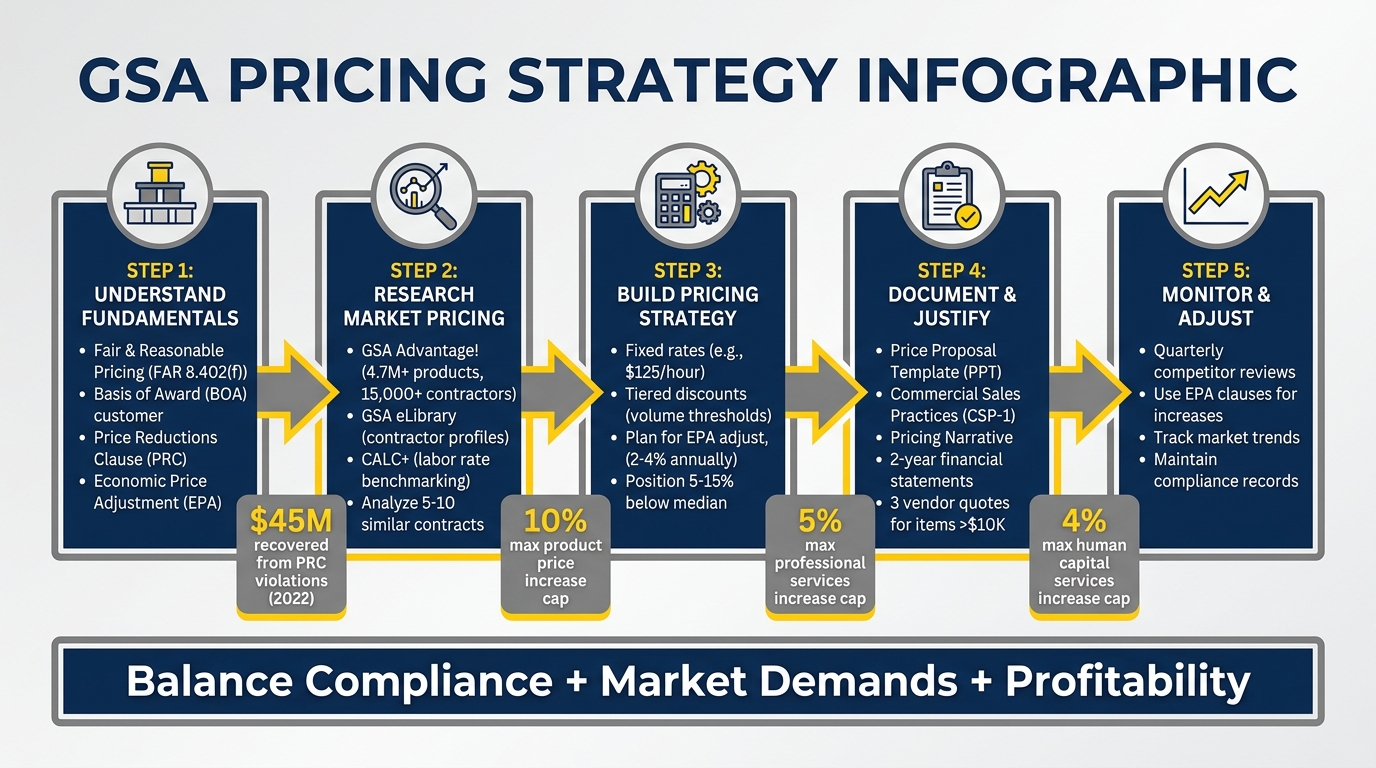
5-Step GSA Pricing Strategy: From Research to Compliance
Ep 339: How to Find Competitive Pricing Information
GSA Pricing Fundamentals
Understanding GSA pricing means mastering three key elements: fair and reasonable pricing, your Basis of Award (BOA), and pricing adjustment clauses. Each plays a critical role in ensuring your rates are competitive and compliant.
Fair and Reasonable Pricing Requirements
The Federal Acquisition Regulation (FAR) 8.402(f) mandates that GSA rates must reflect what a prudent buyer would pay in the commercial marketplace. This isn’t just a guideline – it’s a strict requirement. GSA reviews this during negotiations and may audit it later.
To determine if your rates are "fair and reasonable", GSA examines commercial catalogs, past purchases, and competitor pricing available in tools like the GSA eLibrary. For instance, if you charge $150 per hour for IT services, that rate should align with similar services listed in the CALC database, typically ranging from $120 to $180 per hour. Rates outside this range without solid justification could raise red flags.
To prove your pricing meets this standard, you’ll need to provide a Commercial Sales Practice Disclosure, detailed price lists showing commercial discounts, and supporting documents like invoices or competitor quotes. Essentially, you must show that the government is getting a deal comparable to what you offer your most favored commercial customers – which ties directly to your BOA.
Core Pricing Mechanisms
Your Basis of Award (BOA) is the cornerstone of your GSA pricing structure. It identifies the commercial customer or customer category that serves as the benchmark for your GSA discounts. For example, if your largest commercial customer gets a 20% discount off your catalog price, GSA expects that to be the baseline discount for its rates – unless you negotiate otherwise. This ensures your rates are competitive while maintaining compliance.
The Price Reductions Clause (PRC) ensures the government continues to receive favorable terms throughout your contract. If you later offer your BOA customer a better discount – say, 25% instead of 20% – you are required to inform GSA within 60 days and adjust your GSA rates accordingly. Small businesses, in particular, must track sales to BOA customers quarterly to avoid compliance issues. In 2022 alone, GSA recovered $45 million from PRC violations, highlighting the importance of staying vigilant.
The Economic Price Adjustment (EPA) clause offers a way to adjust prices when costs change. These adjustments are often tied to economic indices like the Consumer Price Index or Bureau of Labor Statistics data. However, there are limits – price increases are typically capped at 10% per adjustment and require substantial documentation. Note that not all GSA Schedules include the EPA clause, so it’s worth confirming during negotiations.
With these foundational elements in place, the next step is to dive into federal market pricing to gain a competitive edge.
Research Federal Market Pricing
Understanding how your pricing stacks up in the federal marketplace is key to staying competitive and compliant. With tools provided by GSA, you can dive into what competitors charge for similar services and products. This research helps you refine your pricing strategy while meeting fair and reasonable pricing standards.
Review Competitor Pricing on GSA Tools
Two essential resources for competitor analysis are GSA Advantage! and GSA eLibrary.
- GSA Advantage! (gsaadvantage.gov) is a comprehensive online marketplace where federal buyers browse over 4.7 million products and services offered by more than 15,000 contractors. By entering your SIN (Special Item Number) – for instance, SIN 541611 for management consulting – you can view competitors’ pricing, discounts, and delivery terms. For example, administrative support services under SIN 541614 often range between $45 and $65 per hour, with volume discounts of 10–15%.
- GSA eLibrary (gsaelibrary.gsa.gov) complements this by offering contractor profiles, modification histories, and SIN descriptions. You can filter results by SIN category and business size to pinpoint direct competitors. Cross-referencing this data with GSA Advantage! pricing allows you to validate whether your rates align with market trends. For instance, engineering services under SIN 541511 typically have a median rate of $150 per hour.
By analyzing 5–10 similar contracts, you can calculate median pricing benchmarks and gain a clearer picture of where your rates stand. These insights are invaluable when you use other tools like CALC+ for deeper analysis.
Benchmark Labor Rates with CALC+
For service-based businesses, CALC+ (calc.gsa.gov) is an indispensable tool for labor rate benchmarking. This platform pulls labor cost data directly from existing GSA Schedule contracts, letting you filter by SIN, labor category, geographic location, and contract year. It ensures your pricing complies with FAR 15.402 standards for fair and reasonable rates.
Here’s how CALC+ works:
- Go to calc.gsa.gov and select your SIN – say, SIN 541330 for engineering services.
- Narrow down your search by choosing a labor category (e.g., Senior Engineer) and applying modifiers like location (Washington, DC) or fiscal year (FY 2026).
- Run the query to see minimum, maximum, and median labor rates. For instance, Senior Consultant rates under SIN 541611 typically range from $145–$195 per hour, with a median of $170.
To fine-tune your pricing, gather data from at least 10 entries and adjust for inflation using Bureau of Labor Statistics indices. Position your rates 5–15% below the median to stay competitive while covering your costs. Be sure to document your findings with screenshots and date stamps – this becomes crucial for pricing justifications and audits.
Small businesses that back their pricing proposals with CALC+ data and 3–5 comparables for each labor category not only demonstrate compliance but also strengthen their case during negotiations with GSA.
Build Your Pricing Strategy
After gathering insights from your market research, the next step is to develop a pricing structure that aligns with both profitability goals and GSA compliance. Remember, your GSA rates serve as a cap – you cannot charge federal agencies more than the negotiated rates in your contract. This makes it crucial to design a pricing model that allows flexibility while staying within regulatory limits.
The challenge lies in striking a balance between staying competitive and ensuring long-term profitability. Instead of setting the lowest possible prices to win contracts, consider factors like future cost increases, discount structures, and the specifics of your Basis of Award (BOA) customer. From here, you can explore pricing models and discount strategies that enhance both compliance and competitiveness.
Create Fixed and Tiered Pricing Models
Using the insights from your BOA, you can establish both fixed rates and tiered discount structures. Your BOA customer or category acts as the benchmark for GSA pricing negotiations and compliance requirements. Keep in mind that your BOA isn’t necessarily your Most Favored Customer (MFC); it’s the specific customer relationship outlined in your contract that dictates how discounts are structured.
For fixed pricing, set clear hourly rates or unit prices that account for costs and a sustainable margin. For instance, if your commercial rate is $150 per hour and your MFC rate is $135 per hour, you might set your GSA rate at $125 per hour to reflect the long-term nature of government contracts. This approach maintains profitability while communicating value effectively.
Tiered pricing models work well when offering volume discounts or incentives for prompt payments. Define clear thresholds – such as discounts for orders over $50,000 or payments made within 15 days – and document these terms in your proposal. This not only protects your BOA relationship but also minimizes the risk of unintentionally triggering the Price Reductions Clause (PRC). For service-based contracts, consider bundling related offerings to provide additional value while safeguarding your core rates.
Additionally, plan for inflation adjustments using Economic Price Adjustment (EPA) clauses after 12 months. These clauses (e.g., 552.216-70 for products or I-FSS-969 for services) allow price increases based on recognized inflation indexes or documented labor cost changes.
Structure Discounts to Comply with the Price Reductions Clause
The Price Reductions Clause (PRC) is a critical element of GSA pricing and requires careful attention. Unless you opt into Transactional Data Reporting (TDR), the PRC applies retroactively. This means that if you offer better discounts or lower prices to your BOA customer in the commercial market, you may be required to reduce your GSA prices accordingly.
To avoid compliance issues, establish clear discount tiers and stick to them. Avoid offering undocumented or across-the-board discounts in the commercial sector, as these could inadvertently trigger the PRC during audits or Contractor Assistance Visits. Keep detailed records of non-comparable sales, such as one-time promotions, emergency services, or unique contract terms, to defend against potential price reduction demands.
Some contractors choose to participate in TDR, which eliminates the PRC requirement but requires regular, detailed reporting of all GSA transactions. This shifts the focus from pricing audits to data transparency. Whichever approach you choose, ensure your discount structure is well-documented, defensible, and consistent with your BOA terms. Include details about discount schedules, payment terms, volume thresholds, and any exceptions to maintain compliance and avoid penalties.
Document and Justify Your Pricing
Once your pricing strategy is set, the next step is to clearly document and back up every pricing decision. This is crucial, as the General Services Administration (GSA) requires detailed paperwork both during your initial proposal and throughout the contract term to confirm that your rates are fair, reasonable, and compliant.
Required Compliance Documentation
For your initial offer, you’ll need to submit a Price Proposal Template (PPT). This document should outline each Special Item Number (SIN), unit, description, and your GSA price. Alongside this, include a Pricing Narrative that explains how you arrived at your rates – whether through cost-based pricing with detailed calculations or market-based pricing tied to your commercial catalogs. Additionally, you’ll need to provide your financial statements for the past two years, including both your balance sheet and income statement.
If you opt out of Transactional Data Reporting (TDR), you must complete the Commercial Sales Practices (CSP-1) form. This form discloses the discounts you offer to commercial customers and establishes your Most Favored Customer (MFC) and Basis of Award (BOA). For cost-based pricing, include detailed cost buildup documentation that breaks down direct costs, indirect costs, general and administrative (G&A) expenses, profit margins, and the 0.75% Industrial Funding Fee (IFF). This level of detail ensures your pricing meets GSA’s standards for fairness and reasonableness. Service providers must also submit a Professional Compensation Plan that outlines salaries, fringe benefits, and a policy addressing uncompensated overtime.
"A determination that an Offeror’s price is not fair and reasonable may result in the rejection of the offer." – GSA Solicitation Instructions
For materials priced above $10,000, you’ll need at least three independent vendor quotes to demonstrate price reasonableness. Subcontractor quotes must be on company letterhead and include a detailed cost breakdown; verbal estimates won’t hold up during an audit.
Prepare for Audits and Contractor Assistance Visits
Thorough documentation doesn’t just justify your pricing – it also prepares you for audits. Contractor Assistance Visits (CAVs) are conducted to ensure pricing compliance. During these visits, auditors will check whether you’re charging the government more than your MFC and whether changes in your commercial pricing trigger the Price Reductions Clause. To stay audit-ready, keep a centralized archive with commercial invoices, discount records, and documentation of any pricing exceptions.
If you need to request price increases under Economic Price Adjustment (EPA) clauses, have the necessary supporting documents ready. This could include supplier letters confirming cost increases, updated catalogs, or relevant data from the Bureau of Labor Statistics (BLS). GSA won’t approve a price increase unless your commercial rates have already gone up, so be sure to verify this before submitting your request. Contractors are typically allowed up to three price increases within a 12-month period, with caps of 10% for products, 5% for professional services, and 4% for human capital services.
To make audits smoother, maintain an organized archive with wage reports, supplier documentation, and explanations for any pricing deviations. If this level of record-keeping feels daunting, companies like GSA Focus offer services to help small businesses stay on top of compliance and audit preparation, ensuring you’re always ready throughout your contract lifecycle.
Monitor and Adjust Pricing
Once you’ve established your pricing strategy, keeping an eye on the market is crucial to ensure your rates stay competitive and in line with federal requirements. The federal marketplace is always shifting, and your pricing needs to strike a balance – competitive enough to win contracts but still profitable enough to sustain your business. Regular monitoring helps you identify when your prices might need adjustments, whether they’re too high to attract buyers or too low to maintain healthy margins.
Review Competitor Pricing Regularly
Set up a quarterly schedule to review competitor pricing. Tools like the Contract Awarded Labor Category (CALC) allow you to search hourly rates from awarded GSA and VA contracts. You can filter results by factors like education, experience, and location, giving you a clear picture of how your labor categories stack up in the market. For products, GSA Advantage! provides insights into competitor pricing, bundled accessories, and how they position their offerings.
"In 2026, data transparency has made pricing strategy more aggressive than ever. Contracting Officers (KOs) have access to comprehensive databases of awarded rates (like CALC), meaning outliers are immediately flagged." – Aliff Solutions
When benchmarking, aim for the median range for standard bids, while reserving higher pricing (third quartile) for specialized expertise. Additional tools like Schedule Sales Query Plus (SSQ+) can give you contractor-specific sales data and reports, helping you analyze competitors’ success within your Special Item Numbers (SINs). Platforms like USASpending.gov and the Federal Procurement Data System (FPDS) also reveal which agencies your competitors work with and the task orders they’ve secured.
These insights ensure you’re well-informed about the market and can adjust your pricing when necessary, often through Economic Price Adjustment (EPA) clauses.
Use EPA Clauses for Price Adjustments
The market evolves, and so do your costs. Whether it’s rising salaries, supplier price increases, or inflation, EPA clauses provide a mechanism to adjust your pricing and protect your margins. GSA has streamlined these adjustments under the 552.238-120 clause, which replaces legacy EPA clauses. This updated clause removes previous restrictions like time-based limitations and ceiling percentage limits, giving contractors more flexibility.
There are three main ways to adjust prices under an EPA clause:
- Fixed escalation rates: Prices increase automatically on your contract anniversary.
- Market index: Adjustments are tied to an external index, such as the Consumer Price Index.
- Established pricing: Adjustments are based on your Commercial Price List.
If you’re using fixed escalation rates, your prices adjust automatically without needing separate EPA modifications. These rates typically range between 2.0% and 3.5% annually, though some contractors are now advocating for 3-4% increases due to inflation volatility in recent years.
Before submitting any EPA request, verify that your contract includes the updated clause via MAS Refresh #29. If needed, submit a "Revise Terms and Conditions" modification beforehand. Keep in mind that adjustments based on fixed escalation rates or Commercial Price Lists don’t require a new "fair and reasonable" pricing determination during the modification process. This streamlines the process and ensures you’re not caught off guard by rising costs.
Conclusion
Setting competitive GSA rates is all about finding the sweet spot between market demands and strict compliance requirements. To succeed, your pricing needs to strike a balance: low enough to win task orders but high enough to maintain healthy margins over the life of a contract. This starts with a solid understanding of your cost structure – building rates from direct labor costs to profit – and aligning those rates with market benchmarks. Tools like CALC+ can help you anchor your rates effectively, ensuring they meet both competitive and compliance standards.
"Competitive GSA pricing is not about being the cheapest. It is about understanding the market ceiling and your cost floor." – Aliff Solutions
As discussed earlier, accurate documentation is critical to justifying your pricing decisions. Whether you’re working under the Commercial Sales Practices model or the newer Transactional Data Reporting model, your pricing must be defensible. That means confirming your contract’s compliance model, keeping detailed cost records, and documenting every discount or adjustment. Pricing issues often surface later in the contract lifecycle, making thorough records essential.
Staying competitive also requires regular reviews of your competitors’ pricing. As previously mentioned, benchmarking competitor rates and incorporating EPA clauses can protect your margins in a constantly shifting market. With increased data transparency in 2026, pricing outliers and uncompetitive rates are easier to spot than ever before. By staying informed and proactive, you can remain competitive without compromising profitability or compliance.
Feeling overwhelmed by the complexities of GSA pricing? GSA Focus offers a full-service solution for small businesses. From document preparation to compliance management and negotiation support, they handle the heavy lifting, allowing you to focus on securing federal contracts with confidence.
FAQs
How do I choose my Basis of Award (BOA) customer?
When choosing your Basis of Award (BOA) customer for your GSA schedule, it’s crucial to select one that aligns closely with your business focus and has a proven relationship with your company. This customer should not only reflect your pricing strategy but also meet the GSA compliance requirements, including adhering to fair pricing standards such as the Most Favored Customer rule. Essentially, this customer will act as your benchmark for ensuring your rates remain both competitive and compliant.
Will my commercial discounts trigger the Price Reductions Clause (PRC)?
Your commercial discounts could activate the Price Reductions Clause (PRC) if they fall below the discounts provided to your largest commercial customer. To remain compliant, it’s crucial to adhere to the Price Reduction Rules and ensure your GSA pricing stays in line with these guidelines.
What proof do I need to support a GSA price increase (EPA)?
To request a GSA price increase under an Economic Price Adjustment (EPA) clause, you’ll need to back up your request with solid documentation that reflects market or cost changes. This typically includes:
- Market analysis: Evidence showing shifts in the market that justify the adjustment.
- Sales history: Records that demonstrate trends or changes in your sales data.
- Updated price lists: A revised list of your prices reflecting the proposed changes.
- Relevant data: Any other supporting information that strengthens your case.
You may also need to include a cover letter explaining your request and, in some cases, complete the Commercial Sales Practice (CSP) form.
Once you’ve gathered everything, submit your materials through the GSA eMod system. From there, your request will go through a review process, which may involve further discussions or negotiations.
Related Blog Posts
- How to Update GSA Schedule Prices
- How to Set GSA Prices for Federal Contracts
- Ultimate Guide to GSA Labor Rate Development
- Price Reasonableness in GSA Contracts: Basics