

Pricing is the cornerstone of your GSA Schedule success. Poor pricing decisions often lead to zero revenue for over 60% of GSA contractors. Here’s why:
- Underpricing locks you into slim margins for up to 20 years.
- Overpricing risks losing contracts unless backed by solid ROI data.
The GSA requires transparent, competitive pricing tied to commercial discounts or "most favored customer" rates. With stricter 2026 rules, you’ll need robust documentation to justify your pricing, whether using cost-plus or value-based strategies:
- Cost-Plus Pricing: Covers costs with fixed profit margins but limits revenue potential and adds heavy compliance requirements.
- Value-Based Pricing: Ties pricing to measurable benefits, offering higher margins but requiring proof of value (e.g., case studies, metrics).
Both models have trade-offs, and your choice will directly affect revenue, compliance risks, and profit margins. Additionally, discount strategies like tiered or prompt payment discounts can further influence your GSA sales performance.
To succeed, align your pricing and discount approach with your business goals, ensure compliance, and leverage tools like Economic Price Adjustment clauses to safeguard profits.
1. Cost-Plus Pricing
Revenue Impact
Cost-plus pricing ensures a steady and predictable revenue stream, but it often falls short of maximizing earnings when compared to value-based pricing. This method focuses on covering all direct and indirect costs, along with a set profit margin. For example, a Virginia-based IT firm operating under a GSA Schedule 70 contract applied fixed hourly rates for labor and materials. While this approach reliably covered expenses, it capped potential earnings by tying prices strictly to internal costs. Additionally, the GSA enforces negotiated rates as a ceiling price, meaning contractors can’t charge above these rates without formally modifying the contract. This pricing limitation, combined with the stringent compliance requirements, can restrict revenue growth.
Compliance Risk
Cost-plus pricing comes with heavy compliance obligations, which can be a major challenge for contractors. Under FAR 15.404-1, businesses must submit detailed cost analyses to prove their rates are "fair and reasonable." However, GSA Contracting Officers don’t simply accept internal cost data – they also validate rates against market conditions. On top of that, contractors must adhere to the Most Favored Customer rule and the Price Reductions Clause. If a better discount is extended to a Basis of Award customer than to the GSA, contractors are required to immediately lower their government prices or risk serious compliance violations. There’s also the quarterly 0.75% Industrial Funding Fee, which must be paid to avoid contract termination. Seeking price adjustments through Economic Price Adjustment (EPA) clauses adds another layer of complexity, as contractors need to provide cost-based evidence like inflation indexes or supplier cost increases. These requirements can put significant pressure on internal teams and resources.
Implementation Complexity
Managing cost-plus pricing effectively demands considerable effort and resources. Many smaller contractors underestimate the level of commitment required. Contracts valued under $5 million, for instance, often necessitate a dedicated team and annual investments in compliance tools. To navigate the GSA framework successfully, contractors need to carefully allocate resources to balance compliance demands with the inherent limitations of cost-plus pricing.
2. Value-Based Pricing
Revenue Impact
Value-based pricing moves the spotlight from internal costs to the real benefits delivered to federal clients. This approach works particularly well for software and consulting services that produce measurable results. For example, if your software saves federal agencies hundreds of hours annually, or your consulting services lead to millions in operational improvements, you can justify higher prices that align with the value you deliver. This strategy also opens the door to higher average order values by bundling complementary offerings – without relying on steep discounts that could harm long-term profitability. While federal agencies often expect GSA Schedule contracts to provide 15-25% savings compared to open-market purchases, value-based pricing positions your solutions as offering benefits that go beyond mere cost savings.
Compliance Risk
While the revenue potential is clear, you must back up every value claim with solid evidence. The GSA requires empirical proof to support pricing, such as case studies, customer testimonials, and performance metrics that demonstrate measurable benefits. During audits or contract renewals, you’ll need to justify your pricing by linking value claims directly to quantifiable outcomes. Failure to provide proper documentation can lead to pricing disputes or even contract modifications. On the bright side, value-based pricing reduces some compliance headaches by moving away from the most-favored-customer tracking requirements that are common in traditional discount models.
Profit Margins
This pricing approach is a safeguard for profit margins because it ties prices to the value delivered rather than just covering costs. Unlike aggressive discounting, which can erode profitability, value-based pricing ensures sustainable margins – even over contracts that may last up to 20 years. Interestingly, 88% of GSA vendors report improved financial planning and profitability during economic downturns when they use fixed, value-driven pricing instead of cost-based models. The key is to avoid underpricing your offerings simply to secure a GSA Schedule placement, as that can have lasting negative effects on your bottom line.
Implementation Complexity
Adopting value-based pricing does require effort upfront. You’ll need to conduct detailed value assessments, compile customer testimonials, gather performance metrics, and create proposals that can withstand GSA scrutiny. This process is more demanding than traditional discount-based pricing and involves aligning with Economic Price Adjustment clauses for future rate changes. However, strategic bundling can help streamline implementation while also making your offerings more attractive to federal buyers. The 2026 MAS updates highlight the importance of understanding which pricing compliance model applies to your contract, ensuring your documentation and substantiation are in order.
Use the Secret Power of GSA CALC Tool | Discover the Billing Rates of Your Small Business Competitor
Pros and Cons
Cost-Plus vs Value-Based Pricing for GSA Contracts Comparison
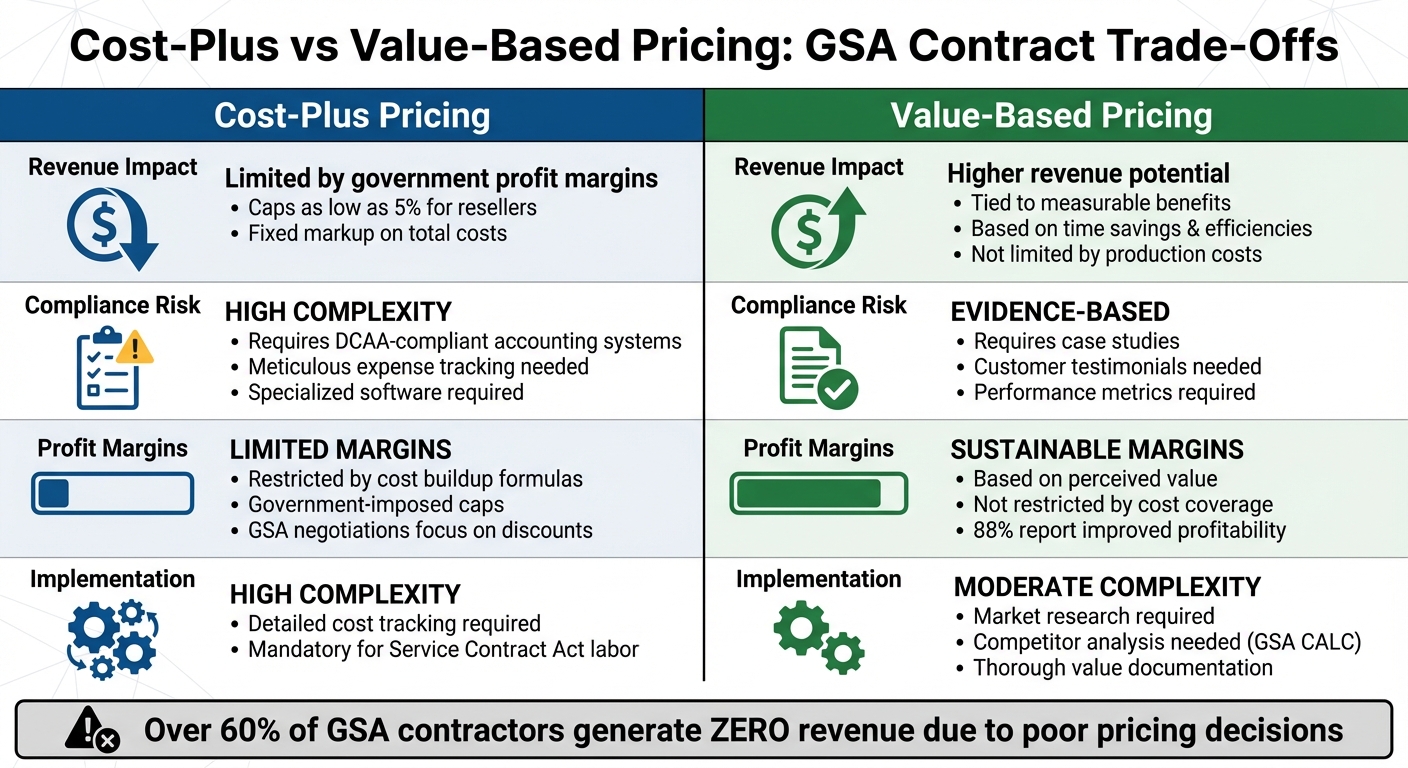
Here’s a breakdown of the key trade-offs when deciding between cost-plus and value-based pricing for your GSA sales. Each approach comes with its own set of strengths and challenges, impacting your revenue, compliance, profit margins, and implementation requirements.
| Factor | Cost-Plus Pricing | Value-Based Pricing |
|---|---|---|
| Revenue Impact | Revenue is limited by government-negotiated profit margins, with caps as low as 5% for resellers. Pricing is determined by adding a fixed markup to total costs. | Offers higher revenue potential since pricing is tied to measurable benefits like time savings or operational efficiencies rather than production costs. |
| Compliance Risk | Requires adherence to DCAA-compliant cost accounting systems and meticulous expense tracking, often needing specialized software. | Demands evidence to back up value claims, such as case studies, testimonials, and performance metrics, to satisfy GSA requirements. |
| Profit Margins | Margins are limited by cost buildup formulas and government-imposed caps. GSA negotiations often focus on securing discounts, further restricting profits, as noted by G. Chris Brown from SYMPAQ. | Margins are more sustainable because pricing is based on perceived value rather than just covering costs. |
| Implementation Complexity | High complexity due to the need for detailed cost tracking and specialized accounting software. Best suited for labor categories under the Service Contract Act, where cost-plus pricing is mandatory. | Moderate complexity, requiring market research, competitor analysis (using tools like GSA’s CALC database), and thorough documentation to prove your value proposition. |
How Discount Structures Affect Revenue
When it comes to GSA contracts, your discount strategy isn’t just about offering a lower price – it’s about aligning your approach with your broader revenue goals. Whether you’re aiming for higher sales, better cash flow, or simplified compliance, the way you structure discounts has a direct impact on your bottom line.
There are three primary discount approaches to consider: standard GSA discounts, volume or tiered discounts, and prompt payment discounts. Each serves a unique purpose and comes with its own set of advantages and challenges.
Standard GSA pricing acts as your baseline, setting a ceiling rate tied to your Basis of Award (BOA) customer. This approach provides stability and predictable margins while keeping compliance straightforward. However, you’re not locked into this rate. You can offer spot discounts on individual bids to stay competitive without needing to modify your overall contract. This flexibility allows you to adapt quickly to changing market demands.
Volume and tiered discounts are designed to encourage larger orders and repeat business, often increasing order values by 10–20%. While the revenue potential is appealing, these discounts come with added complexity. You’ll need to carefully monitor your pricing to avoid triggering the Price Reduction Clause (PRC). According to Winvale:
The Price Reduction Clause ensures a fixed relationship between the discounting practices offered by a contractor to GSA, and the discounts offered by the same contractor to its ‘Basis of Award customer.’
If you offer a better discount to your BOA customer than to GSA, you could be required to lower your GSA pricing across the board.
Prompt payment discounts serve a different purpose. These discounts, typically reducing margins by 0.5–2%, are less about driving sales and more about improving cash flow. Since they don’t trigger PRC or Trade Discount Register (TDR) tracking requirements, they carry minimal compliance risk. While they won’t significantly boost revenue, they can help smaller contractors manage government payment cycles more effectively.
Each discount structure complements your core pricing strategy by fine-tuning your revenue performance while staying within GSA compliance rules. The challenge lies in choosing the right approach for your business needs.
- For predictable revenue and easy compliance, stick with standard pricing and spot discounts.
- If growth is your priority and you can handle the added administrative workload, tiered discounts offer the most revenue potential.
- For contractors focused on cash flow, prompt payment discounts provide a simple and low-risk solution.
Conclusion
Developing a GSA pricing strategy that aligns with your revenue goals while meeting compliance requirements is no small task. For smaller contractors, cost-plus pricing can be a solid starting point, helping to establish credibility and secure initial contracts. On the other hand, value-based pricing is a better fit for businesses with a proven track record, allowing them to command higher margins by showcasing the benefits they deliver. The NCMA 4-Tier Framework even illustrates how a hybrid pricing model can generate profits of $150K–$180K on a $1M contract. These pricing foundations pave the way for effective discount strategies.
Discounts, when used wisely, can amplify revenue and support cash flow. A standard pricing model offers simplicity and predictability, while tiered discounts encourage larger orders. For those focused on financial stability, prompt payment discounts can help maintain steady cash flow. The secret lies in aligning your discount strategy with your business priorities – whether you’re targeting growth, stability, or liquidity.
To maintain compliance, annual internal audits are a must. These ensure your pricing aligns with GSA terms and MFC (Most Favored Customer) standards. If you’re looking for more flexibility, switching from the Price Reductions Clause to Transactional Data Reporting can eliminate the need for Basis of Award customer linkage. Additionally, incorporating Economic Price Adjustment clauses early on can safeguard your margins against market shifts.
Mastering these strategic elements is critical for balancing compliance with operational efficiency. Expert pricing guidance can make all the difference. GSA Focus specializes in optimizing pricing strategies while ensuring compliance throughout the contract lifecycle. Their comprehensive services handle 95% of the documentation process and boast a 94% compliance success rate – far surpassing the 72% success rate of businesses managing contracts internally. With a 98% success rate and acquisition speeds 4–6× faster than DIY methods, they reduce your workload from over 100 hours to just 3 hours.
Whether you’re navigating your first GSA Schedule or fine-tuning an existing contract, the right pricing strategy combined with thoughtful discount structures can dramatically improve your federal sales revenue. The most successful businesses treat pricing as a strategic asset, turning compliance challenges into opportunities for growth and profitability. Together, these elements create a roadmap for turning GSA contracts into a powerful revenue-generating tool.
FAQs
How do I choose between cost-plus and value-based pricing for my GSA Schedule?
When deciding between cost-plus pricing and value-based pricing, it’s essential to consider both your business capabilities and the government’s objectives.
- Cost-plus pricing: This method focuses on covering your expenses while ensuring compliance. It’s a solid choice when your costs are predictable and straightforward, providing a reliable foundation for pricing.
- Value-based pricing: This approach emphasizes the benefits and results your product or service delivers. It’s particularly effective when your offering aligns with the government’s emphasis on quality and innovation.
Many small businesses initially opt for cost-plus pricing because it’s simpler to implement and helps ensure financial stability. As they grow and gain a clearer understanding of their unique strengths, they often shift to value-based pricing, leveraging their proven performance and measurable outcomes to justify higher rates.
What evidence do I need to justify value-based pricing to the GSA?
When presenting value-based pricing to the GSA, it’s essential to back your proposal with solid evidence that clearly connects your pricing to the value your product or service delivers. Here’s how you can make your case effectively:
- Leverage Market Research: Use detailed market studies to show how your pricing compares to industry standards and customer expectations. This helps establish that your prices are competitive for the value offered.
- Present Historical Sales Data: Highlight consistent demand and sales trends for your product or service. Demonstrating a track record of success supports the notion that your pricing is justified by customer satisfaction and results.
- Analyze Competitor Pricing: Provide a comparison of competitor offerings and prices, emphasizing how your product delivers greater benefits or unique advantages for a similar or slightly higher cost.
Additionally, focus on showcasing measurable benefits that your offering brings to the table:
- Quality: Emphasize superior materials, craftsmanship, or performance metrics that set your product apart.
- Proven Results: Share case studies, testimonials, or data that illustrate how your product or service has delivered tangible success for other customers.
- Differentiation: Highlight any standout features or solutions that make your offering more effective or efficient than alternatives.
By tying your pricing directly to the value and outcomes your product delivers, you can demonstrate that it aligns with the GSA’s priorities and provides a fair exchange for the benefits received.
How can I use discounts without triggering the Price Reductions Clause?
To offer discounts while staying clear of the Price Reductions Clause (PRC), it’s crucial to follow GSA rules carefully. Ensure that any discounts you provide are consistent with or better than those given to your Basis of Award (BOA) customer. Maintain a stable discount structure and avoid offering discounts that haven’t been approved. Regularly monitor and document pricing changes to ensure your federal pricing remains in line with your commercial pricing. This approach helps you stay compliant with GSA regulations and avoid potential violations.
Related Blog Posts
- How Value-Based Pricing Impacts GSA Contracts
- How to Analyze GSA Competitor Pricing
- How to Set GSA Prices for Federal Contracts
- Competitive Pricing in Federal Contracts: Analysis