

Winning federal contracts requires more than the lowest price – it’s about aligning your bid with agency budgets, evaluation criteria, and competitor strategies. Price-to-Win (PTW) strategies help businesses find the sweet spot between competitiveness and profitability. Here’s what you need to know:
- Key Focus Areas: Understand agency priorities (e.g., "Best Value Tradeoff" vs. "Lowest Price Technically Acceptable"), analyze competitors’ pricing, and ensure your costs are realistic and reasonable.
- Tools and Resources: Platforms like SAM.gov and FPDS.gov offer historical award data, while tools like Deltek ProPricer and GovWin IQ streamline cost modeling and competitive analysis.
- Common Challenges: Misaligned pricing, underbidding, and incomplete competitive analysis can hurt your chances, even if your technical proposal is strong.
- GSA Contracts: GSA Schedule bids require tailored PTW approaches, including compliance with pricing structures and leveraging tools like GSA Advantage! for benchmarking.
PTW strategies are critical for balancing agency needs, competitive intelligence, and cost modeling, ensuring your bid stands out without sacrificing profitability.
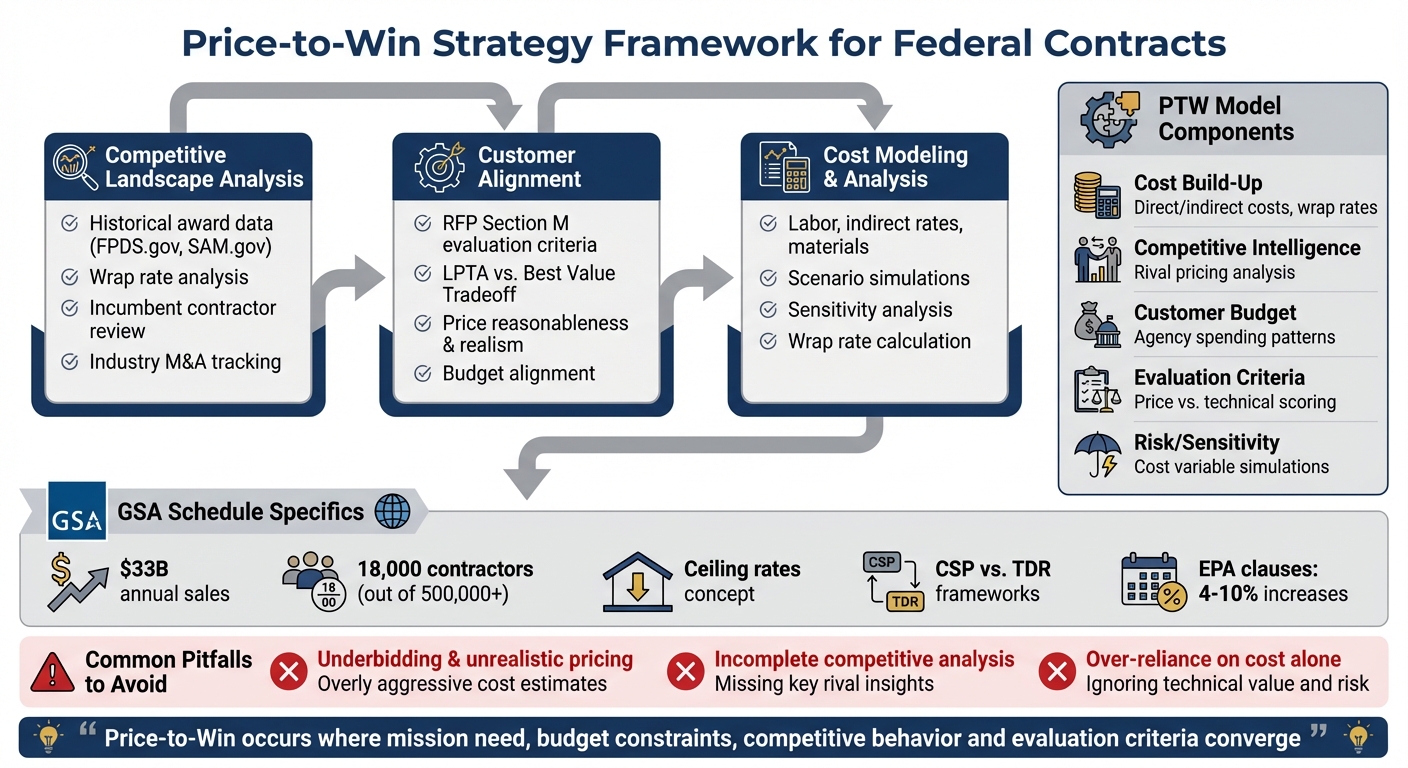
Price-to-Win Strategy Framework for Federal Contracts
Proposal and Pricing Strategies to Win Federal Contracts
Building Blocks of Price-to-Win
Addressing the pricing challenges discussed earlier, these core elements form the foundation of an effective price-to-win (PTW) strategy. By combining competitive insights, a focus on agency priorities, and a strong cost model, businesses can craft pricing strategies that are both precise and competitive.
Analyzing the Competitive Landscape
The first step in shaping a PTW strategy is understanding the competitive environment. Historical award data from platforms like FPDS.gov and SAM.gov provides valuable insights into how competitors have priced similar contracts. This analysis sheds light on whether competitors lean toward aggressive, low-margin bids or position themselves as premium "best value" providers.
A key metric to examine is the wrap rate – a comprehensive measure that includes employee benefits, overhead, and general & administrative expenses added to direct labor. Wrap rates reveal the underlying cost structure of a bid. Additionally, comparing labor categories, experience levels, and geographic locations can provide further clues about competitors’ strategies. If an incumbent contractor holds the current contract, their past performance and pricing deserve close scrutiny, as agencies often prefer sticking with proven providers. Keep an eye on industry developments as well; mergers and acquisitions can quickly reshape the competitive field.
"PTW is a strategy for setting your price in a contract bid based on analyzing your competitors’ capabilities and evaluated prices." – Boost LLC
Aligning with Customer Needs and Budgets
Equally important is understanding the priorities of the agency issuing the contract. The RFP’s Section M serves as a guide, revealing whether the evaluation will follow a "Lowest Price Technically Acceptable" (LPTA) approach or a "Best Value Tradeoff". Agencies typically evaluate two aspects: price reasonableness (fairness relative to market standards) and price realism (whether the quoted price reflects the ability to deliver). Even a technically excellent proposal can be rejected if it doesn’t align with the agency’s budget.
To anticipate spending patterns and pricing expectations, review government budget reports, procurement forecasts, and participate in pre-solicitation events like RFIs and industry days.
"A proposal that doesn’t align with agency budget expectations may be rejected, even if technically superior." – Hinz Consulting
A strong cost volume narrative is also essential. This narrative should clearly explain the rationale behind labor hours, escalation assumptions, and subcontractor costs, giving evaluators confidence in the sustainability of your pricing.
Cost Modeling and Data Analysis
Cost modeling is the backbone of a PTW strategy, breaking down labor, indirect rates, and material costs to ensure the bid is both executable and competitive. Pair this with data analysis to align your bid with market realities, using historical award data to predict the optimal price point for maximizing your chances of winning.
Scenario simulations can be invaluable. Adjust variables like labor mix, profit margins, or subcontractor workshare to evaluate their impact on both competitiveness and profitability. Sensitivity analysis can also highlight potential risks, such as changes in government budgets or competitor strategies.
The first step in this process is calculating your wrap rate to establish your true cost floor.
A notable example comes from Microsoft, which in 2019 secured a major DoD contract by balancing innovation with budget constraints.
"The goal is not just to win a contract but to do so in a manner that ensures long-term growth." – Deltek
For context, under the GSA’s structured approach, material acquisition typically accounts for 1–4%, direct labor for 4–12%, and general management for 2–5%. Contract cost risk varies depending on the contract type, with cost-reimbursement contracts at 0–3%, fixed-price contracts at 3–7%, and service contracts at 0–4%.
These foundational elements pave the way for creating a tailored and effective PTW model, which will be explored further in the next section.
Developing a Price-to-Win Model
Creating a Price-to-Win (PTW) model involves customizing traditional cost analysis to meet the specific challenges of federal and GSA Schedule contract pricing. This approach helps you strike the right balance between competitiveness and profitability.
Key Inputs for the Model
To build an effective PTW model, you need to gather critical data from several sources: internal costs, competitive intelligence, evaluation criteria, and the customer’s budget.
Start with your internal cost foundation, which includes direct labor, materials, equipment, and indirect rates such as fringe benefits, overhead, and general and administrative (G&A) expenses. This establishes your "cost floor", or the minimum price you can bid without incurring a loss.
Next, turn to competitive intelligence by analyzing data from platforms like SAM.gov and FPDS.gov. These sources can provide insights into how competitors have priced similar contracts. Examine their historical awards, labor categories, and pricing patterns. Additionally, review Section M of the RFP to understand how the agency will evaluate and score proposals.
Lastly, study the agency’s budget by reviewing pre-solicitation notices, RFIs, and historical spending patterns. The FAR 15.405 emphasizes that reaching a "fair and reasonable" price doesn’t require agreement on every cost element, nor does it mandate staying within the contracting officer’s initial negotiation range. Understanding these nuances allows you to position your bid strategically.
| PTW Model Component | Description | Key Data Sources |
|---|---|---|
| Cost Build-Up | Internal direct and indirect costs, including wrap rates | Internal ERP systems (e.g., Costpoint) |
| Competitive Intelligence | Analysis of rival bidders’ likely pricing and tactics | FPDS.gov, SAM.gov, GovWin IQ |
| Customer Budget | Agency spending patterns and estimated project funding | Pre-solicitation notices, RFIs |
| Evaluation Criteria | Scoring weights for price vs. technical merit | RFP Section M |
| Risk/Sensitivity | Simulations of cost variables and profit margins | ProPricer, Excel models |
Once you’ve gathered these inputs, integrate risk factors to shield your bid against unexpected cost changes.
Incorporating Risk and Contingencies
Including risk buffers in your bid can safeguard your business against cost overruns while maintaining competitiveness. Sensitivity analysis is key – adjust variables like labor mix, profit margins, or subcontractor costs to assess how different scenarios might impact your win probability and profitability.
The type of contract also plays a critical role. Fixed-price contracts require precise cost estimates since you assume the risk of overruns. On the other hand, cost-reimbursable contracts emphasize cost realism, as the government covers allowable costs plus a fee.
"Bidding too high makes your offer uncompetitive, while bidding too low can jeopardize contract execution and long-term business sustainability".
Develop a Basis of Estimate (BOE) that clearly outlines your labor hours, escalation assumptions, and subcontractor costs. This detailed explanation reassures evaluators that your pricing is both realistic and sustainable. For instance, the Consumer Price Index rose 8.3% from January 2021 to January 2022. Including Economic Price Adjustment (EPA) clauses in fixed-price contracts can help mitigate the risks of inflation.
To further refine your PTW model, leverage specialized tools that allow you to simulate pricing scenarios and fine-tune your strategy.
Using Tools and Software for PTW Analysis
Several tools can streamline the PTW process and improve your pricing accuracy:
- Deltek ProPricer: This software simplifies proposal pricing, enabling you to adjust pricing tables and run "what-if" scenarios to find the right balance between profit and competitiveness.
- Deltek Costpoint: As an ERP solution, it offers in-depth insights into your cost structures while ensuring compliance with FAR and CAS regulations.
- GovWin IQ: This tool provides market intelligence by tracking competitor awards and forecasting agency budgets, giving you the context needed to position your bid effectively.
Free government resources also play a valuable role. Platforms like the GSA’s buy.gsa.gov (formerly CALC) allow you to benchmark labor rates against existing GSA schedule contracts. Additionally, SAM.gov and FPDS provide historical award data that reveal competitor pricing trends.
Starting your PTW modeling early – during the capture phase – gives you more time to refine your cost structures and align your technical solution with your pricing strategy. This proactive approach ensures you’re better prepared when the final RFP is released.
Applying PTW Strategies to GSA Schedule Contracts
GSA Schedule contracts call for a specialized Price-to-Win (PTW) approach. With annual sales of about $33 billion across over 11 million products and services, these contracts are highly competitive. Out of more than 500,000 contractors, only 18,000 hold GSA Schedule contracts, making competitive pricing a critical factor.
Evaluating GSA RFQs and RFPs
When reviewing GSA solicitations, keep in mind that the rates listed on your GSA Schedule pricelist represent ceiling rates. As John Abel, Director of Client Services at The Winvale Group, explains:
"The GSA awarded rates on your Schedule pricelist are ceiling rates – meaning that work for government buyers under the GSA Schedule must be billed either at or below those awarded rates, NEVER above".
Federal agencies typically use the Best Value evaluation method under FAR Part 8 instead of the Lowest Price Technically Acceptable approach. This means your PTW strategy should weigh non-price factors like past performance, delivery terms, and warranties alongside pricing.
It’s also essential to determine whether your contract operates under Commercial Sales Practices (CSP) or Transactional Data Reporting (TDR). CSP requires you to disclose your "Most Favored Customer" pricing and maintain consistent discount relationships with commercial invoices. TDR, on the other hand, focuses on market-based horizontal price analysis without requiring such disclosures. Tools like GSA Advantage!, GSA eLibrary, and GSA eBuy can help you analyze competitor pricing and benchmark your own rates.
These insights can serve as the foundation for a more strategic PTW approach.
How GSA Focus Supports PTW Implementation
GSA Focus provides comprehensive support to simplify the complexities of GSA Schedule pricing. Their services include document preparation, compliance management, and negotiation assistance, all aligned with tailored cost and risk models.
The GSA Focus team conducts horizontal pricing analysis using data from GSA Advantage! catalogs, past awarded pricing, and Blanket Purchase Agreement data. This ensures your bids are competitive while remaining fair and reasonable. They also help you select the right framework – CSP or TDR – for your business and guide you through the necessary disclosures.
When it comes to negotiations, GSA Focus assists with Economic Price Adjustment (EPA) clauses during the proposal phase. For product vendors, EPA Clause 552.216-70 typically allows price increases ranging from 4% to 10%, depending on the Schedule Large Category. For service contracts, they help secure automatic annual price increases through EPA Clause I-FSS-969(b), eliminating the need for individual modification requests. They also optimize your wrap rate, ensuring that your direct labor costs – including benefits, overhead, and G&A expenses – are both sustainable and competitive.
With a 98% success rate, GSA Focus also provides ongoing maintenance support to help businesses meet the minimum $25,000 annual sales requirement and stay compliant with GSA pricing regulations through Mass Modifications and updates from the Vendor Support Center.
Maximizing Value and Differentiation
Beyond pricing accuracy, you can strengthen your bid by emphasizing your socioeconomic designations, such as SDVOSB, HUBZone, or WOSB. Federal agencies often set aside orders specifically for these categories to meet their purchasing goals.
Additionally, include a pricing narrative that outlines your assumptions, escalation rates, and subcontractor costs. This builds evaluator confidence and demonstrates that your pricing is realistic. For Time & Materials contracts, focus on optimizing your labor mix – balancing senior and junior staff – rather than just reducing hourly rates.
With federal agencies increasingly required to purchase sustainable goods under executive orders, showcasing bio-based products or energy-efficient services can provide a competitive edge. These differentiation strategies, combined with a strong pricing approach, position your business to succeed in GSA Schedule bids while maintaining profitability.
Avoiding Common Pitfalls in Price-to-Win Strategies
Even the most refined Price-to-Win (PTW) models can stumble if certain pitfalls aren’t avoided. To ensure your pricing strategy stays on track, it’s crucial to recognize and address these common missteps. A competitive and well-balanced approach requires more than just crunching numbers – it demands a clear understanding of market dynamics and strategic foresight.
Underbidding and Unrealistic Pricing
Pricing too low might seem like a shortcut to winning a contract, but it often backfires. Low bids can trigger concerns about your ability to deliver or meet market standards. Contracting officers evaluate bids for both price realism (can you deliver at this cost?) and price reasonableness (is your price competitive?). If your bid raises doubts, it may be rejected outright.
One key mistake is neglecting indirect costs when calculating your wrap rate. As Jon Barker from Unanet points out:
"The wrap rate is indicative of a company’s culture and impacts its ability to compete, win contracts, and retain a quality workforce".
To avoid this, always account for hidden costs and include a risk buffer in your pricing. This safeguard helps ensure profitability, even when unexpected changes affect your cost assumptions.
Incomplete Competitive Analysis
Failing to thoroughly research your competition can leave you at a disadvantage. Even if your technical proposal shines, misaligned pricing can undermine your chances. BOOST LLC emphasizes this point:
"Underneath these pricing problems is an analysis gap. PTW solves your pricing problems by filling that opening".
A strong PTW strategy relies on consistent, up-to-date competitive intelligence. Use historical award data to refine your insights and pay close attention to incumbent contractors. Agencies often favor incumbents with solid performance histories unless your proposal offers significantly better value or pricing.
It’s also essential to integrate PTW strategies early, starting at the bid/no-bid decision stage, rather than scrambling to address pricing at the last minute. Keep an eye on industry changes, such as mergers and acquisitions, as these can quickly reshape the competitive landscape.
Over-Reliance on Cost Alone
An overly aggressive focus on low pricing can be just as damaging as overpricing. Fedmarket warns:
"Pricing too low can raise red flags with buyers, while pricing too high means you have no chance of winning".
Striking the right balance is key. Excessively low bids might make contracting officers question your ability to deliver, while high bids can push you out of contention. The Federal Acquisition Regulation (FAR) makes it clear:
"The contracting officer’s primary concern is the overall price the Government will actually pay".
Your pricing must align with your technical and management strategies. A disconnect between your solution and its cost can lead to disqualification. In Best Value Tradeoff evaluations, agencies prioritize a balance between price and technical capabilities, rather than simply choosing the lowest bidder. Misunderstanding the distinction between cost and price can weaken your overall bid.
Conclusion: Key Takeaways for Federal PTW Success
Recap of Core PTW Strategies
Price-to-Win (PTW) is all about hitting the sweet spot – crafting a bid that aligns with agency budgets, outshines competitors, and still turns a profit. As David Sanborn from BlackFlag Advisors aptly puts it:
"Price-to-Win occurs where mission need, budget constraints, competitive behavior and evaluation criteria converge".
To build an effective PTW strategy, start with thorough research. Dive into historical award data, assess incumbent performance, and analyze competitor bids using resources like FPDS.gov and SAM.gov. Then, focus on pricing – study the government’s IGCE (Independent Government Cost Estimate) and affordability benchmarks to ensure your bid aligns with their expectations. Your cost modeling should be detailed and comprehensive, factoring in wrap rates (benefits, overhead, and G&A) and benchmarking labor categories against market norms. Finally, tailor your proposal to meet the agency’s evaluation criteria. Starting this analysis early – during the capture phase – gives you the data-driven insights needed for smarter bid/no-bid decisions and a more competitive strategy.
This structured approach lays a solid foundation for actionable steps.
Next Steps for Small Businesses
For small businesses venturing into federal contracting, turning these strategies into action can feel like a daunting task. Managing GSA Schedule contracts, with their intricate pricing structures and strict compliance requirements under FAR Part 15, adds another layer of complexity.
That’s where GSA Focus steps in. They simplify the process with a full-service solution, handling everything from document preparation to compliance with GSA pricing standards, such as Commercial Sales Practices or Transactional Data Reporting. They also assist with negotiations to secure favorable Economic Price Adjustment clauses. Their pricing is straightforward – starting at $1,000 for basic modifications and $1,800 annually for ongoing maintenance and advisory services. By taking care of the heavy lifting, GSA Focus lets you concentrate on delivering value to federal agencies.
Whether you’re pursuing your first GSA Schedule or fine-tuning your PTW strategy for competitive RFQs, having expert guidance can make all the difference. Success in the federal marketplace comes down to strategic pricing paired with operational excellence, and having the right partner ensures you’re positioned to win and thrive in the long run.
FAQs
How can businesses create bids that meet federal agency budgets and evaluation criteria?
To align your bid with a federal agency’s budget and evaluation criteria, rely on a data-driven strategy instead of guesswork. Begin by thoroughly analyzing the RFP to uncover critical details such as the budget ceiling, the evaluation method (e.g., Lowest-Price Technically Acceptable or Best-Value trade-offs), and the emphasis placed on price versus technical performance. Leverage historical contract data and insights from past agency awards to calculate a realistic Total Evaluated Price (TEP) that aligns with the agency’s expected spending limits.
Dive into a competitive analysis to see how other bidders structure their costs. Consider factors like labor rates, geographic influences, and volume assumptions. Use these benchmarks to compare with your own pricing model, ensuring your costs are competitive yet profitable. Then, develop a compelling price narrative that clearly explains how your pricing meets the agency’s requirements while staying within their budget. Be sure to address elements like price realism, reasonableness, and any mandatory cost-accounting standards.
GSA Focus provides tailored support to small businesses by offering services like market research, cost modeling, and compliance guidance. This expertise helps businesses create bids that meet agency expectations and improve their chances of securing federal contracts.
What tools and resources can help develop a Price-to-Win strategy for federal contracts?
Creating a winning Price-to-Win (PTW) strategy starts with having the right tools and data to evaluate competitor pricing, government budgets, and your own costs. Some of the most useful resources include government pricing databases such as GSA Advantage, GSA CALC, and the Federal Procurement Data System (FPDS). These platforms offer insights into labor rates, historical pricing trends, and market dynamics. Publicly available tools like the GSA eLibrary and agency budget documents can also provide helpful context when shaping your pricing approach.
For small businesses, cost-estimating software can make calculations easier and save time, while competitive-analysis worksheets can help you map out key factors like labor categories, geographic rate differences, and additional services. If you’re looking for expert support, GSA Focus offers a full-service option. They handle everything from market research and pricing analysis to documentation, ensuring your PTW strategy not only meets federal requirements but also increases your chances of success.
What are the common mistakes to avoid when developing a Price-to-Win strategy?
Crafting a solid Price-to-Win (PTW) strategy involves much more than just submitting the lowest bid. Underbidding is a trap many fall into – it can eat away at your profit margins and leave you struggling to fulfill contract obligations. On the flip side, if your pricing doesn’t align with the solicitation’s evaluation model – whether it’s Lowest Price Technically Acceptable (LPTA) or a best-value trade-off – you risk rejection, even with a technically sound proposal. To avoid this, pair your pricing with a compelling narrative and a thorough cost-realism analysis. This ensures your numbers are backed by solid reasoning, not shaky assumptions.
Another frequent misstep is skipping proper market research. Without a detailed competitive analysis or insights from key resources like SAM.gov or historical pricing data, your bid might land far outside the competitive range – either too high or too low. Not only does this hurt your chances, but it could also trigger compliance issues under federal regulations.
Timing is another critical factor. Starting your PTW analysis too late or ignoring updates to the solicitation can leave you out of sync with the agency’s expectations. To stay competitive, begin early, incorporate insights about your competitors, and regularly validate your assumptions. This approach ensures your pricing strategy is both realistic and aligned with the agency’s goals and timeline.
Related Blog Posts
- How to Analyze GSA Competitor Pricing
- How to Set GSA Prices for Federal Contracts
- Competitive Pricing in Federal Contracts: Analysis
- How Price-to-Win Impacts GSA Bids