

Major changes to GSA contract modifications in 2026:
- Mandatory Transactional Data Reporting (TDR):
- Replaces the Price Reduction Clause (PRC) and Commercial Sales Practices (CSP).
- Requires monthly line-item reporting (e.g., part numbers, unit prices, federal buyers).
- Applies to all MAS contractors under Refresh 31.
- Tight Deadlines:
- Non-TDR offers: Withdraw and resubmit within 10 business days or face rejection.
- TDR Mass Modifications (A909): Accept within 90 days to avoid delays.
- Updated Economic Price Adjustment (EPA) Clause:
- Stricter documentation for price adjustments.
- New clause 552.238-120 replaces older versions.
- eMod Platform Requirements:
- Up-to-date SAM.gov record and FAS ID needed.
- Only authorized negotiators can initiate/sign modifications.
Key Dates:
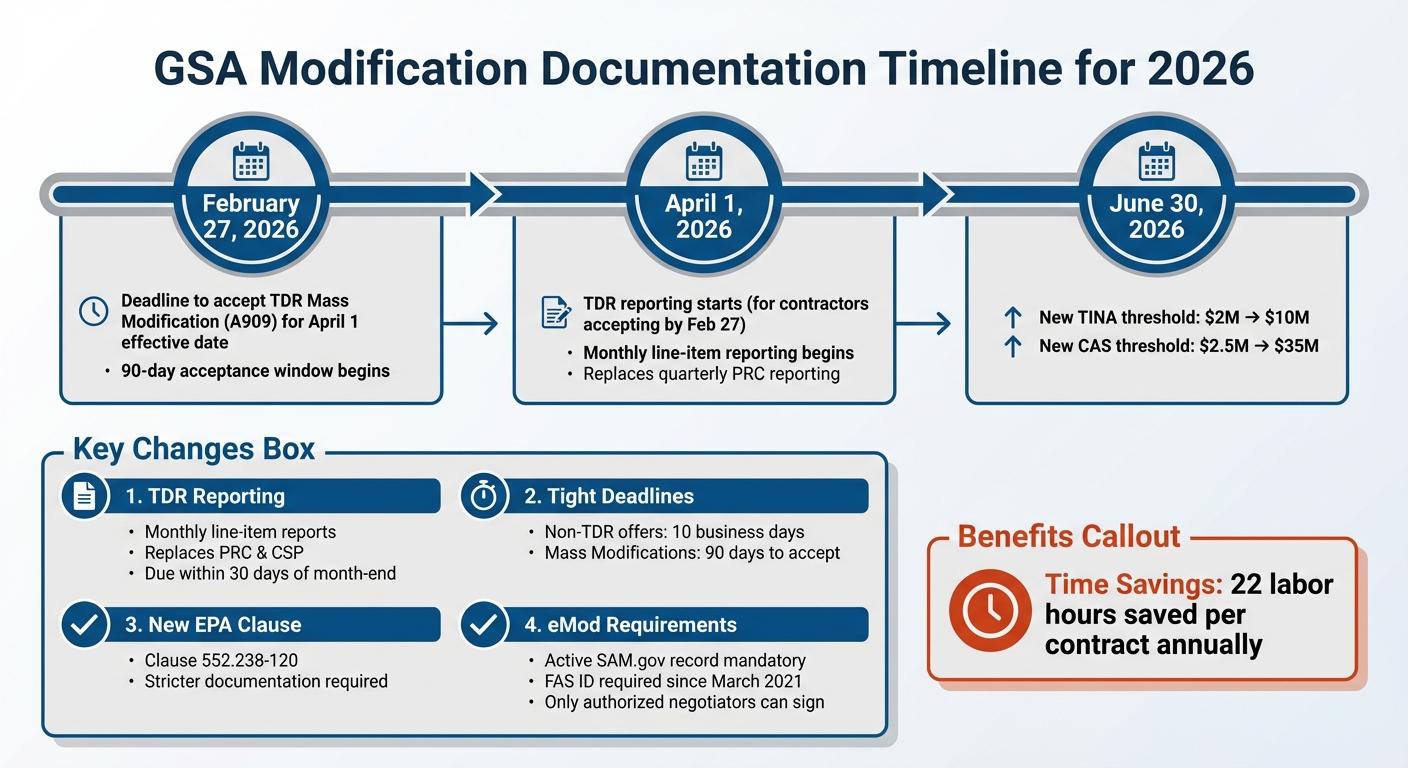
- TDR reporting starts April 1, 2026, for those accepting by February 27, 2026.
- New TINA and CAS thresholds take effect June 30, 2026.
Takeaway:
Staying compliant means adopting TDR, meeting tighter deadlines, and ensuring accurate documentation. Missing updates risks delays or rejection.
GSA Contract Modification Timeline and Key Changes for 2026
Major Changes in GSA Modification Documentation for 2026

Transition from PRC to TDR Reporting
The move from the Price Reduction Clause (PRC) to Transactional Data Reporting (TDR) represents one of the most impactful shifts in GSA documentation in recent years. This change aims to modernize reporting and simplify compliance for contractors. Previously, contractors were required to submit quarterly aggregate sales reports and maintain detailed Commercial Sales Practices (CSP-1) disclosures, which outlined their Most Favored Customer (MFC) pricing relationships. With TDR, the focus shifts to monthly line-item reporting, requiring details such as manufacturer part numbers, unit measures, price paid per unit, and the federal customer involved.
This overhaul significantly alters documentation requirements. As noted by Holland & Knight:
"The existing Price Reduction Clause (PRC) will be eliminated from MAS contracts, and a new version of the PRC with a different liability structure consistent with TDR will be added."
Contractors must now ensure their accounting systems capture detailed transaction data every month, with reports due within 30 days after the end of each month. For those accepting the TDR Mass Modification in February 2026, the new reporting standards kick in on April 1, 2026.
These updates pave the way for additional refinements, such as the revised Economic Price Adjustment requirements and stricter deadlines for mass modifications.
Stricter Economic Price Adjustment Documentation
The updated Economic Price Adjustment (EPA) clause – 552.238-120 – replaces older clauses I-FSS-969 and 552.216-70, introducing more rigorous documentation standards. Contractors must now provide clear details on their calculation methods (how adjustments are determined) and the basis for those adjustments (such as referencing the Consumer Price Index or specific cost indices).
This updated EPA documentation must be in place before certain key events: submitting an EPA modification request, adding new products or SINs, or renewing a contract option. Preparing your pricing adjustment methods in advance is critical to avoiding delays when these adjustments become necessary.
Mass Modification Documentation and New Deadlines
In addition to TDR reporting, contractors must adhere to a strict 90-day window to accept mass modifications. This process involves first accepting the Refresh 31 Mass Modification to update general terms, followed by the TDR Mass Modification (A909). Missing this deadline keeps your contract under the old PRC system, prolonging your liability exposure.
The timing of your acceptance also determines when the new requirements take effect. For instance, accepting the TDR Mass Modification on February 27, 2026, makes TDR effective on April 1, 2026. However, if you wait until April 15, 2026, the effective date moves to July 1, 2026. According to GSA, this transition is expected to save contractors an average of 22 labor hours per contract annually by removing outdated pricing tracking obligations.
Advanced Compliance Issues and Changes in the GSA Multiple Award Schedule Program
Required Documentation by Modification Type
The documents you need to submit depend on the type of modification you’re requesting. While the eMod platform is the go-to for all submissions, the materials required differ for administrative, pricing, and technical modifications.
Here’s a quick guide to what’s needed for each modification type:
Administrative Modifications
These modifications handle updates like address changes, contact information corrections, or legal entity updates. Before using eMod, make sure your SAM.gov record is up to date, as GSA systems pull data directly from there. Since March 2021, access to the eMod platform requires a valid FAS ID, replacing the need for digital certificates.
If you’re updating authorized negotiators or contacts, you’ll need an Agent Authorization Letter on company letterhead. This is especially crucial if a consultant or third-party agent was involved before. As GSA.gov emphasizes:
If you delegated pre-award responsibilities to a consultant or third-party agent but do not intend for these agents to represent your firm following contract award, you must specifically request that these agents be removed as authorized negotiators from your contract.
For legal entity changes, include the relevant legal documentation along with your updated SAM record.
Pricing and Scope Modifications
When it comes to pricing adjustments or scope changes, financial validation is key. You’ll need to submit Price Proposal Templates (PPT), but be sure to confirm whether your contract uses the legacy system or the newer FAS Catalog Platform (FCP), as this determines the correct template version.
For product modifications, provide 5–10 invoices, and for service modifications, include 3–5 contracts, purchase orders, or invoices from the last two years for each new labor category. If you’re requesting an Economic Price Adjustment (EPA) under the updated GSAR 552.238-120 clause, use the specific EPA cover letter template introduced in Refresh 29.
Keep in mind that outdated documentation is a common reason for rejection, so ensure all supporting materials are from the past two years.
Technical Modifications
Technical updates focus on specifications and capabilities rather than pricing. For services, you’ll need to submit detailed Labor Category Documents, including project evidence to demonstrate your firm’s expertise in each new category. For product modifications, include updated specifications and, if adding a new manufacturer not listed in the Verified Products Portal, a Letter of Supply (LOS). Missing the Letter of Supply is a frequent cause of delays.
If needed, you can combine multiple modification types – like administrative and technical changes – into a single eMod submission. After approval, the package will be electronically signed by you and finalized by the GSA Contracting Officer.
Best Practices for eOffer/eMod Submissions
Submitting Accurate and Complete Documentation
Getting your documentation right can save you weeks of back-and-forth. Before you even think about logging into eMod, make sure your Unique Entity ID (SAM) is active. Since April 2022, this has been a non-negotiable requirement – you won’t even get access to the system without it.
Another key step? Download the latest MAS solicitation and Roadmap from GSA.gov/MASModGuide to ensure you’re working with the most current templates. Using outdated forms is a surefire way to have your submission rejected by a Contracting Officer. GSA regularly updates these templates, so keeping up with solicitation refreshes is crucial.
Here’s a critical detail: Only Authorized Negotiators listed on your contract can initiate or sign modifications in eMod. If you’re not on the list, you won’t get access, no matter how valid your credentials are. To fix this, an existing negotiator must submit an administrative modification to add you. And if you’re using a digital certificate, double-check that the name matches exactly as it appears in the eMod system. Even something as small as a missing period in a middle initial can cause a lockout.
Once your documentation is in order, the next step is navigating the eOffer/eMod platform efficiently, especially with the newer TDR requirements in play.
Using the eOffer/eMod Platform Effectively
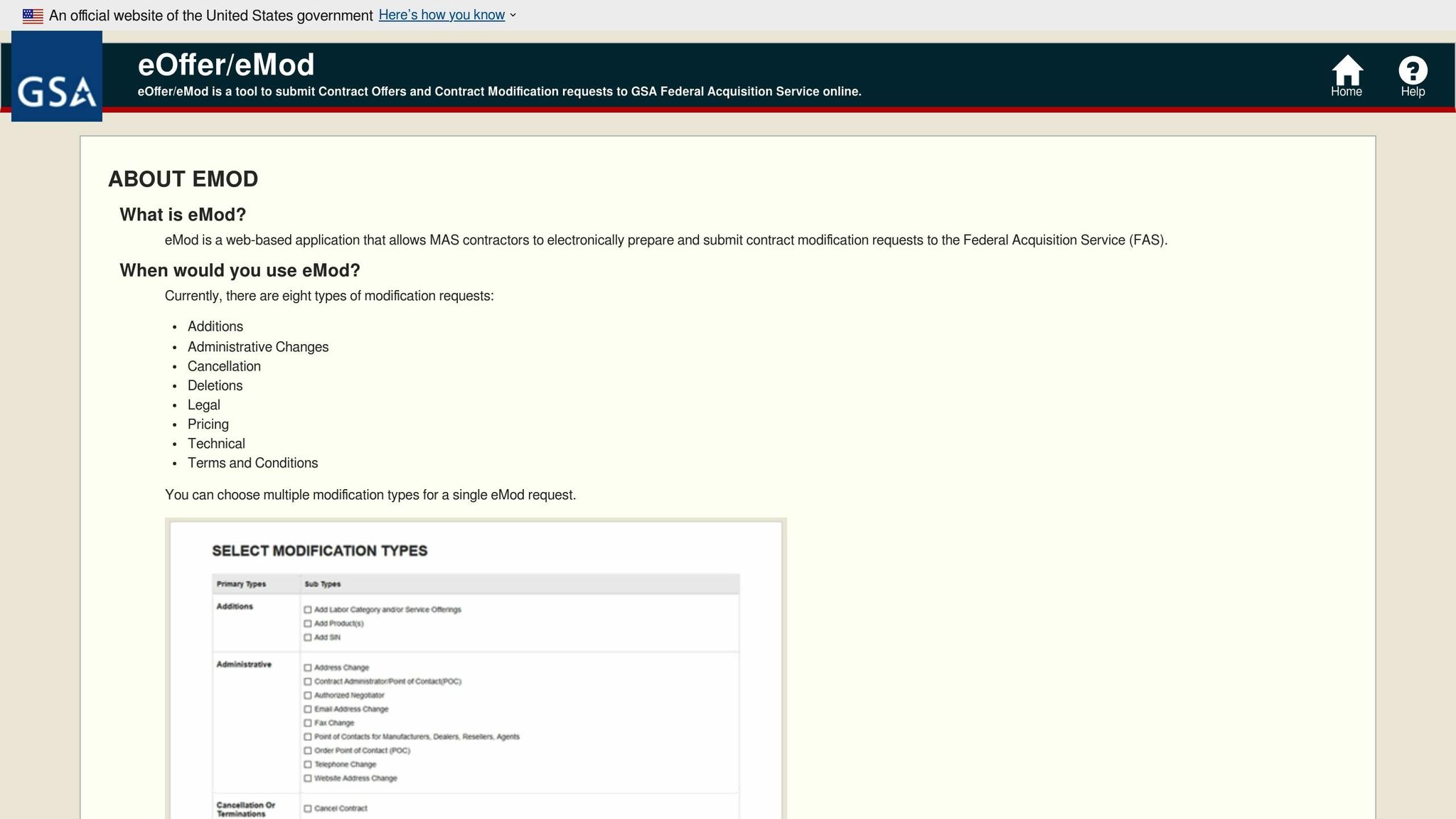
The eMod platform has its quirks, including restrictions on certain modification combinations. For instance, you can’t submit an Economic Price Adjustment and add products in the same eMod. Tackle critical modifications first to avoid unnecessary delays, as the system won’t allow some combined submissions.
Did you know there are around 35 different modification types available, each with its own set of requirements? If you hit a snag, the Vendor Support Center (VSC) is your go-to resource. They’re available Monday through Friday, 8:00 a.m. to 7:00 p.m. EST, at 1-866-472-9114 or via email at eoffer@gsa.gov.
For Mass Modifications initiated by the government, keep an eye on your inbox. You’ll need a PIN to review and accept changes through the VSC. Staying on top of these notifications ensures you don’t miss critical updates.
Conclusion
The updates to GSA contract requirements in 2026 are shaking up how contractors handle their documentation. With the mandatory shift to Transactional Data Reporting (TDR) under Refresh 31, changes to the FAR, and increased thresholds for TINA and CAS, contractors need to adapt quickly to avoid compliance issues.
"The companies that will struggle are the ones that ignore this until a contracting officer points out that their proposal references clauses that no longer exist, or that their accounting system was set up to meet requirements that are no longer applicable." – USFCR
To recap, the TINA threshold will jump from $2 million to $10 million, and the per-contract CAS trigger will rise from $2.5 million to $35 million starting June 30, 2026. Missing these updates could lead to contract disputes or missed opportunities, making it essential for contractors to adjust their documentation and processes now.
These changes don’t just simplify documentation – they also create opportunities for businesses to improve their operations. For small business contractors, services like GSA Focus offer a lifeline. Their full-service approach to GSA Schedule acquisition and management takes care of everything from document preparation to compliance and negotiation. With a 98% success rate and a refund guarantee, GSA Focus helps businesses stay ahead of regulatory changes so they can focus on winning federal contracts instead of getting bogged down in paperwork.
The key to navigating these 2026 updates is staying informed, updating templates immediately, and accepting Mass Modifications as soon as they’re issued. Businesses that see these changes as a chance to improve rather than a hurdle to overcome will position themselves for success in the evolving federal contracting world.
FAQs
What do I need to change internally to handle monthly TDR line-item reporting?
To handle monthly TDR (Transactional Data Reporting) effectively, implement systems that automate the collection and submission of detailed transaction data. This must be completed within 30 days after the month’s end. Ensure your processes accurately capture all 16 required data points per transaction to meet compliance standards. Using the FAS Sales Reporting Portal (SRP) for automated submissions can help minimize errors and streamline the process. Additionally, update your compliance procedures and train your team to prepare for the expanded TDR requirements that will apply to all SINs by FY26.
What happens if I miss a Mass Mod deadline for my contract?
Missing a Mass Mod deadline can put your GSA contract at risk of becoming non-compliant. This could lead to blocked future modifications, stalled renewals, and heightened compliance risks. Staying on top of Mass Mod requirements is crucial to keeping your contract valid and steering clear of potential complications.
What proof does GSA expect now for an EPA request under 552.238-120?
To comply with the GSA’s requirements under 552.238-120, businesses must now provide specific documentation to support an Economic Price Adjustment (EPA) request. This includes market data, pricing comparisons, and discount policies. These materials are essential for showing that the request aligns with current pricing trends and discount practices.
Related Blog Posts
- How to Submit Administrative Modifications in eMod
- Checklist for Substantive GSA Contract Modifications
- What Are Mass Modifications?
- Types of GSA Contract Modifications