
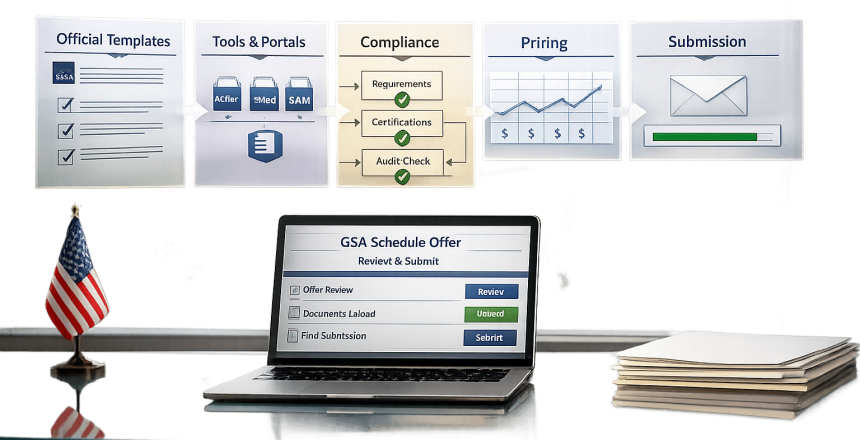
Navigating GSA documentation can be overwhelming, especially for small businesses. Whether you’re applying for a GSA Schedule or maintaining compliance post-award, understanding the right tools and processes is crucial to avoid delays or rejections. Here’s a quick summary of the best resources and services to simplify your journey:
- GSA eOffer System: Central platform for submitting proposals electronically. Requires a FAS ID and accurate SAM.gov details.
- Vendor Support Center (VSC): Offers training, templates, and guides like "Pathways to Success" to help businesses meet GSA requirements.
- GSA eLibrary: Helps identify the correct Special Item Numbers (SINs) for your products or services and provides solicitation documents.
- Templates: Use standardized forms for past performance, pricing, and compliance (e.g., Commercial Sales Practices and TAA Compliance guides).
- Consulting Services (e.g., GSA Focus): For businesses short on time or expertise, consultants handle 95% of the work, ensuring compliance and faster submissions.
Quick Tip: Proper preparation is key. Double-check compliance documents like financial statements, price proposals, and past performance records before submitting. For a more hands-off approach, consider professional services like GSA Focus, which boasts a 98% success rate.
Ready to simplify your process? Dive into the resources or explore consulting options to secure your GSA Schedule with confidence.
GSA Schedule – Part 2 of 3: Getting Onto The GSA Schedule Proposal Prep
Official GSA Resources for Documentation
The General Services Administration (GSA) offers a range of free tools to help businesses navigate documentation and submission processes. These platforms are essential for understanding requirements, submitting proposals, and ensuring your products or services align with federal categories. Getting familiar with these resources is a must before diving into specialized templates or seeking assistance from GSA Focus.
GSA eOffer System
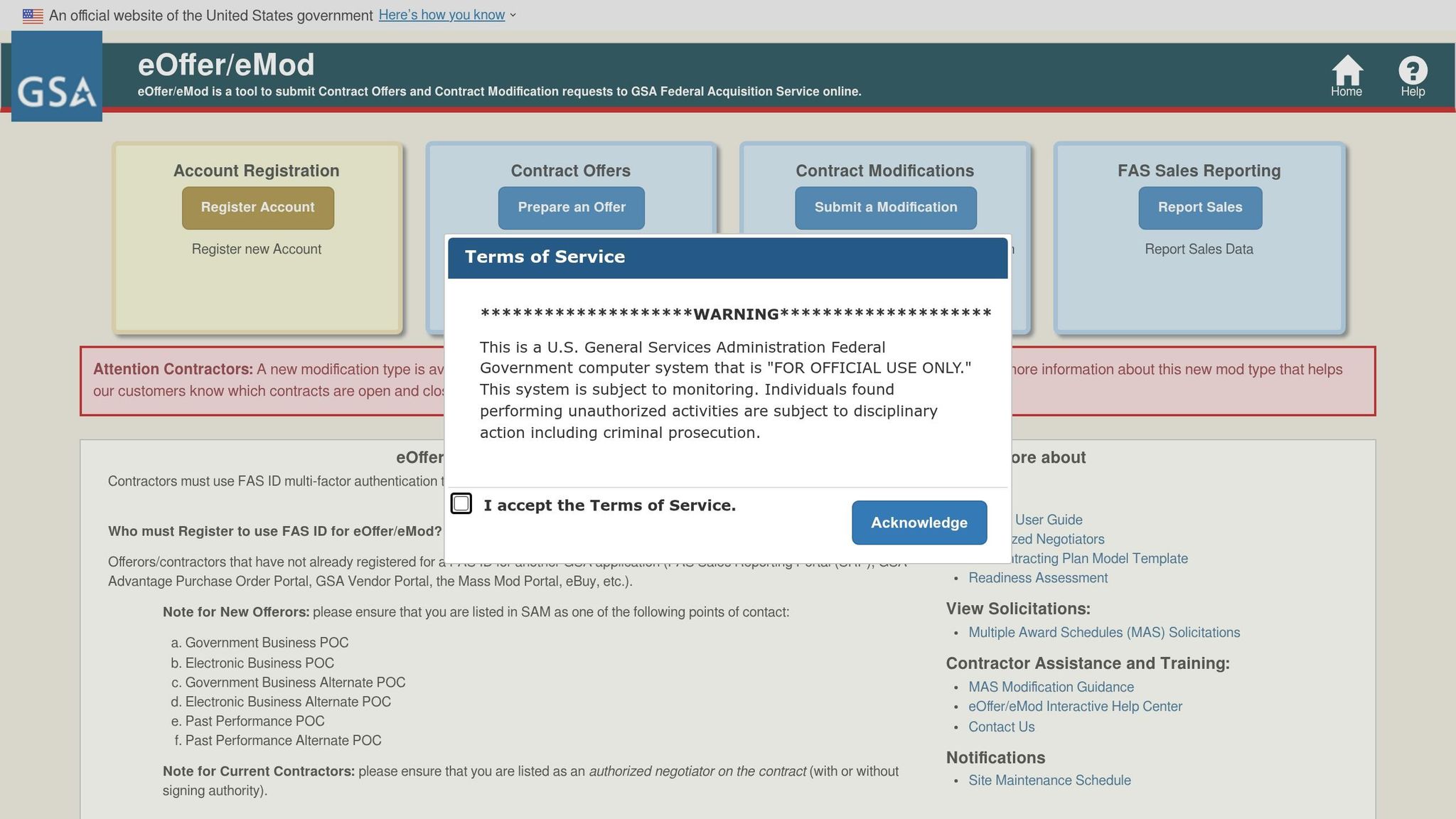
The eOffer system is an online platform designed for preparing and submitting Multiple Award Schedule (MAS) proposals electronically. It streamlines the process from document uploads to final electronic signatures.
To use eOffer, you’ll need a FAS ID, which replaced the older digital certificate system on March 8, 2021. If you already have credentials for other GSA systems like eBuy or the FAS Sales Reporting Portal, you can use them to log in. Make sure your SAM.gov profile has accurate Points of Contact, as the system relies on this information for authentication.
The eOffer process includes five stages: Authentication, Document Upload, Submission, Review, and Award. For technical issues, you can contact their help desk at 1-866-472-9114 or email eoffer@gsa.gov.
GSA Vendor Support Center
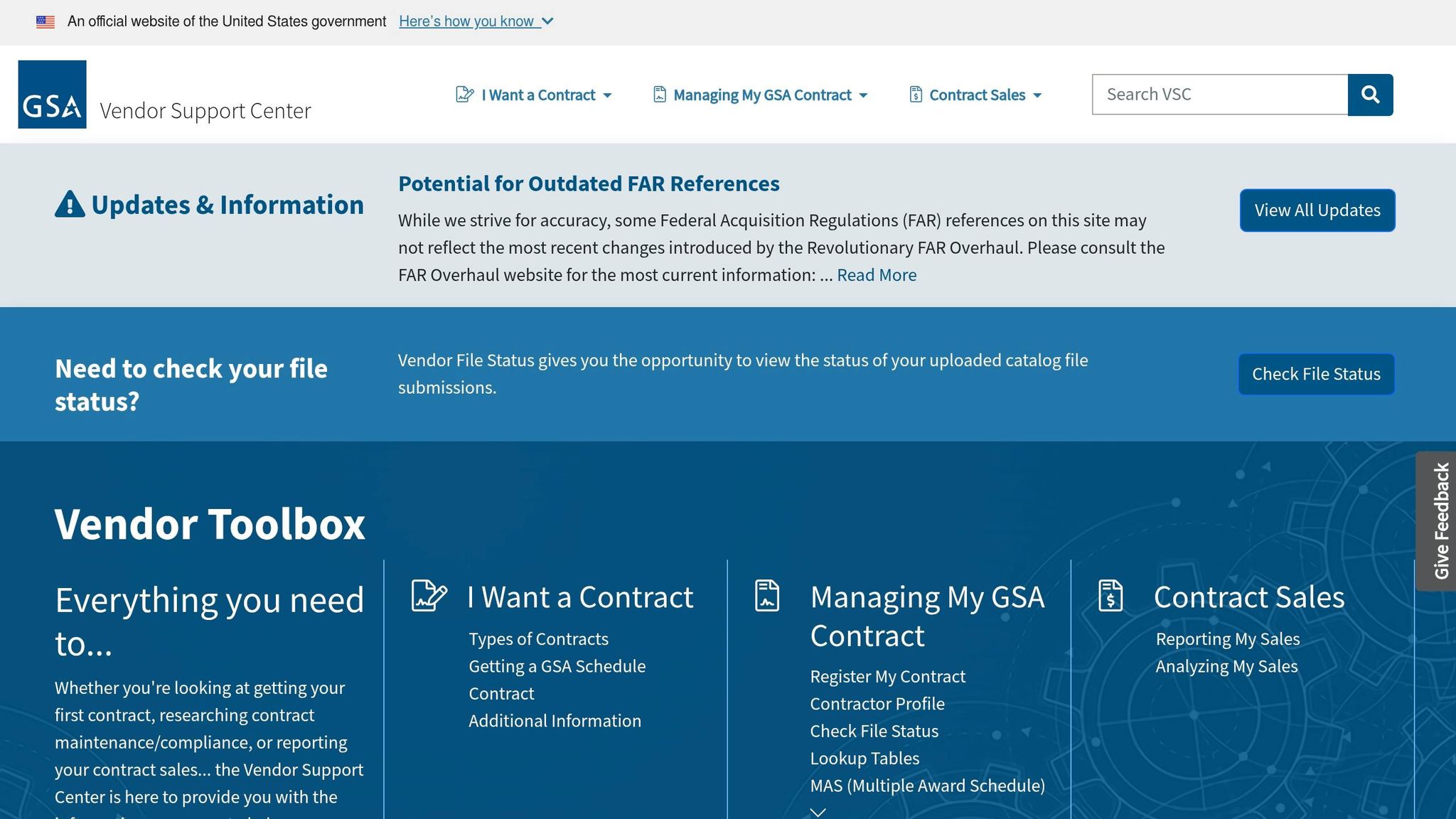
The Vendor Support Center (VSC) is a treasure trove of resources for MAS applicants. It provides essential documentation, training materials, and tools for contract management. One key requirement for all applicants is the "Pathways to Success" training, which must be completed by a company officer, such as the CEO, President, or Vice President. This training helps you evaluate whether a GSA Schedule is the right fit for your business.
The VSC also offers downloadable Contractor Start-up Kits, which include guides for listing products online and maintaining contracts. If you’re working on catalog submissions, the VSC provides technical instructions for the FAS Catalog Platform (FCP), which has replaced the older Schedule Input Program (SIP). The site is frequently updated with helpful resources like how-to videos, FAQs, infographics, and webinars, especially during system transitions. Use the VSC to access readiness assessments and checklists to ensure your offer meets GSA standards.
GSA eLibrary
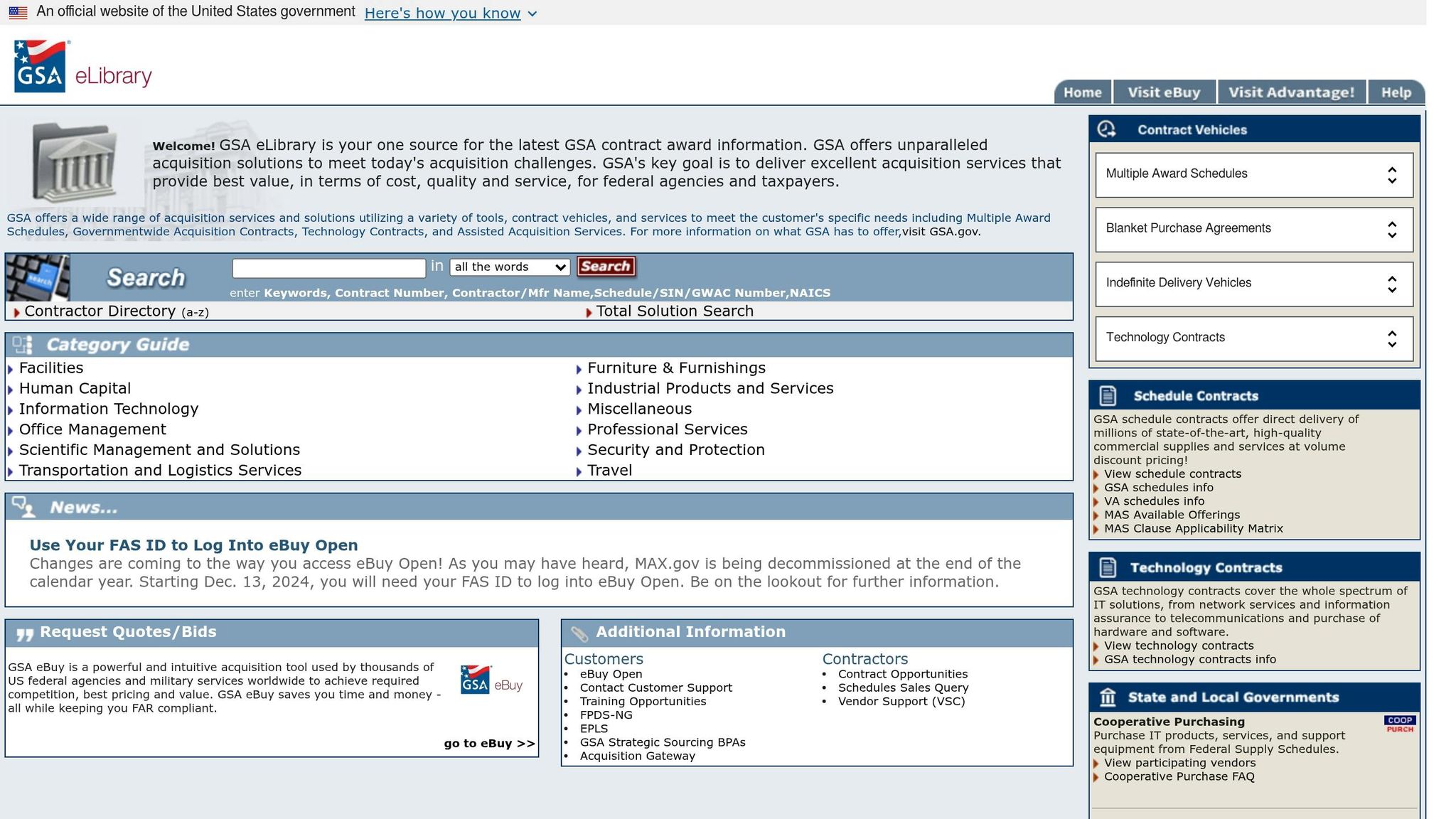
The eLibrary (formerly known as Schedules e-Library) is your go-to research tool for identifying Special Item Numbers (SINs) – the categories that determine what you can sell under your GSA Schedule. It provides detailed information on contract awards across GSA Schedules, VA Schedules, and Technology Contracts.
Before submitting your eOffer, use the eLibrary to confirm which SINs align with your products or services. You can also download solicitation documents for your chosen MAS. These documents outline the specific compliance requirements and "artifacts" you’ll need to prepare, helping you avoid missing any critical paperwork during submission.
Documentation Templates and Guides
Using templates can help streamline your proposal process and ensure everything aligns with GSA requirements.
SAM.gov Registration Guide
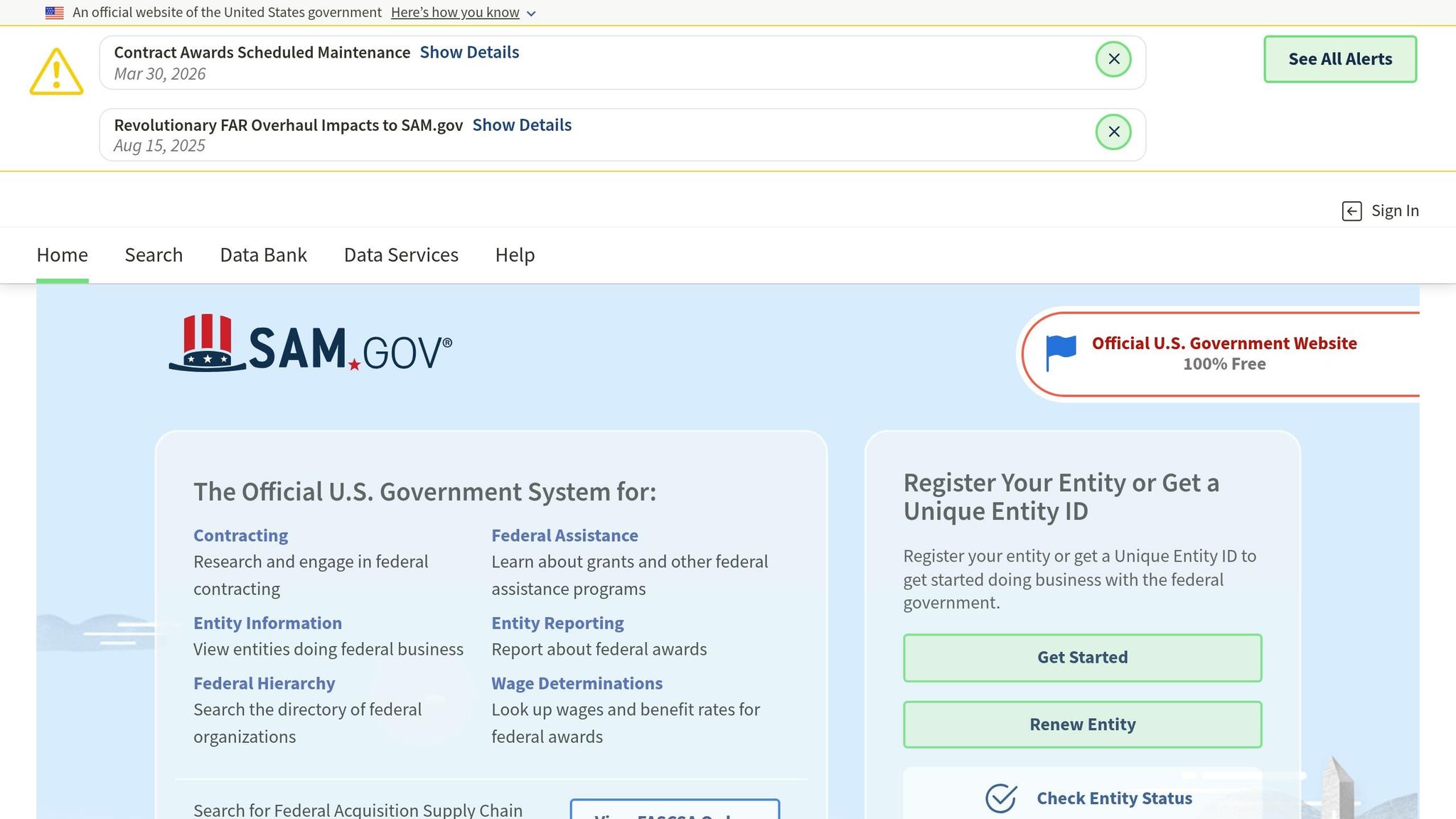
Start by completing your free SAM.gov registration to get your Unique Entity Identifier (UEI), which replaced the DUNS number in April 2022. Double-check that your Points of Contact in SAM.gov are current, as the eOffer system pulls authentication details directly from your profile. If you hit any technical snags, the Federal Service Desk is available to assist.
Once your registration is squared away, focus on preparing your past performance documentation to meet GSA standards.
Past Performance Documentation Template
To demonstrate past performance, provide three recent references using the PPQ template. This form allows your clients to verify your performance, especially if federal evaluations aren’t available. The PPQ collects key details like the customer’s name, point of contact, a brief project description, the total dollar value, and the exact period of performance. Make sure your references align closely with the type of work you’re proposing under your GSA Schedule. If a client prefers to send their PPQ directly to the GSA Contracting Officer, include a letter in your eOffer explaining this arrangement to avoid any issues with your proposal.
Once past performance is documented, shift your focus to pricing.
Pricing and Commercial Sales Practice Proposal
For product offers, you’ll need a Commercial Price List (CPL) and a Letter of Supply. For services, include detailed descriptions of each Labor Category. Fill out the Commercial Sales Practices (CSP) template to disclose your standard discount policies and basis of award. Additionally, confirm that your products meet Trade Agreements Act (TAA) requirements, meaning they are either manufactured or substantially transformed in the U.S. or a TAA-designated country. Don’t forget to account for the Industrial Funding Fee (IFF) – 0.75% of reported sales.
| Documentation Category | Key Templates & Guides | Source/Location |
|---|---|---|
| Entity Validation | SAM.gov Registration Guide, UEI Request Guide | SAM.gov / Federal Service Desk |
| Past Performance | Project Experience Template, PPQ, SOW/PWS | GSA eOffer / GSA Schedule Services |
| Pricing/Sales | Commercial Sales Practices (CSP), Commercial Price List | GSA MAS Solicitation / eOffer |
| Compliance | TAA Compliance Guide, Letter of Supply Template | GSA.gov / GSA Vendor Support Center |
| Administrative | Agent Authorization Letter, Org Chart, Financial Statements | GSA Schedule Services Knowledge Base |
Other administrative documents you might need include the Agent Authorization Letter (if you’re working with a consultant), organizational charts, and financial statements. Pulling these together early can help you avoid delays when it’s time to submit your eOffer.
GSA Focus Consulting Services
For small businesses looking to sidestep the hassle of endless paperwork, GSA Focus offers a solution that takes the weight off your shoulders. If managing the tools and processes feels overwhelming, their done-for-you service simplifies everything, connecting the dots between preparation and submission with ease.
What GSA Focus Brings to the Table
GSA Focus handles the heavy lifting – over 100 hours of documentation work, to be exact. Your role? Just 3 to 4 hours of effort, providing about 12 essential items like financial statements, past performance records, and your SAM.gov details. From there, their team takes charge, preparing and submitting your GSA Offer, ensuring FAR compliance, and negotiating pricing that works for your small business.
"We’ll be there with you, on-call, as your authorized negotiator, to make sure you get the prices your Small Business deserves."
– Josh Ladick, Founder, GSA Focus
With 17 years of experience, a 98% success rate, and 550+ awarded contracts, their track record speaks volumes. On average, clients see an additional $927,000 in revenue through their GSA Schedule.
Saving You Time and Effort
The process is five times faster than going it alone. Using their guided checklist portal, you upload your documents, and GSA Focus handles the rest – completing 95% of the paperwork. They also respond to government reviewers’ questions to keep your application moving forward. Post-award maintenance? They’ve got it covered, managing tasks like price increase requests and ensuring compliance with MAS Refresh updates, so your contract stays active and hassle-free.
"GSA Focus was crucial in helping us get our GSA contract quickly with no headaches, setting us on the path to some big wins."
– Deena T., Pacific Point
GSA Tools vs. GSA Focus Services
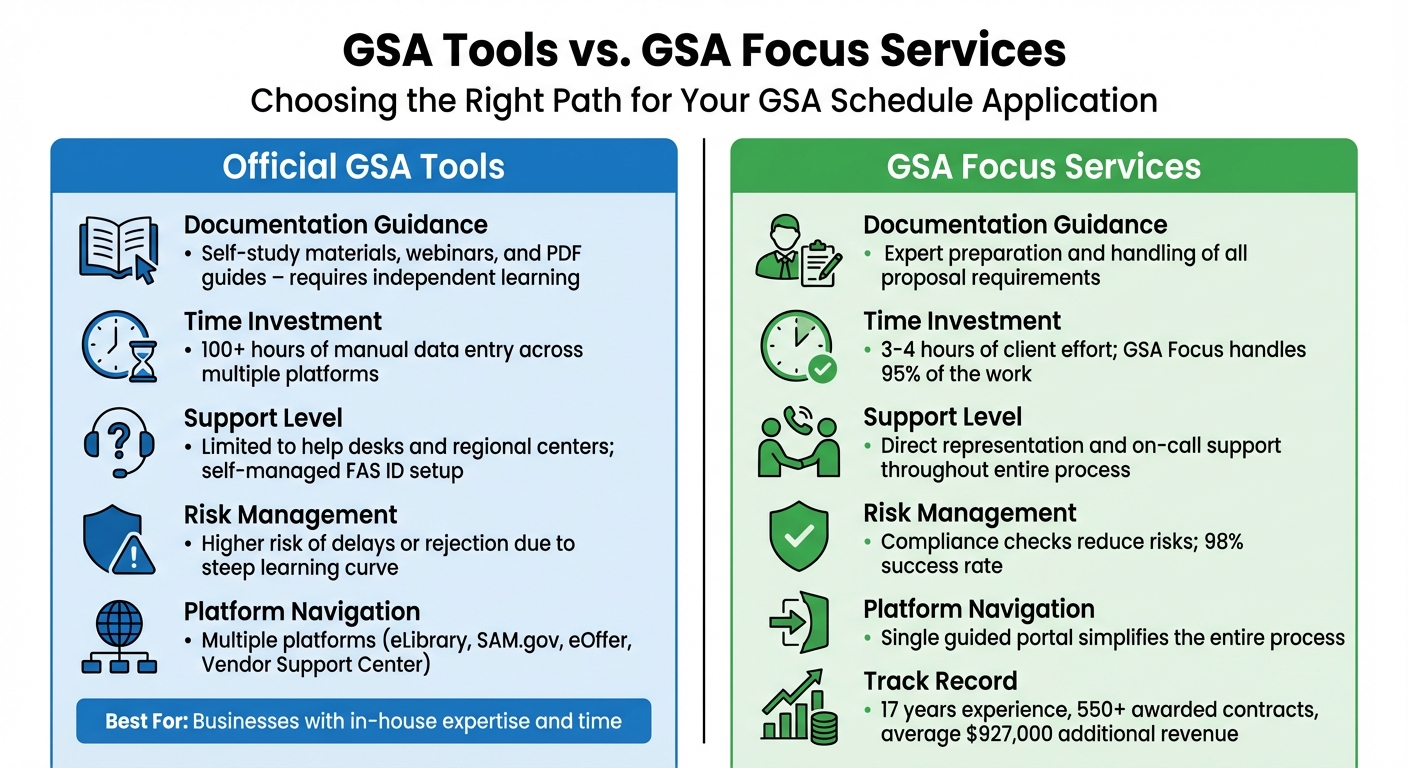
GSA Tools vs GSA Focus Services Comparison Chart
Navigating the complexities of GSA documentation can feel overwhelming, especially for small businesses. So, how do the official GSA tools stack up against the expert-led services offered by GSA Focus? The choice largely depends on your available time, resources, and familiarity with federal procurement processes. As the GSA itself admits, "obtaining a Schedules contract is a challenging process for a company of any size". This challenge often drives smaller businesses to seek outside expertise.
Feature Comparison Table
Here’s a breakdown of how official GSA tools compare to GSA Focus services:
| Feature | Official GSA Tools | GSA Focus Services |
|---|---|---|
| Documentation Guidance | Requires independent learning through self-study materials, webinars, and PDF guides | Provides expert preparation and handling of all proposal requirements |
| Time Investment | Needs over 100 hours of manual data entry and navigating multiple platforms | Minimal input required – GSA Focus takes care of most of the process |
| Support Level | Limited to help desks and regional centers; users must manage FAS ID setup and authentication themselves | Offers direct representation and on-call support throughout the entire process |
| Risk Management | Higher risk of delays or rejection due to the steep learning curve and complex requirements | Ensures compliance checks, reducing risks and improving success rates |
| Platform Navigation | Involves multiple platforms like eLibrary, SAM.gov, eOffer, and Vendor Support Center | Simplifies the process through a single, guided portal |
For businesses with in-house expertise and time, the official GSA tools can be a cost-effective option. However, as Stephanie Hagan, Training and Communications Manager at Winvale, explains:
"While this walkthrough may have made the process look simple and straightforward, it didn’t show all the work that goes into preparing your GSA Schedule proposal before you get to this step".
This is where GSA Focus shines. By managing the heavy lifting, such as pre-submission preparation and compliance reviews, they streamline the process, making it significantly easier for small businesses. For companies without dedicated procurement teams, the expert guidance and quicker turnaround offered by GSA Focus can be the key to securing a GSA Schedule in a matter of months, avoiding the lengthy and uncertain DIY route.
Conclusion
Navigating the complexities of GSA Schedule documentation requires a mix of official resources and expert insight. Tools like the eOffer system, SAM.gov, and the Vendor Support Center provide the essential framework and templates needed to maintain compliance with government standards.
As the PSI Team aptly puts it, "Proper documentation forms the backbone of trustworthy partnerships with government agencies, providing opportunities for business growth and stability". This is where professional consulting services, such as GSA Focus, can play a crucial role. Their expertise helps businesses avoid common missteps, like submitting outdated financial statements or inconsistent pricing. Combining standardized templates with expert review creates a strong foundation for crafting a successful GSA proposal.
To truly stand out, businesses should adopt a strategy that merges compliance with competitiveness. As GSA.gov reminds us, "Just getting a contract does not guarantee sales from government agencies". Additionally, understanding key details, like the 0.75% Industrial Funding Fee on reported sales, highlights why getting your documentation right from the start is so important. By prioritizing regular updates and thorough reviews, businesses can ensure their submissions are not only compliant but also strategically positioned to seize federal contracting opportunities.
FAQs
Which SINs should I choose for my GSA offer?
When choosing Special Item Numbers (SINs), it’s important to ensure they align with your expertise and meet federal procurement demands. For example, SIN 541611 covers business consulting, 54151S applies to IT services, and 561210FAC is ideal for facility management. These are highly sought after and can position your business for success.
Steer clear of outdated or overly generic SINs – they can lead to compliance challenges and may reduce your competitiveness in securing federal contracts. Focus on SINs that truly reflect your strengths and the services you excel at delivering.
What documents cause the most GSA proposal rejections?
The reasons why GSA proposals get rejected often boil down to a few key issues. Incomplete or outdated forms are a big one – missing details or using old versions of required documents can derail your submission. Errors in financial statements also raise red flags, as they might suggest instability or inaccuracies in your business operations. Then there are compliance issues, which can stem from not meeting the specific requirements outlined by GSA.
Other common pitfalls include mistakes in pricing, such as miscalculations or failing to align with GSA’s pricing expectations, and incorrect SIN (Special Item Number) selection, which can make your proposal irrelevant to the contract. Additionally, technical documentation errors – like missing or unclear information – can lead to outright rejection.
The takeaway? Double-check everything. Accurate, up-to-date, and carefully reviewed documentation is your best defense against these common errors.
When should I use GSA Focus instead of doing it myself?
If you’re looking to simplify the often-complicated process of preparing GSA Schedule proposals, GSA Focus might be just what you need. They offer a full-service solution that takes care of everything from document preparation to ensuring compliance and managing negotiations. This can save you valuable time and help minimize errors.
Their service is particularly useful for small businesses or anyone new to federal contracting. The process can be overwhelming, but having professional guidance not only makes it more manageable, it also improves your chances of success while helping you avoid expensive mistakes.
Related Blog Posts
- How to Read GSA Solicitation Documents
- Ultimate Guide to GSA Proposal Documents
- GSA Post-Award Checklist for Contractors
- 5 Steps to Meet GSA Prequalification Standards