
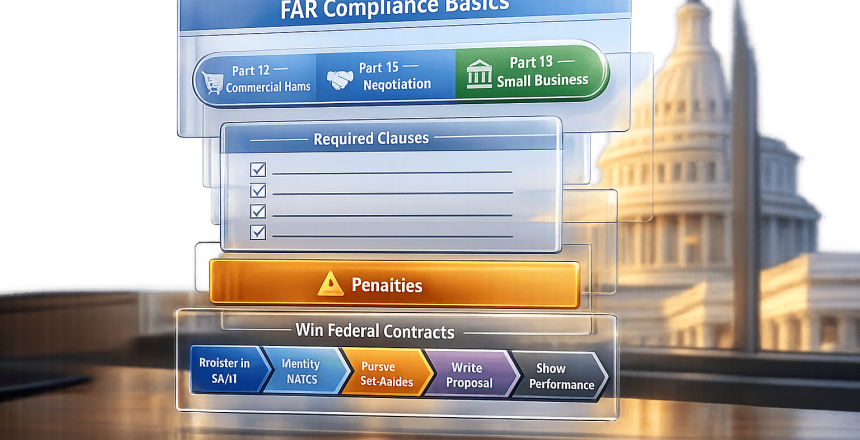
FAR (Federal Acquisition Regulation) is the rulebook for federal government procurement, detailing how agencies spend taxpayer money on goods and services. For small businesses, understanding FAR is essential for winning contracts, avoiding penalties, and navigating the $183 billion federal contracting market captured by small businesses in FY 2024.
Key takeaways:
- Why FAR matters: Ensures compliance, prevents disqualification, and opens opportunities in government contracts.
- Risks of non-compliance: Contract termination, fines, or debarment.
- Focus areas: FAR Parts 12 (commercial contracts), 15 (negotiated contracts), and 19 (small business programs).
- Recent updates: FAR 2.0 simplifies language, increases compliance thresholds, and renumbers clauses starting June 2026.
To succeed, small businesses should:
- Review and understand contract-specific FAR clauses.
- Build internal compliance systems with clear processes.
- Leverage resources like compliance experts or SBA programs.
Mastering FAR compliance is critical to accessing federal contracts and building long-term success in the government marketplace.
(live) How To Use the FAR To Your Advantage as a Small Business Government Contractor
What Is the Federal Acquisition Regulation (FAR)?
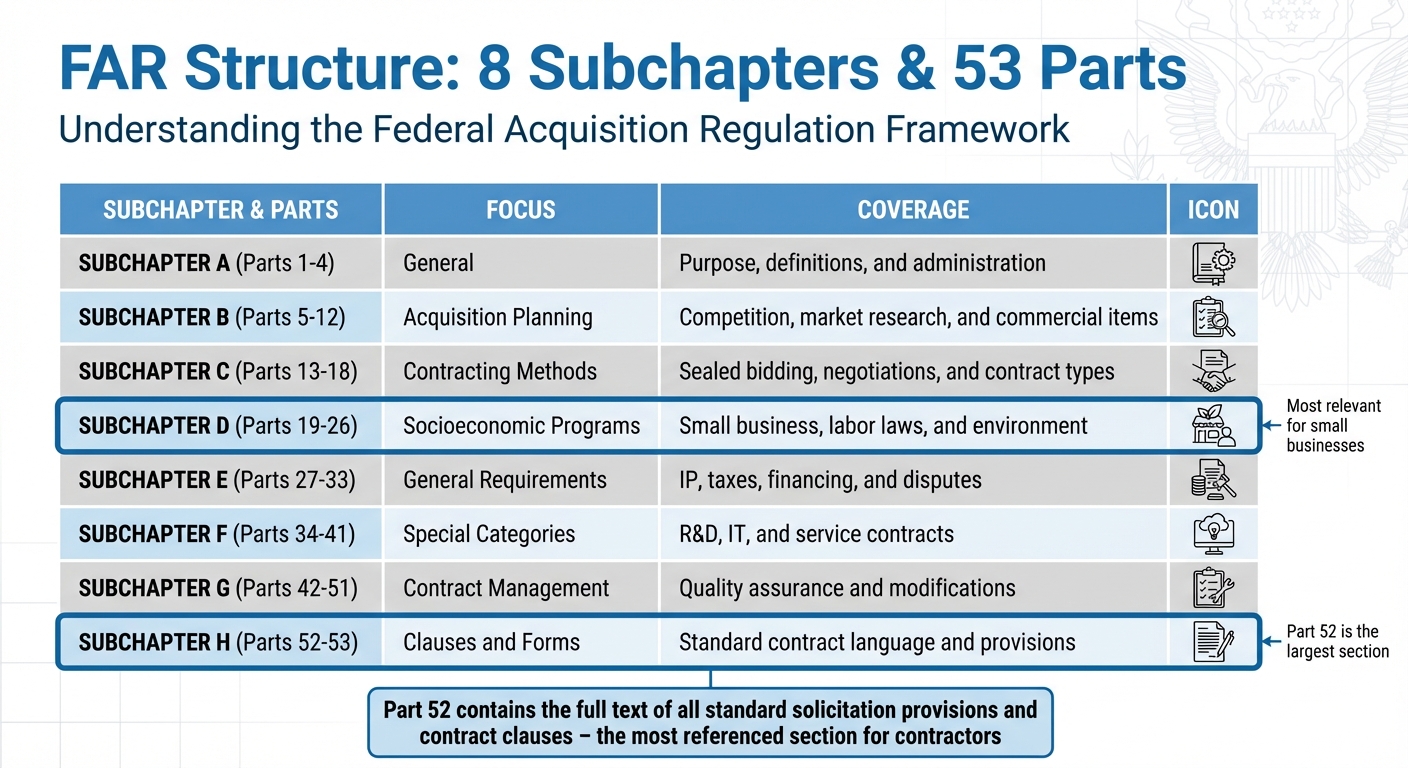
FAR Structure: 8 Subchapters and 53 Parts for Federal Procurement
The Federal Acquisition Regulation (FAR) serves as the main rulebook for how the U.S. federal government purchases goods and services using taxpayer dollars. It provides a standardized framework for federal procurement, which is especially important for small businesses aiming to stay compliant and take advantage of federal contracting opportunities.
Three agencies oversee the FAR: the Department of Defense (DoD), the General Services Administration (GSA), and NASA. This collaborative management ensures consistent application across federal agencies. The FAR is officially codified in Chapter 1 of Title 48 (48 CFR 1).
Before the FAR was established in 1984, federal procurement was a mess. A study uncovered 877 different procurement regulations across 19 agencies, totaling a staggering 64,600 pages. This patchwork led to inconsistencies and inefficiencies. President Harry S. Truman once highlighted the need for clear standards:
It is of great importance in procurement matters to establish standards and definitions to guide all personnel who have authority to place contracts. Otherwise, differences in interpretation and policies may result in imprudent contracts.
To address this, the FAR was created, unifying these scattered rules into one cohesive system. Today, it’s divided into 8 subchapters (A through H) and 53 parts, covering everything from basic definitions to detailed contract procedures.
What FAR Does
The FAR’s primary goal is to ensure transparency and uniformity in how the government spends taxpayer money. As outlined in FAR 1.101, its purpose is:
to deliver on a timely basis the best value product or service to the customer, while maintaining the public’s trust and fulfilling public policy objectives.
This system promotes fair competition, giving businesses of all sizes a chance to compete for contracts while ensuring the government gets the best value. It also protects against fraud, waste, and abuse by enforcing standardized processes.
For contractors, the FAR provides a consistent set of rules, even when specific clauses are accidentally left out of a contract. This is covered by the Christian Doctrine, which automatically enforces legally required clauses. Whether working with the Department of Veterans Affairs or the Environmental Protection Agency, contractors can rely on a familiar framework, making it easier to build expertise that applies across multiple agencies.
Main Sections of FAR
The FAR is organized into 53 parts within 8 subchapters, each focusing on a different area of federal procurement:
| FAR Subchapter | Parts | Focus Area |
|---|---|---|
| Subchapter A | 1–4 | General: Purpose, definitions, and administration |
| Subchapter B | 5–12 | Acquisition Planning: Competition, market research, and commercial items |
| Subchapter C | 13–18 | Contracting Methods: Sealed bidding, negotiations, and contract types |
| Subchapter D | 19–26 | Socioeconomic Programs: Small business, labor laws, and environment |
| Subchapter E | 27–33 | General Requirements: IP, taxes, financing, and disputes |
| Subchapter F | 34–41 | Special Categories: R&D, IT, and service contracts |
| Subchapter G | 42–51 | Contract Management: Quality assurance and modifications |
| Subchapter H | 52–53 | Clauses and Forms: Standard contract language and provisions |
Part 52 deserves extra attention. It’s the largest section and contains the full text of standard solicitation provisions and contract clauses. For example, if a solicitation mentions "52.212-4 Contract Terms and Conditions – Commercial Products and Commercial Services", you’ll find the complete language in Part 52.
Although the FAR applies government-wide, individual agencies can issue supplements for their specific needs. For instance, the Defense Federal Acquisition Regulation Supplement (DFARS) outlines additional rules for defense contracts, including stricter cybersecurity requirements. These supplements follow the FAR’s structure to maintain consistency.
Understanding how the FAR is structured is crucial for small businesses navigating federal contracting. Familiarity with its core sections helps businesses prepare for compliance and tackle the challenges of working with the federal government effectively.
Why FAR Compliance Matters for Small Businesses
Navigating the Federal Acquisition Regulation (FAR) isn’t just about ticking boxes – it’s about protecting your business and unlocking opportunities in the federal marketplace. For small businesses, mastering FAR compliance can mean access to a lucrative market and avoiding costly missteps.
Consider this: In FY 2024, small businesses secured $183 billion in prime contracts, accounting for 28.8% of all eligible federal contracting dollars. These contracts weren’t awarded randomly. They went to businesses that understood and adhered to FAR requirements. Small Disadvantaged Businesses alone captured $78 billion, while Service-Disabled Veteran-Owned Small Businesses earned about $32.8 billion.
But FAR compliance is about more than just winning contracts – it’s about longevity. Following the rules ensures you avoid contract termination, remain eligible for future opportunities, and build a reputation as a dependable federal contractor. While the government actively seeks to work with small businesses, it prioritizes those that meet its standards.
Penalties for Non-Compliance
The stakes are high when it comes to FAR compliance. Falling short can derail your federal contracting journey before it even gains momentum. The consequences range from rejected bids to financial penalties that could cripple a small business.
One of the most immediate risks is termination for default. If you fail to meet contract requirements or make adequate progress, the government can cancel your contract and charge you for the extra costs of procuring the goods or services elsewhere. This isn’t just about losing the contract – you could be financially liable for the difference if the government has to pay more to another contractor.
Specific violations come with their own penalties. Misrepresenting your business status on SAM.gov can lead to fines, imprisonment, debarment from future contracts, and False Claims Act settlements. Violating the Trade Agreements Act (TAA) by supplying non-compliant products can result in contract cancellations and refusal of renewals. For contracts involving sensitive information, failing to meet cybersecurity standards like CMMC can disqualify you from awards or lead to termination for default.
Another common compliance issue is subcontracting limit breaches. Small business prime contractors must handle at least 50% of the personnel costs in service contracts and 50% of manufacturing costs in supply contracts. Failing to meet these thresholds could label your business as a front for larger firms, which is exactly what these regulations aim to prevent. The consequences? Contract termination and possible financial penalties for excess costs.
Small Business Programs Under FAR Part 19
While the penalties for non-compliance are serious, FAR Part 19 offers programs designed to benefit small businesses. These initiatives don’t just level the playing field – they can give small businesses a competitive edge.
One key provision is the "Rule of Two". This rule mandates that contracting officers set aside acquisitions for small businesses when at least two responsible small businesses are expected to submit competitive offers at fair market prices. Essentially, it creates opportunities that exclude larger companies from competing.
FAR Part 19 also includes socioeconomic programs that provide additional advantages. The 8(a) Business Development program supports disadvantaged firms with both competitive and sole-source contracting opportunities. HUBZone-certified businesses enjoy a 10% price evaluation preference in full and open competitions, giving them an edge over larger competitors. Similarly, Service-Disabled Veteran-Owned Small Businesses (SDVOSB) and Women-Owned Small Businesses (WOSB) benefit from set-asides and sole-source awards tailored to their categories.
The late 2025 overhaul of FAR Part 19 simplified these programs by removing over 12,000 words of outdated content. As iQuasar LLC put it:
The FAR Part 19 overhaul is more than just a cleanup; it’s a strategic reset.
The reorganization around the acquisition lifecycle – Presolicitation, Evaluation & Award, and Post-Award – makes it easier for small business owners to find and understand the rules that apply to them.
These programs also offer protections. For instance, if a contracting officer deems your small business non-responsible, the case must be referred to the SBA through the Certificate of Competency (COC) process. This ensures the SBA has the final say on your ability to perform, preventing arbitrary exclusions by contracting officers.
For companies pursuing GSA Schedule Contracts, adhering to FAR Part 19 is especially critical. Organizations like GSA Focus help small businesses navigate these rules and prepare their GSA Schedule applications, ensuring that all set-aside eligibility and socioeconomic certifications are properly documented from the outset.
Next, we’ll break down the key FAR sections every small business needs to understand to stay compliant.
FAR Sections Small Businesses Need to Know
Getting familiar with these three FAR sections can strengthen your compliance efforts and improve your chances of success in federal contracting. If you’re a small business looking to enter this space, FAR Parts 12, 15, and 19 are the key areas to focus on.
FAR Part 12: Commercial Products and Services
FAR Part 12 prioritizes purchasing commercial items and adopts simplified procedures that mirror commercial market practices. This approach cuts through bureaucracy and accelerates the procurement process.
Under Part 12, acquisitions can go up to $9 million, with the ceiling increasing to $15 million for purchases tied to contingency operations or defense against cyber, nuclear, biological, or radiological threats. These simplified methods let you submit existing product literature instead of investing in costly, custom technical proposals.
Contracts under Part 12 are straightforward. Agencies must use firm-fixed-price or fixed-price with economic price adjustment contracts. Cost-reimbursement contracts are off the table. This predictability makes it easier to price your offerings, knowing what structure to expect.
Another advantage? Part 12 accepts the quality assurance systems you already use for your commercial clients. This eliminates the need for extra government inspections, saving you time and effort.
Recent updates to FAR Part 12 have reduced its length by 30%, cutting over 40 unnecessary clauses. Now, you only need to focus on four consolidated clauses when submitting offers: FAR 52.212-1 (Instructions), 52.212-3 (Offeror Representations and Certifications), 52.212-4 (Terms and Conditions), and 52.212-5 (Statutory/Executive Order Requirements).
Next, FAR Part 15 dives into how negotiated contracts and "best value" considerations shape your proposals.
FAR Part 15: Contracting by Negotiation
FAR Part 15 governs both competitive and non-competitive negotiated acquisitions, emphasizing "best value" rather than just the lowest price. This section is critical when responding to formal Requests for Proposals (RFPs), where agencies evaluate offers based on multiple factors.
Agencies generally use one of two source selection methods under Part 15:
- Tradeoff Process: Balances price against technical merit, allowing a higher-priced proposal to win if it offers better technical value.
- Lowest Price Technically Acceptable (LPTA): Awards the contract to the lowest-priced offeror who meets all technical requirements.
Understanding which method applies to a specific solicitation helps you fine-tune your proposal strategy.
Pre-proposal exchanges, like site visits, Requests for Information (RFIs), or pre-proposal conferences, are opportunities to engage with agencies early. These interactions, allowed under FAR 15.201, can help you influence acquisition strategies before an RFP is issued.
If your proposal isn’t selected, you can request a debriefing to learn about any weaknesses or deficiencies in your submission. This feedback can help you improve for future opportunities. Unlike the streamlined approach in Part 12, Part 15 requires detailed proposals using the Uniform Contract Format (UCF), which includes sections for schedules, clauses, and representations.
While Part 15 often requires certified cost or pricing data, commercial products and services are usually exempt, reducing the paperwork burden when offering these items.
Building on these acquisition processes, FAR Part 19 focuses on small business programs that create targeted opportunities.
FAR Part 19: Small Business Programs
FAR Part 19 enforces the Small Business Act, ensuring agencies give maximum practicable opportunities to small businesses through set-asides and socioeconomic programs.
Make sure your socioeconomic certifications – like 8(a), WOSB, HUBZone, and SDVOSB – are active and updated in SAM.gov. FAR Part 19 now requires verification before award, so outdated or incorrect certifications could disqualify you from set-aside opportunities.
Pay close attention to the NAICS codes assigned to solicitations. These codes determine the size standard for small business eligibility. If a contracting officer assigns a code that impacts your eligibility, you have just 10 calendar days from the solicitation’s release to file an appeal with the SBA. Missing this deadline means you lose the chance to challenge the code.
For bundled or consolidated contracts, the contracting officer must send the proposed acquisition package to the SBA at least 30 days before issuing a solicitation. This gives the SBA time to review whether the bundling disadvantages small businesses and, if necessary, recommend breaking the contract into smaller parts.
If you’re pursuing GSA Schedule Contracts, understanding FAR Part 19 is crucial from the start. GSA Focus can guide you through the process, ensuring your set-aside eligibility and certifications are properly documented and maintained throughout the contract lifecycle.
How to Prepare for FAR Compliance
Getting ready for FAR compliance takes careful planning, clear processes, and consistent attention to detail. Here’s how to create a strong framework to follow your FAR roadmap effectively.
Read Contract Clauses Carefully
The FAR is massive, spanning 2,300 pages, but don’t worry – you’re not expected to memorize it all. Instead, focus on identifying and understanding the clauses that apply to your specific contract. Each solicitation includes different FAR provisions based on factors like contract type, agency, and acquisition method.
Start with FAR Part 52, which contains all the provisions and clauses. When reviewing a solicitation, pay close attention to these four key areas:
- Supplies or Services and Price/Costs
- Statement of Work (SOW)
- Instructions to Offerors
- Evaluation Criteria
For commercial item solicitations, prioritize FAR 52.212-1 (Instructions to Offerors) and FAR 52.212-4 (Contract Terms and Conditions). These are critical for understanding submission requirements and contract terms.
To stay organized, create a compliance matrix in Excel. This matrix should list every FAR clause referenced in your solicitation or award, along with columns for the clause number, description, current compliance status, and actions needed to meet the requirements. This tool helps prevent oversights and ensures you’re prepared for audits.
Once you’ve identified the relevant clauses, incorporate them into your compliance processes.
Set Up Internal Compliance Systems
"Adherence to the Federal Acquisition Regulation (FAR) is crucial for contractors doing business with the U.S. federal government because it ensures compliance with the complex laws governing procurement processes, thereby minimizing legal and financial risks and enhancing the likelihood of successful contract performance." – FedFeather Frank, Fed Contract Pros
Building an internal compliance system starts with assembling a dedicated compliance team. This team should include individuals responsible for contract management and regulatory oversight. Ideally, assign a contract manager and, if possible, legal counsel to handle regulatory resources and compliance tasks.
Document your organization’s policies for contract administration, negotiation, and oversight. These written procedures not only guide your team but also serve as evidence during government audits. Regular employee training is essential – educational sessions ensure everyone involved in government contracts understands their responsibilities.
Establish a system for recurring contract reviews and internal audits. Keep detailed records of contract negotiations, amendments, training sessions, and any corrective actions. The government expects thorough documentation, and missing records can lead to compliance issues.
To stay ahead of changing standards, consider bringing in external experts for additional support.
Work with Compliance Experts
For many small businesses, hiring fractional compliance experts is a cost-effective way to handle FAR requirements. External advisors can help you navigate the complexities of compliance without the need for a full-time team. Initial setup for FAR compliance typically costs between $5,000 and $15,000, with ongoing expenses amounting to 2% to 3% of your total contract value.
These experts can conduct annual audits of your policies, procedures, and systems, ensuring you’re prepared for reviews by agencies like the DCAA or GSA Industrial Operations Analyst (IOA). They can also help align solicitation requirements with proposal sections, reducing the risk of technical disqualifications.
For GSA Schedule Contracts, GSA Focus offers comprehensive support, from document preparation to compliance assurance and negotiation assistance. Their team boasts a 98% success rate and even provides a refund guarantee, making them a reliable option for ensuring your systems meet FAR standards.
Additionally, you can tap into free technical guidance through APEX Accelerators (formerly PTACs). These programs assist with registration processes and certification eligibility checks. For agency-specific advice, reach out to the Office of Small and Disadvantaged Business Utilization (OSDBU) or the Office of Small Business Programs (OSBP) at your target agencies. These resources offer tailored guidance to meet specific compliance requirements.
Recent FAR Changes Affecting Small Businesses
The Federal Acquisition Regulation (FAR) is undergoing one of its biggest updates in decades. Known as the Revolutionary FAR Overhaul (RFO) or FAR 2.0, this initiative simplifies the regulation by using plain language and eliminating outdated rules. For small businesses, these changes bring a mix of benefits and new administrative demands. Starting June 30, 2026, several compliance thresholds will increase. For instance, the threshold for certified cost or pricing data under the Truth in Negotiations Act (TINA) will jump from $2 million to $10 million – a 400% increase. Similarly, the per-contract trigger for Cost Accounting Standards (CAS) will rise from $2.5 million to $35 million, and the threshold for full CAS coverage will double from $50 million to $100 million in total annual awards.
Another major shift involves clause renumbering. Many familiar FAR clauses now have new identifiers. For example, basic safeguarding requirements have moved from FAR 52.204-21 to FAR 52.240-93. Small businesses will need to update their proposal templates and compliance matrices to reflect these changes, as solicitations issued after February 2026 will use the revised numbering. These adjustments aim to streamline compliance processes and reduce complexity for small businesses.
Updates for Simpler Language
Beyond numerical changes, the FAR overhaul prioritizes clarity in regulatory language. Building on its core principles, the updated FAR reorganizes and simplifies its text for easier understanding. This plain-language initiative marks a major shift in federal regulatory writing. For example, FAR Part 19, previously titled "Small Business Programs", was renamed simply "Small Business" in late 2025 and restructured into three distinct phases: Presolicitation (19.1), Evaluation and Award (19.2), and Postaward (19.3).
"The revision preserves most substantive requirements while reorganizing them to align with the actual workflow of a contracting professional".
The Office of Federal Procurement Policy (OFPP) clearly articulated the goals of these changes: "faster acquisitions, greater competition, and better results".
Rule of Two Remains in Effect
The Rule of Two, a cornerstone of small business contracting, remains firmly in place. This rule mandates that federal agencies set aside contracts for small businesses when at least two responsible small businesses can submit competitive offers at fair market prices. The FAR Council has reinforced its importance, calling it "essential to sound procurement" policy. The updated FAR consolidates the Rule of Two into a single section (FAR 19.104-1), resolving past confusion caused by separate rules for different contract thresholds. It now applies consistently to all acquisitions above the micro-purchase threshold. This streamlined approach supports stronger competition among small businesses. In FY 2024, small businesses secured $183 billion in prime federal contracts, accounting for 28.8% of all federal procurement spending.
Additionally, contracting officers are now required to prioritize competitive 8(a) acquisitions before considering sole-source awards. This adjustment aims to foster more competition among certified 8(a) firms. To stay competitive, small businesses should invest in proactive market research to ensure they are identified as one of the two viable firms during set-aside decisions.
Conclusion
FAR compliance plays a critical role for small businesses aiming to secure federal contracts. It lays the groundwork for building strong, reliable relationships with government agencies. Key sections like FAR Part 12 (commercial products), FAR Part 15 (negotiated contracting), and FAR Part 19 (small business programs) provide essential guidelines. These sections, along with recent updates that simplify language and adjust acquisition thresholds, make it easier for businesses to navigate the process.
This guide has highlighted the key elements of FAR compliance that small businesses need to know. As regulations continue to evolve, staying informed and maintaining flexibility are vital. The consequences of non-compliance can be severe – even small mistakes can derail federal contracting opportunities. That’s why it’s essential to implement strong internal compliance systems and keep up with the latest regulatory changes.
Successfully managing FAR requirements takes both expertise and commitment. GSA Focus offers a comprehensive service designed to handle the heavy lifting for you. From preparing documents to ensuring compliance and supporting negotiations, their team simplifies the process. With a 98% success rate in helping businesses secure and manage GSA Schedule contracts, they make it easier to meet FAR requirements and focus on growing your business. By mastering FAR compliance, small businesses can confidently pursue federal contracts and establish enduring partnerships with government agencies.
FAQs
Which FAR clauses apply to my contract?
The FAR clauses relevant to your contract hinge on factors like the contract type, the agency involved, and the scope of work. While some clauses – such as those addressing compliance, payment terms, and performance standards – are common across federal contracts, others are tailored to specific agencies or programs. To ensure you’re on solid ground, take the time to thoroughly review your contract documents. If you’re unsure about any requirements, seeking advice from experts can help you stay compliant and steer clear of potential penalties.
How do I build a FAR compliance system fast?
To get a FAR compliance system up and running efficiently, start by grasping the fundamentals of the Federal Acquisition Regulation (FAR) and pinpointing the specific rules that apply to your contracts. Develop a clear compliance plan, including a matrix to map out requirements and responsibilities. Assign a dedicated team to monitor and manage compliance efforts, and make regular audits part of the routine to catch and address any issues.
Employee training is crucial – ensuring your team understands FAR requirements helps maintain consistency. Also, keep an eye on updates to FAR regulations to avoid falling behind. Leveraging tools like templates and checklists can make the process smoother, helping you stay organized and save time.
What changes in FAR 2.0 should I prep for?
FAR 2.0 brings some notable updates designed to streamline and clarify federal procurement rules. Among the key changes is the retention of the small business rule of two in Part 19, ensuring opportunities remain open for small businesses. Other updates include the use of plain language to make the regulations easier to understand, trimming down unnecessary content, and standardizing practices across agencies. These adjustments are aimed at making federal contracting simpler and more transparent, especially for small businesses looking to navigate the system.
Related Blog Posts
- Top 5 Compliance Issues in GSA Contracts
- Regulatory Requirements for Federal Contracts
- Federal Procurement Specialist Roles: A Guide
- FAR Compliance Penalties: What Small Businesses Should Know