
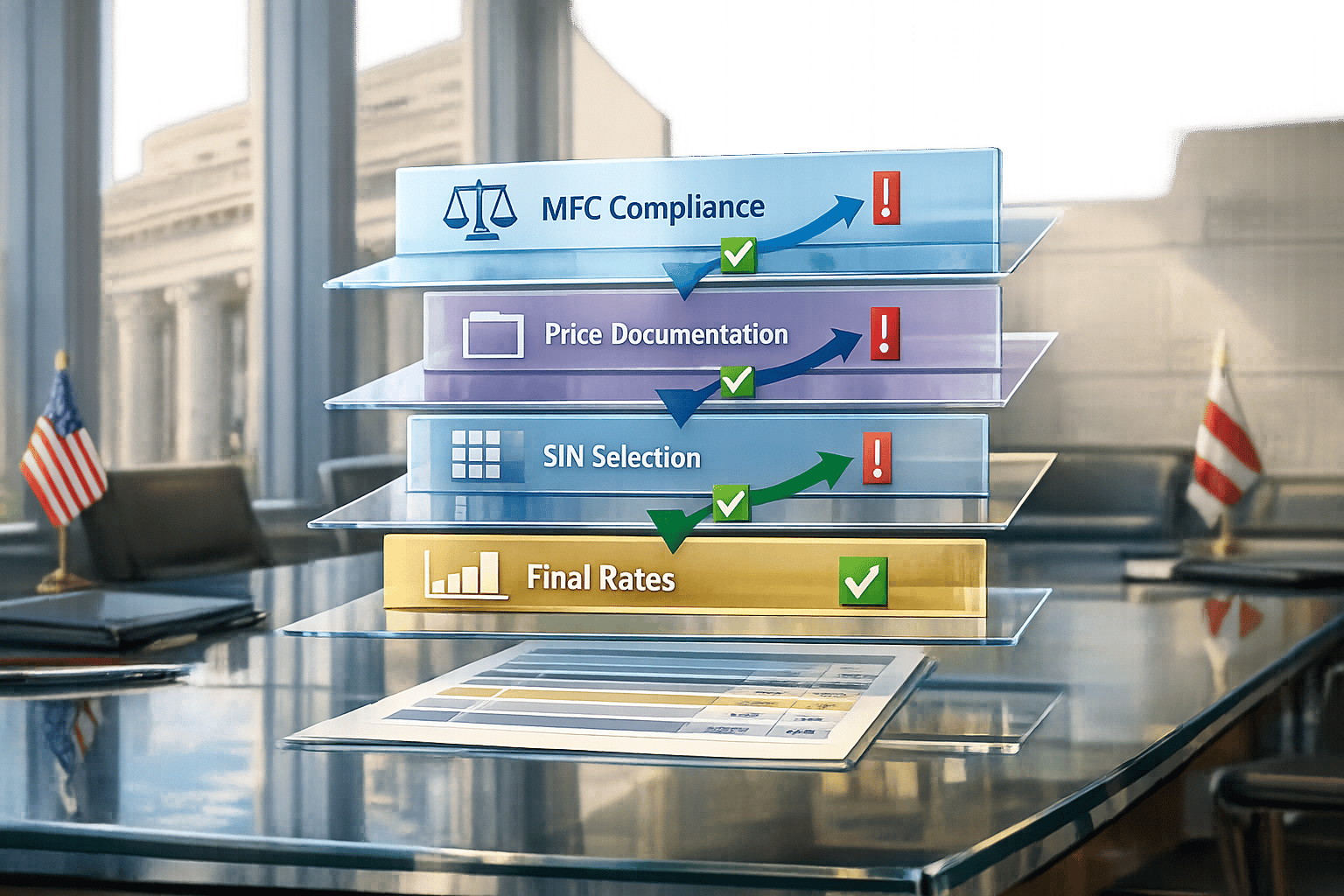
GSA pricing mistakes can cost you contracts and profits. Here’s what you need to know to avoid them:
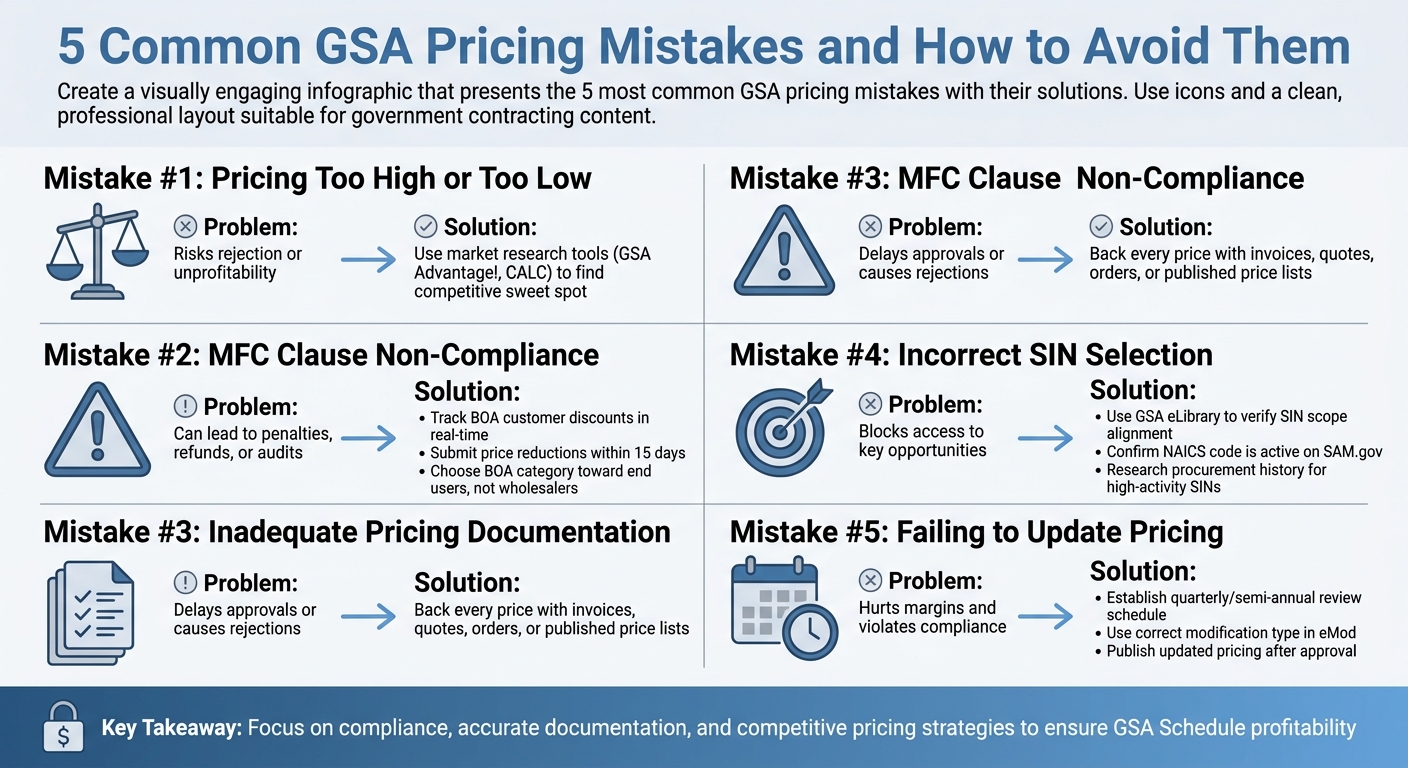
- Pricing too high or too low risks rejection or unprofitability.
- Non-compliance with the Most Favored Customer (MFC) clause can lead to penalties, refunds, or audits.
- Inadequate pricing documentation delays approvals or causes rejections.
- Incorrect SIN (Special Item Number) selection blocks access to key opportunities.
- Failing to update pricing in line with GSA rules hurts your margins.
To succeed, focus on compliance, accurate documentation, and competitive pricing strategies. This ensures your GSA Schedule is profitable and aligned with government expectations.
5 Common GSA Pricing Mistakes and How to Avoid Them
Top 10 GSA FAQs – GSA Contracts for Beginners!
Pricing Compliance and Most Favored Customer (MFC) Policies
Staying compliant with the Most Favored Customer (MFC) clause is a critical part of maintaining competitive and profitable GSA pricing.
What the MFC Clause Requires
The MFC clause is central to GSA pricing compliance. Carl Dickson, Founder of CapturePlanning.com, describes it this way:
"The MFC clause is based on the premise that the government deserves similar or better discounts than the best discount you offer to a particular customer category."
This means you must disclose the best discounts you offer to groups like dealers, distributors, educational institutions, OEMs, and end users. Based on this information, GSA negotiates a Basis of Award (BOA) customer, which sets the benchmark for "fair and reasonable" pricing. Importantly, you’re required to maintain a consistent percentage difference between the pricing offered to your BOA customer and the government. If you later provide a better discount to your BOA customer, you must adjust your GSA price proportionately within 15 days.
Frequent MFC Compliance Errors
One of the most common mistakes contractors make is failing to track BOA customer discounts in real time. This often leads to missed deadlines for the 15-day price modification requirement. Another frequent misstep is incorrectly identifying the BOA customer category. For example, some contractors mistakenly allow GSA to benchmark against high-volume wholesalers or OEMs, who typically receive larger discounts. This can make it difficult to maintain both compliance and profitability.
Kevin Lancaster from Winvale highlights the consequences of non-compliance:
"If GSA discovers that there have been violations to the PRC, they reserve the right to demand refunds on behalf of the federal government."
Beyond refunds, violations can lead to severe penalties, including civil or criminal charges and substantial fines during audits by the Office of Inspector General.
How to Maintain MFC Compliance
To avoid these pitfalls, it’s essential to take proactive measures:
- Assign dedicated personnel to review BOA orders before they’re finalized.
- Choose a BOA category that leans toward end users rather than wholesalers, ensuring pricing aligns with government expectations.
- Keep in mind that sales exceeding maximum order thresholds and direct sales to federal agencies do not trigger the Price Reductions Clause.
- Establish a clear process for submitting required price reductions to your GSA Contracting Officer within the 15-day timeframe.
Missing or Inadequate Pricing Documentation
When submitting a proposal to the GSA, you need to provide solid evidence that your pricing is fair and reasonable. Without this, your proposal could face delays or even rejection. Just like maintaining MFC (Most Favored Customer) compliance, having thorough pricing documentation strengthens your proposal and supports your pricing strategy. Patrick Morgans, Manager for Winvale’s BCG team, puts it plainly:
"If you cannot provide an invoice, quote, order, published price list, or similar document that substantiates the pricing of your offering, then GSA is likely to reject that offering."
This makes it clear: documentation isn’t just a formality – it’s a crucial part of the process.
Why Pricing Documentation Matters
Pricing documentation creates a clear, traceable link between your commercial sales practices and your GSA proposal. It assures Contracting Officers that your proposed rates are consistent with what you charge other customers and reflect real market conditions. Even if you qualify for Transactional Data Reporting (TDR), which can ease documentation requirements, Contracting Officers may still ask for supporting evidence. This is particularly true for services and labor categories, where competition might be limited, and pricing scrutiny is higher.
Common Mistakes in Pricing Documentation
One of the biggest errors contractors make is not providing any documentation at all. Others submit incomplete or irrelevant records – like a quote without the matching invoice or a price list that doesn’t align with the proposed rates. Sometimes, the documentation fails to connect your commercial pricing to the GSA rate you’re proposing, leaving Contracting Officers unable to verify compliance with the Basis of Award.
Tips for Organizing Your Pricing Records
To avoid these pitfalls, ensure every proposed price is backed by at least one reliable document, such as:
- Commercial invoices
- Quotes
- Sales orders
- Published commercial price lists
Double-check your rates using GSA’s tools, like CALC and GSA Advantage!, to confirm they align with market standards. Implement internal controls to track discounts and train your sales team to recognize when GSA price reductions are triggered. For federal sales made outside GSA channels, secure written confirmation that the customer chose not to use the GSA Schedule. This extra step can shield you during compliance audits.
Choosing the Right Special Item Numbers (SINs)
Selecting the wrong SINs for your GSA proposal can derail your chances of success. SINs serve as the classification system for your products and services within the GSA Multiple Award Schedule. They also determine how you receive notifications about relevant opportunities. Government buyers rely on SINs to issue Requests for Quotations (RFQs) and Requests for Proposals (RFPs) through the GSA eBuy system. Without the appropriate SIN on your Schedule, you’ll miss out on those opportunities entirely.
How SINs Work in GSA Proposals
Just as precise pricing documentation is critical, choosing the correct SINs is equally essential to ensure your proposal targets the right audience.
SINs represent the most specific level within the GSA classification structure, sitting below Large Categories (broad industry sectors) and Subcategories (more detailed industry breakdowns). Each SIN reflects specific procurement criteria. As GSA Focus puts it:
"A SIN is more than a number; it represents a specific category of products or services… Understanding the breadth and scope of each SIN is vital for vendors to correctly align their offerings." – GSA Focus
Every SIN has a defined scope, outlining exactly what can be sold under it. If your offering doesn’t align perfectly with this scope, the Contracting Officer will reject your proposal. The stakes are high – consider this: in Fiscal Year 2023, SIN 54151S (Information Technology Professional Services) generated $8,568,175,896 in sales, while SIN 541611 (Management and Financial Consulting) accounted for $4,286,087,144.
Common SIN Selection Mistakes
A common pitfall is confusing SINs with NAICS codes. While the two are connected, they aren’t interchangeable. Having an active NAICS code on your SAM.gov account is only part of the equation – it allows you to pursue a related SIN, but you still need documented past performance in that specific category to qualify.
Another frequent misstep is mismatching your offerings with the SIN scope. Some contractors attempt to fit their products or services into a SIN that seems close but doesn’t match the official scope language. This often leads to rejected proposals and wasted time. Additionally, businesses modifying existing contracts sometimes select the wrong modification type in the eMod system, such as confusing an "Add SIN" modification with an "Add Product" modification.
Steps for Selecting the Correct SINs
To get it right:
- Use the GSA eLibrary to review detailed SIN descriptions and ensure your offerings align with the scope.
- Confirm your corresponding NAICS code is active on SAM.gov and check for any required Price Proposal Templates under "Category Specific Attachments" on the GSA website.
- Research procurement history to identify SINs with high purchasing activity in your sector. Observing which SINs your competitors use can also help shape your strategy.
- If your offerings span multiple categories, list them under multiple SINs to broaden your visibility and opportunities.
Keep in mind, GSA regularly updates SIN categories, so periodic reviews are essential to stay compliant and competitive.
This meticulous approach to SIN selection echoes the same level of care needed for compliance and accurate pricing documentation.
Setting Competitive Yet Profitable Prices
Once you’ve aligned with your SIN (Special Item Number), the next step is to set prices that strike a balance between winning contracts and maintaining profitability. A common mistake contractors make is offering their absolute lowest price right out of the gate, assuming it will secure approval. But as Patrick Morgans, Manager for Winvale’s BCG team, advises:
"It is generally advisable to not offer the absolute lowest pricing you can with your initial submission since you will want some wiggle room".
Contracting Officers often negotiate pricing. If you start too low, you risk cutting into your profits or even operating at a loss. This pricing strategy builds on the compliance and SIN selection processes you’ve already tackled.
Finding the Right Price Point
The price you set for your GSA Schedule becomes your ceiling rate. You can’t exceed this rate without a formal contract modification, but you can strategically offer spot discounts when bidding for specific opportunities. This makes your initial pricing decision critical. The goal isn’t to be the cheapest but to be competitive in a way that preserves your margins. For example, you could bundle services or offer volume discounts to make your proposal more appealing without undercutting your base rates.
Using Market Data for Pricing Decisions
Market research is your best friend when determining pricing. Tools like GSA Advantage! and the GSA CALC tool are invaluable for this. GSA Advantage! allows you to search competitor pricing for similar products, while CALC provides ceiling rates for labor categories across existing contracts. Additionally, GSA publishes product demand data, which can reveal average transaction prices for specific items – key insights for positioning your offerings.
When analyzing competitor pricing, don’t just look at the numbers. Federal buyers often weigh other factors like delivery times, minimum order quantities, and product descriptions alongside price. In many cases, a slightly higher price paired with faster delivery or better terms can win the contract. As Patrick Morgans points out:
"One of the most important things to keep in mind when drafting your GSA Schedule pricing is that… you need to make sure the pricing is beneficial to the government but also something you can be happy with".
This balanced approach helps you stay competitive while protecting your bottom line.
Getting Professional Help with Pricing Strategy
Pricing for GSA contracts involves juggling government requirements, competitor data, compliance rules, and your profit margins. Professional support can make a big difference. For instance, GSA Focus has guided over 600 clients through this process, delivering an average 87x ROI. Their team can help you structure pricing that satisfies Contracting Officers and leaves room for growth. They also assist with planning for Economic Price Adjustments (EPA), which allow you to raise prices annually to account for increasing costs.
Keeping Pricing Current Through Modifications
Your GSA Schedule isn’t just a static document – it evolves with your business. As Patrick Morgans, Manager for Winvale’s BCG team, explains:
"Your GSA Schedule is a living document, and changes are often required to ensure that it remains up-to-date and compliant".
But here’s the thing: you can’t charge above your approved GSA price until your Contracting Officer gives the green light through a formal modification. This "ceiling rate" makes it essential to stay on top of pricing updates to protect your margins.
Common Errors in Pricing Updates
When it comes to updating pricing, contractors often stumble into avoidable pitfalls. Here are some of the most frequent mistakes:
- Delaying updates: Missing the window to adjust pricing when commercial rates shift can hurt your business.
- Using outdated templates: Submitting an older Price Proposal Template (PPT) or the wrong form (like "Offer" instead of "Modification") leads to rejections.
- Selecting the wrong modification type: Choosing an incorrect category in eMod (e.g., "Add SIN" instead of "Add Product") sends your request down the wrong review path.
- Overlooking mandatory mass modifications: Failing to sign these within 90 days can block Contracting Officers from processing voluntary updates.
- Not publishing updated pricing: Even after a modification is approved, contractors not yet on the FAS Catalog Platform (FCP) must manually upload their new catalog via SIP or EDI.
Patrick Morgans emphasizes this last point:
"Award of a modification through eMod will not automatically publish their updated pricing or offerings… These contractors are still required to upload their new catalog either through SIP or EDI after approval".
Another common misstep? Signing the SF-30 form without a thorough review. Any errors in discount structures or terms become binding, leading to compliance headaches.
Creating a Pricing Review Process
Avoiding these issues starts with a solid pricing review system. A quarterly or semi-annual review schedule works well for most contractors. This routine helps you spot when commercial price changes, market trends (like shifts in the Consumer Price Index), or other factors call for a modification.
Plan ahead – pricing modifications often take longer to process than technical or administrative updates. Submitting early ensures your new rates go into effect when needed. Always consult the latest MAS Modification Guide and GSA checklists before submitting.
Your sales team plays a critical role here. They need to understand how commercial discounts interact with GSA compliance. Offering deeper discounts to commercial customers can trigger the Price Reductions Clause (PRC), requiring a proportional reduction in your GSA pricing. Implementing internal controls, like the documentation practices mentioned earlier, can help prevent accidental violations.
Understanding the Price Reductions Clause
For non-TDR (Transactional Data Reporting) contractors, the PRC requires constant oversight of commercial sales to maintain the "basis of award" discount relationship. Patrick Morgans explains:
"When the basis of award discount relationship is disturbed, a GSA Schedule contractor is usually required to inform their Contracting Officer and submit a modification to lower their GSA Schedule pricing proportionally".
Offering a discount to a commercial customer that exceeds what you disclosed in your Commercial Sales Practices triggers a compliance issue. However, temporary discounts – like spot discounts – don’t count. Federal customers can receive these short-term discounts without activating the PRC or requiring a modification.
TDR contractors have an easier path since they don’t need to monitor the PRC or disclose Commercial Sales Practices. In fact, as of Solicitation Refresh #28, all contractors with TDR-eligible SINs must participate in TDR reporting.
When submitting pricing modifications, always gather supporting documents – like invoices, quotes, or published price lists. Even TDR contractors might need to provide this data if a Contracting Officer requests it to confirm pricing is fair and reasonable. One tip: avoid offering your lowest price upfront during a modification submission. This leaves room for negotiation.
Matching Commercial Sales Practices (CSP) with Proposed Pricing
Your Commercial Sales Practices (CSP) disclosure is the bedrock of your GSA pricing structure. For contractors not enrolled in the Transactional Data Reporting (TDR) program, the discounts you offer to commercial customers establish your Basis of Award (BOA). This relationship directly impacts your GSA pricing. If your CSP and pricing practices don’t align, you could face compliance violations and serious contract issues.
Common CSP Documentation Problems
One of the most critical errors? Offering deeper discounts to your commercial customers than what you disclosed to GSA. This disrupts your BOA relationship and triggers mandatory price reductions across your entire GSA contract. Patrick Morgans, Manager for Winvale’s BCG team, underscores the importance of maintaining compliance:
"It is imperative that GSA Multiple Award Schedule holders enact internal controls and ensure that sales personnel are educated and aware of the impact that giving commercial customers discounts greater than disclosed in the company’s Commercial Sales Practices can have on GSA Schedule pricing".
Even unauthorized spot discounts can wreak havoc, leading to government-wide price reductions and eroding your profit margins on federal sales. To avoid this, you need strong internal controls and meticulous documentation.
Setting Up Internal Tracking Systems
Real-time monitoring is essential to prevent BOA violations. Your tracking system should automatically flag any discount that approaches or surpasses your disclosed CSP thresholds. This ensures your sales team operates within GSA compliance boundaries, with clear visibility into these limits.
To stay ahead, create a centralized repository for all pricing documentation – this includes invoices, quotes, and price lists – organized by product and date. Such a system allows you to quickly verify and substantiate pricing during proposal reviews. It also aligns with strategies for maintaining accurate CSP disclosures and Most Favored Customer (MFC) compliance.
Here’s a commonly overlooked tip: Separate documentation for non-GSA federal sales. If a federal customer uses a different contracting vehicle, secure written confirmation that GSA pricing requirements didn’t apply to that transaction. This small step can safeguard you during audits.
Reviewing Proposals Before Submission
Once your monitoring and documentation systems are in place, the next step is to ensure every proposal aligns with your disclosed CSP. Before submitting any proposal or modification, cross-check each price point with at least one redacted invoice or an equivalent document. This step helps catch discrepancies between your CSP disclosure and actual commercial practices.
Additionally, verify whether your Special Item Numbers (SINs) are TDR-eligible. Opting into TDR can eliminate CSP disclosure requirements and the need to track the Price Reductions Clause. While TDR does require more frequent sales reporting, it removes the constant burden of monitoring commercial discount relationships.
Finally, train your sales team to understand how shifts in commercial pricing can affect GSA compliance. They need to recognize that every commercial deal has both legal and financial implications for your federal contracts. A single mistake could force a contract modification and lead to proportional price reductions across your entire GSA Schedule.
Conclusion
Navigating GSA pricing is no walk in the park. Even small errors can snowball into major setbacks. This process demands precision – accurate documentation, strict adherence to regulations, and a well-thought-out pricing strategy within a tightly controlled framework.
That’s where expert assistance becomes invaluable. As GSA Focus explains, "Doing it yourself often costs more in lost time and missed opportunities". With a track record of serving over 600 clients and achieving a 98% satisfaction rate, their expertise speaks volumes. On average, their clients report an impressive return on investment of 87x. This shows that having professionals in your corner can turn a daunting process into a manageable pathway to success in federal contracting.
Whether you’re grappling with compliance hurdles, pricing strategies, or documentation requirements, the solution is clear: establish strong internal controls and seek expert support. GSA Focus (https://gsascheduleservices.com) provides comprehensive, done-for-you services, covering everything from document preparation to compliance checks and negotiation guidance.
Patrick Morgans of Winvale emphasizes this point: "We often consider the pricing section of a GSA Schedule offer the most important to focus on because a lot of time and effort needs to be put into making certain that a prospective GSA Schedule contractor is putting forward the best pricing package… while maintaining a healthy profit margin". By getting the pricing right, you not only safeguard your profitability but also set the stage for lasting success in federal contracts. Addressing these common challenges head-on ensures your business is well-positioned for long-term growth in the federal marketplace.
FAQs
How do I choose the right Basis of Award customer?
To choose the best Basis of Award customer for your GSA Schedule proposal, it’s crucial to match your product or service to the appropriate SIN (Special Item Number). Getting this wrong can result in your proposal being rejected.
- Review SIN Descriptions: Use the GSA eLibrary to compare your offering against the SIN descriptions.
- Double-Check for Accuracy: Don’t rely on assumptions – take the time to confirm your product or service fits the chosen SIN.
- Seek Guidance if Needed: If you’re uncertain, consult a GSA specialist or thoroughly review the SIN criteria to ensure compliance.
Taking these steps can save you time and prevent unnecessary complications.
What documents does GSA accept to support my pricing?
GSA requires a range of documents, including financial statements, pricing templates, commercial sales data, and detailed product or service descriptions. To ensure your pricing is well-supported, make sure these materials are accurate, complete, and fully aligned with GSA’s standards.
When do I need to submit a GSA pricing modification?
When making major updates – like changes to pricing, product offerings, scope, or terms – you’ll need to submit a GSA pricing modification. To stay compliant, it’s crucial to thoroughly review the requirements and follow the correct submission process. This ensures your contract remains aligned with GSA standards and maintains its integrity.
Related Blog Posts
- Common GSA Compliance Mistakes And Fixes
- 5 GSA Discounting Rules for Compliance
- Avoid These Mistakes When Applying for a GSA Contract
- Common GSA Proposal Mistakes and How to Avoid Them