

Federal procurement can be simplified with GSA Schedules, which provide pre-negotiated prices, terms, and conditions for millions of products and services. These contracts help federal agencies save time, ensure compliance, and focus on value. Here’s a quick overview of how to make the most of GSA Schedules:
- Platforms: Use GSA Advantage! for catalog purchases, GSA eBuy for RFQs and competitive quotes, and GSA eLibrary for vendor research.
- Eligibility: Federal agencies, the Department of Defense, and authorized state or local governments can use GSA Schedules under specific programs like Cooperative Purchasing.
- Purchase Thresholds: Follow guidelines based on value:
- Up to $10,000: Direct purchases with minimal competition.
- $10,001–$250,000: Obtain multiple quotes and document decisions.
- Over $250,000: Use formal RFQs with detailed evaluations.
- Compliance: Maintain thorough documentation, including RFQs, quotes, and best-value justifications, and adhere to FAR 8.4 guidelines.
- Government Purchase Cards (GPCs): Ideal for small purchases under $10,000, ensuring quick transactions while meeting compliance standards.
This guide ensures your procurement process is efficient, compliant, and tailored to your agency’s needs.
Buying Services Through GSA Schedules – Basics of Buying Part 1
Eligibility and Compliance Requirements
Federal agencies and wholly owned government corporations are the main groups allowed to purchase from GSA Schedules, following the guidelines outlined in FAR Part 8 ordering procedures. Other entities, including federal civilian agencies, the Department of Defense, and certain quasi-governmental and international organizations, may also place orders if they have specific GSA authorization. This eligibility framework also extends limited access to state, local, and tribal entities through specialized programs.
For state and local governments, GSA Schedules aren’t typically used for everyday purchases. However, they can access specific programs under certain conditions. For example:
- Cooperative Purchasing Program: This program allows state, local, and tribal governments to buy IT, security, and law enforcement products and services from participating Schedule contractors.
- Disaster Recovery Program: Designed for disaster-related needs, this program provides access to goods and services for preparation, response, and recovery efforts, especially during emergencies like hurricanes, wildfires, or floods.
In both cases, purchases must serve government purposes and be paid for with public funds.
It’s important to note that GSA Schedules are strictly for official government use. Items bought through these contracts cannot be used for personal purposes or resold. Government Purchase Card users must ensure items are shipped to official government addresses and must keep records to confirm the purchases are mission-related.
All purchases must comply with FAR and GSA-specific policies, which include rules on socioeconomic considerations, domestic preferences, and labor standards. These policies are updated periodically through Mass Modifications. To ensure compliance, agencies often implement training programs and internal controls. These measures might include supervisory reviews, regular audits, and automated tools to monitor transactions, ensuring that only authorized personnel place orders within approved limits.
Agencies are also required to maintain detailed acquisition files. These records should confirm the purchaser’s authorized status, valid funding, contracting authority, and determination of best value. Contractor eligibility can be verified using resources like GSA eLibrary or GSA Advantage. Keeping accurate records ensures that all purchases meet federal procurement standards.
GSA Online Platforms for Purchasing
Federal buyers rely on three primary platforms to simplify the procurement process: GSA eLibrary for research, GSA Advantage! for standard purchases, and GSA eBuy for customized quotes. Together, these tools streamline purchasing, reduce lead times, and ensure compliance with federal procurement standards.
The process typically begins with eLibrary to identify qualified vendors and confirm contract details. Buyers then turn to GSA Advantage! for routine product purchases or to eBuy for more complex requirements, such as services or competitive bids. These platforms work together in a sequence, making each step of the procurement process faster and more efficient.
GSA Advantage!
GSA Advantage! is the go-to platform for federal buyers searching for products. With its user-friendly search tools, buyers can look up millions of items using keywords, part numbers, or NSNs (National Stock Numbers). The platform displays side-by-side comparisons of pricing, features, and delivery options from various contractors, making it easy to evaluate offers.
Buyers can refine their searches based on criteria like country of origin, small business status, or environmental features to meet agency-specific goals. Orders can be placed directly online using Government Purchase Cards (GPCs), blanket purchase agreements, or requisitions. The system also integrates with agency purchasing systems, supporting everything from simple transactions to more complex procurement needs.
One of the key advantages of GSA Advantage! is its access to pre-negotiated pricing under the Multiple Award Schedule (MAS) program. This allows buyers to quickly compare unit prices across vendors and document best value determinations, ensuring transparency and efficiency in the purchasing process.
GSA eBuy for Requests for Quotes
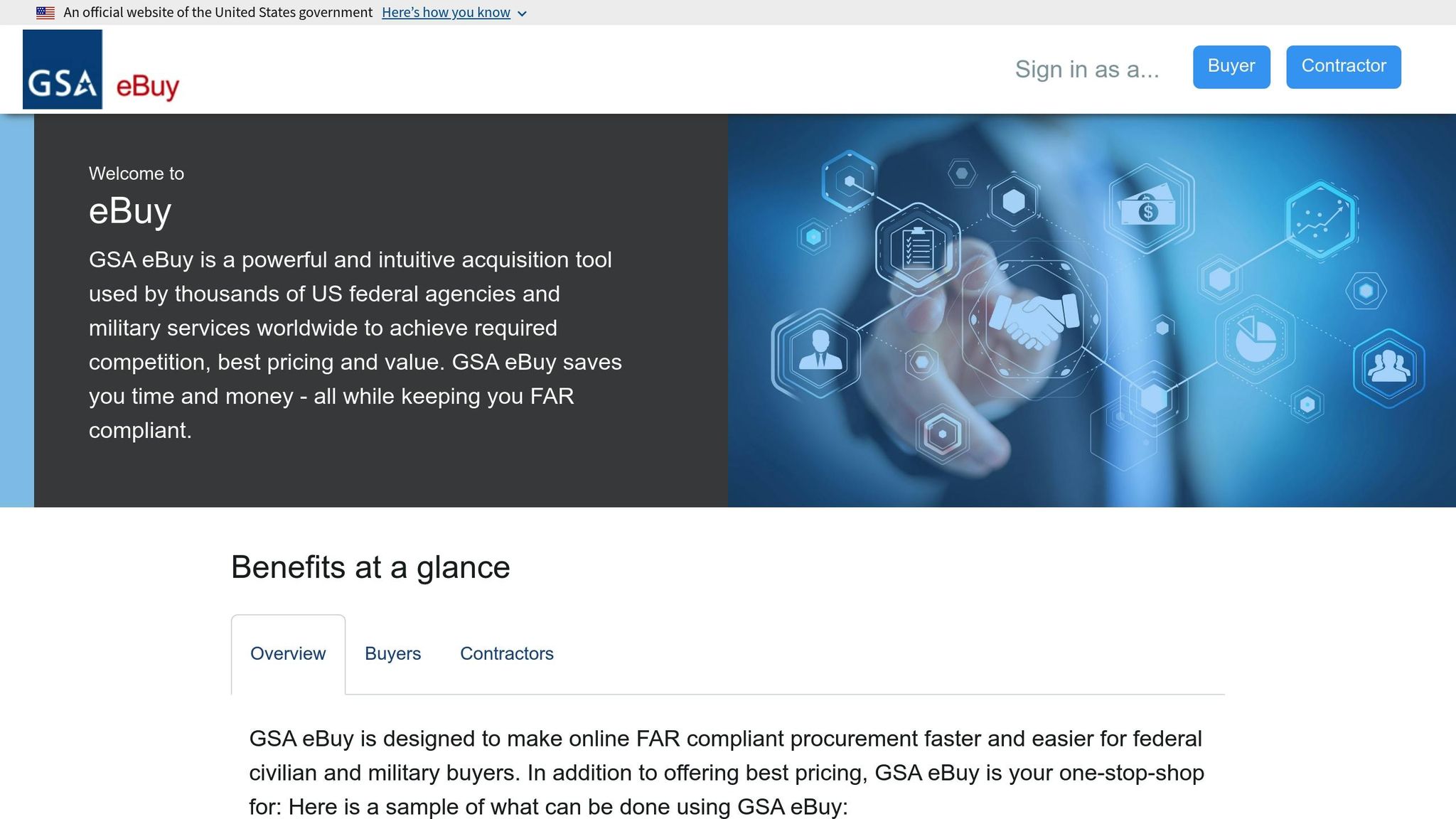
When buyers need tailored solutions, services, or volume discounts, GSA eBuy becomes the platform of choice. It allows federal agencies to post Requests for Quotes (RFQs) to Schedule contractors. Buyers can outline their requirements, attach statements of work, set deadlines, and specify the relevant Schedule or SIN (Special Item Number) to ensure only qualified contractors are notified.
eBuy simplifies the evaluation process by collecting quotes electronically, enabling buyers to review and document their decisions online. This platform supports FAR Part 8.4 compliance, creating an electronic record of competition, vendor notifications, and evaluation outcomes. For situations where GSA Advantage! doesn’t provide enough pricing clarity, eBuy offers a seamless transition to gather competitive quotes from Schedule holders.
By integrating with GSA Advantage!, eBuy ensures that buyers can move effortlessly between platforms, whether they’re sourcing straightforward products or more complex, customized solutions.
GSA eLibrary
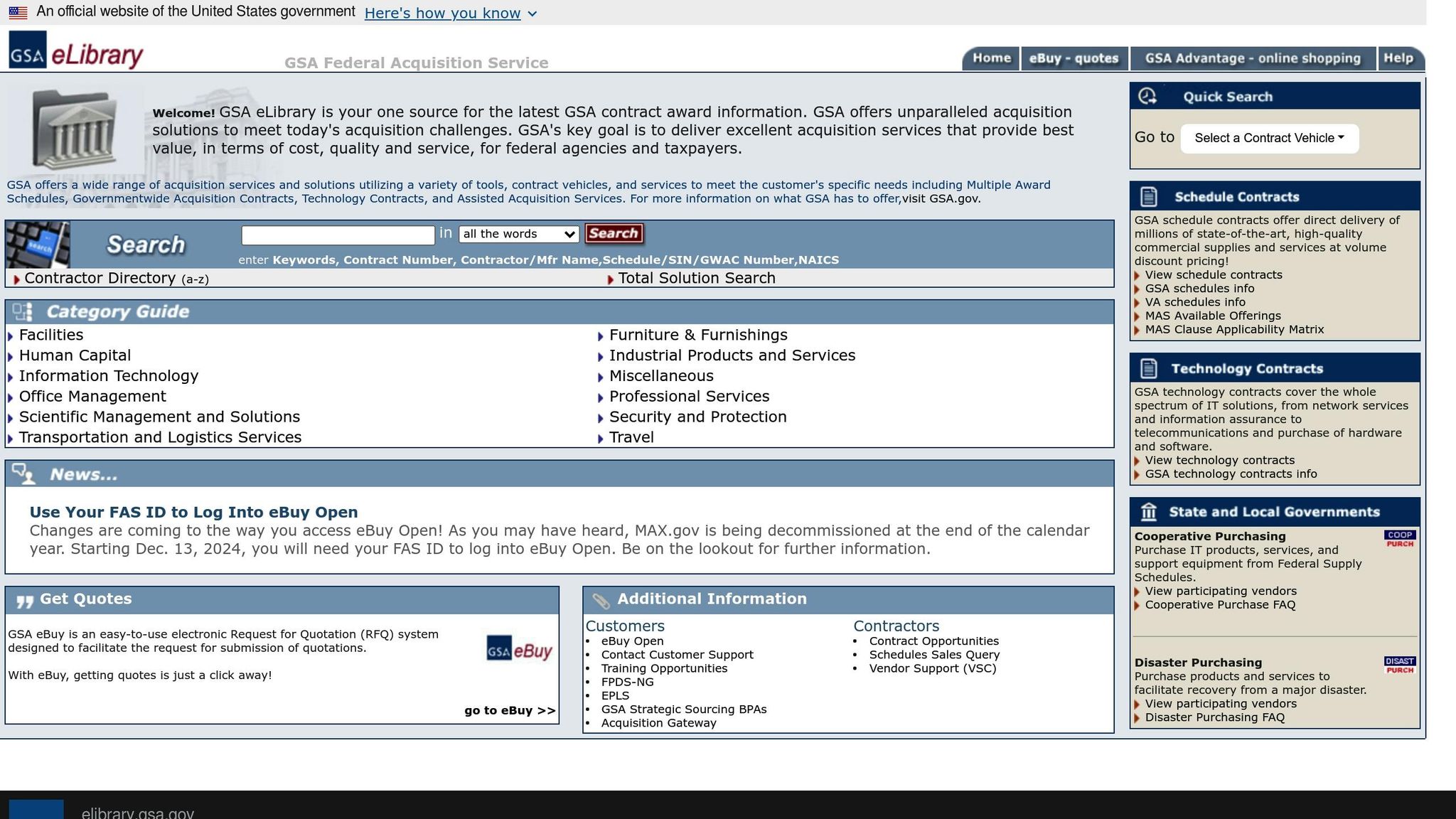
GSA eLibrary serves as the primary resource for researching MAS contracts. It provides comprehensive details on all active GSA Schedule contracts, including contractor information, SINs, and awarded schedules. Buyers can search by contractor name, contract number, Schedule number, SIN, or keyword to compile a list of qualified vendors.
The platform offers downloadable price lists, labor category descriptions, and contract terms, such as geographic coverage and set-aside status. Before making purchases, buyers use eLibrary to verify contract scope, confirm SIN alignment, check contractor eligibility, and review pricing structures. For additional details, eLibrary links directly to GSA Advantage! for specific product information or to contractor websites for broader catalog access.
Ordering Procedures by Purchase Threshold

GSA Schedule Purchase Thresholds and Requirements Guide
Federal buyers adhere to specific procedures based on the value of the purchase. These thresholds determine the level of competition, documentation, and approvals required. For most supplies and services, the Micro-Purchase Threshold (MPT) is set at $10,000, while the Simplified Acquisition Threshold (SAT) is $250,000. Below is a breakdown of how purchases are handled within these ranges.
At or below the MPT ($10,000): For purchases within this range, buyers can make direct acquisitions as long as prices are verified as competitive. The Government Purchase Card (GPC) is the preferred payment method, and transactions are often processed through GSA Advantage!. Formal competition isn’t necessary, but whenever possible, buyers should rotate among qualified vendors to ensure fairness.
Between the MPT and SAT ($10,001 to $250,000): Buyers must obtain at least three quotes from Schedule contractors and document their selection based on factors like price, delivery timelines, past performance, and technical merits. Many agencies use GSA eBuy to post Requests for Quotes (RFQs) and gather competitive pricing. Additionally, buyers are encouraged to request discounts beyond the listed Schedule price. While GPCs may still be used, agency policies often dictate whether larger purchases require purchase orders or blanket purchase agreements.
Above the SAT (over $250,000): Formal procurement procedures come into play for purchases exceeding this threshold. Buyers must prepare a detailed RFQ, which includes a statement of work, evaluation criteria, and rationale for awarding the contract. The RFQ is typically sent to enough Schedule contractors to ensure at least three competitive quotes, often via GSA eBuy. Buyers are expected to actively negotiate for price reductions and conduct either a tradeoff analysis or select the lowest-priced technically acceptable offer. Documentation requirements are extensive and include market research, evaluation results, and justifications for the final decision to comply with federal procurement standards.
Purchase Threshold Comparison Table
The table below provides a quick overview of the requirements for each purchase threshold:
| Threshold Level | Dollar Range | Quote Requirements | RFQ Development | GPC Usage | Key Documentation |
|---|---|---|---|---|---|
| Micro-Purchase (MPT) | Up to $10,000 | None, if the price is competitive | Not required | Yes, preferred method | Price verification, vendor rotation record |
| Above MPT to SAT | $10,001 to $250,000 | Minimum of 3 quotes from contractors | Optional, often via eBuy | Subject to agency policy | Quotes received, price analysis, best value record |
| Above SAT | Over $250,000 | Minimum of 3 quotes; full competition | Required with SOW and evaluation criteria | Not typically used | Complete RFQ package, evaluation file, tradeoff analysis |
Best Value Determination and Price Analysis
When it comes to determining best value under FAR Subpart 8.4, it’s not just about picking the lowest price. Federal buyers need to weigh price alongside non-price factors – like past performance, technical capability, delivery speed, warranty terms, and support services – to find the solution that delivers the greatest benefit to the government. Since GSA Schedule prices are already negotiated to be fair and reasonable, the focus shifts to comparing available discounts, total evaluated costs (including lifecycle expenses like maintenance or software renewals), and how well each contractor’s offer aligns with your mission requirements.
To ensure fair comparisons, standardize your evaluation process. Normalize all quotes by ensuring contractors price the same quantities, delivery locations, installation, training, and other direct costs. Then, calculate a total evaluated price that includes freight, setup, and ongoing expenses. Tools like GSA Advantage! can help you benchmark published Schedule prices, and the Schedule Sales Query provides insights into what similar agencies have paid for comparable items or labor categories.
When seeking discounts, consider larger orders, multi-year commitments, or Blanket Purchase Agreements. Contractors often provide better pricing when faced with competitive pressure. Be transparent about receiving multiple quotes and explain that improved pricing or non-price concessions – such as faster delivery, training, or extended warranties – could influence your decision. Just make sure any negotiated reductions are reflected in the final order and align with the contractor’s Schedule terms.
Non-price factors deserve close attention, especially past performance. Review CPARS ratings, contact references for similar orders, and verify delivery performance. Also, assess whether contractors can realistically meet required delivery dates and whether expedited or just-in-time delivery adds enough value to justify a higher price. If you decide to pay a premium for better performance or faster delivery, document the tradeoff and explain how it better supports your mission.
Finally, maintain thorough documentation. Include the RFQ, all quotes, a price analysis memo, and a best value narrative that ties evaluation factors to your award decision. This ensures compliance with FAR 8.4 and GSA policy while safeguarding your decision during audits or protests by clearly outlining the rationale behind your choice.
Government Purchase Cards for Small Purchases
Government Purchase Cards (GPCs), often referred to as SMART Pay cards, provide federal agencies with a quick and efficient way to handle low-value purchases. These cards are specifically designed for transactions under the micro-purchase threshold of $10,000, allowing agencies to buy items from GSA Schedules without the need for traditional purchase orders or invoices. Instead, cardholders simply use their card details at checkout, skipping the usual three-step process involving purchase orders, receipts, and invoices.
This streamlined approach significantly reduces processing time. While traditional ordering can take weeks, GPC transactions are often completed within hours or days. For example, a $2,500 purchase made through GSA Advantage! can be finalized immediately using a GPC, eliminating the need for RFQs or additional approvals. Once the transaction is approved at the point of sale, funds are electronically transferred within days, ensuring vendors are paid promptly.
To ensure compliance, cardholders must follow specific guidelines. These include completing training, verifying that GSA Schedule pricing is fair through GSA Advantage!, maintaining transaction logs, reconciling accounts monthly, and keeping digital receipts. However, there are strict rules against splitting purchases to stay under the $10,000 limit – a violation that could lead to card suspension.
For purchases exceeding $10,000, competitive quotes and formal ordering processes are required. This makes GPCs an ideal tool for routine, low-value acquisitions where speed and simplicity are critical.
Compliance and Documentation Requirements
To maintain the integrity of GSA Schedule purchases, federal agencies must keep well-organized contract files that align with FAR Subpart 8.4. These files are crucial for demonstrating compliance and ensuring transparency in procurement processes. At a minimum, your documentation should include:
- A detailed requirements description or statement of work.
- Proof of market research, such as GSA Advantage! searches or RFQs issued via GSA eBuy.
- Justifications for best value decisions and price reasonableness.
- Copies of all RFQs and vendor quotes.
- The executed order, including any modifications.
- Approvals for limited-source or brand-name justifications, if applicable.
- Funding documentation and necessary approvals.
- Correspondence related to scope, schedule, or cost changes.
These files must be organized for easy access during reviews by your agency or the GSA Office of Inspector General (OIG). Proper documentation not only supports compliance but also lays the foundation for retention and audit readiness.
Retention requirements for these records generally follow federal schedules, requiring agencies to keep contract files for 6 years and 3 months after the final payment. During audits, reviewers often examine key records like acquisition plans, independent government cost estimates, competition documentation (including the number of quotes received and rationale for decisions), price analysis, discount justifications, socioeconomic considerations, and training or warrant documentation for the contracting officer. Maintaining these records is not just about meeting legal obligations – it also ensures smoother oversight by the GSA.
The GSA oversees Schedule use through policy monitoring, data analysis, and post-award reviews conducted by the OIG and Federal Acquisition Service. Common issues identified during these reviews include insufficient competition or lack of fair-opportunity documentation, inadequate price reasonableness analyses, misuse of SINs or inclusion of out-of-scope work, orders placed after contract expiration, improper use of non-Schedule items, and incomplete contract files that fail to justify best value decisions.
When utilizing GSA’s online tools, agencies should document their actions thoroughly. For example:
- Save screen captures or exports from GSA Advantage! that show items compared, prices, vendors, and filters used during the decision-making process.
- For GSA eBuy, include the RFQ posting, the list of invited Schedule holders (if limited), all received quotes, and source selection documentation.
- From GSA eLibrary, retain copies or printouts of relevant SINs and contract details to confirm scope and contract status.
These records provide additional proof of compliance and strengthen the agency’s ability to justify procurement decisions.
To improve documentation practices, agencies can create a standard file checklist for Schedule orders. This might include standardized templates for RFQs, price reasonableness and best value determinations, limited-source justifications, and a file index outlining required documents by dollar threshold. Conducting regular internal reviews ensures that files meet FAR 8.4 and agency policy requirements before external audits take place. This proactive approach helps agencies stay prepared and minimizes the risk of compliance issues.
Conclusion
Navigating GSA Schedule purchasing involves three essential steps: using the right platform, following threshold procedures, and documenting decisions thoroughly. Here’s a quick recap of the process: Start with GSA eLibrary to verify the Schedule, Special Item Number (SIN), and contractor scope. For routine catalog purchases, turn to GSA Advantage!, and when you need to issue an RFQ and compare quotes, use GSA eBuy. This structured approach minimizes scope errors, meets competition requirements, and creates an electronic audit trail to show compliance.
For micro-purchases (typically at or below the micro-purchase threshold), use your Government purchase card, ensuring items are on Schedule if required by your agency’s policies. Avoid splitting purchases to stay under the threshold. For acquisitions in the simplified acquisition range, gather quotes from multiple Schedule contractors when possible, use eBuy or other competitive methods, and document your pricing analysis and best-value decision. For purchases exceeding the simplified acquisition threshold, adhere to full Schedule ordering procedures, including additional agency reviews and written justifications when necessary.
Once you’ve followed the correct ordering procedures, focus on determining the best value. While GSA pricing provides pre-negotiated ceiling rates, it’s not a substitute for detailed analysis. Compare at least two contractors when feasible, and weigh factors like price, technical capabilities, past performance, and delivery timelines. Document your rationale clearly to demonstrate how the selected option provides the best value.
Maintain comprehensive acquisition files that include details on what was purchased, the contractor, Schedule/SIN, cost, and justification. These files should also contain evidence of competition (or justification for limited sources), quotes, pricing details, and required approvals. Organize these records for easy access, and retain them for 6 years and 3 months after final payment to meet audit and review requirements. Proper documentation ensures you’re prepared for both internal reviews and external audits.
Lastly, stay up-to-date with evolving GSA policies. GSA frequently updates clauses and procedures through Mass Modifications. Assign clear oversight responsibilities within your office to track and implement these updates. Always verify the latest guidance on official GSA channels and consider consulting specialists to improve catalog accuracy and pricing. While specialists can assist, the ultimate responsibility for correct ordering and documentation lies with government buyers. By consistently applying these practices, you’ll reduce risks, streamline audits, and make GSA Schedule purchases faster and more defensible.
FAQs
Who can purchase through GSA Schedules?
Federal government agencies and other authorized government entities can make purchases through GSA Schedules. This includes federal agencies, certain state and local governments, and other organizations that have been granted purchasing authority by the GSA.
If you’re not certain whether your organization qualifies, take the time to confirm your eligibility directly with the GSA. This ensures compliance and proper use of the program.
What documents are required for making a GSA Schedule purchase?
To finalize a GSA Schedule purchase, you’ll need to gather certain documents to meet federal compliance standards. These usually include SAM registration, financial statements, and past performance records. Depending on the agency or contract, there might be additional forms or details required.
Double-check that all your paperwork is accurate and current to prevent delays or compliance setbacks. It’s wise to carefully review the specific requirements provided by the contracting agency before moving forward.
How can I ensure I’m getting the best value through GSA Schedules?
To make the most out of GSA Schedules, it’s important to focus on a few key advantages. These include pre-negotiated pricing that ensures fairness, less competition for long-term contracts, and the opportunity for steady demand from government buyers. Another critical aspect is assessing your return on investment (ROI). GSA Schedules can save significant time and resources by simplifying marketing and negotiation processes.
Partnering with professionals who specialize in GSA Schedule Contracts can also be a game-changer. They can guide you through compliance requirements, help you secure competitive pricing, and unlock the full potential of federal contracting opportunities. This approach allows you to maximize the value of your GSA Schedule purchases while staying efficient and compliant.
Related Blog Posts
- Types of Federal Procurement Methods Explained
- GSA Ordering Rules: What to Know
- How Agencies Use GSA Schedules to Order
- How GSA Advantage Simplifies Federal Buying