
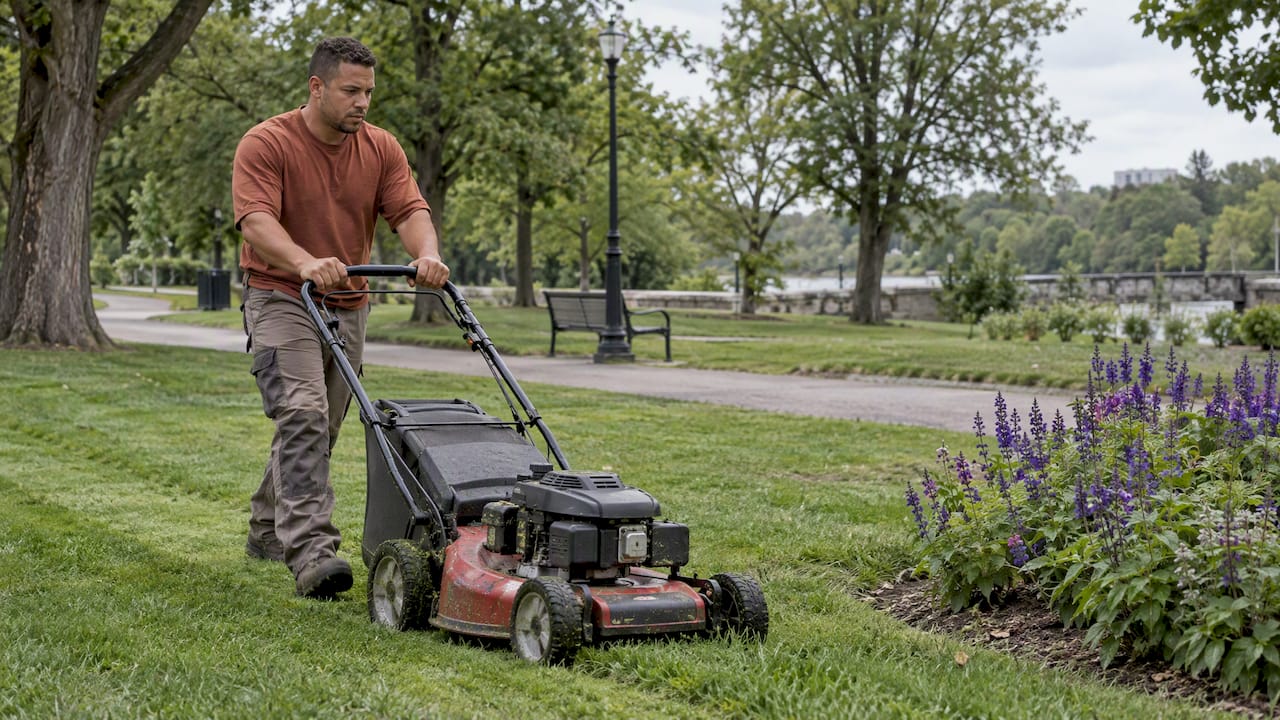
To win government landscaping work, register your business (SAM.gov for federal work, vendor lists for cities and states), confirm your licenses, search open solicitations, and submit a compliant, fully priced bid before the deadline. Start with small local bids to build past performance, then move to larger federal work.
TL;DR
- Federal buyers must advertise contracts over $25,000 on SAM.gov, so that is the first place to search. Cities, counties and states use their own vendor lists and bid portals.
- Register first: size check, SAM registration, local vendor registration, W-9, insurance and the licenses the job requires.
- Most small bids are rejected for missing forms, not high prices. Read the solicitation line by line and submit every required document.
- Past performance is the real barrier. Win small city or subcontract jobs first, keep written evaluations, then bid up.
- Once you have a track record, a federal schedule contract can put you in front of agencies that buy repeatedly.
Table of Contents
- What does government landscaping work actually look like?
- Where do you find government landscaping bids?
- What do you need to register before you bid?
- How do you read and evaluate a solicitation?
- How do you prepare a bid that gets accepted?
- Are government bids and award records public?
- What are the easiest government landscaping contracts to win?
- How do you get found by buyers?
- Our perspective: where a federal schedule fits for landscapers
- What does it cost to get a schedule contract with help?
- FAQ
- Sources
What does government landscaping work actually look like?
It is rarely a single yard. Public landscaping work is mostly recurring grounds maintenance: mowing, edging, bed care, tree and shrub work, irrigation checks and often seasonal cleanup or snow removal. Agencies buy it as a base period plus option years, so one win can mean several years of revenue.
The buyers are varied. Federal buyers include military installations, Veterans Affairs facilities, national cemeteries and park units. State buyers include departments of transportation that maintain highway rights-of-way. Local buyers include cities, school districts, housing authorities and utilities.
The common thread is that every purchase follows a written process. You do not pitch a manager and get a verbal yes. You respond to a solicitation, and the lowest compliant price, or the best value when quality is scored, wins.
Where do you find government landscaping bids?
Use several channels, because no single list covers federal, state and local buyers.
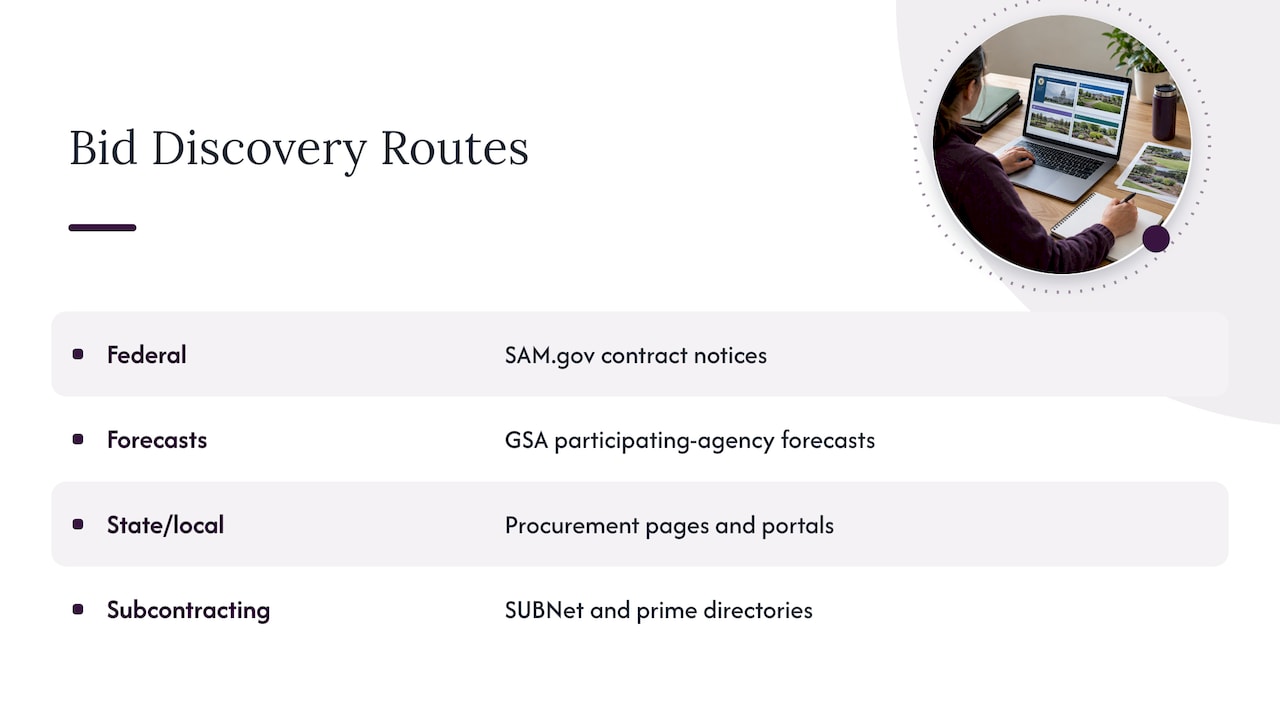
Federal. SAM.gov Contract Opportunities is where federal contracting offices post notices that anyone can search. USDA’s small business guidance notes that agencies must advertise all contracts over $25,000 there. Set a saved search for grounds maintenance, mowing, landscaping and snow removal, filtered to your state and nearby ones. Federal notices from the old FedBizOpps system now all live on SAM.gov.
Forecasts. GSA’s Forecast of Contracting Opportunities tool gives a central view of forecasts from participating agencies, so you can prepare before a solicitation appears. We cover the habit of planning around these in our guide to the federal procurement forecast.
State and local. Cities and counties post on their own procurement pages or on third-party portals. Springfield, Missouri’s 2026 informal landscaping bid required electronic submission through DemandStar, for example. Make a list of every city, school district, housing authority and state agency within your service radius, then find where each one posts bids and sign up for email alerts.
Subcontracting. Large primes often need local crews. The SBA’s how to win contracts page points to SUBNet and the SBA and GSA prime-contractor directories. Subcontracting is a legitimate way to earn the references that primes and agencies ask for.
For a deeper walkthrough of searching, see our guides to researching federal contract opportunities and the SAM.gov portal.
What do you need to register before you bid?
Do the paperwork before you find the bid you want. Many deadlines are two to four weeks out, and federal registration alone can take longer than that.
Federal registration
Per USDA, becoming a federal contractor means assessing your size under SBA standards and registering at SAM.gov. The UEI that SAM.gov issues has replaced the old DUNS number as the entity identifier. Your SAM registration also feeds the SBA’s Dynamic Small Business Search database, which agencies use to find small firms.
Local and state registration
Local rules vary, so read your own buyer’s page. The City of Charlotte, for example, requires landscape contractors to register as city vendors and submit a W-9. Awarded state vendors often must also register with the Secretary of State, as North Carolina requires as of 2026.
Licenses and certifications
What you need depends on the work and the state. Charlotte says landscape contractors may need pesticide, irrigation, trapping or arborist credentials depending on the job. Oregon’s transportation department requires a valid state landscape contractor’s license for its landscape bids, though that rule does not apply to federally funded projects. Hawaii’s transportation department stresses that licenses must stay valid for the whole contract or the contract can be cancelled. Check your state licensing board and the solicitation itself.
Your registration checklist
- Confirm your size status against SBA standards.
- Register in SAM.gov and keep it active.
- Register as a vendor with each city, county and state buyer you target.
- Keep a current W-9, certificate of insurance and license copies in one folder.
- Assemble a list of similar jobs with contacts and dates.
How do you read and evaluate a solicitation?
Before you price anything, decide if the bid is worth your time. Work through the document in this order.
- Type of document. An invitation for bid (IFB) is awarded mostly on price. A request for proposal (RFP) scores your approach, staffing and experience as well. A request for quotation is usually a simpler price request.
- Scope of work. Look for acreage or square footage, mowing frequency, season length, equipment limits, disposal rules and any snow or storm response duty. A site map or site visit is often provided. Go to the visit if one is offered.
- Contract term. Note the base year and option years. A price that works in year one may not survive fuel and wage changes in year three.
- Set-aside status. Under FAR 19.502-2, purchases between the micro-purchase threshold and the simplified acquisition threshold must be set aside for small business unless the contracting officer cannot expect offers from two or more capable small firms. A set-aside notice means you compete against peers, not national firms.
- Qualification requirements. Look for licenses, insurance minimums, bonding, safety plans and prior experience. Hawaii’s transportation department, for instance, may require a written site-specific health and safety plan and a list of similar projects with positive evaluations.
- Submission rules. Note the portal, the deadline, the required forms and who to contact with questions. Ask questions in writing before the question deadline.
- Evaluation method. If the buyer scores past performance, you need real references. If it is price only, your cost model matters most.
Walk away from bids you cannot perform profitably. A lost bid costs a few hours. A badly priced win costs a season.
How do you prepare a bid that gets accepted?
Start with compliance, then price.
Goose Creek, South Carolina’s 2026 landscaping invitation for bid shows what a typical local package looks like: an electronic response with the required forms, a W-9, a certificate of insurance, licenses, a conflict statement and an authorized signature, all by the deadline. Miss one item and a buyer can disqualify an otherwise low bid.
Build the price from your real costs
Break the work into cycles or acres. Include labor with burden, equipment and fuel, dump fees, materials, insurance, overhead and a profit margin you can live with. Public buyers compare unit prices, so know your cost per visit and per acre before you read the bid tabulation of other firms.
Plan for bonds
Some bids require bid, performance or payment bonds. The SBA’s surety bond program lists a guarantee fee of 0.6% of the contract price for performance and payment bonds. Since March 18, 2024, the SBA has been able to guarantee bonds up to $9 million on all projects and $14 million on federal contracts. Talk to a surety agent early if your bid needs one, because underwriting takes time.
Submit early
Portals fail, files are too large, and signatures get forgotten. Submit a day ahead. Then save the confirmation.
Are government bids and award records public?
Yes, and that is useful to you. Federal notices, including award notices, can be searched by anyone on SAM.gov. The SBA also points to FPDS and USASpending.gov for tracking awards. Many cities post bid tabulations and award minutes online, and you can request them from the purchasing office if they are not posted.
Use them to learn who holds the incumbent contract, what they charged, when the option years end and when the work is likely to be re-competed. That timeline is your calendar for the next bid.
What are the easiest government landscaping contracts to win?
The easiest are small, local and recurring: a city park strip, a fire station, a library, a housing authority property, a school grounds package. Small purchases often use informal quotes, short forms and fewer competitors. Federal purchases under the simplified acquisition threshold are generally reserved for small firms, as the FAR rule above explains.
These jobs matter more for what they give you than for their revenue: a signed contract, an on-time record and a written performance evaluation. Those become the references that bigger solicitations score. Treat every small award as your resume.
Be wary of anyone who promises a shortcut, such as paying a middleman a share of every payment. Public contracts are won through open, written procedures. You should never need to pay anyone a cut of your revenue to bid.
How do you get found by buyers?
Buyers search before they call. Complete your SAM profile with accurate capability descriptions and keywords. Build a one-page capability statement with your services, equipment, service area, bonding capacity, insurance and three references. Keep your website clear about the public agencies you serve. If you want help with the web side, SEO for home service businesses can help local buyers and procurement staff find you.
Also market directly. The SBA suggests showing agencies and prime contractors how your capabilities match their specific needs. Email the facilities manager with a concise capability statement before a bid appears, not after.
Our perspective: where a federal schedule fits for landscapers
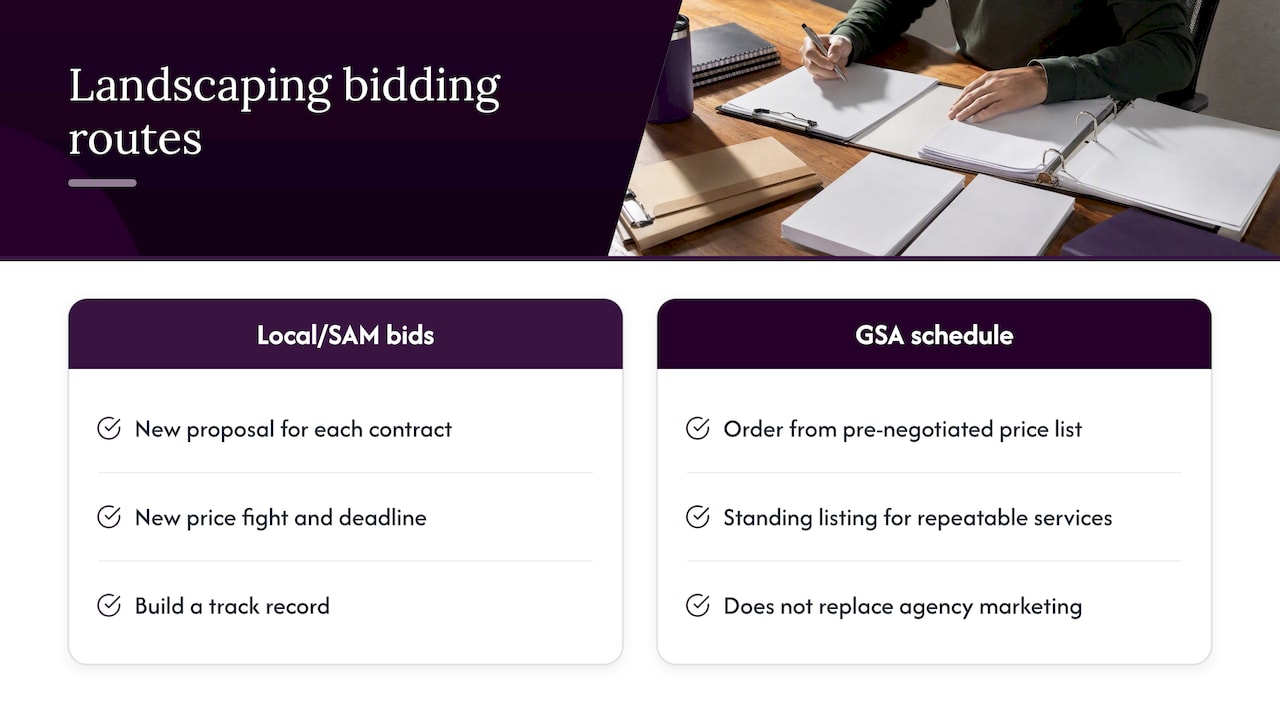
Most landscapers should start with local bids and SAM.gov solicitations. That is the right way to build a track record. But there is a point where one-off bidding becomes a treadmill: every contract is a new proposal, a new price fight, a new deadline.
A GSA Multiple Award Schedule contract is a different route. Agencies can order from your pre-negotiated price list instead of running a full competition each time. For businesses that qualify, it turns a stream of separate bids into a standing listing. It is not instant revenue, and it does not replace marketing to agencies. But it is a credible long-term channel for firms with a repeatable service and a track record.
The obstacle is the application. It means detailed documentation, a price list that holds up to negotiation, and precise answers to what the evaluators ask. Companies that go it alone often spend two or more years. The clients we guide are typically awarded in about six months and spend around three hours of their own time. Those are our figures from our own client work, not a promise for every application, and eligibility depends on your business, your past performance and your sales history.
Our advice: win a few local or subcontract jobs, keep every performance evaluation, keep your financials clean, and then ask whether a schedule fits your service line. If you want a view on that, we are glad to look.
— Josh
What does it cost to get a schedule contract with help?
We are paid after approval, and our full-service application support is quoted to your situation on the application proposal page. Once you hold a contract, our retainer is $1,500 per year, and our maintenance plans start at $99 per month for one modification a year. If you prefer to do the filing yourself, we also offer a DIY Quick Start.
We also back the application with a money-back guarantee. Before you decide anything, use our free eligibility check and we will tell you whether your landscaping business is ready now or what to build first.
FAQ
Do I need a federal contract to get city or state landscaping work?
No. Cities, counties and states run their own procurement and require their own vendor registration. You typically need a W-9, insurance and any required licenses, as Charlotte’s landscape contractor page shows. Federal registration in SAM.gov is only needed for federal work.
How much money do I need to start bidding?
There is no standard figure, because it depends on the bid. Budget for insurance, any license fees, and working capital, since public buyers often pay after the work is invoiced. If a bond is required, the SBA lists a 0.6% guarantee fee for performance and payment bonds under its program.
Can a small landscaping company compete with large firms?
Yes, especially through set-asides. Federal purchases above the micro-purchase threshold and up to the simplified acquisition threshold must be set aside for small business in most cases. Subcontracting to a prime is another way to gain experience and references.
Are small business set-asides guaranteed?
No. The contracting officer can skip a set-aside if the office does not expect offers from two or more capable small firms at fair prices. Read the solicitation to see whether it is restricted, and bid either way if you are qualified.
Sources
- Contract Opportunities, SAM.gov
- Find opportunities, GSA
- Getting Started as a Government Contractor, USDA
- How to win contracts, Small Business Administration
- Resources for Landscape Contractors, City of Charlotte
- State of North Carolina vendor requirements
- OAR 731-005-0460, Oregon
- Contractor Qualifications, Hawaii DOT
- Invitation for Bid, Landscaping 2026, City of Goose Creek
- Invitation for Informal Bid 043-2026, Springfield, MO
- FAR 19.502-2 Total small business set-asides, acquisition.gov
- Surety bonds, Small Business Administration
- SBA announces statutory increases to the Surety Bond Guarantee Program
Recommended
- How to Win Government Contracts: A Step-by-Step Plan
- How to Get Government Contracts: The Complete Guide to Finding & Winning Federal Contracts (2026)
- Government Contracting 101: A Small Business Guide
- Applying for Government Contracts: Step-by-Step Guide