

Under GSAR 552.238-120, you must follow the exact EPA method already written into your contract, not a generic inflation number, and get a properly documented eMod approved before charging any revised Schedule price. Skipping that sequence is the single most common reason 2026 price modifications get delayed or rejected.
GSAR 552.238-120 and GSAM 538.270-4 govern how you can raise or adjust your Schedule prices, and your contract’s specific economic price adjustment method controls the mechanism, timing, and any caps that apply. A modification built on the Price Proposal Template, submitted through eMod with visible formulas and supporting evidence, has to receive Contracting Officer approval before you apply the new prices to any order.
TL;DR:
- Contractors must follow their specific EPA method, not generic inflation rates, when requesting a price adjustment, and get it approved before applying to orders.
- Four EPA mechanisms are allowed: fixed escalation, market index, established pricing, or unforeseen market changes, and your contract must explicitly specify one of these.
- Preparing an EPA modification involves verifying your clause, gathering source data, completing the Price Proposal Template with visible formulas, and submitting through eMod with a detailed narrative.
- Approved price changes only take effect from the modification’s effective date on new orders; retroactive application is not permitted.
- Separate controls are necessary for EPA adjustments and price reductions because they are tracked independently under different clauses.
Table of Contents
- What do GSAR 552.238-120 and GSAM 538.270-4 actually require?
- What is the step-by-step checklist for a 2026 EPA modification?
- What documentation and formatting does GSA expect, and what gets modifications rejected?
- When do approved price changes actually take effect in 2026?
- How does the Price Reductions clause interact with EPA increases?
- What should contractors prioritize when acting on 2026 EPA guidance?
- How can GSA Schedule Services help with your EPA modification?
- Sources
- FAQ
What do GSAR 552.238-120 and GSAM 538.270-4 actually require?
An EPA method is the specific formula your contract uses to adjust prices over time. It is not a market average or a published inflation rate. GSAR 552.238-120 makes clear that any EPA request has to conform to the method already agreed to in your contract, and an approved adjustment only takes effect after the modification’s effective date, not the date you filed it.
GSAM 538.270-4 lists four permitted mechanisms:
- Fixed escalation rate: a preset percentage or formula written into the contract that applies on a schedule, regardless of outside market movement.
- Market index or other basis: pricing tied to a published index or benchmark named in the contract, such as a labor or materials index.
- Established pricing: adjustments that track a verifiable, publicly available commercial price list you already use with other customers.
- Unforeseeable significant changes in market conditions: a narrower path for cost shocks not anticipated at the time of award, supported by documented evidence.
None of these mechanisms function as an automatic entitlement. The GSAM subpart 538.2 text treats inflation as evidence that has to fit the contract’s agreed conditions, not as a standalone justification. If your contract does not name one of these four mechanisms, or if it still carries older EPA language, you have a terms problem to fix before you have a pricing problem.
What is the step-by-step checklist for a 2026 EPA modification?
Preparing an EPA modification is a sequencing exercise as much as a pricing one. Miss a step and the Contracting Officer sends the package back, which costs you weeks.
- Confirm your clause and method. Pull your current contract text and verify which EPA clause and mechanism apply. If you are still on a legacy clause, file a Revise Terms and Conditions modification before any triggering event, since GSA’s implementation guidance set a deadline of November 26, 2025 for replacing older EPA language after MAS Refresh 29.
- Choose your mechanism and gather source data. Pull the exact index values, commercial price list copies, invoices, or market-condition evidence your method requires.
- Populate the Price Proposal Template. Use Tab A for your full current offering, Tab B for the specific changes, or the dedicated EPA tab, keeping every formula visible in the Excel file and building in the 0.75% Industrial Funding Fee.
- Write a price narrative. Tie each proposed line item to its supporting document so a reviewer can trace the math from source data to final price.
- Submit through eMod or eOffer. Attach a tailored cover letter referencing GSA’s sample templates, then be ready to answer follow-up questions from the Contracting Officer.
Pro Tip: Build your audit trail before you touch the pricing tabs. It is faster to plug numbers into a template once the supporting evidence is organized than to reverse-engineer justification after the fact.
Our own breakdown of the four EPA mechanisms and a simple selection checklist walks through how to match your contract to the right mechanism before you start the paperwork.
What documentation and formatting does GSA expect, and what gets modifications rejected?
The MAS Modification Guide sets specific formatting rules for the Price Proposal Template: Tab A carries your full current offering, Tab B carries only the changes, and EPA-specific tabs carry the adjustment math.
The MAS Modification Guide requires visible formulas in every submitted Excel workbook. That documented rule exists because reviewers need to trace your math, not just check your final number.
The recurring mistakes we see are predictable:
- Submitting a static Excel file with formulas converted to values, which forces the reviewer to ask for a resubmission.
- Using the wrong PPT tab for the type of change being requested.
- Leaving gaps in the audit trail between the source data and the proposed price.
- Failing to connect the evidence back to the original basis-of-award pricing relationship.
Our guide to demystifying GSA pricing covers how awarded prices map back to your proposed prices, which is the same logic a Contracting Officer applies when checking your audit trail.
When do approved price changes actually take effect in 2026?
Timing trips up more contractors than the math does. An approved EPA modification only applies to orders placed on or after its effective date, never retroactively, and never from the date you submitted the request.
- If your contract still reflects legacy EPA clauses, file a Revise Terms and Conditions modification before your next anticipated pricing trigger rather than waiting until you need the adjustment.
- Expect the Contracting Officer to request clarification on your evidence or math. Do not apply any increase to live orders until the modification shows as effective.
- A contract without a clearly defined EPA method cannot support a request based on a general inflation figure. Fix the contract terms first.
Our post on GSA’s options for increasing your prices walks through the procedural routes available and when each one fits.
How does the Price Reductions clause interact with EPA increases?
GSAR 552.238-81 runs on a separate compliance track from your EPA increases. It protects the basis-of-award relationship between your Schedule prices and the commercial prices you charge comparable customers.
- If a commercial price reduction disturbs that basis-of-award relationship, you have to notify the Contracting Officer within 15 calendar days of the reduction’s effective date.
- An EPA increase does not offset or cancel a pending price reduction obligation. They are tracked independently.
- Keep separate internal controls for upward EPA requests and downward commercial price monitoring so one process does not obscure the other.
Our detailed comparison of the Price Reductions clause versus transactional data reporting explains the reporting mechanics in more depth.
What should contractors prioritize when acting on 2026 EPA guidance?
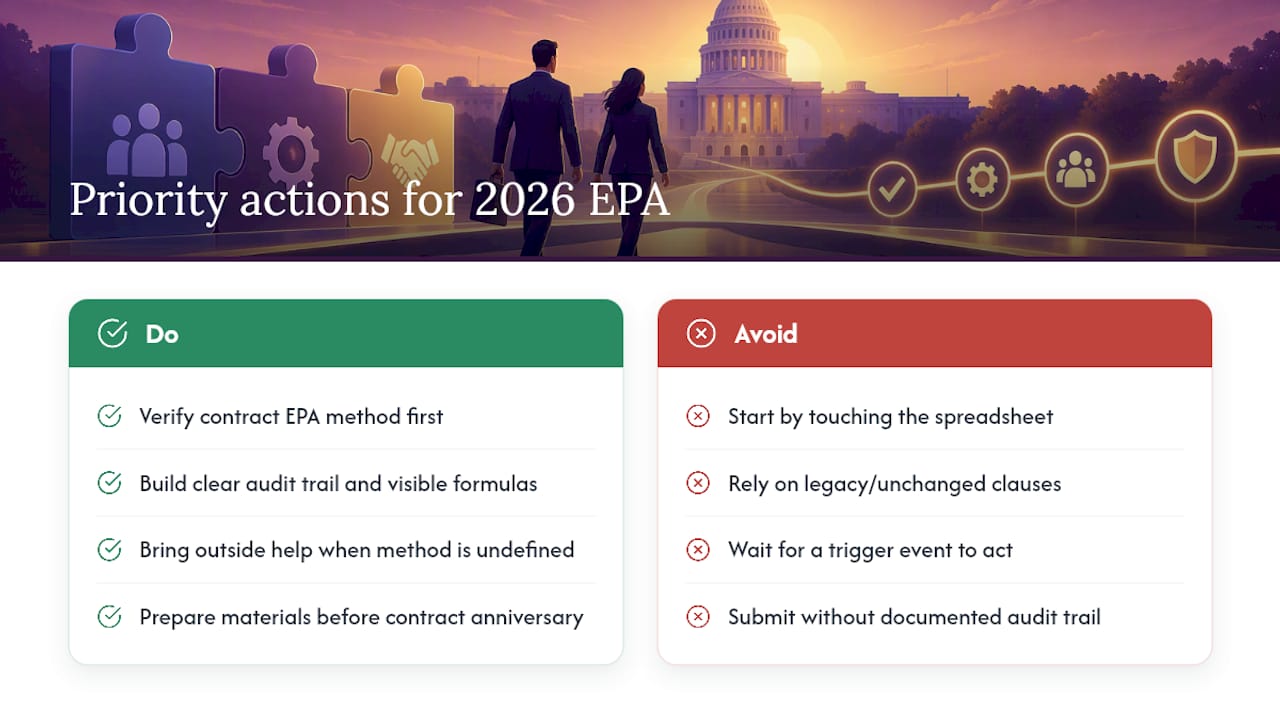
Verify your contract’s EPA method before you touch a spreadsheet. Most delays trace back to contractors building a pricing case on the wrong mechanism or a legacy clause that should have been updated first. Once the method is confirmed, the audit trail and visible-formula PPT matter more than the size of the increase you are requesting.
Bring in outside help when your contract lacks a defined method, when established-pricing evidence is scattered across multiple commercial channels, or when your market-condition claim depends on judgment calls a Contracting Officer is likely to question. Preparing your materials ahead of your contract anniversary, rather than after a trigger event forces your hand, cuts weeks off the administrative back and forth.
— Josh
How can GSA Schedule Services help with your EPA modification?
Sorting out which EPA mechanism applies to your contract, then building a compliant Price Proposal Template from scratch, eats time most small business owners do not have. GSA Schedule Services handles the parts that create the most delay: confirming your contract’s method, preparing Revise Terms and Conditions modifications when your clause is outdated, assembling audit-ready PPT tabs, and filing the eMod submission itself.
- Simple, Basic, and Advanced Price List change services fit contractors who need help preparing a specific EPA or price-list modification.
- Revise Terms and Conditions modifications cover contractors whose contracts still carry legacy EPA clauses.
- Maintenance plans, including 1 Mod per year at $99 per month up to Custom Mods from $339 per month, fit contractors who expect recurring modification needs across the year.
If you are unsure whether your contract’s EPA method still qualifies under current rules, request a free eligibility check and we will walk through your specific contract language with you.
Sources
FAQ
Does GSA set a fixed inflation rate for Schedule contracts in 2026?
No. GSA does not publish a single inflation rate contractors can apply across the board. Your adjustment has to follow the specific EPA mechanism named in your contract under GSAR 552.238-120, whether that is fixed escalation, a market index, established pricing, or a documented market-condition change.
What happens if my contract still has the old EPA clause?
You should file a Revise Terms and Conditions modification to update to 552.238-120 before your next pricing trigger event. GSA’s transition guidance set November 26, 2025 as the deadline for this transition, so acting early avoids complications later in 2026.
Can I raise my prices before my modification is approved?
No. An EPA modification only applies to orders placed on or after its approved effective date. Applying an increase before that point, even with a request pending submission, is not compliant under 552.238-120.
Why do EPA modification submissions get rejected most often?
The most common causes are static Excel formulas instead of visible calculations, using the wrong Price Proposal Template tab, and gaps between the supporting evidence and the proposed price. The MAS Modification Guide requires a traceable audit trail, and reviewers send back anything they cannot follow line by line.
Are EPA increases and price reductions handled the same way?
No, they run on separate tracks. EPA increases follow the contract’s agreed mechanism under 552.238-120, while commercial price reductions that disturb your basis-of-award relationship trigger a separate 15-day notice requirement under 552.238-81.
Recommended
- GSA Escalation Rates: 4 EPA Mechanisms and a Checklist for SMBs
- Government Contract Opportunities 2026: SME Guide
- GSA Schedule Award: Complete Checklist for Success
- GSA eOffer process guide: Steps to secure your schedule contract