
If you’ve been researching federal contracting, you’ve probably come across GSA eBuy and assumed it works like Amazon for the government. It doesn’t. Understanding what is GSA eBuy — and what it actually does — is the difference between pursuing opportunities you’re eligible for and wasting time on a platform you can’t access. GSA eBuy is an online electronic request system that government buyers use to request information and obtain quotes and proposals from contractors, not a public storefront. For small and medium-sized businesses aiming at federal sales, that distinction matters immediately.
Table of Contents
- Understanding the basics of GSA eBuy
- How GSA eBuy differs from other government contracting portals
- Navigating the eBuy solicitation process
- Preparing your business to participate in GSA eBuy
- Tips and strategies for succeeding with GSA eBuy competitions
- Why mastering GSA eBuy is a game-changer for small and medium businesses
- Get expert help to grow your federal sales through GSA eBuy
- Frequently asked questions
Key Takeaways
| Point | Details |
|---|---|
| GSA eBuy defined | It is an online solicitation tool for government buyers to request quotes from GSA contract holders, not an open marketplace. |
| Eligibility matters | Only businesses holding relevant GSA schedules or contracting vehicles can access eBuy opportunities. |
| Full solicitation lifecycle | eBuy supports RFIs, RFPs, amendments, Q&A, proposal submissions, and award reporting. |
| Maintain vendor registration | Active, accurate maintenance of your GSA profile and catalogs is crucial for eBuy visibility. |
| Strategic engagement pays | Mastering eBuy workflows enhances your federal sales success and speeds contract awards. |
Understanding the basics of GSA eBuy
To build a solid foundation, let’s clarify exactly what GSA eBuy is and how it fits into the government procurement landscape.
GSA eBuy is not a search engine for government contracts, and it’s not a directory. It’s a request and quote platform built specifically for government buyers who already know what they want and need to solicit it from a pre-qualified pool of vendors. Think of it as a closed bidding room rather than an open auction house.
Here’s what you actually need to know about how it works:
- It lives inside GSA Advantage. GSA Advantage is the broader online shopping and ordering system for federal agencies. eBuy is the module within that ecosystem designed to handle formal requests for quotes (RFQs) and proposals (RFPs). You can explore this relationship in depth through our ultimate guide to GSA Advantage eBuy.
- It operates through Multiple Award Schedules (MAS). The GSA MAS program is the government’s primary contracting vehicle for commercial products and services. eBuy facilitates requests and ensures purchasing follows fair opportunity regulations and MAS contracting rules, without functioning as an open market.
- Access is restricted. Only contractors who hold a relevant GSA contract can see and respond to solicitations on eBuy. If you don’t have a GSA Schedule, the system is essentially invisible to you.
- It promotes transparency and speed. Agencies use eBuy to document their solicitation process, track vendor responses, and make awards in a way that satisfies fair opportunity requirements.
- Special Item Numbers (SINs) determine visibility. When a government buyer posts an opportunity, they select a SIN category. Only vendors with matching SINs in their contract appear in the buyer’s eligible pool.
Pro Tip: Keep your GSA Advantage profile and eBuy registration details current. Even one outdated SIN or an expired registration can make you invisible to buyers actively looking for what you offer.
The practical implication here is straightforward. Before eBuy ever becomes relevant to your business, you need a GSA contract. Once you have one, eBuy becomes one of your most direct channels to federal buyers.
How GSA eBuy differs from other government contracting portals
Now that you know what eBuy is, it’s important to understand how it differs from other platforms like SAM.gov.

The federal contracting ecosystem has multiple platforms, and they serve very different purposes. Confusing them leads to wasted effort. Here’s how eBuy stacks up against SAM.gov, the platform most contractors hear about first.
| Feature | GSA eBuy | SAM.gov |
|---|---|---|
| Who can access it | GSA Schedule and contract vehicle holders only | Any registered business |
| Primary purpose | RFQ and RFP solicitation for Schedule holders | Public listing of all federal contracting opportunities |
| Opportunity visibility | Restricted by SIN and contract vehicle | Broadly open to all registrants |
| Registration requirement | GSA Multiple Award Schedule contract required | SAM.gov registration required |
| Solicitation type | Quotes, proposals, RFIs for Schedule work | Full range including competitive bids and grants |
The most important takeaway from that table: eBuy posting opportunities are limited to contractors holding relevant GSA MAS contracts, while SAM.gov is the broader public listing site for all active contract opportunities.
What this means in practice for your business:
- SAM.gov registration is a prerequisite for nearly everything in federal contracting, but it doesn’t get you into eBuy.
- eBuy gives you access to a smaller, more targeted set of opportunities where competition is limited to other Schedule holders.
- The solicitations you see on eBuy tend to be further along in the buying process. The agency already has budget authority and is actively looking for vendors.
- Both platforms serve different phases of the contract cycle. Learn how the MAS consolidation impact on eBuy has shaped what categories appear on the platform.
Monitoring both platforms is not optional. SAM.gov gives you early signals about agency needs. eBuy gives you the direct shot at closing business once you’re contract-ready.
Navigating the eBuy solicitation process
With the differences clear, let’s explore how the eBuy solicitation process works in practice for vendors.
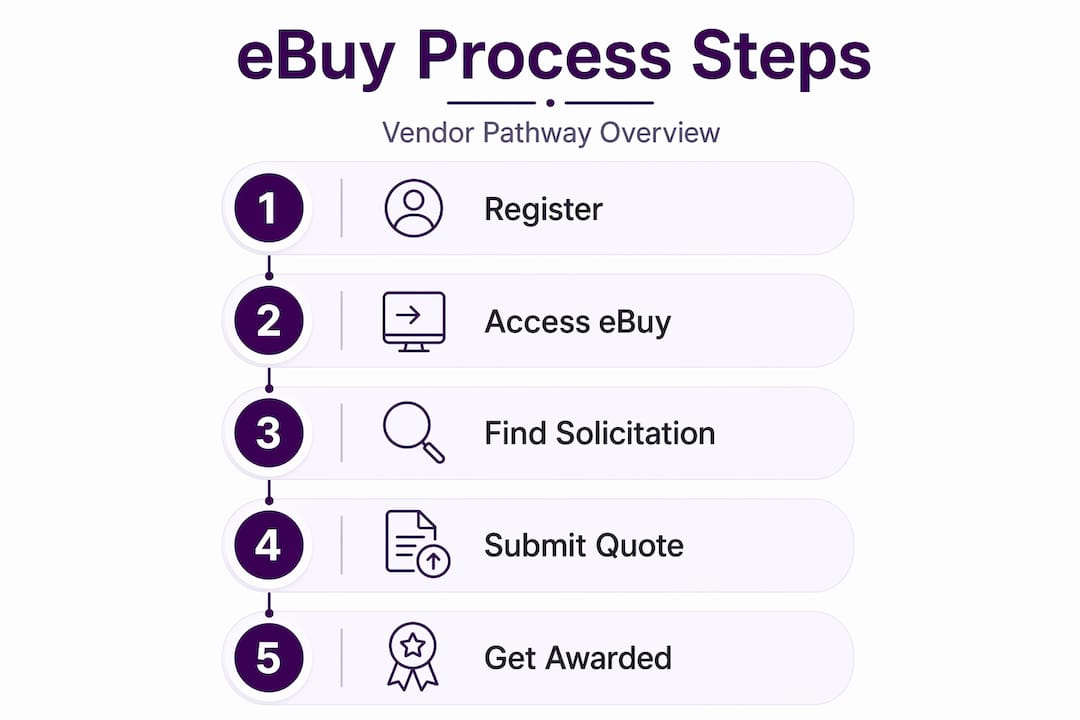
When a government buyer decides to use eBuy for a purchase, they launch what’s called a solicitation. That solicitation goes through several structured stages, and knowing each one helps you respond better, faster, and more accurately.
Here is the typical workflow you’ll encounter:
- RFI issuance (Request for Information). The buyer may start by gathering market intelligence before committing to a formal solicitation. Responding to RFIs is optional but valuable. It gets your name in front of the contracting officer early.
- RFP or RFQ release. This is the formal solicitation. The buyer specifies scope, period of performance, evaluation criteria, and submission instructions. Read it thoroughly before drafting a single word of your response.
- Q&A period. Buyers typically open a window for vendor questions. This is one of the most underused phases. A sharp, well-targeted question can clarify scope and reveal gaps your competitors miss.
- Amendments. Buyers frequently modify solicitations after initial release. Each amendment resets the clock on your response strategy. Ignoring amendments is one of the most common reasons proposals get disqualified.
- Proposal submission. You submit your response through eBuy’s secure portal. Late submissions are generally not accepted.
- Award reporting. After evaluation, the buyer reports the award through eBuy. Winners and, in some cases, the award value are documented.
For OASIS+ contracts specifically, this process is mandatory. OASIS+ task order solicitations must be issued via eBuy, which supports the full workflow including RFI and RFP issuance, Q&A, proposal submission, and award reporting. If you’re pursuing professional services work under OASIS+, eBuy is not optional, it’s the only path.
Understanding how this workflow connects to your initial GSA application helps too. Our GSA eOffer process guide walks through the front end of that journey in detail.
Pro Tip: Track solicitation amendments closely. Set a calendar reminder for every amendment deadline. Buyers who see your proposal reference updated requirements know you were paying attention.
Preparing your business to participate in GSA eBuy
To take advantage of eBuy effectively, you need to prepare and maintain your business registration and profile properly.
A lot of businesses win a GSA contract, set up their profile once, and then wonder why they’re not seeing opportunities. The answer is almost always account hygiene. eBuy notifications go to vendors whose profiles are current, accurate, and correctly matched to relevant SINs.
Here’s what active participation actually requires:
- Register and manage your account through the Vendor Support Center. The VSC (Vendor Support Center) is the hub for eBuy registration and profile management. Vendors must register and maintain their profile via the VSC, including uploading information to GSA Advantage and ensuring registration and vehicle setup are current to participate in eBuy.
- Keep your GSA Advantage listings current. Your product and service listings on GSA Advantage feed directly into how buyers find you and whether eBuy notifies you of relevant solicitations. Outdated pricing, expired catalog data, or missing documents break that connection.
- Review and align your SINs regularly. As your business grows or pivots, your contract’s SIN structure should reflect where you actually want to compete. Misaligned SINs mean you’re either missing opportunities or receiving notifications for work outside your capabilities.
- Monitor your contract modification dates. Contracts require periodic modification and renewal actions. A lapsed modification can interrupt your eBuy access without any obvious warning.
- Confirm your notifiction email settings. eBuy sends solicitation alerts via email. If that inbox isn’t monitored, you’re effectively offline. Assign a specific person or alias to manage eBuy notifications. Learn more about the GSA registration process to get these fundamentals right from the start.
This is unglamorous work, but it separates the contractors who win regularly from those who check in once and wonder why nothing happened.
Tips and strategies for succeeding with GSA eBuy competitions
Understanding the process and setup is essential, but succeeding on eBuy also requires proven strategies and proactive management.
Most vendors treat eBuy like a passive job board. The ones winning business treat it like an active sales channel. That shift in mindset changes how you prepare, how you respond, and how you position your company.
“eBuy enables fair opportunity and faster awards, but requires active engagement from vendors throughout the solicitation lifecycle.”
Here’s what separates competitive vendors from the rest:
- Match your capabilities tightly to your SINs. The broader you go, the less targeted your responses will be. Buyers can tell when a proposal is generic. Narrow SIN alignment leads to better-fit opportunities and stronger proposals.
- Keep your registration and Advantage account fully active. eBuy is designed to speed solicitation logistics and improve integrity, but success depends on matching contract scopes, maintaining registrations, and managing the full proposal lifecycle.
- Plan internally for the Q&A and amendment phases. Assign someone to own each solicitation. That person tracks every amendment, submits clarifying questions, and makes sure the final response reflects the most current version of the requirement.
- Develop reusable proposal content. Past performance summaries, technical approach templates, and pricing structures that you can adapt quickly give you a real edge when turnaround times are tight.
- Use tools that keep you informed. Regulatory changes and new solicitation categories affect what appears on eBuy. Platforms like OneGov legislative intelligence help you monitor policy changes that could open or close categories relevant to your work.
Pro Tip: Build a simple internal tracker for every eBuy solicitation you respond to. Document your win and loss rates, the SINs involved, and the agencies you’re pursuing. Over time, that data tells you exactly where to focus your energy. You can also find specific strategies for winning business with a GSA contract to apply alongside your eBuy participation.
Why mastering GSA eBuy is a game-changer for small and medium businesses
Having covered how to succeed, let’s reflect on the deeper value and overlooked potential of mastering eBuy for your business.
Most SMBs look at eBuy and see a notification system. That’s underselling it significantly. What eBuy actually offers is a structured, repeatable pipeline into federal buyers who have already allocated budget and are actively seeking solutions. That’s extraordinarily rare in any sales environment.
The vendors who treat eBuy as an ongoing account management practice rather than a series of one-off submissions are the ones building real federal revenue. Every RFI response is a chance to shape the final RFP. Every Q&A submission is a chance to demonstrate technical depth before evaluation begins. Every amendment you catch is a signal that you’re paying closer attention than your competition.
There’s also a compounding effect that most small businesses miss entirely. When agencies see your name responding consistently and professionally across multiple solicitations, you build a reputation even before you win. Contracting officers talk. Familiarity reduces the friction of choosing a new vendor.
The businesses we see struggle with eBuy are typically not failing on price or technical capability. They’re failing on process. Missed amendments, stale profiles, misaligned SINs, and slow Q&A responses sink proposals that were otherwise competitive.
Mastering the process side of eBuy is genuinely achievable for any small or medium-sized business. It doesn’t require a large team. It requires a system, consistent attention, and someone who owns the process. If you build that infrastructure early, you position your company to grow revenue with GSA eBuy in a way that compounds year over year.
The deeper point: eBuy isn’t a place you visit when you want a contract. It’s a channel you maintain when you want to build a federal business.
Get expert help to grow your federal sales through GSA eBuy
Navigating GSA eBuy effectively takes more than reading a guide. It takes accurate registration, maintained contract vehicles, aligned SINs, and consistent proposal management. For most small and medium-sized businesses, that’s a real operational lift, especially if federal contracting is not your primary background.
At GSA Schedule Services, we specialize in helping businesses like yours get contract-ready, stay compliant, and position for wins through eBuy and the broader GSA ecosystem. From profile setup and SIN alignment to proposal support and contract maintenance, our team handles the details so you can focus on delivering. If you’re serious about federal sales, the right support partner shortens your learning curve and puts real revenue within reach faster than going it alone.
Frequently asked questions
Can any business use GSA eBuy to find government contract opportunities?
No, only businesses holding relevant GSA contracting vehicles like Multiple Award Schedules can participate in eBuy opportunities. Without an active GSA contract, the platform’s solicitations are not accessible to you.
How does GSA eBuy differ from SAM.gov for government contracting?
GSA eBuy is used for solicitation requests targeting Schedule holders, while SAM.gov is more broadly used for active contract opportunities accessible to all registered businesses. eBuy is for vendors already inside the GSA ecosystem.
What steps should a business take to participate in eBuy?
Businesses must register via the Vendor Support Center, maintain up-to-date GSA Advantage listings, and ensure their contract vehicles and SINs align with available solicitations. Vendors use the Vendor Support Center for registration, profile updates, and maintaining ongoing eligibility.
Does eBuy only support quotes, or does it handle complete solicitation workflows?
eBuy supports the full solicitation lifecycle. eBuy supports issuance of RFIs and RFPs, amendments, Q&A, proposal receipt, and task order award reporting, especially for OASIS+ task orders.
How can I improve my chances of winning contracts through eBuy?
Regularly update your registration, match your business scope to solicitation SINs, and track amendments and Q&A phases carefully. Success depends on active engagement throughout the solicitation lifecycle and maintaining eligibility matching across your contract vehicles.
Recommended
- GSA Advantage eBuy: Ultimate Guide to Grow Revenue Through GSA Contracts
- A Guide to a Successful eBuy Login
- GSA eOffer process guide: Steps to secure your schedule contract
- GSA eBuy Advantage – Maximizing GSA Advantage and eBuy